Private Limited Company Registration creates a separate legal entity with limited liability and share-based ownership. It generally requires at least 2 directors and 2 shareholders and is incorporated online through the MCA.
What Is a Private Limited Company?
separate from the identity of its shareholders and directors. The company can own assets, open bank accounts, enter contracts, borrow funds, employ people, hold intellectual property and initiate or defend legal proceedings in its own name.
For founders, this separation is important because routine business obligations are ordinarily borne by the company rather than automatically becoming personal obligations of every shareholder. Limited liability does not protect fraud, personal guarantees or statutory misconduct, but it creates a much clearer legal boundary between the business and its owners than an unincorporated structure.
- Separate legal identity distinct from promoters and shareholders
- Limited liability of shareholders, subject to law and contractual commitments
- Ownership represented through shares
- Perpetual succession despite changes in directors or shareholders
- Structured corporate governance under the Companies Act, 2013
- Better suitability for investment, ESOP planning and long-term expansion

Choosing the Right Business Structure Before Filing
A Private Limited Company is powerful, but it should be selected after comparing the promoter profile, number of owners, funding plan and compliance capacity. A solo founder may first review One Person Company (OPC) Registration Registration, while professional co-founders may compare a Limited Liability Partnership (LLP)Registration. Very small owner-managed businesses sometimes begin with a Sole Proprietorship Registration or a Partnership Firm Registration, depending on risk, tax and growth expectations.
Special-purpose founders should also evaluate the correct statutory form: social-impact promoters may consider a Section 8 Company Registration, producer groups can explore a Farmer Producer Company Registration, businesses planning a wider shareholder base can study Public Limited Company Registration, and overseas promoters entering India may require an Indian Subsidiary Company Registration. Charitable structures that do not require a company form may separately examine Trust Registration. For activity-specific approvals, founders can also use the Government of India's National Single Window System to identify licences and approvals that may apply to the proposed business.

Who Should Consider Private Limited Company Registration?
A Private Limited Company is not automatically the best choice for every business. It is most useful when the promoters need a structure that can scale, accept new investors, allocate ownership clearly and maintain a professional corporate identity.
- Startups planning angel, venture capital or strategic investment.
- Technology, SaaS, e-commerce, manufacturing and service businesses expecting rapid growth.
- Businesses with two or more founders who want clearly documented shareholding and decision rights.
- Promoters who want to separate business assets and liabilities from their personal identity.
- Companies planning to work with large corporate customers, government tenders banks or institutional vendors.
- Businesses that may introduce employees through ESOPs or bring additional investors later.
- Export-oriented or national-scale businesses that need a stronger legal and banking framework.
Basic Requirements for Private Limited Company Registration
Before filing the incorporation application, the proposed company should satisfy the basic statutory and practical requirements. Correct planning at this stage reduces the risk of name rejection, document resubmission and avoidable delays.
| Requirement | Practical Meaning |
|---|---|
| Minimum Directors | At least 2 directors are generally required. The same persons may also be shareholders where legally permissible. |
| Minimum Shareholders | At least 2 shareholders are generally required. A private company can have up to 200 members, subject to statutory exclusions and conditions. |
| Resident Director | At least one director should satisfy the resident-director requirement under applicable law. |
| Unique Name | The proposed name should be distinguishable, compliant with MCA naming rules and should not improperly conflict with existing trademarks or company names. |
| Registered Office | A registered office address in India is required for official communication. A residential premises may be used if the documentation and owner authorisation are valid. |
| Digital Signature | Electronic incorporation filings require valid Digital Signature Certificates for the relevant signatories. |
| Director Identification Number | Existing DINs can be used; eligible proposed directors without DIN may obtain DIN through the integrated incorporation process. |
| Lawful Business Objects | The business activities should be clearly and correctly drafted in the Memorandum of Association. |
Company Name Selection and Availability Check
A company name is both a legal identity and a long-term brand asset. Choosing a name only because it sounds attractive can create problems if it is too similar to an existing company, contains restricted expressions, does not reflect the proposed business activity or conflicts with an existing trademark.
- Shortlist at least 2-3 commercially usable names before filing.
- Check MCA records for identical or closely resembling existing names.
- Check the trademark database before finalising a brand-sensitive name.
- Avoid words that imply government patronage, regulated activity or statutory status unless permitted.
- Ensure the name is consistent with the principal objects of the proposed company.
- Consider future expansion so the name does not become too narrow as the business grows.
Name, Brand and Intellectual Property Checks Before Incorporation
Company-name approval and brand protection are separate exercises. Before finalising a brand-sensitive company name, founders should consider a professional Trademark Registration strategy and independently review the Government's Trademark Public Search. If the trademark application later faces examination or a third-party challenge, the lifecycle may involve a Trademark Objection Reply, Trademark Opposition, or a Trademark Hearing.
As the brand portfolio grows, companies may also need Trademark Rectification, Trademark Renewal, Trademark Transfer & Assignment or, where the legal conditions and business urgency justify it, Expedited Trademark Registration. Software, content, product appearance and inventions may require separate Copyright Registration, Design Registration or Patent Registration. The Government's IP India e-Services portal is the primary official gateway for intellectual-property e-services and searches.
DSC, DIN, MoA and AoA - What They Mean
DSC, DIN, MoA and AoA are essential components of Private Limited Company Registration. A DSC enables secure digital signing of MCA forms, while a DIN uniquely identifies each director. The MoA defines the company’s objectives, activities and scope, whereas the AoA sets the rules for internal management, shareholding, meetings and governance.
Digital Signature Certificate (DSC)
Because the incorporation process is electronic, prescribed forms and linked documents are digitally signed. A DSC verifies the identity of the signatory and is also used in many future MCA filings.
- Used for electronic authentication of incorporation and later ROC filings
- Should be valid and correctly associated with the relevant MCA user where required
Director Identification Number (DIN)
DIN is the unique identification number linked to an individual acting as a director. For eligible new directors, the integrated incorporation process can be used to seek DIN allotment. Existing directors should use their valid DIN and keep their director KYC obligations current.
Memorandum of Association (MoA)
The MoA is the constitutional document that sets out the company name, state of registered office, business objects, liability, capital and subscriber framework. Business objects should be drafted carefully because vague, contradictory or improperly regulated objects can result in resubmission or future licensing complications.
Articles of Association (AoA)
The AoA contains the internal governance rules of the company. It deals with matters such as share capital, transfer of shares, meetings, director powers, voting and corporate administration. Founders planning investment or special ownership rights should ensure that the AoA works together with any founders or shareholders agreement.
Official Filing Ecosystem and Constitutional Documents
Company incorporation and later ROC filings should be cross-checked against the Ministry of Corporate Affairs (MCA) portal and the official Companies Act, 2013. Director-related filings can be reviewed through the MCA's DIR-3 e-Filing page and the official DIR-3 KYC Instruction Kit. Integrated registrations connected with incorporation can also be understood from the MCA's AGILE-PRO-S Instruction Kit.
After incorporation, constitutional and capital changes should not be treated as informal founder decisions. Depending on the transaction, companies may need a formal AOA Amendment, MOA Amendment or Authorized Capital Increase. Director records should remain current through DIN eKYC Filing, and a deactivated DIN may require DIN Reactivation before further filings can proceed smoothly.
Documents Required for Private Limited Company Registration
The exact document set depends on the nationality of promoters, ownership of the registered office, subscriber structure and whether any body corporate is participating. For a standard Indian promoter incorporation, the following checklist is commonly required.
Identity and KYC Documents
- PAN Card of Indian directors and subscribers
- Aadhaar Card or other accepted identity proof
- Passport for foreign nationals and where otherwise applicable
- Recent personal address proof
- Passport-size photograph
- Active email ID and mobile number
Registered Office Documents
- Recent utility bill for the premises
- Rent/lease agreement if the office is rented
- No Objection Certificate from the owner where required
- Ownership document where the premises is owned by a promoter or related person
Company Information
- Proposed company names
- Main business activities and detailed objects
- Shareholding ratio between subscribers
- Authorised and subscribed capital structure
- Details of directors and subscribers
- Registered office particulars
Private Limited Company Registration Process in India
Company incorporation is completed online through the MCA system. The current workflow uses the integrated SPICe+ framework and linked forms rather than treating every registration as an isolated application. MCA has also moved company incorporation forms to the V3 portal environment.
1. Structure Consultation
Confirm whether a Private Limited Company is appropriate based on founders, investment plans, risk, taxation, future expansion and compliance capacity.
2. Name Shortlisting
Suitable company names are shortlisted according to MCA naming guidelines. Name availability and trademark conflicts are reviewed before submitting the incorporation application.
3. DSC Preparation
Digital Signature Certificate (DSC) is prepared for proposed directors and authorised signatories. DSC is required for digitally signing MCA incorporation forms and related documents.
4. SPICe+ Part A
SPICe+ Part A is used for company name reservation with the Ministry of Corporate Affairs. The proposed name is checked for availability and compliance before approval.
5. SPICe+ Part B
SPICe+ Part B contains important company details including registered office address, directors, shareholders, capital structure and business activities. Accurate information is submitted for incorporation processing.
6. MoA/AoA and Linked Forms
Prepare constitutional documents and linked declarations/forms, including the electronic MoA/AoA and applicable integrated registrations.
7. Professional Certification and DSC
The incorporation documents are reviewed and certified by the authorised professional wherever required. After verification, forms are digitally signed and prepared for MCA submission.
8. MCA Filing and Examination
Submit the incorporation set with applicable fees and stamp duty. The Registrar may approve, seek clarification or issue a resubmission request.
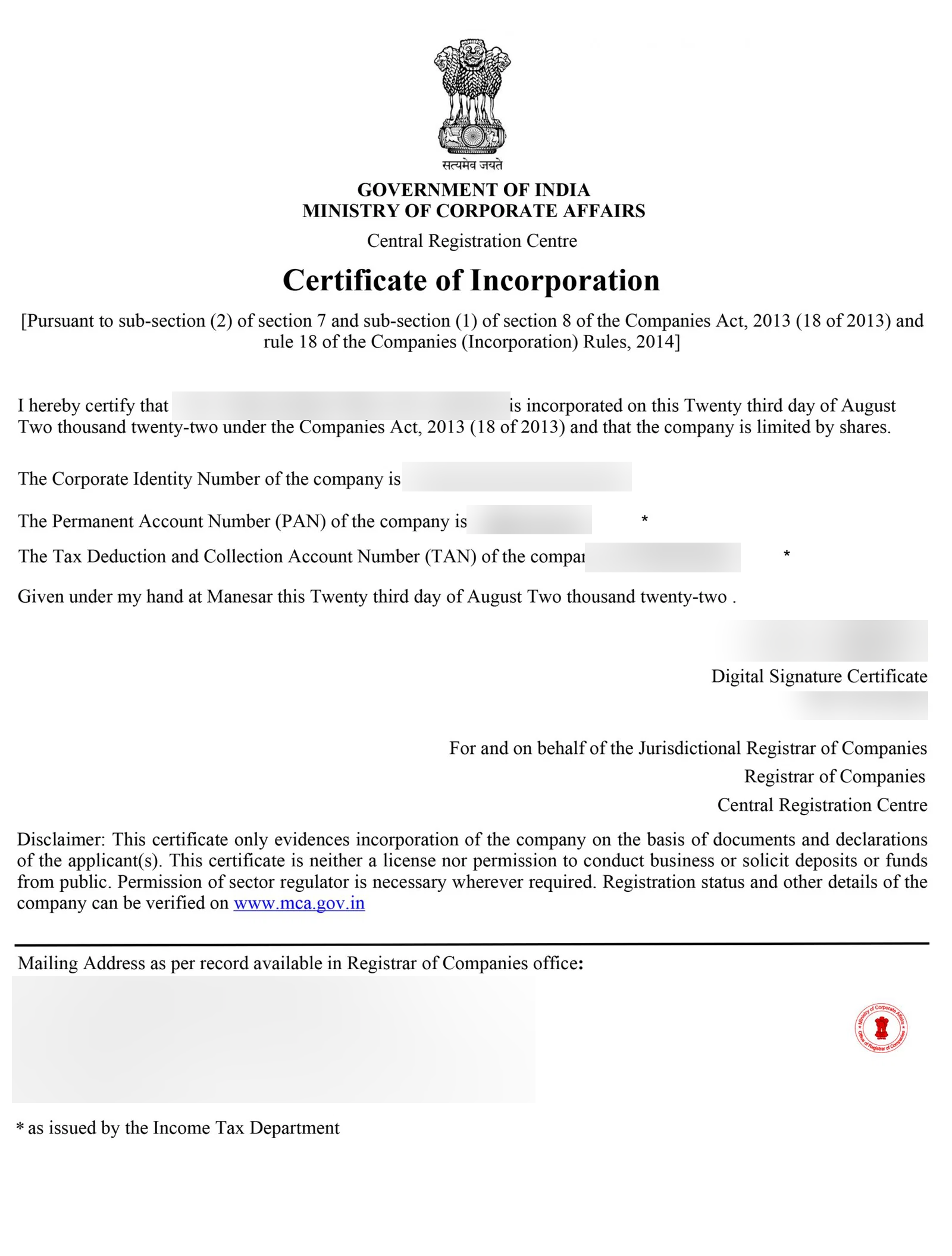
9. Certificate of Incorporation
On approval, the company receives its Certificate of Incorporation and CIN. PAN and TAN are integrated with the incorporation process.
10. Post-Incorporation Actions
Open/activate the company bank account, bring in subscription money, issue share certificates, complete commencement filing where applicable and set up the compliance calendar.
What You Receive After Incorporation
After the Registrar approves the application, the company is created as a legal entity. The incorporation set generally results in or supports the following core outputs and registrations:
- Certificate of Incorporation issued by the Registrar of Companies
- Corporate Identification Number (CIN)
- Permanent Account Number (PAN)
- Tax Deduction and Collection Account Number (TAN)
- Approved Memorandum of Association (MoA)
- Approved Articles of Association (AoA)
- Director Identification Number for eligible new directors where allotted through the process
- Integrated registrations/requests through linked forms where applicable
Post-Incorporation Actions to Plan from Day One
Receiving the Certificate of Incorporation is the start of the compliance cycle. Where applicable, the company should plan Commencement (INC-20A) Filing, first-auditor documentation through ADT-1 Filing, and a properly documented Account Opening Resolution for banking formalities. Good Bookkeeping should begin with the first transaction so that statutory records, taxes and annual financial statements remain consistent.
Depending on the company's transactions and regulatory position, the compliance calendar may also include DPT-3 Filing and, where the applicable framework requires it, Demat of Shares. Tax readiness should cover Company ITR Filing, TAN Registration and periodic TDS Return Filing. For official tax guidance, companies can refer to the Income Tax Department's Domestic Company return-and-forms page and its Company e-Filing Registration FAQs.
Benefits of Private Limited Company Registration
Private Limited Company Registration provides a separate legal identity, limited liability protection, better credibility, and easier access to funding opportunities. It helps businesses build trust among customers, investors, and partners while providing a structured framework for growth, expansion, and long-term success.
1. Separate Legal Entity
The company can own assets, enter contracts and conduct business independently of the personal identity of shareholders.
2. Limited Liability
Shareholder exposure is generally limited to the extent provided by the shareholding and law, subject to guarantees, fraud and statutory exceptions.
3. Investment Ready
A Private Limited Company structure is widely accepted by investors, making it easier to attract angel investors, venture capital and business funding.
4. Perpetual Succession
The company continues to exist even when directors or shareholders change, ensuring stability and continuous business operations.
5. Business Credibility
A registered corporate identity can improve confidence among vendors, clients, banks and institutional counterparties.
6. Ownership Flexibility
Shares provide a structured mechanism for introducing investors, transferring ownership and planning succession.
7. Brand and IP Ownership
Trademarks, software, contracts and other assets can be held in the company name, creating clearer enterprise value.
8. Scalability
A Private Limited Company is suitable for businesses planning growth, expansion into new markets and building a larger corporate structure.
Private Limited Company and Startup India Recognition
An eligible Private Limited Company may separately apply for DPIIT recognition under the Startup India initiative. Recognition is not automatic merely because a company is incorporated. Eligibility and benefits depend on the current Startup India criteria and the nature, age and innovation profile of the entity.
- Potential access to Startup India benefits is subject to DPIIT eligibility and applicable conditions.
- Startup recognition should be treated as a separate post-incorporation step, not as part of the basic Certificate of Incorporation.
Private Limited Company Registration Cost and Government Fees
There is no single all-India fixed total cost for incorporating every Private Limited Company. The final amount depends on the authorised capital, state of registered office, stamp duty, number and profile of directors/subscribers, DSC requirements, professional scope and any optional registrations requested.
| Cost Component | What Affects It |
|---|---|
| MCA / Incorporation Filing | Depends on the filing and capital structure under the applicable fee framework. |
| State Stamp Duty | Varies by state/union territory and the authorised capital/constitutional documents. |
| Name Reservation | Applicable when name reservation is filed separately under the chosen SPICe+ route. |
| PAN / TAN Charges | Integrated into the incorporation filing/challan structure as applicable. |
| DSC Cost | Depends on the number of signatories and issuing service provider. |
| Professional Fee | Depends on drafting, complexity, number of promoters, foreign participation and add-on services. |
How Long Does Private Limited Company Registration Take?
A straightforward incorporation can often be completed within about 7-10 working days when documents are complete and the application is not sent for resubmission. This is an estimate, not a statutory guarantee. Actual time depends on name approval, DSC readiness, MCA processing load, accuracy of the filing and whether clarification is sought.
| Stage | Indicative Time |
|---|---|
| Initial structure and document review | Same day to 1 working day |
| Name shortlisting and filing | 1 working day, subject to approval |
| DSC and KYC readiness | 1-2 working days depending on readiness |
| SPICe+ and document drafting | 1-2 working days |
| MCA examination | Commonly a few working days; may vary |
| Resubmission, if any | Additional time depends on issue raised |
| Certificate of Incorporation | Issued on approval |
Important Compliances After Company Registration
Incorporation is the beginning of the compliance cycle, not the end. A company that receives its Certificate of Incorporation should immediately create a post-incorporation checklist and annual compliance calendar.
- Open/activate the company bank account and deposit subscription money as required.
- File the declaration for commencement of business in Form INC-20A within the applicable statutory period for companies covered by Section 10A.
- Issue share certificates and maintain member/share records within applicable timelines.
- Hold board meetings and maintain minutes and statutory registers as required.
- Appoint the statutory auditor within the applicable time and complete related filing where required.
- Maintain books of account and prepare annual financial statements.
- File annual ROC returns and financial statements within applicable due dates.
- Complete director KYC requirements annually where applicable.
- File income tax returns and tax-related forms.
- Complete GST registration/returns where threshold, activity or business model makes GST applicable.
- Update MCA records whenever directors, office, capital, objects or ownership change.
Registrations You May Need After Incorporation
Not every company needs every registration. The correct set depends on the business activity, turnover, workforce, location and industry. Vakilkaro recommends adding only those registrations that are legally applicable or commercially useful.
| Registration | When It Matters |
|---|---|
| GST Registration | Required where the company becomes liable under GST law or chooses permitted voluntary registration. |
| Startup India / DPIIT | For eligible innovative startups seeking recognition and related benefits. |
| Udyam / MSME | Available to eligible enterprises under the official Udyam framework. |
| Trademark Registration | Useful for protecting the company name, product brand, logo or other distinctive marks. |
| IEC Registration | Required for many import/export activities, subject to the applicable DGFT framework. |
| FSSAI / Sector Licence | Needed where the business operates in regulated industries such as food, finance, healthcare or other licensed activities. |
| EPFO / ESIC | Applicability depends on workforce thresholds and the integrated registration framework. |
Startup, Tax, Labour and Sector Registrations After Incorporation
An eligible growth-stage company may separately seek Startup India Registration. Founders should verify current eligibility on the official DPIIT Startup Recognition page and use the Startup Recognition application page or the linked government workflow. MSME-eligible companies can review the official Udyam Registration Portal and the Government's new-enterprise Udyam registration form.
Indirect-tax registration depends on turnover, supply type, state presence and the applicable GST rules. Vakilkaro can assist with GST Registration, while the authoritative filing environment remains the GST Portal. Existing registrations may later require GST Amendment, routine GST Return Filing and, where applicable, GST Annual Return (GSTR-9).
Sector and workforce registrations should be evaluated according to the actual business model. Food businesses may need FSSAI License Registration through the official FoSCoS licensing portal; importers and exporters may require Import Export Code (IEC) Registration and should review DGFT IEC guidance. Quality-driven businesses may separately consider ISO Certification.
Workforce thresholds and coverage rules may trigger ESI Registration and PF (EPF) Registration. Official employer information is available through ESIC, the EPFO's For Employers guidance and the EPFO Unified Employer Portal.
Common Mistakes to Avoid During Company Registration
- Selecting a company name without checking trademark conflicts.
- Using generic or inaccurate business objects in the MoA.
- Entering inconsistent names, dates or addresses across KYC documents.
- Choosing an unnecessarily high authorised capital without considering state stamp duty.
- Finalising shareholding without discussing founder contributions, future funding and control.
- Using a registered office address without proper utility proof or owner NOC.
- Assuming incorporation automatically gives GST, Startup India, MSME or sector licences.
- Ignoring post-incorporation INC-20A, auditor, share certificate and annual compliance requirements.
- Treating the company certificate as the end of the legal setup instead of the beginning of governance.
Private Limited Company vs LLP vs OPC vs Sole Proprietorship
The right structure depends on ownership, investment plans, liability protection and compliance expectations. The comparison below is a practical overview, not a substitute for transaction-specific advice.
| Factor | Private Limited | LLP | OPC | Sole Proprietorship |
|---|---|---|---|---|
| Separate legal entity | Yes | Yes | Yes | No |
| Limited liability | Yes | Yes | Yes | No |
| Minimum owners | 2 shareholders | 2 partners | 1 member | 1 proprietor |
| External equity investment | Strong suitability | Limited compared with company | More restricted | Not share-based |
| Corporate governance | Higher | Moderate | Moderate | Low |
| Compliance load | Higher | Moderate | Moderate | Low |
| Best suited for | Scalable/funded businesses | Professional/partner firms | Solo founder seeking company form | Small owner-operated business |
Founder, Funding and Ownership Documentation
When there is more than one founder, governance should be documented early rather than left to verbal understanding. A tailored Founders Agreement can record roles, vesting, decision rights and founder exits, while a detailed Shareholders Agreement can govern investor rights, reserved matters and transfer restrictions. Investment or acquisition transactions may also require a Share Purchase Agreement supported by a credible Business Plan.
Companies receiving or reporting foreign investment should evaluate the applicable FEMA and RBI reporting requirements, including professional support for FDI Filing and annual FLA Return Filing where applicable. Ownership or governance changes may later involve Share Transfer, Remove Director, Registered Office Change or a formal Company Name Change. Each event should be documented and filed according to the law, the company's constitutional documents and the facts of the transaction.
Why Choose Vakilkaro for Private Limited Company Registration?
Vakilkaro focuses on accurate incorporation, transparent communication and long-term business readiness. The company registration process is handled through qualified professionals and structured checks so that founders understand what is being filed and what they need to do after incorporation.
- Structure consultation before filing - not just form filling.
- MCA name review combined with brand/trademark risk checks.
- DSC, DIN and SPICe+ incorporation support.
- Business-specific MoA and AoA drafting instead of careless copy-paste objects.
- Document verification to reduce avoidable resubmissions.
- Clear breakup of professional fee and applicable government charges.
- Support for GST, Startup India, Trademark, Udyam and other post-registration requirements where applicable.
- Guidance for INC-20A and ongoing corporate compliance after incorporation.
- Pan-India online support for founders, startups and growing businesses.