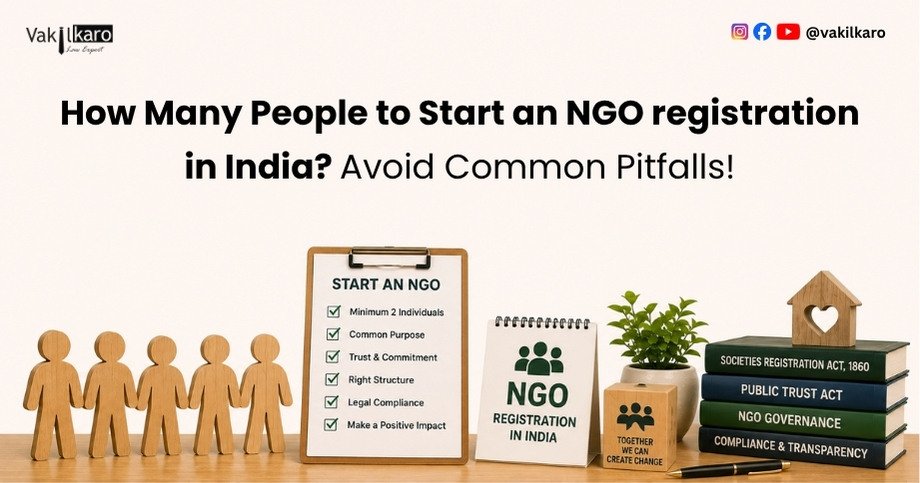
Starting an NGO is a powerful way to drive social change, but legal setup can be complex. A Trust needs just 2 trustees and a registered Trust Deed. A Society requires 7 members, a Memorandum of Association, and state‐level NGO registration. A Section 8 Company demands 2 directors and 2 shareholders, digital signatures, DINs, and incorporation via the MCA. After registration—whether Trust, Society, or Section 8—you must secure 12A (income‐tax exemption) and 80G (donor tax‐deductions). Choose your structure based on your cause, scale, and compliance readiness, then follow the prescribed steps to register and obtain these crucial tax certificates.
Key Takeaways
- It also facilitates easier access to essential tax benefits like 12A and 80G registration, making it a preferred choice for many NGO founders aiming for national or international impact.
- In conclusion, the number of people required to start an NGO depends on the chosen structure.
- Choosing the right one lays the groundwork for a smooth NGO registration process and facilitates access to Section 8 company registration, as well as 12A and 80G registration—essential for tax exemptions and fundraising success.
- When evaluating how many people you need and which format suits you best, consider the following key aspects: Nature of the Cause Your NGO's purpose will greatly influence the best structure.
- This strategic decision will directly influence your NGO registration, ease of Section 8 company registration if chosen, and successful application for vital 12A and 80G certifications, which are crucial for tax exemptions and fundraising.
Understanding the Requirements to Start an NGO in India
Starting a Non-Governmental Organization (NGO) in India is a meaningful and impactful way to contribute to societal welfare. However, before embarking on this journey, understanding the necessary legal requirements and the number of people needed for the formation of the NGO is critical. In India, there are three primary structures for registering an NGO: Trust, Society, and Section 8 Company. The number of people required for each structure varies, and knowing the differences can help you make an informed decision that aligns with your cause and vision.
Trust: A Simple and Traditional Structure
A Trust is one of the simplest forms of NGO structure and requires a minimum of two trustees to start. It is typically formed to carry out charitable, religious, or philanthropic activities. The trust is governed by the Indian Trusts Act, 1882 (for private trusts) and relevant state laws (for public charitable trusts). While it is easy to form and manage, the flexibility for future changes can be limited. Trusts are often ideal for smaller, family-led initiatives or community-based charities that do not require complex governance.
Society: A Collaborative Community-Based Approach
A Society, under the Societies Registration Act, 1860, requires a minimum of seven members for registration. Societies are generally formed for educational, cultural, scientific, or charitable purposes and work on a democratic basis, with members forming a governing body or managing committee. This structure is more suitable for community-driven causes and has a more collaborative governance system. The society must be registered with the Registrar of Societies at the state level and has the potential to operate regionally or nationally.
Section 8 Company: A Professional and Transparent Approach
The Section 8 Company offers the highest level of structure and transparency. It requires at least two directors and two shareholders, and at least one director must be a resident of India. Section 8 Companies are governed by the Companies Act, 2013, and provide a corporate framework without the intention of generating profit. This structure is ideal for larger-scale operations that require funding from corporates, foreign donors, or government bodies. It also facilitates easier access to essential tax benefits like 12A and 80G registration, making it a preferred choice for many NGO founders aiming for national or international impact.
In conclusion, the number of people required to start an NGO depends on the chosen structure. Trusts require a minimum of two trustees, Societies need at least seven members, and Section 8 Companies demand two directors and two shareholders. Each structure has its unique benefits and compliance requirements, so it is essential to select the one that best fits your NGO’s goals, scale, and operational needs.
Launching a Non-Governmental Organization (NGO) is one of the most rewarding ways to channel passion into tangible social impact. Whether you aim to support underprivileged children, protect the environment, or advance healthcare initiatives, an NGO provides the legal framework to organize resources, attract funding, and mobilize volunteers around a shared mission. Yet, for many first‐time founders, the path to formalizing an NGO can feel overwhelming. From choosing the right legal structure to navigating complex registration procedures, each step demands careful planning and a clear understanding of regulatory requirements.
A foundational question that often arises is: How many individuals are necessary to establish an NGO in India? The answer hinges entirely on the legal form you select. India offers three principal structures—Trust, Society, and Section 8 Company—each with distinct formation criteria, governance norms, and compliance obligations. A private trust can be set up by as few as two trustees, while a society requires a minimum of seven members. For those seeking a corporate‐style framework with enhanced credibility, a Section 8 Company mandates at least two directors and two shareholders.
Beyond headcount, your choice influences how you complete NGO registration, secure a Section 8 Company registration, and later obtain essential tax‐exempt certifications like 12A and 80G. Understanding these people‐related requirements is the first step toward a robust organizational foundation. In the sections that follow, we’ll delve into each structure’s specifics, examine governance and compliance demands, and provide a clear roadmap for turning your vision into a legally recognized, impactful NGO.
Understanding NGO Structures in India
Before diving into the process of forming an NGO, it's essential to understand the legal structures available in India. The country recognizes three main types of NGO entities—Trust, Society, and Section 8 Company. Each of these has unique features, legal backing, operational dynamics, and people-based requirements, which significantly influence how your organization will function and grow.
- Trust
A Trust is typically set up to carry out charitable, religious, or philanthropic activities. It is governed by the Indian Trusts Act, 1882 for private trusts, while public charitable trusts are subject to respective state laws. Trusts are relatively simple to form and manage, making them ideal for family-run or localized charitable efforts. The minimum number of individuals required to start a trust is two trustees, and a Trust Deed is the core document that outlines its objectives, governance, and duties of trustees.
- Society
A Society is formed when a group of people come together with a common goal, such as promoting science, literature, culture, education, or charitable causes. Societies are governed by the Societies Registration Act, 1860. To register a society, you need a minimum of seven founding members, and they may even belong to different states if the organization seeks national scope. Societies function through a Managing Committee and require a Memorandum of Association (MoA) along with rules and regulations to define their governance.
- Section 8 Company
A Section 8 Company is the most structured and formalized type of NGO, formed under the Companies Act, 2013. It is ideal for organizations looking for national or international impact and institutional funding. It requires at least two directors and two shareholders, who can be the same individuals. The company must obtain a license from the Ministry of Corporate Affairs (MCA) to be incorporated. Due to its professional structure, it is often the most preferred for CSR partnerships and international grants.
Each structure requires a different level of commitment in terms of members, compliance, and long-term management. Your decision should align with your mission, operational scale, and ability to manage regulatory responsibilities. Choosing the right one lays the groundwork for a smooth NGO registration process and facilitates access to Section 8 company registration, as well as 12A and 80G registration—essential for tax exemptions and fundraising success.
Trust: Simplicity and Traditional Governance
A Trust is formed to carry out charitable, religious, or philanthropic activities. It is governed under the Indian Trusts Act, 1882 (in case of private trusts) or relevant state laws (in case of public charitable trusts).
People Required:
- Minimum of two trustees.
Key Highlights:
- Trust Deed is the core legal document.
- Trustees manage the trust's assets and operations.
- Suitable for family-led or small, community-based initiatives.
- Easier compliance but less flexibility for future expansion.
NGO Registration:
- Requires submission of a Trust Deed with the local Sub-Registrar.
12A and 80G Registration:
- Can be applied for post-registration with the Income Tax Department.
Society: Community and Collaboration
A Society is generally formed for promoting literature, science, fine arts, or charitable activities. It is governed under the Societies Registration Act, 1860.
People Required:
- Minimum of seven members.
- Members can be from different states to give the society a national character.
Key Highlights:
- Governed by a Memorandum of Association (MoA) and Rules & Regulations.
- Requires a Managing Committee or Governing Body.
- More democratic and suitable for cultural or educational associations.
NGO Registration:
- Registered with the Registrar of Societies at the state level.
12A and 80G Registration:
- Application for tax exemption can be made after society registration.
Section 8 Company: Corporate Structure for Social Good
A Section 8 Company is the most structured and professional form of NGO. It is incorporated under the Companies Act, 2013 for promoting charitable objectives such as education, science, art, religion, or environmental protection.
People Required:
- Minimum of two directors and two shareholders (can be the same individuals).
- At least one director must be a resident of India.
Key Highlights:
- Requires a digital signature and Director Identification Number (DIN)
- Governed by Memorandum and Articles of Association.
- High credibility and transparency.
- Favored for CSR funding and international donations.
Section 8 Company Registration:
- Done through the Ministry of Corporate Affairs (MCA).
- Requires name reservation, license application, and incorporation filings.
12A and 80G Registration:
- More easily granted due to structured governance and compliance.
Comparative Table: Number of People Required
NGO Structure Minimum Members Required
Trust 2 Trustees
Society 7 Members
Section 8 Company 2 Directors & Shareholders
Choosing the Right Structure Based on Your Team and Vision
Selecting the appropriate legal structure for your NGO is not just about meeting legal formalities—it’s about aligning your team’s strengths, long-term goals, and the nature of your mission. Each NGO structure in India—Trust, Society, and Section 8 Company—caters to different operational needs and requires varying numbers of people to get started. When evaluating how many people you need and which format suits you best, consider the following key aspects:
- Nature of the Cause
Your NGO's purpose will greatly influence the best structure. If you’re working on a small-scale, localized, or family-led charitable effort, forming a Trust may be sufficient. Trusts are ideal when fewer people are involved and the operations are straightforward. On the other hand, if your cause involves collaborative work such as promoting education, culture, art, or scientific research, then a Society is more appropriate. Societies allow for broader participation and are more suited to community-driven models. However, if your goal is to make a national or international impact, secure significant funding, or work with corporates and CSR initiatives, a Section 8 Company offers the professional structure and credibility required.
- Scalability and Governance
As your NGO grows, you’ll need a structure that supports expansion. Section 8 Companies are highly scalable, governed by the Companies Act, and backed by formal procedures and documentation. Societies allow moderate flexibility with a democratic governance style, making them suitable for medium-scale NGOs. Trusts, however, are relatively rigid, and altering their objectives or expanding operations can be legally complex.
- Funding and Credibility
When it comes to attracting donors, especially corporates for CSR funding or international grants, Section 8 Companies stand out. Their stringent compliance, transparent governance, and structured processes build strong donor confidence. In contrast, Trusts and Societies might face more scrutiny and hesitation from large funders due to less rigid compliance requirements.
- Compliance Willingness
While Section 8 Companies demand a higher degree of regulatory compliance, including regular filings and audits, the long-term benefits in terms of credibility, ease of fundraising, and access to 12A and 80G registration far outweigh the efforts. Societies require state-level compliance and general meetings, while Trusts have the simplest regulatory needs but also the least room for formal governance improvements.
In essence, choose a structure that complements not only your cause but also the commitment level of your founding team, your growth aspirations, and your readiness to meet compliance standards. This strategic decision will directly influence your NGO registration, ease of Section 8 company registration if chosen, and successful application for vital 12A and 80G certifications, which are crucial for tax exemptions and fundraising.
Importance of 12A and 80G Registration for NGOs
Once your NGO is legally registered—whether as a Trust, Society, or a Section 8 Company—the next essential step is obtaining 12A and 80G registrations. These two certifications, issued by the Income Tax Department of India, play a critical role in ensuring your NGO's financial sustainability, legitimacy, and ability to attract consistent funding.
What Are 12A and 80G Registrations?
- 12A Registration: This certification grants income tax exemption to the NGO. It means that the income your organization receives—whether through donations, grants, or other means—is not taxable, provided it's used strictly for charitable purposes. This allows NGOs to utilize all received funds toward their mission without the burden of tax deductions.
- 80G Registration: This benefits the donors who support your NGO. With this certification, donors can claim deductions on the donations they make, thus reducing their taxable income. For many individuals and especially corporate entities involved in CSR (Corporate Social Responsibility) activities, 80G registration is a major incentive to contribute.
Why Are These Registrations So Crucial?
- Enhances Credibility and Trust
NGOs with 12A and 80G registrations are seen as credible and compliant organizations. These certifications serve as a government-backed endorsement that the NGO is operating with genuine charitable intent.
- Boosts Fundraising Opportunities
Without 80G, donors may hesitate to contribute since they won’t receive any tax benefits. Similarly, many grant providers, CSR funders, and international organizations require 12A and 80G as a minimum criterion for financial support.
- Supports Long-Term Financial Planning
With tax-exempt income and increased donor contributions, your NGO can focus on long-term planning, program development, and scaling your impact.
Why Section 8 Companies Have an Advantage
Among the three legal structures, Section 8 Companies are generally more successful and faster in obtaining 12A and 80G registrations. Their transparent corporate structure, clearly defined Memorandum of Association (MOA), regular compliance with MCA guidelines, and formal board governance make it easier for authorities to verify legitimacy. The professional framework of a Section 8 Company aligns well with the expectations of tax authorities, resulting in smoother approval of these certifications.
In contrast, Trusts and Societies, while eligible, may face more scrutiny during the application process due to varying governance styles and lesser uniformity in compliance, especially when registered under state-specific laws.
Step-by-Step: Section 8 Company Registration Process
If you decide to go with a Section 8 Company, here’s what the process typically looks like:
- Obtain Digital Signature Certificate (DSC)
- Apply for Director Identification Number (DIN)
- Reserve Company Name using the RUN service
- Draft Memorandum and Articles of Association
- Apply for Section 8 license using Form INC-12
- Submit SPICe+ form for incorporation
- Get Certificate of Incorporation from MCA
- Apply for PAN, TAN, and open a bank account
- Apply for 12A and 80G registrations
Conclusion
In summary, the number of people required to start an NGO in India ranges from two to seven, depending on the legal structure you choose. While Trusts and Societies have lower entry requirements, Section 8 Companies provide a structured and professional foundation for serious social enterprises.
For those who aspire to make a large-scale impact, especially in collaboration with corporations, international organizations, and government agencies, Section 8 company registration offers the best combination of credibility, governance, and growth potential. Pair that with timely NGO registration and obtaining 12A and 80G registrations, and you’ll be well on your way to creating a lasting impact.
The journey begins with people—a passionate team willing to dedicate their time and effort to a cause. So, whether you’re two, seven, or more, what truly matters is the vision and commitment to make a difference.
Why Choose Vakilkaro for Section 8 Company & NGO Registration?
Vakilkaro is a trusted legal service provider offering expert support for Section 8 company registration, NGO registration, and 12A & 80G registration. With a team of experienced professionals, Vakilkaro ensures smooth, error-free processes at affordable, transparent pricing.
✅Expert in Trust, Society & Section 8 registration
✅End-to-end assistance with 12A & 80G applications
✅100% online, pan-India services
✅Quick turnaround time
✅ One-stop solution for all legal & compliance needs
Vakilkaro makes legal processes simple, reliable, and stress-free—so you can focus on making an impact.
Official External Resources
Use these primary/official sources to verify rules, forms, fees, timelines and regulatory updates before publication.
Frequently asked questions
How Many People to Start an NGO registration in India? Avoid Common Pitfalls!+
It also facilitates easier access to essential tax benefits like 12A and 80G registration, making it a preferred choice for many NGO founders aiming for national or international impact. In conclusion, the number of people required to start an NGO depends on the chosen structure.
