
Farmer Producer Company Registration allows 10 or more eligible producers to form a registered company for collective agricultural business. It helps members manage procurement, processing, storage, marketing and sale of produce through a formal company structure under the Companies Act, 2013. Vakilkaro's professional fee starts at ₹5,999 + GST.
What is a Farmer Producer Company?
A Farmer Producer Company, commonly called an FPC, is a Producer Company formed by eligible producers to carry on producer-related business through a registered corporate entity. The legal framework is contained in Chapter XXIA of the Companies Act, 2013, which covers Producer Companies from Sections 378A to 378ZU.
The structure is designed for people connected with primary produce, including eligible farmers, dairy producers, fishermen, horticulture growers, persons engaged in animal husbandry, forestry, bee keeping, plantation, handloom, handicrafts and similar primary-production activities.
Once incorporated, an FPC becomes a separate legal entity capable of opening bank accounts, entering contracts, owning assets, employing people, purchasing inputs and selling member produce in its own name. Members generally enjoy limited liability to the extent provided by the share structure.
- The central idea is simple: producers remain the owners, while the company provides a professional platform for collective business.
For a detailed educational overview, producers can also read Vakilkaro’s guide on Farmer Producer Company.
Farmer Producer Company vs Farmer Producer Organisation
A Farmer Producer Organisation, or FPO, is a broader concept for an organisation of farmers or primary producers. An FPO may be organised in different legal forms depending on the scheme, state framework and applicable law. A Farmer Producer Company is one specific corporate form through which an FPO may operate.
The Small Farmers’ Agribusiness Consortium (SFAC) explains that a Producer Organisation can take different legal forms and that a Producer Company is one recognised structure. Incorporation as an FPC also does not automatically grant benefits under every FPO scheme.
- FPO = broader producer-organisation concept.
- FPC = Producer Company registered under the Companies Act framework.
- Scheme support, grants or credit guarantees = separate eligibility and application process.
Who Can Apply for Farmer Producer Company Registration?
Under Section 378C of the Companies Act framework, a Producer Company may be formed by:
- Ten or more individuals, each of whom is a producer; or
- Two or more Producer Institutions; or
- A permitted combination of ten or more individuals and Producer Institutions.
For a farmer-focused company, the members should be able to establish their connection with eligible production activity. The exact evidence may vary by activity and factual situation. Agricultural land records, cultivation records, producer certificates, milk society records, fisheries documents, procurement records, activity certificates or other suitable supporting documents may be relevant depending on the producer category.
Membership planning should be completed before filing. Ineligible members, inconsistent documents or an unsuitable ownership pattern can create legal and operational problems later.
Directors Required for Farmer Producer Company Registration
Every Producer Company must have at least five and not more than fifteen directors under Section 378-O, subject to the special statutory exception applicable to certain converted inter-State co-operative societies.
Proposed directors should be selected carefully because they will be responsible for governance and statutory decisions. The MCA SPICe+ incorporation system allows DIN applications for up to five proposed directors in a Producer Company through the integrated process, subject to filing requirements.
- Minimum directors: 5
- Maximum directors: 15
- DIN and DSC: required for relevant proposed directors/signatories
- Governance: should match the company’s Articles and Producer Company provisions
What Activities Can a Farmer Producer Company Undertake?
Section 378B permits a Producer Company to pursue specified producer-related objects. The objects clause should be drafted around the actual business model rather than copied as a generic agriculture paragraph.
Depending on the proposed operations, an FPC may undertake activities such as:
- Production and harvesting of primary produce.
- Procurement and aggregation of members’ produce.
- Grading, sorting, pooling and handling.
- Storage, warehousing and cold-chain related activities where legally permitted.
- Processing, preserving, drying, packaging and other value-addition activities.
- Marketing and sale of members’ produce.
- Export of eligible produce, subject to trade and product-specific requirements.
- Supply of machinery, equipment, seeds, inputs or consumables mainly for members.
- Technical services, training, research, consultancy and member education.
- Activities relating to land, water, energy or infrastructure connected with primary produce.
- Welfare measures for producer members.
- Permitted financing or credit support connected with procurement, processing or marketing of members’ produce, subject to applicable law and the company’s objects.
The company should deal primarily with the produce of its active members for carrying out its statutory objects. This member-centric approach is one of the most important features separating a Producer Company from an ordinary trading company.
Benefits of Farmer Producer Company Registration
Farmers often face fragmented supply, weak bargaining power, high input costs and limited ability to invest in processing or branding. A Producer Company creates a platform to address these challenges collectively.
Better Bargaining Power
Aggregated produce can help the company negotiate larger volumes with buyers, processors, institutional customers or exporters and improve consistency in quality and pricing.
Direct Market Access
An FPC can work toward reducing unnecessary layers between producers and markets. Depending on the business model, it may sell to wholesalers, retailers, processors, e-commerce channels, institutional buyers, government procurement systems or export customers.
Value Addition
The company may add value through cleaning, grading, processing, packaging, branding and organised distribution, subject to product-specific licences.
Professional Business Structure
The company has a Board, statutory records, share capital, bank account, audited financial statements and defined governance rules. This creates a more formal foundation for dealing with banks, vendors, government agencies and commercial buyers.
Limited Liability and Continuity
A Producer Company has a legal identity separate from its members, supporting long-term continuity despite changes in individual membership.
Member-Focused Economic Participation
Producer Companies are designed around mutual assistance and member participation. The Articles, patronage structure, voting rights and distribution mechanisms should therefore be drafted and managed with the member relationship at the centre.
Share Capital and Member Rights
A Producer Company’s share capital consists of equity shares. The law does not prescribe a general minimum paid-up capital specifically for incorporation of a Producer Company, but the capital structure should still be commercially realistic.
Promoters should estimate working capital, equipment, rent, manpower, logistics and seasonal procurement needs before deciding the authorised and subscribed capital.
Voting and member rights in a Producer Company follow special rules and cannot be assumed to work exactly like an ordinary Private Limited Company. The Articles should correctly reflect the statutory framework, including producer membership, patronage and member participation.
Documents Required for Farmer Producer Company Registration
Accurate document preparation prevents many incorporation delays. Names, addresses and identity details should match across PAN, Aadhaar, bank documents and MCA records.
Producer Members
- PAN Card.
- Aadhaar Card or other valid identity proof, as applicable.
- Recent address proof.
- Passport-size photograph, if required for the professional file.
- Email ID and mobile number.
- Evidence supporting producer status or connection with primary produce.
- Proposed number of shares/subscription details.
Proposed Directors
- PAN and identity proof.
- Residential address proof.
- Digital Signature Certificate (DSC).
- DIN details, if already allotted.
- Consent and declarations required for incorporation.
- Details of interests in other entities, where required.
Registered Office
- Recent utility bill for the premises.
- Rent/lease agreement, where the premises are rented.
- No Objection Certificate from the owner, where applicable.
- Ownership document or supporting proof, where required.
Company-Level Information
- Proposed company names.
- Main objects and detailed business model.
- Producer categories and proposed activities.
- Capital and share subscription structure.
- Details of first directors and subscribers.
- Registered office details.
- Draft Memorandum and Articles suitable for a Producer Company
Vakilkaro recommends checking every spelling, date and address before DSC-based filing. Even a small mismatch can lead to resubmission.
Name Selection for Farmer Producer Company Registration
The proposed name should be distinctive, legally acceptable and aligned with the company’s activities. Producer Company names ordinarily use the expression “Producer Company Limited” as required under the Producer Company framework.
Before filing, check the name against existing company/LLP names on the Ministry of Corporate Affairs portal and against relevant trademarks. MCA availability alone does not remove trademark risk.
If the company plans to sell packaged produce under a distinctive brand, Vakilkaro can also assist with Trademark Registration.
Farmer Producer Company Registration Process
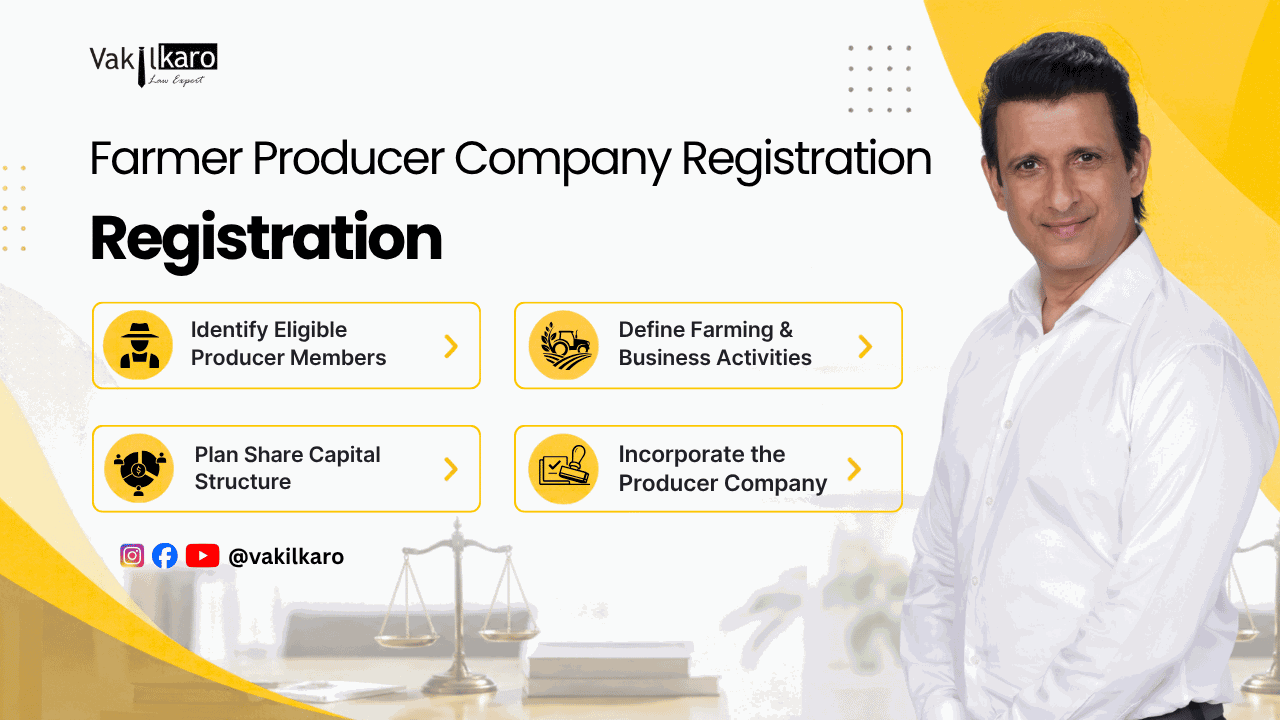
Farmer Producer Company registration involves checking member eligibility, finalising business objects, name, capital and office details, obtaining DSCs, filing MCA forms and completing any resubmission requirements. The steps below explain the process.
Eligibility and Producer-Member Review
Confirm that the proposed subscribers satisfy producer eligibility and that the minimum member structure is met. Identify the primary produce and the commercial problem the company intends to solve.
Decide the Business Objects
Define whether the company will focus on aggregation, procurement, processing, storage, marketing, inputs, dairy, fisheries, horticulture, export or another permitted producer activity. The Memorandum should clearly connect the proposed business to statutory Producer Company objects.
Finalise Name, Capital and Registered Office
Shortlist suitable names, decide authorised/subscribed capital, identify the registered office and prepare owner consent and address evidence.
Obtain DSC and Prepare Director Details
Relevant subscribers and directors require valid digital signatures for MCA filings. DIN may be obtained through SPICe+ for eligible proposed directors within the applicable limits.
File SPICe+ and Linked Incorporation Forms
The application is filed through MCA V3 using SPICe+ and the applicable linked incorporation forms. The filing package includes company details, subscribers, directors, registered office, capital, declarations and constitutional documents.
Registrar Review and Resubmission, if Any
The Registrar/processing authority examines the proposed name, documents, objects and statutory compliance. A query or resubmission may be issued if any document is unclear, inconsistent or incomplete.
Certificate of Incorporation
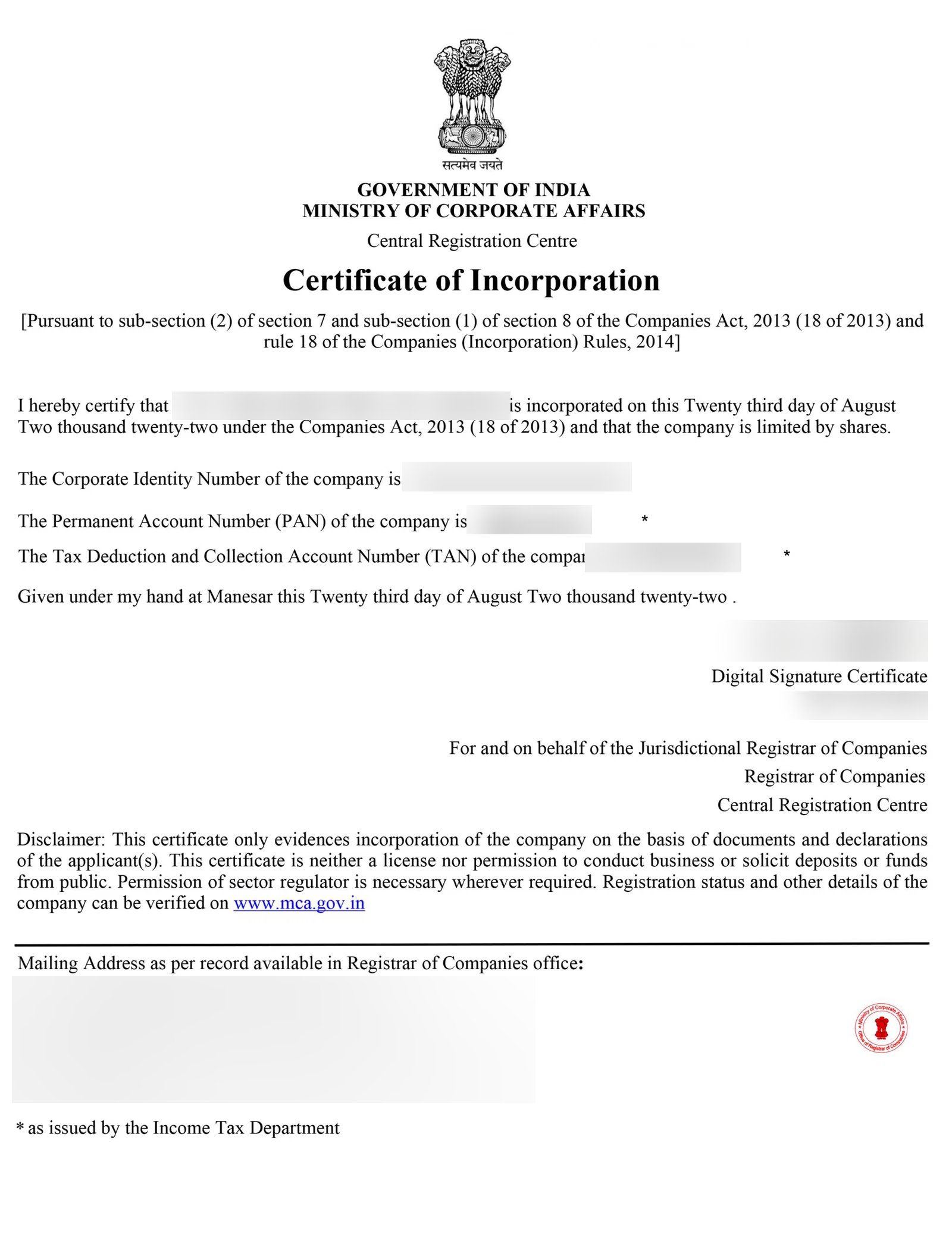
After approval, the company receives its Certificate of Incorporation and Corporate Identity Number. PAN and TAN are also integrated into the incorporation process in accordance with MCA procedures.
Post-Incorporation Setup
After incorporation, the company should complete its bank, accounting, statutory registers, share-related records, Board actions and activity-specific registrations before starting regulated operations.
How Long Does Farmer Producer Company Registration Take?
There is no guaranteed timeline because approval depends on name availability, document readiness, MCA processing and any resubmission. Unclear producer evidence, unsuitable objects, incorrect office papers or a conflicting name can increase the time required.
The best way to reduce delay is to prepare the producer-member evidence, business objects and registered-office documents before the incorporation form is started. Any quoted professional timeline should therefore be treated as an estimate, not a statutory guarantee.
Farmer Producer Company Registration Fees in India (2026)
Vakilkaro's professional fee for Farmer Producer Company Registration starts at ₹5,999 + GST. MCA fees, state stamp duty and DSC charges for directors are paid at actuals and depend on the state and authorised capital.
These may include:
- MCA filing fees, where applicable.
- Stamp duty based on the state and capital/constitutional documents.
- Digital Signature Certificate cost.
- Professional drafting and filing charges.
- Additional charges may apply for special documents, resubmission or post-incorporation registrations.
- Government fees and stamp duty should be calculated after the state, capital and subscriber/director details are finalised.
Registrations After Farmer Producer Company Registration
After incorporation, an FPC may need additional registrations based on its activities, such as GST, FSSAI, IEC or Trademark Registration. The requirements depend on the company’s business model and operations.
GST Registration
If the company becomes liable under GST law or chooses registration where legally appropriate, it can apply for GST Registration. GST treatment depends on the nature of goods, turnover, exemptions and supply structure.
FSSAI Registration or Licence
An FPC engaged in food processing, packing, storage, distribution or other food business activities may require an appropriate FSSAI Registration through the food-safety framework.
Import Export Code
If the company plans commercial import or export, it should evaluate Import Export Code Registration and the relevant customs, product and export-compliance requirements.
Trademark Registration
A branded FPC selling packaged products should consider protecting its brand through Trademark Registration.
Other licences may apply for warehouses, factories, pollution control, seeds, fertilisers, pesticides, weights and measures, local trade, food processing or sector-specific activities. The correct compliance map depends on what the company actually does.
FPO Schemes, NABARD and Government Support
Producer Companies may explore government and institutional support, but incorporation does not automatically grant subsidy, equity support, credit guarantee or scheme approval.
NABARD supports development of Producer Organisations through various programmes and capacity-building initiatives. SFAC’s FPO resources also provide information relating to the Central Sector Scheme for Formation and Promotion of FPOs and related operational material.
Eligibility for any specific scheme should be checked separately at the time of application because conditions may depend on the implementing agency, FPO size, geography, member composition, business plan, turnover, credit profile and scheme period.
- Incorporation = legal entity creation.
- Scheme registration = separate process.
- Bank finance = separate credit appraisal.
- Grant or credit guarantee = subject to programme eligibility.
Taxation of a Farmer Producer Company
An FPC should not assume that all agricultural or producer-company income is automatically tax-free. Corporate tax treatment depends on the nature and source of income, applicable provisions of the Income-tax Act and the specific activities carried on.
Trading, processing, services, interest and other commercial income can have different tax treatment from income qualifying under an agricultural-income provision. The company should maintain proper books, invoices, procurement records and member ledgers from the beginning.
Compliance After Farmer Producer Company Registration
A Producer Company is a regulated company, not a one-time registration certificate. Ongoing governance and filings must be maintained.
Important compliance areas may include:
- Board meetings and minutes.
- Statutory registers and member records.
- Share allotment and share-related documentation.
- Books of account.
- Annual financial statements and audit.
- Annual return and applicable ROC filings.
- Income-tax return.
- GST returns, where registered.
- TDS and payroll-related compliance, where applicable.
- Renewal or filing obligations under sector-specific licences.
- First AGM within 90 days, followed by regular AGMs as required.
- Maintenance of the company’s producer-member eligibility and governance records.
Producer Companies also have special provisions dealing with Board composition, general meetings, voting, reserves, member benefits and other matters. These should be read together with the provisions applicable to companies generally.
Common Farmer Producer Company Registration Mistakes
- Adding Ineligible Subscribers:Every proposed producer member should fit the applicable producer requirement. Do not add people merely to reach the minimum member count.
- Copying Objects from an Ordinary Trading Company:Producer Company objects need to be aligned with Section 378B and the members’ produce. Generic objects can create incorporation and future-compliance issues.
- Ignoring Producer Evidence:Keep member-level evidence organised before filing. A strong documentation file also helps later during banking, schemes and internal governance.
- Choosing a Weak Capital Structure:There may be no general statutory minimum paid-up capital, but undercapitalising a procurement or processing business can make the company commercially ineffective.
- Treating FPC Registration as Automatic Scheme Approval:MCA incorporation does not automatically result in FPO subsidy, NABARD support, SFAC benefits or bank finance.
- Starting Regulated Operations Without Licences:Food processing, exports, warehouses, manufacturing or specialised agricultural inputs can require additional approvals.
- Ignoring Brand Protection:If the company intends to build a consumer brand, check and protect the name before spending heavily on packaging, labels and marketing.
Practical Readiness Checklist Before Filing
Before filing, promoters should confirm key business and compliance details, including eligible producer members, director requirements, primary produce, proposed activities, company name, initial capital, registered office, required documents, licences, accounting process, statutory compliance, and a practical market or value-addition strategy.
- Who are the eligible producer subscribers?
- What proof supports their producer status?
- Who will serve as the first five or more directors?
- What primary produce will the company deal with?
- What will the company actually buy, process, store or sell?
- Is the proposed name available and commercially usable?
- What capital is realistically required for the first operating cycle?
- Where will the registered office be located?
- Are utility bill, NOC and occupancy documents ready?
- Does the business need GST, FSSAI, IEC or another licence immediately after incorporation?
- How will procurement from members be recorded?
- Who will maintain accounts and statutory compliance?
- What market, buyer or value-addition strategy will support the company after registration?
The file is stronger when the business model and documents are prepared together rather than treating incorporation as form filling.
Why Choose Vakilkaro for Farmer Producer Company Registration?
Farmer Producer Company incorporation requires member eligibility, correct objects, Board structure, constitutional documents and a practical post-registration roadmap. Vakilkaro provides end-to-end support with a structured legal approach.
- Eligibility review of proposed producer members.
- Guidance on minimum members and director structure.
- Name planning and preliminary conflict review.
- DSC and DIN coordination.
- Drafting support for Producer Company objects.
- SPICe+ and linked MCA filing assistance.
- Registered-office document review.
- Resubmission support, where required within the agreed scope.
- Post-incorporation guidance for bank setup and corporate records.
- Support for relevant registrations such as GST, FSSAI, IEC and trademark protection.
- Compliance guidance so the company can move from registration to organised operations.
Start Your Farmer Producer Company with Vakilkaro
If your farmer group, producer institution or primary-producer network wants to aggregate produce, improve market access, create a processing or packaging business, build a common brand or operate through a formal member-owned company, Vakilkaro can assist with the complete incorporation process.
- Share your proposed activity, producer-member details and state with the Vakilkaro team.
- We will review the structure and document requirements.
- Our team can assist with incorporation drafting, MCA filing and applicable post-registration registrations.