
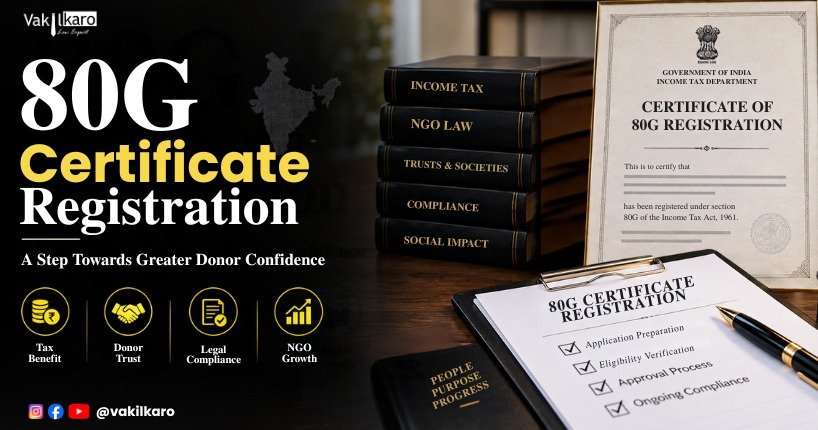
80G Certificate Registration allows eligible donors to claim income-tax deductions on qualifying donations made to an approved organisation. Eligible trusts, societies, Section 8 companies and other qualifying institutions may apply through the Income Tax e-Filing system. The correct filing route depends on the NGO’s existing approval status, activities and application category.
What Is an 80G Certificate?
Section 80G of the income-tax framework provides a deduction mechanism for qualifying donations made to approved funds and institutions. The approval is held by the donee organisation, while the tax deduction is considered in the hands of the eligible donor. The benefit should not be presented as identical for every donation because the applicable percentage, qualifying limit, payment mode and donor circumstances can differ.
- Purpose: to support eligible donor tax deduction on qualifying donations.
- Who holds the approval: the approved NGO or institution receiving the donation.
- What it does not do: it does not, by itself, exempt the NGO’s own income from tax.
- Practical approach: 80G should be planned together with the NGO’s wider tax, record-keeping and compliance requirements.
An organisation should keep its annual tax filings aligned with the approval record. Timely Income Tax E Filing and properly maintained Trust NGO Tax Filing records make it easier to explain the NGO's income, spending and charitable activities during review.. NGO should separately examine 12A Registration or 12AB Registration because these approvals serve different purposes. Both may be relevant to the same organisation, but neither should be described as a substitute for the other.
An NGO should choose and maintain the legal structure that actually matches its objects. The obligations applicable to LLP Compliance or OPC Compliance are different from charitable-entity requirements and should not be treated as substitutes for NGO compliance.
Who Can Apply for 80G Registration?
Eligibility depends on the organisation’s legal constitution, governing objects, actual activities and compliance position. A properly constituted charitable trust, registered society, Section 8 company or another eligible institution may apply when the applicable conditions are satisfied.
| Applicant / Area | What should be checked | Why it matters |
|---|---|---|
| Charitable trust / society / Section 8 company | Valid constitution and charitable objects | The legal form and governing records must support the application. |
| Objects and activities | Activities should remain consistent with stated charitable purposes | A mismatch between objects and actual work can create questions during review. |
| Use of income and assets | Funds should be applied consistently with charitable purposes | Private-benefit arrangements can create eligibility concerns. |
| Accounts and records | Books should be regular, verifiable and consistent | The authority may examine the financial and activity record behind the application. |
If the institution carries on an incidental business activity, it should examine whether the activity is connected with its objects and whether separate books or other statutory conditions are required. The governing document should also avoid clauses that permit application of income for non-charitable purposes.
Where charitable work is supported by another business vehicle, the organisation should separately review Proprietorship Compliance or Partnership Compliance so that business receipts are not mixed with restricted donations or NGO funds.
The governing document and registration proof must match the applicant's legal form. Applicants considering a charitable trust can review Trust Registration, while organisations planning a non-profit lending model may need to understand Section 8 Microfinance Company Registration before applying for tax approvals.

80G Certificate Registration for NGOs
For an NGO, 80G approval is not merely a certificate to display. It becomes part of the organisation’s fundraising and donor-compliance system. The NGO should be able to connect its charitable objects, activity records, bank transactions, donation records and reporting obligations in a consistent manner.
- Fundraising readiness: approval details can support discussions with eligible donors who consider tax deduction availability.
- Record readiness: the NGO should maintain a traceable bank account, organised activity records and supporting financial documents.
- Status mapping: before filing, identify whether the organisation is new, provisionally approved, regularly approved, renewing or converting its existing status.
- Electronic filing: the application is made online and is examined by the Income Tax Department.
The entity's foundation affects its later tax filings. Promoters choosing a corporate non-profit structure can first understand Section 8 NGO Registration, and eligible organisations should coordinate this with 12A Registration because 12A or 12AB and 80G serve different tax purposes.
A focused 80G Registration review helps determine the correct approval route, while organisations seeking both exemption and donor-deduction support may plan 12A And 80G Registration together to reduce inconsistencies in documents and declarations.
Benefits of 80G Registration
| Benefit | Practical value for the NGO |
|---|---|
| Donor confidence | Provides a recognised basis for eligible donors to consider tax deduction and helps the NGO present approval details, receipts and donor certificates in an organised manner. |
| Stronger fundraising readiness | Can remove a common due-diligence gap when donors, corporate contributors or grant evaluators review legal status, tax registrations, accounts and governance records. |
| Better internal discipline | Encourages alignment between governing objects, bank records, activity evidence, financial statements and statutory filings, which also helps during renewal and future scrutiny. |
The practical value of approval depends on continuing Tax Compliance and accurate NGO records. The NGO Trust resource section can also help applicants understand connected formation, governance and charitable-registration requirements.
The organisation should separately assess its own Income Tax position and the donor's deduction conditions. Founders who are still selecting an entity may also compare a commercial company with a charitable structure through Private Limited Vs Section 8 Company guidance.
For a non-profit microfinance organisation, charitable tax approvals must fit the operating model. Separate guidance on 12A Registration For Section 8 Microfinance and 80G Registration For Section 8 Microfinance can help distinguish exemption-related requirements from donor-deduction approval.
Documents Required for 80G Certificate Registration
The exact document list depends on the legal form, age, activities and current approval status of the organisation. Instead of uploading documents at random, the NGO should build a clean application file in three groups.
| Document Category | Documents Required | Purpose / Key Check |
|---|---|---|
| Legal Registration Documents | Registration Certificate, Trust Deed, Society Registration Certificate, Section 8 Company Incorporation Certificate, Memorandum of Association and other governing documents (as applicable) | To verify the legal existence, structure and charitable objects of the organisation. |
| PAN and Identity Documents | PAN Card of the organisation, PAN and identity details of trustees, directors or authorised persons | To ensure consistency of applicant details with tax records and application information. |
| Registered Office Proof | Address proof, ownership document, rent agreement, utility bill or other valid address documents | To verify the registered office details of the organisation. |
| Bank Account Details | Bank statement, cancelled cheque and account details of the organisation | To establish a proper financial trail and verify banking information. |
| Activity and Work Records | Activity reports, photographs, beneficiary details, programme records, project documents and supporting evidence | To demonstrate that activities are aligned with the organisation’s charitable objectives. |
| Financial Records | Financial statements, books of accounts, audit reports and income tax return records (where applicable) | To review financial transparency and proper utilisation of funds. |
| Donation Related Records | Donation details, donor records, utilisation records and supporting documents (where applicable) | To maintain proper donation tracking and compliance records. |
| Authorised Person Details | Details of authorised representative, email ID, mobile number and verification details required for filing | To complete online filing and communication with the Income Tax Department. |
| Form and Filing Related Information | Details required for Form 10A/Form 10AB filing, existing approval details and previous registration information (if applicable) | To select the correct application category and filing route. |
Before applying, organisations should ensure that their legal records, financial documents and activity details are properly maintained. NGOs can also review related services such as Trust Registration, Section 8 NGO Registration and 12A Registration to maintain proper charitable compliance.
Step-by-Step 80G Registration Process
The 80G registration process involves checking the NGO’s eligibility and tax status, reviewing and preparing the required documents, selecting the correct application form and filing category, and responding to any Income Tax Department queries with proper supporting evidence.
1. Eligibility and status review: Identify the organisation’s legal form, date of creation, existing tax status, current approval and filing history. Review the objects and activities for issues that may need clarification before filing.
The planning file should also capture registrations and donation controls relevant to the organisation's work. Darpan Registration For Section 8 Microfinance may be relevant for government-facing NGO identification, while Donation Management For Section 8 Microfinance helps structure donor records and fund utilisation.
2. Document audit: Compare the governing document, registration certificate, PAN, bank account, financial statements, activity records and filed returns. Resolve name mismatches, incomplete accounts and missing activity evidence before submission.
Foreign contributions require a separate legal assessment; an 80G approval does not authorise their receipt. Applicants can use the FCRA Guide For Section 8 Microfinance Company to understand that distinction and review Limitations Of Section 8 Microfinance before describing proposed activities in the application.
3. Select the correct form and application category: Choose the filing route that matches the organisation’s actual status. Enter legal details, objects, activities, governing-person information and financial data carefully, upload clear documents and complete the permitted verification method.
If the NGO also conducts permitted microfinance activities, its operating documents should support rather than contradict its charitable objects. The Loan Application Guide For Section 8 Microfinance Company and Loan Compliance Guide For Section 8 Microfinance Company explain records that may be relevant to that operating model.
4. Departmental review and query response: The competent authority may accept the filing, seek clarification or ask for additional documents. Any response should follow the notice point by point, use legible evidence and avoid unsupported statements. If a hearing is offered, the authorised person should be prepared with the complete application record.
The authority may compare stated objects with actual operations, bank entries and beneficiary records. Organisations engaged in microfinance can strengthen this trail through a documented Loan Disbursement Guide For Section 8 Microfinance Company and a compliant Loan Recovery Guide For Section 8 Microfinance Company.
5. Approval and post-approval setup: After approval, preserve the order and acknowledgement, verify the registration particulars, update donation-receipt and donor-reporting procedures, and immediately calendar the validity period, reporting dates and renewal window.
Post-approval controls should cover both charitable compliance and the organisation's actual programme model. The Loan Sanction Guide For Section 8 Microfinance Company supports documented decision-making, while NGO License For Microfinance explains the broader setup considerations for this type of entity.
Form 10A and Form 10AB
Form 10A and Form 10AB are used for specified registration and approval situations under the charitable tax framework. The correct form should not be selected merely by looking at the age of the NGO. The filing choice should reflect the organisation’s existing approval, provisional or regular status, commencement of activities, expiry position and reason for applying.
| Decision point | What to review | Why it matters |
|---|---|---|
| Current registration status | Whether the NGO is new, provisionally approved, regularly approved or approaching renewal/conversion | The correct filing route depends on the status shown in the organisation’s existing record and order. |
| Application reason and timing | Commencement of activities, validity period, renewal or other applicable filing event | A wrong category can create delay or rejection risk, so the complete filing set should be preserved for future reference. |
Identification details should be consistent across the form, PAN records, bank account and governing documents. The PAN TAN Guide For Microfinance can help verify tax identifiers, while the Recovery Compliance Guide For Section 8 Microfinance Company is relevant where recovery activity forms part of the organisation's stated operations.
The application should describe operational risks honestly and show that the organisation can control them. A Risk Management Guide For Section 8 Microfinance Company and a documented Branch Operations Guide For Section 8 Microfinance Company can support consistent policies where the NGO operates through multiple locations.
Validity, Renewal and Conversion
The approval period depends on the route under which the approval is granted. Provisional and regular approvals do not follow the same life cycle, so the NGO should rely on its actual order rather than a generic statement about validity.
| Track this item | Action |
|---|---|
| Approval end date | Record the validity shown in the actual order. |
| Commencement of activities | Keep the date aligned with the organisation’s filing position. |
| Return and audit due dates | Maintain a compliance calendar and supporting record set. |
| Donation reporting | Track annual reporting and donor-certificate obligations where applicable. |
| Change in objects / governing records | Review whether a change creates reporting or fresh-application consequences. |
Approval validity does not remove the need for sound financial controls. The Cash Management Guide For Section 8 Microfinance Company can support traceable handling of programme funds, and the Npa Management Guide For Section 8 Microfinance Company is relevant when the operating model includes a loan portfolio.
A documented SOP Guide For Section 8 Microfinance Company can help keep activities consistent after approval. Organisations choosing between structures should also examine Section 8 Vs NBFC MFI, because an 80G certificate does not convert a charitable company into an RBI-regulated lender.
Donation Receipts and Donor Reporting
Donation documentation should be designed as an ongoing system, not prepared only when an annual filing becomes due.
- Receipt particulars: identify the NGO, donor, amount, date, payment mode, purpose and approval particulars.
- Payment trail: cash donations may face restrictions for deduction purposes, so traceable banking channels provide a clearer audit trail.
- Reconciliation: match donation receipts with the NGO’s bank statement and books.
- Donor data: collect accurate PAN, address and other required details when the donation is received so later reporting and corrections are easier.
- Annual statements and certificates: where prescribed, complete the required donation statement and donor-certificate process within the applicable timeline.
Donation records should remain consistent with the organisation's charitable tax status. The NGO should coordinate 12A Registration requirements with its 80G Registration particulars so receipts, annual statements and donor certificates do not contain conflicting information.
Accurate Accounting For NGO records allow donations to be matched with bank entries, vouchers and programme expenses. A clear Annual Compliance Guide also helps the governing body calendar returns, audit requirements and reporting deadlines.
Common Reasons for Delay or Rejection
| Risk area | Typical issue | Better approach |
|---|---|---|
| Objects and activities | Objects are unclear or the actual activities do not match the governing document | Review and explain the charitable purpose consistently across records. |
| Financial records | Incomplete financial statements, unclear source/use of funds or inconsistent records | Reconcile books, bank records and supporting evidence before filing. |
| Management details | Incorrect or incomplete trustee/director details Verify | identity, address and governing-person records before submission. |
| Application category | Wrong filing route or late filing | Map the organisation’s existing approval status and relevant filing event first. |
| Uploads and replies | Poor-quality scans, missing attachments or incomplete notice replies | Use legible indexed documents and respond to each query in sequence. |
| Post-approval conduct | Inaccurate certificates, reporting failures or use of funds contrary to objects | Treat continuing compliance as part of the 80G system, not as a separate afterthought. |
Delays often arise when financial statements, activity evidence or governing records do not agree. A timely Audit For NGO can reveal these gaps, while understanding the Benefits Of Section 8 Company Registration helps founders choose an appropriate structure before applying.
Missing resolutions and inconsistent bank details can also invite queries. The Board Meeting For Section 8 NGO guide helps maintain governance evidence, and Business Banking For NGO guidance supports a separate, traceable account for organisational receipts and payments.
An NGO should avoid using personal or unrelated accounts for donations. A dedicated Business Current Account For Section 8 Company Registration supports transaction clarity, while CSR Funding Registration guidance explains the separate readiness steps that may apply when seeking corporate social responsibility funds.
80G vs 12A / 12AB Registration
| Point | 80G Approval | 12A / 12AB Registration |
|---|---|---|
| Primary focus | Donor’s ability to claim deduction on an eligible donation | NGO’s eligibility to claim exemption for its own income, subject to legal conditions |
| Who receives the immediate tax benefit | Eligible donor | Eligible NGO / institution, subject to applicable conditions |
| Can one replace the other? | No | No |
| Practical filing approach | Often prepared alongside the NGO’s wider charitable-tax and compliance file | Often coordinated with 80G because several governing and financial records overlap |
For a new NGO, a combined readiness exercise can reduce inconsistency because governing records, PAN, activity plans, bank proof and management details may be relevant across both applications. However, the legal declarations and application category still need separate checking.
The correct registration strategy depends on the entity's objects, governance and funding plan. The Case Study Hub For NGO offers practical scenarios, while Comparison Hub Section 8 Vs Trust helps founders compare two common charitable structures before filing tax applications.
Supporting registrations should be planned according to the NGO's actual activities. Darpan Registration may be relevant for government-linked opportunities, while a DSC Guide For Section 8 Company Registration explains the digital signature used for corporate filings and related compliance.
Compliance After Receiving 80G Approval
Approval should be followed by a practical compliance checklist. The NGO should be able to demonstrate that its records, receipts, donor data and activities remain consistent with the approval and its governing purposes.
- Books and vouchers: Maintain complete books, bank reconciliation, vouchers, donor data and activity records.
- Tax and audit filings: File the organisation’s income-tax return and audit report where applicable.
- Governance records: Keep governing-body minutes for significant programmes, budgets, related-party decisions and changes in office bearers.
- Donation statements: File prescribed donation statements and issue donor certificates within the applicable timeline.
- Approval communication: Display approval particulars carefully and avoid promising a tax deduction that the law does not support.
- Material changes: Review changes in objects, registered office, management, legal form or operating model for reporting or fresh-application consequences.
- Separate approvals: Remember that foreign contributions, CSR funds and government grants may involve separate registrations or controls; 80G alone does not authorise them.
Corporate NGOs should keep director and incorporation records consistent with tax filings. The DIN Guide For Section 8 Company Registration explains director identification, and Documents Required For Section 8 Company Registration provides a useful checklist for maintaining the entity's foundational records.
After approval, Donation Management should cover receipt numbering, donor data, bank reconciliation and utilisation records. Teams can also use the Faqs Hub For Section 8 NGO to address recurring questions about formation and ongoing compliance.
An 80G approval does not replace permission for foreign contributions or indirect-tax review. The FCRA Guide explains the separate foreign-contribution framework, while GST For Section 8 Company Registration helps an NGO assess whether any taxable supply or registration obligation arises.
Estimated Time and Professional Fees
| Area | What affects it | Practical note |
|---|---|---|
| Processing time | Application category, completeness of records, portal processing and whether the authority issues a notice | A complete filing can reduce avoidable delay, but an exact government decision date should not be guaranteed. |
| Professional fees | Condition of documents, years of records, application route and query-response support required | A scope-based quotation can be prepared after preliminary document review; connected government fees, if any, should be shown separately. |
Professional fees and timelines can vary when records are incomplete or connected registrations are required. The Grant Ready For NGO Registration guide helps organisations prepare credible records for funders, while Iec For Section 8 NGO is relevant only when cross-border trade activity genuinely requires an import-export code.
Before engagement, the organisation should identify document gaps and any restructuring work. Investment Readiness For NGO guidance can improve financial and governance preparation, while Limitations Of Section 8 Company Registration helps set realistic expectations about distributions, objects and operating freedom.
Why Choose Vakilkaro for 80G Registration?
Vakilkaro helps NGOs with a structured 80G Registration process by focusing on eligibility review, accurate documentation and proper application preparation. Our approach is designed to help organisations maintain clear records and complete the filing process smoothly.
- Eligibility and Application Assessment:Review the NGO’s legal structure, charitable objectives, existing approvals and filing requirements before selecting the appropriate application route.
- Complete Document Preparation Support:Assist in organising registration documents, PAN details, financial records, activity evidence and other supporting documents required for filing.
- Form 10A / Form 10AB Filing Guidance:Help identify the appropriate filing category and prepare application details according to the NGO’s current approval status and requirements.
- Structured Application Filing Support:Ensure that application details, documents and declarations are properly arranged before submission through the Income Tax e-Filing system.
- Query Response Assistance:Support in preparing point-by-point responses with relevant documents if clarification is requested by the Income Tax Department.
- NGO Compliance Support:Assist with related requirements such as 12A/12AB Registration, NGO Darpan Registration, CSR-1 Registration and other NGO compliance requirements wherever applicable.
- Clear Process Communication:Provide updates regarding document requirements, filing status and next steps without making unsupported approval guarantees.