

12A Registration allows eligible charitable and religious organisations to claim income tax benefits on eligible income. Applications are filed through Form 10A or Form 10AB based on the organisation’s status and requirements. The process is completed online through the Income Tax e-Filing portal with required details and documents.
What Is 12A Registration?
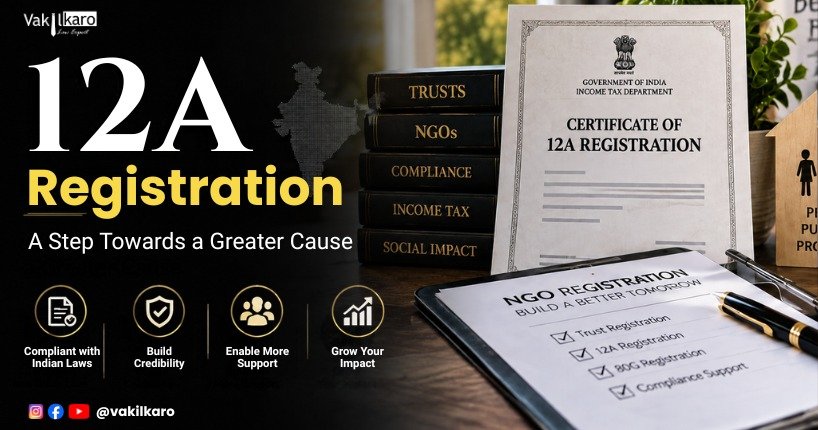
12A Registration is a tax registration for eligible NGOs, trusts, societies and Section 8 companies that allows them to claim available income tax benefits on funds used for their charitable activities. The registration is provided by the Income Tax Department under Section 12A/12AB of the Income Tax Act, 1961 and helps organisations maintain proper tax compliance.
The registration allows eligible organisations such as charitable trusts, societies and Section 8 companies to claim applicable tax benefits while carrying out genuine charitable activities.
The application process is completed online through the Income Tax e-Filing Portal using the prescribed forms and required documents. For newly established organisations, provisional registration may be required before obtaining regular registration as per applicable rules.
12A registration is different from 80G Registration, as 12A mainly provides tax exemption benefits to the organisation, whereas 80G allows eligible donors to claim deductions on donations.
Proper documentation, correct application category and compliance records are important for successful 12A registration approval.
Why 12A Registration Matters for an NGO
An NGO can be legally incorporated yet still remain outside the income-tax exemption framework. Incorporation under a trust law, the Societies Registration Act or Section 8 of the Companies Act establishes the entity; 12AB registration addresses its income-tax status. This distinction matters whenever the organisation receives donations, grants, membership receipts, programme income or investment income.
A valid registration also improves institutional credibility. Donors, CSR teams, grant-making foundations, banks and government departments commonly review the registration certificate together with audited financial statements, governing documents and activity evidence. It shows that the organisation has entered a regulated tax framework, although it should never be presented as a government guarantee of performance.
- Potential exemption for eligible income applied to charitable or religious purposes.
- Better readiness for grants, CSR due diligence and institutional fundraising.
- A necessary foundation for seeking 80G approval for eligible donor deductions.
- Stronger financial discipline through annual reporting, audit and utilisation controls.

Eligibility Criteria for 12A Registration In India:
| Eligibility Criteria | Requirement |
|---|---|
| Eligible Entity | Trust, registered society, Section 8 company or eligible charitable/religious institution |
| Legal Documents | Valid trust deed, MOA, registration certificate and governing documents |
| PAN & Address | Valid PAN and registered address details |
| Charitable Objects | Objects should support charitable or religious purposes |
| Activities | Actual activities should match stated objects |
| Compliance Records | Proper financial and activity records should be maintained |
Charitable Purpose and Genuine Activities
Charitable purpose generally covers relief of the poor, education, yoga, medical relief, preservation of the environment, preservation of monuments and advancement of other objects of general public utility, subject to statutory limits. The correct characterisation of the objects matters when the organisation charges fees or undertakes activities that resemble trade, commerce or business.
The Income Tax Department may review whether the organisation’s activities are genuine and aligned with its stated charitable objectives. A strong application therefore explains what the organisation does, where it operates, who benefits, how beneficiaries are selected, what funds are used and what evidence is available. Programme reports, photographs, invoices, beneficiary records, bank entries and audited statements should tell one coherent story.
Benefits of 12A Registration
The central benefit is access to the exemption framework for eligible income. This can allow more funds to remain available for programmes, staff, infrastructure and future charitable work. The benefit is conditional income must be applied or accumulated in the permitted manner, investments must follow the prescribed rules, and prohibited benefits to founders or related persons must be avoided.
Registration can also make the NGO more funding-ready. Corporate donors and grant-makers frequently ask for 12A and 80G certificates, PAN, governing documents, audited accounts, utilisation reports, conflict-of-interest controls and registration on relevant government portals. A complete compliance file reduces delays during donor due diligence.
- Tax-position support for eligible charitable income.
- Improved confidence among donors and institutional partners.
- Better alignment with 80G, CSR and grant-readiness processes.
- A documented compliance history for future renewals and scrutiny.
Documents Required for 12A Registration
| Document | Purpose |
|---|---|
| Trust Deed / MOA / Rules | Verify legal structure and charitable objects |
| Registration Certificate | Confirm entity registration |
| PAN Card | Tax identity verification |
| Address Proof | Registered office verification |
| Bank Details | Financial record verification |
| Financial Statements | Review income and expenditure |
| Activity Report | Evidence of charitable activities |
| Governing Body Details | Verify trustees/directors/office bearers |
| Document | Purpose |
| Previous 12A/12AB Approval Order (if applicable) | Verification of existing registration status |
| Form 10A/10AB Filing Details | Application category verification |
Form 10A and Form 10AB
Form 10A and Form 10AB serve different situations. Form 10A is commonly associated with specified initial or provisional registration cases, while Form 10AB is used in several regular registration, renewal, conversion or modification situations. The exact clause selected in the electronic form controls the legal route of the application, so it should be matched to the organisation’s present status and certificate history.
A provisional certificate should not be treated as the end of the process. The organisation must monitor the earlier of the relevant activity-based and expiry-based deadlines for moving to regular registration. Because portal options and statutory timelines can change, the applicable form, section, due date and attachments should be checked on the official portal at the time of filing.
Step-by-Step Online Process
The online registration process involves reviewing eligibility, preparing the required documents, selecting the correct Form 10A or Form 10AB, and submitting the application through the Income Tax e-Filing portal. After filing, applicants should respond to any departmental queries and, once approved, preserve the registration details and maintain ongoing compliance records.
Step 1: Eligibility Review
Review the NGO’s legal structure, charitable or religious objects, existing registrations, activities and approvals to determine eligibility and the appropriate registration category.
Step 2: Document Preparation
Prepare and organise the required registration documents, including PAN, constitutional documents, registration proof, financial records, activity evidence and other supporting documents applicable to the NGO.
Step 3: Select Form 10A / Form 10AB
Identify the correct application form and filing route based on the NGO’s existing registration status, application category and the applicable provisions under the Income-tax framework.
Step 4: Online Application Filing
Complete and submit the application online through the Income Tax e-Filing portal with the required details, supporting documents and applicable verification or authentication.
Step 5: Department Review & Query Response
The Income Tax Department may review the application and seek additional information or clarification. Any notice or query should be answered within the prescribed time with appropriate supporting documents.
Step 6: Approval & Compliance Setup
After approval, preserve the registration order and related records, verify the registration details and validity, and maintain the required documentation and ongoing compliance for continued registration benefits.
12A Registration Fees
The cost of 12A/12AB Registration depends on the organisation’s legal structure, application category, availability of documents and the level of professional assistance required.
The overall cost may vary based on the following factors:
- Eligibility Review: Assess the NGO’s legal structure, charitable objects, governing documents, activities, and applicable registration requirements before proceeding with the filing.
- Document Preparation: Organising trust deed, registration documents, PAN, financial records and activity details.
- Form 10A / Form 10AB Filing Support: Assistance with selecting the appropriate application category and preparing the online filing.
- Query Response Support: Assistance in preparing responses and supporting documents if clarification is requested by the Income Tax Department.
The applicable government charges, if any, should be verified from the official Income Tax e-Filing Portal at the time of filing. Professional service charges depend on the scope of work, documentation requirements and additional compliance support required by the organisation.
Before starting the application process, NGOs should keep their legal documents, financial records and activity details properly organised to ensure a smooth filing process.
12A Registration Timeline
| Process Stage | Expected Time |
|---|---|
| Document Preparation | Depends on organisation readiness |
| Online Filing | After completion of documents |
| Department Review | Depends on Income Tax Department verification |
| Query Response | Based on notice timeline |
| Final Approval | After successful verification |
Departmental Verification and Possible Queries
The authority may examine the genuineness of activities, compliance with other applicable laws and consistency between the objects, accounts and evidence. Common queries concern unexplained receipts, related-party payments, cash donations, a mismatch in the name or address, missing registration proof, inadequate activity details, or objects that permit commercial or private benefit.
A response should be factual and document-led. Avoid merely repeating that the organisation is charitable. Provide a point-by-point reply, a document index, relevant bank and ledger extracts, programme evidence and an explanation of any unusual transaction. If additional time is genuinely needed, act before the response window closes rather than allowing the proceeding to become ex parte.
Validity, Regular Registration and Renewal
Under the commonly applied framework, provisional registration is time-limited and regular registration is granted for a defined period rather than forever. Renewal must be initiated within the prescribed window. The certificate date, effective period and next action date should be entered in a central compliance calendar and reviewed at board meetings.
Under the commonly applied framework, provisional registration is time-limited and regular registration is granted for a defined period rather than forever. Renewal must be initiated within the prescribed window. The certificate date, effective period and next action date should be entered in a central compliance calendar and reviewed at board meetings.
An organisation should also review whether a modification of objects requires a fresh application. Changing the deed, memorandum or rules without checking the tax consequences can create a mismatch between the registered objects and current constitution. The revised objects should remain charitable, be properly approved and be reported through the appropriate route within the applicable time.
12A/12AB and 80G: The Difference
12AB registration primarily concerns the organisation’s eligibility for income-tax exemption. 80G approval concerns the donor’s eligibility to claim a deduction for qualifying donations. They are connected but separate approvals, and neither should be described as an unconditional tax benefit. A donor’s deduction depends on the applicable category, payment mode, limits and reporting.
For an NGO dependent on public donations or CSR support, applying for both registrations may be commercially practical. After approval, the organisation must maintain proper donor data and meet applicable reporting and certificate requirements. Cash, anonymous donations and incomplete donor particulars can create avoidable tax and reconciliation problems.
Application of Income, Accumulation and Investments
Registration is only the starting point. Each year, the organisation must apply the required portion of income to its objects or validly exercise the available accumulation options. Timing matters when grants arrive near year-end, projects are postponed or funds are earmarked for a future capital programme. Decisions should be supported by resolutions, budgets and timely prescribed filings.
Funds and corpus amounts should be held or invested only in permitted modes where the law requires it. Loans to related parties, speculative investments, unrecorded advances and diversion of property can threaten exemption. The accounting team should separately track corpus, restricted grants, programme expenses, administrative expenses, advances and related-party transactions.
Annual Compliance After Registration
A registered NGO should maintain complete books, vouchers, bank records, donor data, minutes and programme evidence. Depending on its facts, it may need an audit report, income-tax return, statements relating to donations, TDS filings and other statutory returns. Separate compliance may arise under the Companies Act, state trust law, society law, GST Registration, CSR rules, FCRA or labour laws.
The governing body should receive a simple compliance dashboard showing filing dates, certificate validity, utilisation of restricted grants, related-party transactions and unresolved notices. This turns compliance from a year-end emergency into a routine management process and makes renewal or donor due diligence much easier.
- Maintain books, bank reconciliation and supporting vouchers.
- File the applicable return, audit report and donor reporting on time.
- Monitor certificate validity, changes in objects and key personnel.
- Preserve activity and impact evidence for future scrutiny.
Common Mistakes to Avoid in 12A/12AB Registration
NGOs should carefully review their documents, application details and compliance records before applying for 12A/12AB Registration. Common mistakes that may create delays or compliance issues include:
- Selecting the Wrong Form Category Choosing an incorrect filing route between Form 10A and Form 10AB based on the NGO’s status, approval history or application requirement.
- Submitting Incomplete or Incorrect Documents Uploading unsigned documents, incomplete trust deeds, missing registration records or unclear supporting documents.
- Mismatch in Organisation Details Providing inconsistent information in PAN, registration documents, bank details, governing documents or application forms.
- Using a Generic Activity Note Submitting a general description of activities without explaining the NGO’s objectives, programmes, beneficiaries, locations and supporting evidence.
- Ignoring Previous Registrations or Approvals Failing to consider existing 12A/12AB status, provisional approval, expiry dates, renewal requirements or previous filings.
- Incomplete Financial Records Not maintaining proper books of accounts, financial statements, bank records, audit reports or utilisation details.
- Not Responding Properly to Departmental Notices Missing deadlines or submitting incomplete responses without relevant supporting documents when clarification is requested.
- Assuming Provisional Registration Is Permanent Treating provisional approval as final registration and failing to complete the required process for regular registration.
- Incorrect Claims About Donations Informing donors that every donation automatically qualifies for deduction without considering applicable conditions and limits.
- Improper Use of NGO Funds Using NGO assets for personal benefit, maintaining undocumented reimbursements or making transactions that are not related to charitable objectives.
- Lack of Governance and Documentation Controls Not maintaining proper board records, approvals, internal policies, related-party documentation and financial controls.
- Non-Compliant Investments or Transactions Making investments, payments or arrangements that may not comply with applicable charitable tax requirements.
Maintaining accurate records, transparent financial practices and proper governance systems helps NGOs avoid unnecessary queries and supports long-term compliance after registration.
Estimated Timeline and Professional Fee
The time required for 12A/12AB Registration depends on factors such as application category, document accuracy, portal processing and whether any clarification is required by the Income Tax Department.
A complete and properly prepared application can help avoid unnecessary delays. However, the final approval timeline may vary depending on the review process and applicable requirements.
The cost of 12A Registration depends on the organisation’s requirements and scope of support. Professional assistance may include eligibility review, document verification, Form 10A/10AB filing, query response support and certificate verification.
Government charges, if applicable, are separate from professional service fees and should be verified through the official Income Tax e-Filing Portal.
Why Choose Vakilkaro for 12A Registration?
Vakilkaro helps NGOs with a structured 12A/12AB Registration process by focusing on accurate documentation, proper application preparation and compliance-oriented guidance. Our approach is designed to help organisations complete the filing process with clarity and proper records.
- Eligibility Assessment Before Filing Review the NGO’s legal structure, charitable objects, activity status, existing approvals and filing requirements before selecting the appropriate application route.
- Form 10A / Form 10AB Filing Guidance Assist in understanding the suitable filing category based on the NGO’s registration status, approval history and applicable requirements.
- Complete Document Support Provide a practical document checklist and help organise registration records, PAN details, financial documents, activity evidence and other supporting information.
- Professional Application Preparation Assist in preparing activity notes, object explanations and supporting document indexes with clear and properly structured information.
- End-to-End Filing Support Support includes application preparation, document upload review, verification guidance, filing status tracking and coordination during the registration process.
- Department Query Response Assistance Help prepare organised responses with relevant supporting documents if clarification is requested by the Income Tax Department.
- Post-Registration Compliance Guidance Help NGOs understand validity periods, renewal requirements and compliance responsibilities after receiving 12A/12AB registration.
- Transparent Communication & Online Support Provide clear updates regarding document requirements, process stages and next actions with a transparent scope of work.
- Pan-India Online Service NGOs can complete the process remotely with digital document sharing and online coordination support.