
ISO Certification helps your business follow recognised quality and management standards. The process includes choosing the right ISO standard, preparing documents, implementing required systems, and getting ready for the certification audit.
What is ISO Certification in India?
ISO certification is an independent confirmation that an organisation’s management system complies with the requirements of a particular ISO standard. It helps businesses establish controlled processes, defined responsibilities, measurable objectives and reliable operational records.
The International Organization for Standardization develops the standards, but it does not issue certificates. Certification is granted by an independent certification body after reviewing the organisation’s documentation, implementation and management-system effectiveness.
ISO certification can be obtained by manufacturers, service providers, startups, NGOs, educational institutions and other organisations. The correct standard depends on the organisation’s activities, business risks and customer or tender requirements.
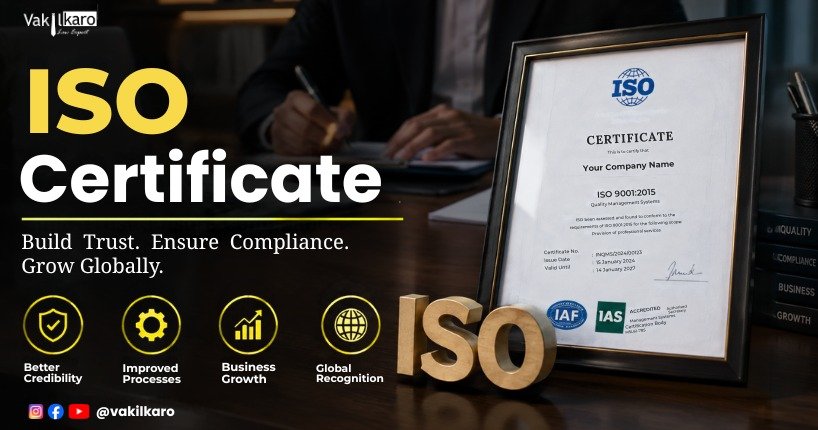
ISO Certification: A Practical Overview
ISO certification helps an organisation convert informal working habits into a controlled management system with defined responsibilities, measurable objectives and dependable records. A newly incorporated business may first organise its legal identity through private limited company registration, LLP registration or one person company registration before defining the certification scope. The legal form does not decide eligibility, but the certificate must correctly show the organisation's name, address, activities and covered sites.
The word ISO is often used as if it were a licence. It is not a general government permission and it does not replace sector-specific approvals. A food operator may still need FSSAI registration, an employer may require ESI registration, and an exporter may need an Import Export Code. ISO certification sits alongside these obligations and demonstrates that the organisation operates a management system against a recognised standard.
A sound engagement separates consultancy from certification. Consultants can help interpret requirements, conduct a gap review, develop documentation, train employees and prepare the organisation. The independent certification body audits the implemented system and issues the certificate only after a favourable decision. This distinction protects impartiality and helps buyers, tender authorities and customers trust the result. Businesses can review BIS standards information, the BIS standards portal and Vakilkaro's ISO certification support while planning the project.

Popular ISO Standards for Indian Businesses
The correct standard depends on risk, customer expectations, contractual requirements and the nature of operations. A company should not choose a standard merely because it is familiar or inexpensive. The scope, locations, processes and desired market outcome should be mapped first. Where multiple systems are required, an integrated approach can reduce duplicated policies, audits, training and management reviews.
| Standard | Management focus | Common users |
|---|---|---|
| ISO 9001 | Quality management | Manufacturing, services, professional firms and organisations seeking consistent delivery and customer satisfaction. |
| ISO 14001 | Environmental management | Factories, construction, logistics and businesses managing waste, emissions, resources or environmental duties. |
| ISO/IEC 27001 | Information security | IT, SaaS, BPO, fintech, healthcare and any organisation processing sensitive or client-controlled information. |
| ISO 45001 | Occupational health and safety | Construction, plants, warehouses and workplaces with meaningful worker health and safety risks. |
| ISO 22000 | Food safety management | Food processors, packers, storage operators, caterers and supply-chain organisations. |
| ISO 50001 | Energy management | Energy-intensive facilities and organisations pursuing measurable energy performance improvement. |
| ISO 13485 | Medical-device quality | Medical-device manufacturers and connected suppliers operating in regulated markets. |
| ISO 20000-1 | IT service management | Managed service providers, data centres and enterprise IT service teams. |
| ISO 37001 | Anti-bribery management | Organisations strengthening integrity controls, due diligence and tender readiness. |
| ISO 21001 | Educational organisations | Schools, colleges, training institutions and learning-service providers. |
Who Can Apply and What Makes an Organisation Ready?
Organisations of almost any size or sector can pursue a certifiable management-system standard. There is generally no universal turnover, capital or headcount threshold. Readiness depends on whether the scope is clear, the system is implemented, responsibilities are assigned and objective evidence exists. A sole owner may first formalise operations through sole proprietorship registration, partners may use a partnership firm structure, and social organisations may operate through Section 8 company registration. Each can build a management system suited to its activities.
Certification is available to established companies and young businesses, but an auditor must see records showing that the system works. The organisation should complete at least one meaningful internal audit and management review, close identified gaps and retain performance evidence. Trusts may separately consider trust registration, NGOs may examine 12A and 80G registration, and producer-owned enterprises may use farmer producer company registration before presenting their exact legal identity to the certification body.
Multi-site applicants must decide whether every location performs similar activities, whether sampling may be permitted, and whether any central function controls the system. The scope should not silently omit a plant, warehouse or service centre that customers expect to be certified. The application should accurately disclose personnel, shifts, outsourced processes and seasonal work because these factors affect audit planning. A public limited company, an Indian subsidiary and a Section 8 microfinance company may therefore require very different audit designs.
Documents and Records Required
The document list varies with the standard, sector, scope and organisation size. Modern ISO standards do not demand paperwork for its own sake; they require controlled documented information necessary for effective operation and evidence. The table below is a practical preparation list, not a universal checklist.
| Document group | Typical evidence |
|---|---|
| Legal identity | Certificate of incorporation or registration, PAN, GST details, registered address, authorised signatory evidence and relevant licences. |
| Organisation profile | Locations, activities, products or services, process map, reporting structure, employee count, shifts and outsourced processes. |
| System framework | Policy, objectives, scope, context analysis, interested-party needs, risk register and responsibility matrix. |
| Operational controls | Procedures, work instructions, inspection plans, acceptance criteria, supplier controls and emergency arrangements. |
| People and competence | Job descriptions, competence criteria, induction, training records, evaluation results and awareness evidence. |
| Performance evidence | KPIs, complaints, nonconformities, corrective actions, monitoring results, legal evaluations and supplier performance. |
| Audit readines | Internal audit programme and reports, management review minutes, corrective-action closure and supporting evidence. |
ISO Certification Process: Step by Step
The ISO Certification process follows a structured series of steps, from selecting the right standard and defining the scope to documentation, implementation, audit and final certification. Understanding each stage helps businesses prepare properly, avoid delays and complete the certification process smoothly.
| Stage | What happens |
|---|---|
| 1. Select the standard | Match business risks, customer demands and tender requirements with the right certifiable standard. |
| 2. Define the scope | State the activities, products, services, sites and organisational boundaries that will be certified. |
| 3. Conduct gap analysis | Compare current practices and evidence against every applicable requirement. |
| 4. Build documentation | Create useful policies, procedures, controls, formats and registers around real operations. |
| 5. Implement and train | Put controls into practice, assign owners, train people and generate records. |
| 6. Internal audit | Test whether the system conforms, is implemented and is effective across the complete scope. |
| 7. Management review | Leadership reviews results, risks, resources, changes and improvement priorities. |
| 8. Choose accredited body | Verify accreditation, relevant scope, auditor competence, audit duration and full-cycle fees. |
| 9. Stage 1 audit | The certification body reviews readiness, documented information and site-specific conditions. |
| 10. Stage 2 audit | Auditors assess implementation through interviews, observation, sampling and records. |
| 11. Close findings | Correct issues, analyse root causes, implement corrective actions and submit evidence. |
| 12. Certification decision | An independent reviewer evaluates the audit result before certificate issuance. |
| 13. Maintain the system | Operate controls, complete surveillance audits and prepare for recertification. |
How to Select a Credible Certification Body
A credible certificate depends on a credible accreditation chain. Ask the certification body to identify its accreditation body, show that the required standard is within its accredited scope and confirm that your industry sector is covered. Check the certificate-body listing independently instead of relying only on a logo in a proposal. The Quality Council of India, NABCB website and the BIS home page provide useful institutional context for Indian organisations.
Compare proposals on audit days, competence, locations, surveillance costs, travel, certificate scope and recertification terms. A surprisingly low fee or instant certificate may signal that essential audit work is being skipped. The certification body should explain Stage 1, Stage 2, sampling, nonconformity closure, certification decision and ongoing surveillance. It should also maintain impartiality: the body that certifies should not sell a bundled consultancy that compromises its independence.
Before appointment, ask who will perform the audit and whether that person has sector competence. Confirm whether remote activity is appropriate, which sites will be visited, how confidential information will be protected and when the audit report will be issued. For information-sensitive organisations, contractual safeguards can be reinforced through a tailored agency agreement, memorandum of understanding or joint venture agreement where third parties participate in the certified scope.
ISO Certification Cost and Timeline
ISO Certification cost depends on factors such as the selected standard, organisation size, number of locations, process complexity, audit requirements and level of preparation required. A proper quotation should clearly mention implementation support, certification charges, surveillance and recertification costs.
| Cost driver | Why it matters |
|---|---|
| Scope and standard | A narrow single-site ISO 9001 scope is usually simpler than an integrated or highly regulated multi-standard scope. |
| Number of employees | Audit duration commonly increases with the number of employees covered under the certification scope. |
| Sites and shifts | Multiple locations, night shifts, seasonal operations and remote teams affect audit planning. |
| Risk and complexity | Food safety, medical devices, information security and hazardous operations require specialised competence. |
| Existing maturity | Usable procedures and reliable records reduce preparation effort; copied templates often increase it. |
| Three-year cycle | Budget for initial certification, annual surveillance and recertification instead of only the first certificate. |
A small organisation may complete preparation within a few months, while complex or multi-site organisations may require more time. The timeline depends on implementation readiness, documentation, internal audit completion and certification body availability.
A realistic project plan provides time for gap closure, document approval, employee awareness, operation of controls, one full internal audit, management review and corrective action. Certification-body availability also affects the schedule. Procurement should avoid choosing a provider solely on headline speed, because an audit without adequate implementation may lead to Stage 1 postponement, significant findings or a certificate that customers cannot verify.
Validity, Surveillance and Renewal
Management-system certificates are commonly issued on a three-year certification cycle, subject to periodic surveillance audits and continued conformity. The certificate can be suspended or withdrawn if serious issues remain unresolved, surveillance is missed, the mark is misused or the organisation no longer operates the certified system. Always confirm the precise programme rules and dates with the appointed accredited certification body.
Surveillance is not a renewal formality. Auditors sample objectives, internal audits, management review, customer feedback, changes, incidents, corrective actions and selected operational areas. The organisation should maintain a live calendar that also covers relevant LLP compliance, OPC compliance and partnership compliance deadlines where those obligations apply.
Recertification should start before expiry so there is time to plan the audit, update the scope and close findings. Significant changes—new sites, products, ownership, legal status, workforce or outsourced processes—should be communicated promptly. Corporate changes such as authorised capital increase, share transfer or removal of a director may also require updates to the management-system context and responsibility matrix.
How to Verify an ISO Certificate
Start with the certificate number, legal name, address, standard, revision year, scope, issue date, expiry date, certification-body name and accreditation mark. Verify the certificate through the issuer's own register and then verify that the issuer is accredited for the relevant standard and sector. A logo alone is not proof. Watch for altered PDFs, mismatched names, expired dates, vague scope wording, missing accreditation and certificates issued without a meaningful audit.
Buyers and tender teams should compare the certified scope with the goods or services being purchased. A certificate covering consulting does not automatically cover software development; a certificate for one plant does not automatically cover another. Organisations selling to public buyers can also review the Government e-Marketplace, Central Public Procurement Portal and Udyam Registration portal while checking the exact qualification language in each procurement document.
Exporters should ensure that the certificate supports the target market and product category. Registration and logistics requirements may separately involve the DGFT portal, ICEGATE portal and Vakilkaro's ICEGATE registration service. None of these portals validates every ISO certificate; they address distinct trade functions, so certificate authenticity must still be checked through the accreditation and certification chain.
Common Mistakes That Delay Certification
- Choosing a standard before understanding customer, regulatory and operational needs.
- Writing a scope that is broader than actual evidence or narrower than the target tender requires.
- Buying generic documents that do not match real processes, job roles or records.
- Conducting internal audit as a checklist exercise without testing effectiveness.
- Holding management review without complete inputs, decisions, owners or due dates.
- Treating training attendance as proof of competence without evaluation.
- Ignoring outsourced processes, remote workers, secondary sites or night shifts.
- Selecting a certification body without verifying accreditation and sector scope.
- Budgeting only for the first certificate and overlooking surveillance or recertification.
- Using the ISO logo or certification mark in a way that implies product certification.
A frequent mismatch appears when a company markets protected brands or technical products but has weak ownership records. Quality-system planning can therefore be coordinated with trademark registration, copyright registration and patent registration where relevant. These rights remain separate from ISO certification, but clear document control helps demonstrate authorised use of designs, specifications, manuals and software.
Another delay occurs when statutory or filing records are inconsistent. Finance and compliance teams may need to regularise GSTR-9 annual return, GSTR-10 final return or DPT-3 filing. The ISO team should record applicable obligations, assign owners and verify completion instead of assuming that every registration is automatically current.
Related Business Readiness and Compliance
ISO Certification often highlights other business compliance areas that may need to be updated or properly documented. Depending on your organisation, this may include Virtual Office with GST Support, MOA Amendment, Commencement of Business Filing (INC-20A), 15CA and 15CB Filing, FDI Filing, and FLA Return. These compliances should be properly managed where they affect the scope of the ISO management system.
Businesses may also need support for ownership, branding and intellectual property matters such as Dematerialisation of Shares, Share Purchase Agreement, Trademark Renewal, Trademark Objection, Trademark Opposition, Trademark Assignment, Trademark Rectification, Trademark Hearing, Design Registration, Design Objection, and Logo Designing. Keeping these records updated can help maintain clear documentation and business control.
Tax and statutory compliance may also be relevant, including Income Tax E-Filing, Partnership Firm ITR Filing, LLP ITR Filing, Trust or NGO Tax Filing, GST Notice Reply, GST Revocation, GST LUT Filing, and GST Registration for Foreigners. These services are separate from ISO Certification, but proper records and compliance can support a more organised and audit-ready management system.
Why Choose Vakilkaro for ISO Certification Support?
- Standard selection based on your business model, customer expectations and tender objective.
- Gap analysis that identifies practical actions, owners, evidence and implementation priorities.
- Scope drafting that correctly covers intended activities, services, products and sites.
- Customised documentation designed around real processes rather than generic templates.
- Employee awareness, process-owner guidance and audit interview preparation.
- Internal audit and management-review support before the external certification audit.
- Coordination with an independent accredited certification body and support for closing findings.
- Surveillance and recertification planning to keep the management system active after certificate issue.
Vakilkaro supports the preparation and coordination journey while the independent certification body performs the accredited audit and takes the certification decision. You can review the wider registration services category, explore MCA compliance services or contact the Vakilkaro team for a scope-specific discussion. The objective is not merely to obtain a document, but to build a system that remains useful after the audit.