

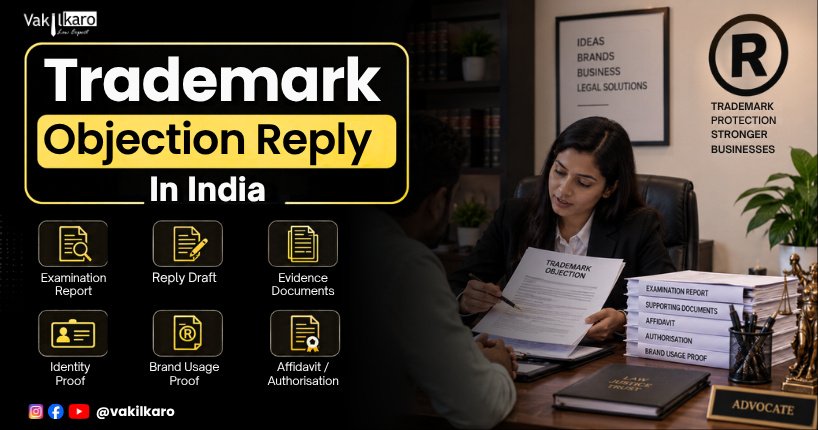
A Trademark Objection Reply is a formal response filed when the Trademark Examiner raises objections to an application. The reply should clearly address the concerns with proper facts, legal points and supporting documents. It should generally be filed within one month of receiving the Examination Report to avoid the application being treated as abandoned.
What Is a Trademark Objection Reply?
A trademark objection is raised when the Trade Marks Registry, during examination of an application, identifies legal or procedural issues that require clarification from the applicant.
An objection does not automatically mean that the trademark application has been rejected. Instead, the Examination Report gives the applicant an opportunity to explain why the trademark should be accepted.
The applicant must analyse the objections mentioned by the examiner and prepare an appropriate Trademark Objection Reply addressing each objection individually.
For applicants who are still at the initial filing stage, understanding the complete Trademark Registration process in India can help clarify where examination and objection fit within the overall registration procedure.
The objection reply may include legal arguments, factual explanations, differences between the applied mark and cited trademarks, evidence of prior use, proof of acquired distinctiveness, invoices, advertisements, packaging, website evidence and other documents relevant to the objection.
A generic response may not adequately address the examiner’s concerns. The reply should therefore be drafted specifically according to the Examination Report issued for that particular application.
Why Does a Trademark Objection Occur ?
A trademark application may receive an objection when the examiner finds that the proposed mark does not fully meet the legal requirements for registration. Some common reasons include:
- Conflict with an earlier trademark – The proposed mark may look, sound, or appear too similar to an existing trademark.
- Too descriptive – The mark directly describes the product, service, quality, purpose, or characteristic instead of acting as a unique brand name.
- Lack of uniqueness – The trademark may be considered too common or ordinary to identify one particular business.
- Misleading trademark – A mark may face an objection if it could create a false impression about the nature, quality, or origin of the goods or services.
- Use of restricted symbols or names – Certain national symbols, official emblems, or protected names may not be freely registered as trademarks.
- Use of geographical terms – A mark mainly consisting of a place or geographical name may face objection in certain circumstances.
- Objectionable or prohibited matter – Marks containing legally prohibited, scandalous, or inappropriate material may not be accepted.
- Improper or dishonest adoption – An objection may arise where the application appears to imitate or take unfair advantage of an existing brand.

Types of Trademark Objections in India
Trademark objections are most commonly associated with Section 9 and Section 11 of the Trade Marks Act, 1999.
1. Section 9 Trademark Objection – Absolute Grounds
Section 9 deals with absolute grounds for refusal of registration.
A mark may face a Section 9 objection where it is considered incapable of distinguishing one person’s goods or services from those of another, where it directly describes characteristics of the goods or services, or where it consists of expressions that have become customary in trade.
The official Trade Marks Act, 1999 specifies the statutory absolute grounds considered when examining a trademark application.
Examples may include:
- Descriptive brand names
- Common industry terms
- Generic expressions
- Marks lacking distinctive character
- Certain geographical references
- Marks considered deceptive
- Marks containing prohibited matter
A Section 9 response usually focuses on demonstrating the inherent distinctiveness of the trademark or, where applicable, explaining how the mark has acquired distinctiveness through genuine commercial use.
2. Section 11 Trademark Objection – Relative Grounds
Section 11 generally deals with conflicts with earlier trademarks.
The examiner may cite one or more existing applications or registrations where the proposed trademark appears identical or similar and the goods or services overlap sufficiently to create a likelihood of confusion or association.
Section 11 of the Act expressly addresses identity or similarity with earlier trademarks and the likelihood of public confusion.
A Section 11 reply may analyse:
- Visual differences between the marks
- Phonetic differences
- Conceptual differences
- Overall commercial impression
- Nature of goods or services
- Target customers
- Trade channels
- Existing use of the applicant’s trademark
- Circumstances surrounding adoption
- Any applicable statutory exceptions
Simply stating that two trademarks are “different” is normally not enough. The response should explain the differences logically and connect them to the particular objections raised in the Examination Report.
Section 9 vs Section 11 Trademark Objection
| Point | Section 9 | Section 11 |
|---|---|---|
| Nature | Absolute grounds | Relative grounds |
| Main concern | Distinctiveness or registrability of the mark itself | Conflict with earlier trademark rights |
| Typical issue | Descriptive or non-distinctive mark | Similarity with earlier mark |
| Main response approach | Establish distinctiveness and registrability | Establish differences and absence of confusion |
| Evidence | Use, recognition, advertisements, sales and promotional evidence | Prior use, comparison of marks, market evidence and other supporting material |
Is Trademark Objection the Same as Trademark Rejection?
No. A trademark objection is part of the examination process and gives the applicant an opportunity to respond.
A trademark objection is part of the examination process and gives the applicant an opportunity to respond.
Rejection or refusal may occur later if the examiner or Registrar remains unsatisfied after considering the reply and, where applicable, submissions made during a hearing.
Rule 33 provides that where a response is filed within the prescribed period, the Registrar must consider it. If the response is not satisfactory, the applicant may be given an opportunity of hearing.
Therefore, receiving an Examination Report should be treated as a requirement to respond—not automatically as the end of the application.
Time Limit for Filing Trademark Objection Reply
The deadline is one of the most important aspects of an objection matter.
Under Rule 33(4) of the Trade Marks Rules, 2017, if the applicant fails to respond within one month from the date of receipt of the Examination Report, the Registrar may treat the trademark application as abandoned.
Applicants should therefore review the Examination Report as soon as it is received rather than waiting until the deadline is close.
The current status of an application can also be checked through the official Trade Marks eRegister and Application Status portal.
Timely monitoring is particularly important when an application is being handled through an authorised representative because notices, status changes and hearing updates should be reviewed throughout the registration process.
Trademark Objection Reply Process in India
The Trademark Objection Reply process starts with reviewing the Examination Report to understand the objections raised by the Trademark Examiner. If earlier trademarks are cited, they should be carefully compared with the applied mark, including their status and relevant goods or services. Supporting documents such as invoices, advertisements, packaging, website records and other proof of use should then be collected to prepare a clear and well-supported reply.
Step 1: Review the Examination Report
Carefully check the Examination Report to understand the objections raised by the Trademark Examiner, including any objections under Section 9, Section 11, or other procedural issues.
Step 2: Check the Cited Trademarks
If earlier trademarks are cited, compare them with the applied mark and review their status, goods or services, and other relevant details.
Where the objection is based on Section 11, the cited trademarks should be examined carefully.
The official Trademark Public Search system can be used to review relevant marks and available registration information.
Step 3: Gather Supporting Documents
Gather relevant documents such as invoices, advertisements, packaging, website records, business documents, or other evidence that may support the trademark application.
Step 4: Prepare Ground-Wise Legal Arguments
Draft a clear Trademark Objection Reply addressing each objection separately. The reply should include appropriate explanations, legal arguments, and supporting evidence wherever required.
For Section 9 objections, arguments may focus on inherent distinctiveness, the overall nature of the mark or acquired distinctiveness.
For Section 11 objections, the response may explain visual, phonetic and conceptual differences and why confusion with the cited mark is unlikely in the particular circumstances.
The drafting should remain consistent with the application originally filed.
Step 5: File the Reply
Submit the reply within one month from the date of receipt of the Examination Report. If no response is filed within this period, the Registrar may treat the application as abandoned.
Step 6: Registrar Reviews the Reply
After filing, the Trade Marks Registry reviews the response. If the reply satisfactorily addresses the objections, the application may proceed toward advertisement in the Trade Marks Journal.
Step 7: Attend a Trademark Hearing, if Required
If the Registrar is not satisfied with the reply, the applicant may be given an opportunity for a Trademark Hearing to present further arguments and supporting submissions before an appropriate order is passed.
The applicant should continue checking the official Trademark Application Status after filing the reply to stay updated about further action by the Registry.
How to Draft an Effective Trademark Objection Reply
A strong Trademark Objection Reply should clearly address the concerns raised by the Trademark Examiner. The response should be specific to the application, supported by relevant facts and documents, and written in a clear legal structure.
Address Every Objection
Each objection mentioned in the Examination Report should be answered properly. Even smaller procedural issues should not be ignored, as every relevant point may affect the application.
Avoid Generic Templates
Every trademark objection is different. A reply for a Section 9 objection may not be suitable for a Section 11 objection, so the response should be prepared according to the specific facts and issues of the case.
Support Important Claims
Any important claim made in the reply should be supported with suitable evidence. Documents such as invoices, advertisements, packaging, website records or other proof of use can help support the applicant’s position.
Maintain Consistency
The objection reply should remain consistent with:
- Applicant details
- Trademark representation
- User claim
- Goods or services
- Earlier submissions
- Supporting documents
How to Respond to a Section 11 Objection
A Section 11 objection generally requires a careful comparison between your trademark and the earlier marks cited by the Trademark Examiner. The reply should clearly explain why the applied mark is different and why confusion is unlikely.
Visual Comparison
The appearance, spelling, structure, device elements, colour arrangement or other visual characteristics may be compared.
Phonetic Comparison
Consider how the trademarks are pronounced and whether they sound similar when spoken.
Conceptual Comparison
Explain whether the marks communicate different ideas, meanings or commercial impressions, even if some words or letters are similar.
Goods and Services Comparison
Review whether the goods or services covered by the trademarks are similar, related or commercially different.
Consumer and Market Context
Consider the type of customers, buying conditions and trade channels relevant to the marks.
A well-prepared reply should clearly explain these differences with relevant facts and supporting material instead of simply stating that the trademarks are different.
Importance of Evidence in Trademark Objection Reply
Evidence can significantly strengthen a trademark objection response by showing how the brand has actually been used in the market. Documents such as dated invoices, packaging, advertisements, brochures, sales records, online listings and business correspondence can help establish genuine commercial use of the mark. Applicants who have already completed or are pursuing Trademark Registration should maintain these records from the beginning, as they may become useful during examination or future disputes.
The documents submitted should clearly connect the trademark with the applicant, relevant goods or services and the claimed period of use. Well-organised and relevant evidence is generally more useful than submitting a large number of unrelated documents. Maintaining proper records can also help if the trademark later faces a Trademark Opposition or another challenge involving ownership, prior use or brand recognition.
Businesses should therefore maintain consistent trademark usage across invoices, packaging, websites, advertisements and other commercial material. This not only supports the objection reply but can also strengthen the overall protection and long-term management of the registered brand.
What Happens After Filing the Trademark Objection Reply?
After the Trademark Objection Reply is filed, the Trademark Registrar reviews the response, supporting documents and arguments submitted by the applicant. If the reply satisfactorily addresses the objection, the application may move forward to advertisement in the Trade Marks Journal. If further clarification is required, the Registry may examine the application again or schedule a hearing.
The outcome can therefore vary from case to case. The objection may be accepted, the application may face further scrutiny, a hearing may be scheduled, certain conditions may be imposed, or the application may be refused through an appropriate order. Because of this, it is important to regularly monitor the trademark application even after the reply has been filed.
Trademark Hearing After Objection Reply
If the Trademark Registry is not fully satisfied with the objection reply, a hearing may be scheduled. The applicant or authorised representative can present legal arguments and supporting evidence, based on the Examination Report, filed reply, cited trademarks and relevant documents.
A Trademark Hearing gives the applicant or authorised representative an opportunity to present legal submissions regarding the objections.
The hearing preparation should normally begin by reviewing:
- Examination Report
- Objection reply already filed
- Cited trademarks
- Supporting evidence
- Relevant statutory provisions
- Hearing notice
- Any additional material permitted to be placed on record
The arguments made at the hearing should remain consistent with the written record while clearly answering the issues still concerning the Registry.
Trademark Objection vs Trademark Opposition
Trademark Objection and Trademark Opposition are different stages of the trademark process. An objection is generally raised by the Trademark Examiner during examination, while an opposition is filed by a third party after the trademark is advertised in the Trade Marks Journal. The table below highlights the key differences between the two.
A Trademark Opposition is a separate proceeding initiated by a third party after a trademark reaches the advertisement stage in the Trademark Journal.
| Trademark Objection | Trademark Opposition |
|---|---|
| Raised during examination | Arises after advertisement |
| Usually raised by Trademark Examiner | Filed by a third party |
| Response is made to Examination Report | Applicant files a counterstatement to opposition |
| Commonly involves Sections 9 and 11 examination objections | Governed principally by opposition provisions including Section 21 |
| May lead to show-cause hearing | Can lead to contested opposition proceedings |
Applicants should therefore avoid using “objection” and “opposition” interchangeably.
Common Mistakes to Avoid in Trademark Objection Reply
Common mistakes in a Trademark Objection Reply include missing the deadline, giving incomplete explanations, ignoring the examiner’s grounds, and submitting insufficient evidence. A clear, legally supported and properly documented reply improves the chances of overcoming the objection.
1. Missing the Reply Deadline
Failure to respond within the period specified under Rule 33 can place the application at risk of being treated as abandoned.
2. Using a Generic Reply
The response must address the specific grounds identified by the examiner.
3. Ignoring a Cited Trademark
Every important cited mark should be reviewed where it forms part of the objection.
4. Making Unsupported Claims
Claims of prior use, reputation or acquired distinctiveness should be supported appropriately.
5. Attaching Irrelevant Evidence
A large volume of unrelated documents may not strengthen the response.
6. Incorrectly Comparing Marks
A legal comparison should consider the overall impression and relevant commercial circumstances rather than only isolated letters.
7. Failing to Monitor the Status
A filed response may later lead to a hearing or another Registry action.
8. Confusing Objection With Opposition
The two stages have different procedures, parties and requirements.
How to Check Trademark Objection Status
Trademark applicants should monitor the official application record regularly.
The government’s Trade Marks eRegister provides registered trademark and application status information.
Depending on the stage of the application, the status may indicate that an Examination Report has been issued, a response is awaited, a hearing is scheduled or another Registry action has occurred.
Status descriptions should be read together with available documents and correspondence because the correct next step depends on the actual procedural history of the application.
What If the Trademark Is Already Registered but Contains an Error?
If a trademark has already been registered and contains an error in the register, the issue is generally handled through a post-registration procedure rather than a standard objection reply. The appropriate remedy depends on the type of error, the status of the registration and the correction required.
For issues involving incorrect or outdated details in the trademark register, the applicant may need to consider the Trademark Rectification process. Rectification can be relevant for certain corrections, modifications or challenges relating to an existing registered trademark, subject to the applicable provisions and facts of the case.
It is therefore important to first confirm whether the trademark is still under examination, has been advertised for opposition, or is already registered. The correct legal process will depend on the current stage of the trademark and the specific issue that needs to be corrected.
Managing a Trademark After Registration
Trademark protection does not end once the mark is registered. The owner should continue monitoring important details such as ownership information, renewal deadlines and any changes affecting the registered mark. Timely Trademark Renewal helps maintain the registration and avoid unnecessary expiry-related issues.
If ownership of the brand changes because of a sale, merger, restructuring or another business transaction, a Trademark Assignment may be required to record the transfer properly. Keeping trademark records updated can help avoid future disputes and ensure that the registered ownership reflects the actual business position.
Ongoing trademark management is therefore important for long-term brand protection. Regular review of renewal dates, ownership details and registration records helps businesses maintain stronger control over their trademark rights.
Who Should Consider Professional Assistance for a Trademark Objection?
Professional assistance may be particularly useful where:
- Multiple trademarks have been cited under Section 11.
- The mark faces objections under both Sections 9 and 11.
- Substantial prior-use evidence needs to be organised.
- The applicant intends to rely on acquired distinctiveness.
- The examination report raises complex legal grounds.
- The application is commercially important.
- A hearing is likely or has already been scheduled.
- Previous submissions contain inconsistencies.
- The applicant is unsure about the evidence required.
Each trademark matter depends on its own facts, which makes application-specific review important.
Trademark Objection Reply Fees
Vakilkaro's professional fee for Trademark Objection Reply starts at ₹2,499 + GST + Govt. charges. This covers Examination Report review, ground-wise reply drafting for Section 9 and Section 11 objections, and online filing. If the Registry schedules a hearing, Trademark Hearing support is available at ₹4,999 + GST + Govt. charges.
Why Choose Vakilkaro for Trademark Objection Reply?
Vakilkaro provides structured assistance for trademark objection matters from Examination Report review through response preparation and subsequent procedural support.
Our Trademark Objection Reply service focuses on identifying the specific objection, organising the relevant evidence and preparing a response aligned with the applicant's trademark record.
Examination Report Review
Each objection and cited mark can be examined before drafting begins.
Section 9 & Section 11 Support
The response strategy is prepared according to the actual statutory ground involved rather than relying on a standard template.
Supporting Evidence Assistance
Applicants can receive assistance identifying relevant documents to support use, distinctiveness and other factual claims.
Ground-Wise Drafting
Arguments can be structured around each objection appearing in the Examination Report.
Online Filing Assistance
The completed reply and appropriate supporting documents can be prepared for submission through the applicable Registry procedure.
Hearing Support
Where the matter proceeds further, assistance can also be provided for preparation and representation at the hearing stage.
Complete Trademark Support
Applicants can access assistance across registration, objection, hearing, opposition, rectification, renewal and assignment matters as their trademark progresses through different stages.