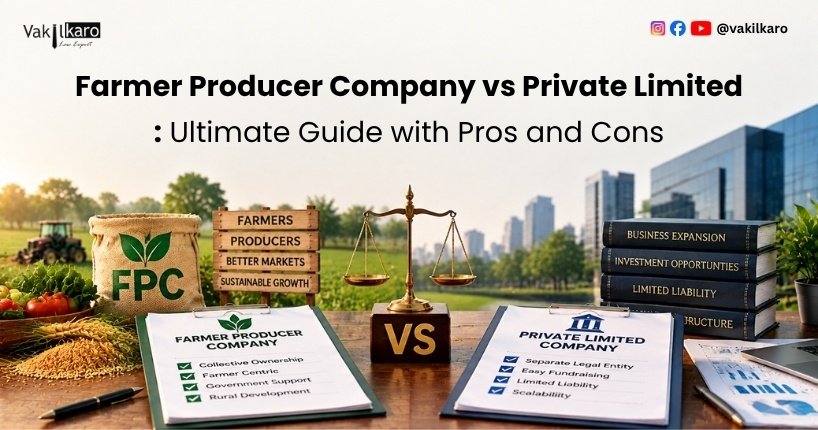
India’s agriculture and business sectors offer two main structures: the Farmer Producer Company (FPC) and the Private Limited Company (Pvt Ltd). FPCs are designed to empower farmers through collective production and marketing, providing tax benefits and access to government subsidies. Pvt Ltd companies, by contrast, focus on broader commercial objectives with profit-driven goals and flexible ownership. This guide explains how each structure works, their benefits, compliance needs, and tax perks. If you’re considering Farmer Producer Company Registration, Vakilkaro provides expert assistance for eligibility, documentation, and incorporation to help you set up confidently and compliantly.
Key Takeaways
- Comparing Farmer Producer Companies and Private Limited Companies India offers farmers and entrepreneurs several ways to structure their ventures, but two of the most common options are the Register a Farmer Producer Company (FPC) and the Private Limited Company (Pvt Ltd).
- To register an FPC, you must have at least 10 farmer members or 2 producer institutions, and the company name must include “Producer Company Limited.” In contrast, a Private Limited Company Registration is a more general business form suitable for a wide range of commercial enterprises, from manufacturing and trading to technology services.
- Among these, two of the most popular legal forms stand out: the Farmer Producer Company (FPC) and the Private Limited Company (Pvt Ltd).
- Conclusion Choosing between a Farmer Producer Company (FPC) and a Private Limited Company (Pvt Ltd) is a strategic decision that can shape the future of your business and the community you serve.
- Contact Vakilkaro today to explore your options and set up your Farmer Producer Company or Private Limited Company easily, compliantly, and efficiently.
Comparing Farmer Producer Companies and Private Limited Companies
India offers farmers and entrepreneurs several ways to structure their ventures, but two of the most common options are the Register a Farmer Producer Company (FPC) and the Private Limited Company (Pvt Ltd). Although they are both governed by the Companies Act, 2013, they serve very different purposes and offer distinct advantages.
A Farmer Producer Company is specifically created to empower farmers and primary producers. This model allows farmers to come together to collectively manage production, processing, and marketing of their agricultural goods. FPCs can access government grants, tax benefits, and subsidized credit under schemes designed to promote farmer welfare. Profits in an FPC are usually distributed based on each member’s participation, not merely on shareholding. This structure encourages cooperation and reinvestment into farming activities and rural development. To register an FPC, you must have at least 10 farmer members or 2 producer institutions, and the company name must include “Producer Company Limited.”
In contrast, a Private Limited Company Registration is a more general business form suitable for a wide range of commercial enterprises, from manufacturing and trading to technology services. A Pvt Ltd offers flexibility in ownership, as any individual or entity, including foreign investors, can hold shares. Profits can be distributed freely as dividends, and there is no requirement that owners must be producers or agriculturists. While Pvt Ltd companies can participate in agriculture, they do not automatically qualify for the subsidies or special support available to FPCs.
Choosing between these structures depends on your goals. If you are primarily focused on improving farmer incomes and accessing rural development benefits, an FPC is likely the better fit. For broader business ambitions with fewer membership restrictions, a Pvt Ltd is often more suitable. Vakilkaro can guide you through eligibility, registration, and compliance for either option, ensuring you make the right choice for your enterprise.
India’s vibrant agriculture and business ecosystems provide a wide variety of organizational structures to suit different goals, whether you are a farmer looking to build collective strength or an entrepreneur planning to scale a commercial enterprise. Among these, two of the most popular legal forms stand out: the Farmer Producer Company (FPC) and the Private Limited Company (Pvt Ltd). Although both are governed by the Companies Act, 2013, and share similar standards of corporate governance, their underlying objectives, ownership rules, compliance requirements, and advantages differ significantly.
A Farmer Producer Company is purpose-built to uplift farmers and producers by enabling them to work together, improve bargaining power, access better markets, and leverage government support. This model blends the spirit of cooperatives with the structure of a corporate entity, offering unique benefits such as subsidies, concessional credit, and tax relief. In contrast, a Private Limited Company is designed for general business and is ideal for entrepreneurs who want flexibility in ownership, profit-sharing, and investment without the constraints of membership being limited to producers.
Choosing between an FPC and a Pvt Ltd company can be a pivotal decision that affects your funding options, taxation, and long-term sustainability. That’s why understanding how each structure works is essential before taking the next step.
This guide will walk you through the key differences in purpose, eligibility, and benefits. You’ll also learn about the Farmer Producer Company Registration Process, documents required, timelines, and why thousands of farmers across India are turning to this model to strengthen their economic prospects.
If you’re unsure which structure fits your vision best, or if you need help navigating the legal process, Vakilkaro’s team of experts can guide you at every stage—from assessing eligibility to drafting documents and completing registration compliantly and efficiently. With Vakilkaro, you can move forward with clarity and confidence.
What Is a Farmer Producer Company?
A Farmer Producer Company Registration is a special type of company introduced under the Companies Act, 1956, later retained and adapted under the Companies Act, 2013, through Section 465. It is designed exclusively for farmers, producers, or agriculturists who join hands to collectively engage in production, procurement, processing, and marketing of agricultural produce and allied activities.
Unlike a Pvt Ltd company that focuses on profit distribution among shareholders, an FPC is meant to improve the incomes and welfare of its farmer members. Essentially, it is a hybrid between a cooperative society and a corporate entity.
Legal Definition:
As per Section 378A of the Companies Act, 2013, a Farmer Producer Company is a body corporate having objectives like production, harvesting, procurement, grading, pooling, handling, marketing, selling, or export of primary produce of members or import of goods for their benefit.
What Is a Private Limited Company?
A Private Limited Company Registration is the most popular form of business incorporation for startups, SMEs, and family businesses in India. It is a separate legal entity from its owners (shareholders), who enjoy limited liability. A Pvt Ltd company can be formed for any lawful purpose—manufacturing, trading, services, technology, or agriculture.
Ownership in a Pvt Ltd company is defined by shareholding, and profits can be freely distributed as dividends. Unlike FPCs, there is no restriction that only producers or farmers can become members.
Farmer Producer Company vs. Private Limited Company: The Key Differences
Below, we break down the differences across the most important dimensions:
Purpose and Objectives
Farmer Producer Company
- Established to serve the economic and welfare interests of farmer members.
- Activities revolve around collective farming, production, procurement, processing, and marketing.
- Surplus is primarily used for the benefit of members and development of agricultural infrastructure.
Private Limited Company
- Formed for any lawful commercial activity.
- Objectives can be purely profit-driven, with no restriction on the sectors or purpose.
Eligibility and Membership
Farmer Producer Company
- Only primary producers, i.e., farmers, artisans, or persons engaged in agriculture and allied activities, can be members.
- Minimum 10 individual producers or 2 producer institutions are required to register.
- Membership is restricted to producers only—no outside investors unless permitted by law.
Private Limited Company
- Anyone (individuals, companies, or foreigners) can become shareholders.
- Minimum 2 shareholders and 2 directors required.
- No restriction that shareholders must be farmers.
Legal Framework
Farmer Producer Company
- Governed by Chapter XXIA of the Companies Act, 2013.
- Specific provisions cover voting rights, patronage bonus, and member benefits.
Private Limited Company
- Governed by general provisions of the Companies Act, 2013.
- No special provisions for agricultural activities.
Profit Distribution
Farmer Producer Company
- Profits are distributed as patronage bonus in proportion to the member’s participation rather than shareholding.
- Dividend on shares is limited.
- Surplus funds are used to develop the business or provide services to members.
Private Limited Company
- Profits are freely distributed as dividends to shareholders based on their equity holding.
- No obligation to reinvest for member welfare.
Benefits and Government Support
Farmer Producer Company
- Eligible for subsidies, grants, and schemes from NABARD, SFAC, and various state governments.
- Access to concessional credit, tax benefits, and training programs under government schemes for Farmer Producer Companies.
- Example: Equity Grant and Credit Guarantee Fund Scheme of SFAC.
Private Limited Company
- No specific agricultural subsidies or concessional finance linked to its structure.
- General MSME schemes and tax benefits are applicable, depending on eligibility.
Compliance Requirements
Farmer Producer Company
- Annual filing under the Companies Act, 2013.
- Maintenance of records, regular board meetings, annual general meetings.
- Compliance with FPC-specific provisions.
Private Limited Company
- Similar compliance under the Companies Act.
- Fewer restrictions on capital raising and membership.
How to Start a Farmer Producer Company
If you are a group of farmers planning to form an FPC, here’s an overview of how to proceed:
Eligibility for Farmer Producer Company
- Minimum of 10 individual farmers or 2 producer institutions.
- All promoters must be involved in agricultural production or allied activities.
- At least 5 directors.
Farmer Producer Company Registration Process
- Digital Signature Certificates (DSC):
- Required for all directors and subscribers.
- Director Identification Number (DIN):
- All directors must have a Director Identification Number (DIN).
- Name Reservation:
- File RUN (Reserve Unique Name) form to reserve the FPC name.
- The name must end with “Producer Company Limited.”
- Drafting MOA and AOA:
- Memorandum of Association and Articles of Association outlining objectives, governance, and rights.
- Filing Incorporation Documents:
- SPICe+ Form with Registrar of Companies (ROC).
- Submit all declarations, affidavits, and proofs.
- Certificate of Incorporation:
- Issued by ROC upon verification.
- PAN, TAN, and Bank Account:
- Open a dedicated bank account.
This is known as Farmer Producer Company Registration under MCA (Ministry of Corporate Affairs).
Documents Required for Farmer Producer Company Registration
- Identity and address proof of directors and members.
- Proof of registered office address.
- PAN cards of members.
- Digital signatures.
- MOA and AOA.
- Affidavits and declarations.
How Much Time Does It Take to Register a Farmer Producer Company?
On average, it takes 30–45 days from document preparation to incorporation. Vakilkaro can help you register faster by preparing compliant documents and coordinating with the ROC.
Farmer Producer Company Registration Fees
The fees depend on:
- Authorized capital.
- Government filing charges.
- Professional services.
Vakilkaro offers transparent packages for Farmer Producer Company Registration Online.
Benefits of Farmer Producer Company
- Collective Bargaining Power:
- Aggregation of produce for better pricing.
- Access to Subsidies:
- Government schemes for Farmer Producer Companies provide grants and low-interest loans.
- Tax Benefits:
- Tax exemptions under certain conditions.
- Professional Governance:
- Corporate governance improves transparency.
- Limited Liability:
- Members’ liability is limited to unpaid capital.
- Recognition and Trust:
- FPCs are credible entities in the eyes of banks and government agencies.
Farmer Producer Company vs Cooperative Society
While both aim to empower farmers, their legal and operational frameworks differ:
Aspect Farmer Producer Company Cooperative Society
Registration Law Companies Act, 2013 Cooperative Societies Act
Governance Board of Directors Managing Committee
Membership Only producers Producers, consumers, any members
Audit Statutory audit mandatory Department audit
Flexibility More flexibility in operations More government control
Profits Patronage bonus + limited dividends Shared as per bye-laws
Why Farmers Should Form a Farmer Producer Company
- Better access to markets and technology.
- Protection from exploitation by middlemen.
- Improved bargaining power.
- Eligibility for institutional finance.
- Structured decision-making.
Farmer Producer Company Business Model
FPCs can engage in:
- Input supply (fertilizers, seeds).
- Aggregation and marketing.
- Processing and branding.
- Export of produce.
They can charge service fees and generate income for reinvestment and patronage bonus.
Farmer Producer Company and Tax Benefits
- Agricultural income tax is generally exempt.
- Additional tax exemptions may apply if certain conditions are met.
- Profits reinvested for member welfare.
Farmer Producer Company Compliance Requirements
- Annual filings with MCA.
- Statutory audit.
- Board meetings and AGM.
- Maintenance of statutory registers.
Role of Farmer Producer Company in Agricultural Development
FPCs are driving transformation by:
- Enabling smallholders to pool resources.
- Improving access to modern inputs.
- Facilitating value addition.
- Increasing incomes sustainably.
How Vakilkaro Helps
Vakilkaro offers end-to-end services to Register a Farmer Producer Company, including:
- Advising on eligibility.
- Drafting MOA and AOA.
- Filing applications and forms.
- Liaising with the ROC.
- Ensuring compliance post-incorporation.
If you are exploring How to Register a Farmer Producer Company in India, Vakilkaro simplifies the process with transparent pricing and expert guidance.
Conclusion
Choosing between a Farmer Producer Company (FPC)) and a Private Limited Company (Pvt Ltd) is a strategic decision that can shape the future of your business and the community you serve. If your core mission is to uplift farmers, pool resources, improve market access, and take advantage of government schemes and subsidies, registering an FPC is often the most effective path. An FPC allows you to combine the collective strength of small producers with the credibility of a corporate structure, ensuring that profits are reinvested to benefit members and their livelihoods.
On the other hand, if your vision is to build a broader commercial enterprise with the freedom to attract outside investors, operate in diverse sectors, and distribute profits purely based on shareholding, a Private Limited Company may be the better option. Pvt Ltd company offer more flexibility in ownership and profit-sharing, which makes them suitable for startups and SMEs beyond the agriculture sector.
Whichever route you choose, understanding the legal, operational, and tax implications of each structure is crucial. The differences in compliance requirements, governance models, and eligibility criteria can significantly impact your day-to-day operations and long-term sustainability.
If you are unsure which model aligns best with your goals, or if you want professional guidance to ensure a smooth registration process, Vakilkaro is here to help. From clarifying eligibility to preparing documents and filing with the Registrar of Companies, Vakilkaro’s experienced team supports you through every step. We offer transparent pricing, clear timelines, and dedicated assistance so you can focus on building your business with confidence.
Ready to get started? Contact Vakilkaro today to explore your options and set up your Farmer Producer Company or Private Limited Company easily, compliantly, and efficiently.
Official External Resources
Use these primary/official sources to verify rules, forms, fees, timelines and regulatory updates before publication.
Frequently asked questions
Farmer Producer Company vs Private Limited: Ultimate Guide with Pros and Cons+
Comparing Farmer Producer Companies and Private Limited Companies India offers farmers and entrepreneurs several ways to structure their ventures, but two of the most common options are the Register a Farmer Producer Company (FPC) and the Private Limited Company (Pvt Ltd). To register an FPC, you must have at least 10 farmer members or 2 producer institutions, and the company name must include “Producer Company Limited.” In contrast, a Private Limited Company Registration is a more general business form suitable for a wide range of commercial enterprises, from manufacturing and trading to technology services.
