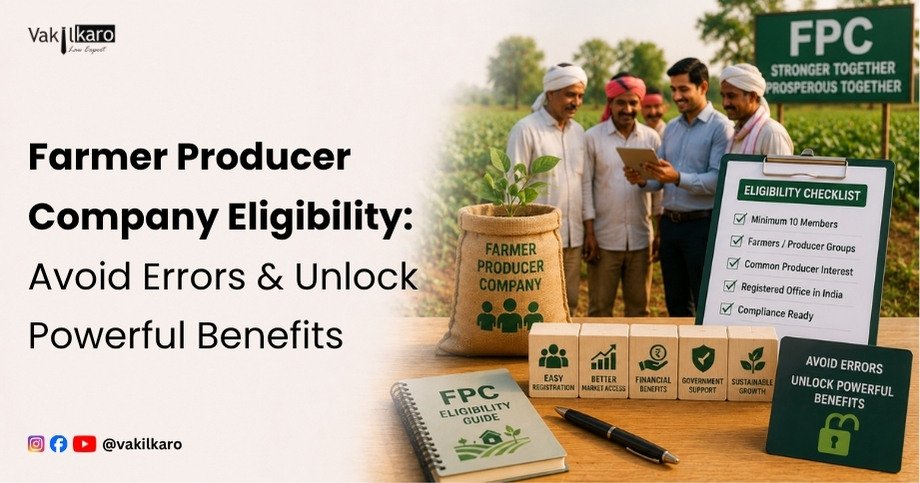
India's agricultural sector faces long-standing challenges such as low incomes, poor market access, and lack of infrastructure. To address these issues and empower small farmers, the Government of India introduced the Farmer Producer Company (FPC) model under the Companies Act, 2013. An FPC is a hybrid of a cooperative and private limited company, offering farmers a formal business platform with legal recognition and institutional support. Before you register a Farmer Producer Company, it's important to understand the eligibility criteria, including minimum member requirements, documentation, and objectives. This blog details the FPC registration process, benefits, compliance, and available government schemes.
Key Takeaways
- Understanding these eligibility norms is the first step toward leveraging the numerous Farmer Producer Company benefits, including access to credit, government schemes, tax advantages, and improved market linkage.
- Acceptable objectives include: Production and harvesting Procurement and pooling Grading, packaging, and storage Processing and marketing Import/export of primary produce Technical consultancy, training, or welfare measures for members How to Start a Farmer Producer Company After meeting the eligibility requirements, the next step is understanding how to start a Farmer Producer Company.
- Farmer Producer Company and Tax Benefits FPCs engaged in agriculture can claim exemptions under Section 10(1) of the Income Tax Act.
- Farmer Producer Company Compliance Requirements FPCs must meet annual compliance requirements: ROC filing of balance sheet and profit & loss account Conducting Annual General Meetings (AGMs) GST returns (if registered) Income tax filing Maintenance of statutory registers Compliance is essential to retain benefits and avoid penalties.
- Why Farmers Should Form a Farmer Producer Company Collective bargaining power Lower input costs Higher returns on produce Access to institutional finance Eligibility for government support These advantages make the FPC model a powerful alternative to fragmented farming and exploitation by intermediaries.
Eligibility Criteria to Register a Farmer Producer Company in India
India’s agricultural sector, while vital to the economy, continues to face systemic issues such as low income levels, fragmented landholdings, and limited access to markets and financial services. To overcome these challenges and empower small and marginal farmers, the Government of India introduced the Farmer Producer Company (FPC)) model under the Companies Act, 2013. This model merges cooperative principles with the structure of a private limited company, enabling producers to form legally recognized, collectively owned business entities.
Before proceeding with Farmer Producer Company Registration, it is essential to understand the eligibility criteria. At its core, an FPC must be formed by primary producers—individuals or institutions directly involved in agriculture or allied activities such as horticulture, dairy, poultry, fisheries, handloom, and forestry.
To register a Farmer Producer Company, you need a minimum of 10 individual producers or 2 producer institutions such as cooperatives, NGOs, or Self-Help Groups (SHGs). All members must be Indian citizens and actively engaged in primary production. The company must be registered in India under the guidelines of the Ministry of Corporate Affairs (MCA).
The objectives of forming an FPC should include promoting collective farming activities like production, harvesting, input procurement, processing, storage, and marketing. Additional purposes may involve providing technical training, facilitating financial services, and welfare support for members.
Understanding these eligibility norms is the first step toward leveraging the numerous Farmer Producer Company benefits, including access to credit, government schemes, tax advantages, and improved market linkage. By meeting the legal requirements and following the correct FPC registration process, farmers can transform traditional agriculture into a scalable, sustainable enterprise.
Whether you’re an individual farmer or part of a larger producer group, forming an FPC is a powerful step toward agricultural and economic self-reliance.
India's agricultural sector is undergoing a significant transformation. For decades, farmers—particularly small and marginal ones—have struggled with fragmented landholdings, market volatility, lack of access to modern inputs, and weak bargaining power. To combat these challenges and promote collective economic strength, the Government of India introduced the Farmer Producer Company (FPC) model under the Companies Act, 2013.
An FPC is a hybrid between a cooperative and a private limited company, specifically designed for primary producers. It enables farmers to own and manage collective business ventures with legal status, better access to markets, and institutional support. But before you register a Farmer Producer Company, it's essential to understand the eligibility criteria.
In this detailed blog, we’ll explain who can form an FPC, how to register it, the benefits of Farmer Producer Company registration, its legal framework, and the government schemes that support this revolutionary model.
Understanding the Farmer Producer Company (FPC)
A Farmer Producer Company is a legally registered corporate entity formed by a group of primary producers. These producers can include farmers, artisans, livestock keepers, weavers, fishermen, and anyone involved in the production or harvesting of any primary product. FPCs enable them to collectively undertake production, procurement, processing, storage, branding, marketing, and distribution.
The FPC structure was introduced under Part IXA of the Companies Act, 2013, specifically Sections 378A to 378ZU. It provides a platform for producers to organize themselves into a business entity while retaining democratic ownership and operational transparency.
Eligibility for Farmer Producer Company
Let’s get to the heart of the matter—what are the eligibility criteria to register a Farmer Producer Company in India?
Minimum Number of Members
To initiate an FPC:
- A minimum of 10 individual producers (e.g., farmers, artisans) OR
- A minimum of 2 producer institutions (e.g., cooperatives, SHGs)
This requirement ensures that the company is genuinely a collective endeavor.
Nature of Members
Only primary producers are eligible to become members of an FPC. A primary producer is anyone engaged in activities such as:
- Agriculture (cultivation of crops, fruits, vegetables)
- Animal husbandry (dairy, poultry, fisheries)
- Forestry and collection of forest produce
- Artisan-based rural industries (e.g., handloom, handicrafts)
Institutions engaged in these areas can also be members, provided they act on behalf of producers.
Producer Institution Criteria
Entities like Self-Help Groups (SHGs), cooperative societies, NGOs working with farmers, and any legally recognized producer body can be considered Producer Institutions under FPC guidelines.
Indian Residency
All members and directors must be Indian citizens, and the company must be registered in India under the Farmer Producer Company Registration under MCA.
Purpose of Formation
The FPC must be established to promote the collective interest of its members. Acceptable objectives include:
- Production and harvesting
- Procurement and pooling
- Grading, packaging, and storage
- Processing and marketing
- Import/export of primary produce
- Technical consultancy, training, or welfare measures for members
How to Start a Farmer Producer Company
After meeting the eligibility requirements, the next step is understanding how to start a Farmer Producer Company. Here’s a step-by-step guide:
FPC Company Registration Steps
Step 1: Digital Signature Certificates (DSC)
All directors must have a DSC to sign digital forms required for online registration.
Step 2: Director Identification Numbers (DIN)
Each director needs to obtain a DIN from the Ministry of Corporate Affairs (MCA).
Step 3: Name Approval
Apply for company name approval using the RUN (Reserve Unique Name) facility on the MCA portal. The name must end with “Producer Company Limited.”
Step 4: Draft MOA and AOA
Draft the Memorandum of Association (MOA) and Articles of Association (AOA) specifying the objectives, governance model, and membership rules.
Step 5: File SPICe+ Form
Submit the SPICe+ form online, which combines name reservation, incorporation, PAN, TAN, and other registrations.
Step 6: Obtain Certificate of Incorporation
Once approved, you’ll receive the Certificate of Incorporation, making your FPC a legal entity.
Farmer Producer Company Registration Process
The Farmer Producer Company Registration under Companies Act is fully digitized and handled via the MCA portal. Once the FPC Registration in India is approved, you’ll also receive a Corporate Identification Number (CIN), PAN, and TAN.
Documents Required for Farmer Producer Company Registration
- PAN and Aadhaar of directors
- Passport-size photographs
- Proof of registered office (utility bill, rent/ownership agreement)
- DSCs and DINs of all directors
- Drafted MOA and AOA
Accurate documentation ensures a smooth Farmer Producer Company Incorporation process.
Farmer Producer Company Registration Fees
The total Farmer Producer Company Registration Fees depend on:
- Number of directors and DSCs required
- Professional charges
- Stamp duty based on the state of registration
Typically, fees range between ₹10,000 to ₹25,000. Subsidized assistance is available through platforms like Vakilkaro, which simplifies the Farmer Producer Company Registration with Vakilkaro experience.
Farmer Producer Company Registration Online
Thanks to digital reforms, you can now complete the entire Farmer Producer Company Registration Online. This makes it accessible even for rural farmers, reducing delays and paperwork.
Legal Structure of a Farmer Producer Company
The FPC must have:
- Minimum of 10 producer members or 2 producer institutions
- Minimum of 5 directors
- Registered as a Private Limited Company
- Share capital contributed only by producer members
- One member, one vote—ensuring democratic control
Farmer Producer Company Business Model
An FPC follows a business model that combines commercial strategy with social welfare, such as:
- Bulk procurement of inputs (seeds, fertilizers, equipment)
- Processing and packaging for value addition
- Direct marketing through retail or B2B channels
- Storage and logistics solutions
- Access to credit and insurance
This Farmer Producer Company Business Model enables members to move up the value chain while retaining control over their produce.
Benefits of Farmer Producer Company
Here are key Farmer Producer Company Benefits for Farmers:
Legal Recognition
FPCs are corporate entities that can sign contracts, own assets, and access institutional credit.
Limited Liability
Members are only liable to the extent of their shares in the company.
Tax Benefits
Under Section 10(1) of the Income Tax Act, income from agricultural activities is exempt from tax.
Government Schemes and Subsidies
FPCs are eligible for a variety of support programs (detailed below).
Collective Strength
Pooling resources gives farmers greater negotiation power and market reach.
Government Schemes for Farmer Producer Companies
The government has launched numerous schemes for Farmer Producer Organizations (FPOs) and FPCs:
- SFAC (Small Farmers Agribusiness Consortium) Equity Grant Scheme
- NABARD’s FPO Promotion Scheme: Capacity building, working capital support
- PM FME Scheme: Grants for food processing enterprises
- Kisan Sampada Yojana: For cold chain and value addition
- Mission for Integrated Development of Horticulture (MIDH)
These schemes provide funding, training, infrastructure, and market linkages.
Farmer Producer Company vs Cooperative Society
In terms of transparency, scalability, and funding, FPCs offer a more modern and growth-oriented structure.
Role of Farmer Producer Company in Agricultural Development
FPCs play a pivotal role in:
- Aggregating produce and reducing middlemen
- Enhancing farmer income through value addition
- Providing market access and competitive pricing
- Enabling rural entrepreneurship and job creation
- Facilitating sustainable and climate-resilient agriculture
Their role in agricultural development aligns with national goals of doubling farmer incomes and rural upliftment.
Farmer Producer Company and Tax Benefits
FPCs engaged in agriculture can claim exemptions under Section 10(1) of the Income Tax Act. Additionally, if their turnover is below prescribed limits, they may be eligible for lower tax rates under presumptive schemes.
Farmer Producer Company Compliance Requirements
FPCs must meet annual compliance requirements:
- ROC filing of balance sheet and profit & loss account
- Conducting Annual General Meetings (AGMs)
- GST returns (if registered)
- Income tax filing
- Maintenance of statutory registers
Compliance is essential to retain benefits and avoid penalties.
How Much Time Does It Take to Register a Farmer Producer Company?
On average, it takes 15 to 25 working days to complete the Farmer Producer Company Registration Process, depending on documentation and regulatory response time.
Why Farmers Should Form a Farmer Producer Company
- Collective bargaining power
- Lower input costs
- Higher returns on produce
- Access to institutional finance
- Eligibility for government support
These advantages make the FPC model a powerful alternative to fragmented farming and exploitation by intermediaries.
Conclusion: Empowering Rural India Through Farmer Producer Companies
Grasping the eligibility criteria to register a Farmer Producer Company (FPC) is not just a procedural requirement—it is a strategic first step toward reshaping India’s agricultural landscape. For decades, small and marginal farmers have operated in isolation, with limited access to resources, markets, and financial support. The FPC model offers a transformative solution by allowing producers to come together, form a legal business entity, and operate collectively as empowered agri-entrepreneurs.
With no maximum member limit, equal voting rights, and full corporate recognition under the Companies Act, 2013, FPCs provide a flexible, democratic, and inclusive structure. They enable farmers to organize their efforts, scale up operations, reduce dependency on intermediaries, and access government schemes and tax incentives that were previously out of reach.
Whether you're an independent farmer looking to expand your reach, a producer institution, or an NGO working with rural communities, now is the ideal time to register a Farmer Producer Company in India. The availability of digital registration through the MCA portal, combined with expert assistance from trusted platforms like Vakilkaro, makes the process more accessible and efficient than ever before.
Moreover, by leveraging support from schemes offered by SFAC, NABARD, and other government bodies, FPCs can gain funding, training, and infrastructure to build a sustainable future.
In essence, Farmer Producer Companies are more than just formalized agricultural cooperatives—they are vehicles for social change and economic empowerment. They symbolize a shift toward self-reliance, shared prosperity, and rural dignity. For India’s farming communities, forming an FPC isn’t just a legal step—it’s a visionary move toward a more resilient and inclusive agricultural economy.
Official External Resources
Use these primary/official sources to verify rules, forms, fees, timelines and regulatory updates before publication.
Frequently asked questions
Farmer Producer Company Eligibility: Avoid Errors & Unlock Powerful Benefits+
Understanding these eligibility norms is the first step toward leveraging the numerous Farmer Producer Company benefits, including access to credit, government schemes, tax advantages, and improved market linkage. Farmer Producer Company Compliance Requirements FPCs must meet annual compliance requirements: ROC filing of balance sheet and profit & loss account Conducting Annual General Meetings (AGMs) GST returns (if registered) Income tax filing Maintenance of statutory registers Compliance is essential to retain benefits and avoid penalties.
