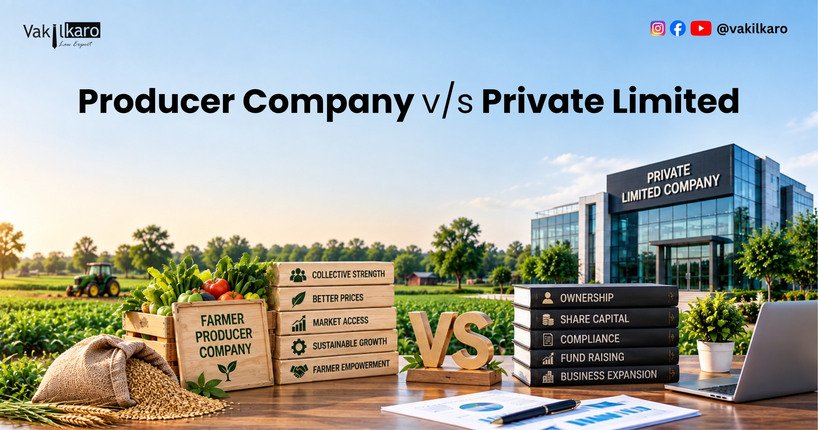
| Particular | Producer Company | Private Limited Company |
|---|---|---|
| Primary Purpose | Producer-Owned Agricultural Business | General Commercial Business |
| Suitable For | Eligible Producers | Entrepreneurs & Investors |
| Governing Law | Companies Act, 2013 | Companies Act, 2013 |
| Ownership | Eligible Producer Members | Shareholders |
| Governance | Corporate Governance | Corporate Governance |
| Long-Term Focus | Agricultural Business Development | Commercial Business Growth |
What is a Producer Company?
Many founders compare a Producer Company with a Private Limited Company because both are incorporated under the Companies Act, 2013.
However, these structures serve different purposes.
A Producer Company generally focuses on:
Agricultural Business
Producer Member Welfare
Collective Procurement
Processing
Marketing
Value Addition
A Private Limited Company generally focuses on:
Commercial Business
Entrepreneurship
Investment
Business Expansion
Profit-Oriented Operations
Selecting the correct legal structure from the beginning supports sustainable organisational development and reduces future restructuring challenges.
A Producer Company is a company incorporated by eligible producers for undertaking producer-related activities in accordance with the applicable provisions of the Companies Act, 2013.
Professional Producer Companies generally focus on:
Agricultural Production
Procurement
Processing
Storage
Marketing
Value Addition
Producer Services
The objective is to strengthen the economic interests of Producer Members through organised business operations.
Typical Features of a Producer Company
Producer Member Ownership
Agricultural Business Activities
Corporate Governance
Collective Marketing
Value Addition
Professional Management
Organised Compliance
Sustainable Producer Development
What is a Private Limited Company?
A Private Limited Company is a company incorporated under the Companies Act, 2013 for carrying on lawful commercial business activities.
Professional Private Limited Companies generally focus on:
Commercial Business
Entrepreneurship
Business Expansion
Investment Opportunities
Profit-Oriented Operations
Unlike a Producer Company, a Private Limited Company is not restricted to producer-related business or producer membership.
Typical Features of a Private Limited Company
Shareholder Ownership
Commercial Business Activities
Corporate Governance
Professional Management
Investment-Oriented Structure
Business Expansion
Organised Compliance
Long-Term Commercial Growth
Comparison Summary Table
Major Differences Overview
Although both structures operate under the Companies Act, 2013, they are designed for different business purposes.
A Producer Company generally focuses on:
Producer-Owned Agricultural Enterprise
Collective Procurement
Value Addition
Producer Prosperity
Agricultural Business Development
A Private Limited Company generally focuses on:
Commercial Business
Entrepreneurial Growth
Business Investment
Profit-Oriented Activities
Corporate Expansion
The correct structure depends upon the founders' objectives rather than the legal form alone.
Ownership Orientation
A Producer Company is generally centred around eligible Producer Members.
A Private Limited Company is generally centred around shareholders.
Business Orientation
Producer Companies generally operate producer-owned agricultural businesses.
Private Limited Companies generally undertake commercial business activities across different industries.
Long-Term Vision
Producer Companies generally focus on:
Agricultural Development
Producer Prosperity
Market Expansion
Sustainable Producer Enterprise
Private Limited Companies generally focus on:
Commercial Growth
Business Expansion
Investment
Profit-Oriented Development
Benefits of Comparing Both Structures
Understanding the differences between these two legal structures helps founders:
Choose the Appropriate Entity
Align Business Activities with Legal Structure
Improve Governance Planning
Avoid Future Restructuring
Build Sustainable Organisations
Selecting the correct structure at the beginning generally improves long-term business success.
Vakilkaro Insight
Many founders assume that a Producer Company is simply another type of Private Limited Company.
Professionally, they are separate legal structures created for different purposes.
A Producer Company is generally appropriate where eligible producers collectively undertake agricultural business activities.
A Private Limited Company is generally appropriate where entrepreneurs wish to operate a commercial business without producer membership requirements.
Choosing the appropriate legal structure from the beginning creates a stronger foundation for governance, compliance and sustainable growth.
Founder Decision Box
Before Choosing Between a Producer Company and a Private Limited Company, Ask:
Is our primary objective agricultural business or general commercial business?
Will eligible producers be the primary owners?
Do we require a producer-owned governance model?
Are we planning producer-centric business activities?
Is our long-term objective commercial investment or producer development?
Which legal structure best supports our future growth plans?
Structure Selection Journey
Define Organisational Objective
↓
Identify Business Activities
↓
Determine Ownership Model
↓
Compare Legal Structures
↓
Review Governance Requirements
↓
Select Appropriate Entity
↓
Build a Sustainable Organisation
Why Choose Vakilkaro?
Vakilkaro helps founders evaluate the most suitable legal structure before registration.
Our services include:
Producer Company Registration
Private Limited Company Registration
Legal Structure Advisory
Governance Planning
Business Model Advisory
Compliance Guidance
Corporate Documentation
Long-Term Business Support
Our experts help founders choose the legal structure that best aligns with their business objectives, ownership model and long-term growth strategy.
Ownership Comparison
One of the biggest differences between a Producer Company and a Private Limited Company is the ownership model.
Although both entities are incorporated under the Companies Act, 2013, their ownership structures are designed for different purposes.
Producer Company Ownership
A Producer Company is generally owned by its eligible Producer Members.
Professional ownership generally focuses on:
Producer Participation
Agricultural Business Activities
Collective Decision-Making
Long-Term Producer Development
Ownership remains closely connected with producer-related activities.
Private Limited Company Ownership
A Private Limited Company is generally owned by its shareholders.
Professional ownership generally focuses on:
Investment
Business Ownership
Commercial Growth
Shareholding Structure
Ownership is determined through shareholding rather than producer membership.
Objective Comparison
The primary objectives of these two structures are significantly different.
Producer Company Objective
Professional Producer Companies generally focus on:
Agricultural Business
Collective Procurement
Processing
Marketing
Value Addition
Producer Prosperity
The organisation exists primarily to strengthen the economic interests of Producer Members.
Private Limited Company Objective
Professional Private Limited Companies generally focus on:
Commercial Business
Entrepreneurship
Business Expansion
Investment Growth
Profit-Oriented Activities
The objective is generally broader commercial business development.
Membership vs Shareholding
One of the most practical differences relates to how people participate in the organisation.
Membership and ownership should always comply with the applicable legal framework.
Governance Comparison
Both organisations operate under corporate governance, but the governance objectives differ.
Producer Company Governance
Professional Producer Companies generally emphasise:
Producer Member Participation
Board Governance
Agricultural Business Oversight
Procurement
Producer Welfare
Business Development
Governance supports producer-owned enterprise.
Private Limited Company Governance
Professional Private Limited Companies generally emphasise:
Shareholder Interests
Board Governance
Commercial Growth
Investment Decisions
Business Strategy
Governance supports commercial business expansion.
Profit Distribution Comparison
The treatment of business profits differs because the objectives of both structures are different.
Producer Company
A Producer Company generally undertakes producer-related business activities.
The treatment of profits, surplus and member benefits is governed by the applicable legal framework and the company's constitutional documents.
Professional organisations generally reinvest earnings to strengthen business operations while complying with the relevant legal provisions.
Private Limited Company
A Private Limited Company generally operates as a commercial business entity.
The treatment of profits depends upon the applicable legal framework, the company's constitutional documents and decisions taken by the shareholders and Board.
Professional financial advice should always be obtained before making financial decisions.
Compliance Comparison
Both entities generally have ongoing compliance responsibilities.
Producer Company
Professional Producer Companies generally maintain:
Board Meetings
Financial Statements
Corporate Records
Statutory Registers
Producer Member Records
Organised Compliance
Compliance generally follows the Companies Act, 2013.
Private Limited Company
Professional Private Limited Companies generally maintain:
Board Meetings
Shareholder Records
Financial Statements
Statutory Registers
Corporate Documentation
Compliance also generally follows the Companies Act, 2013.
Funding Comparison
Funding strategies generally differ because of the organisations' objectives.
Producer Company
Professional Producer Companies generally strengthen financial sustainability through:
Agricultural Business
Procurement
Processing
Marketing
Value Addition
Producer Participation
Eligible organisations may also explore institutional support according to applicable programme guidelines.
Private Limited Company
Professional Private Limited Companies generally strengthen financial sustainability through:
Commercial Business Operations
Share Capital
Business Expansion
Investment Planning
Other lawful sources under the applicable legal framework
Funding strategy depends upon the company's business model.
Business Activities Comparison
Operational focus also differs.
Producer Company
Professional Producer Companies generally undertake:
Procurement
Processing
Storage
Marketing
Agricultural Value Addition
Producer Services
The focus remains on producer-owned agricultural enterprise.
Private Limited Company
Professional Private Limited Companies may undertake:
Manufacturing
Trading
Technology
Services
Consulting
Agriculture (where permitted by their objects and applicable law)
Various Commercial Activities
The structure is generally suitable for a wide range of lawful business activities.
Long-Term Vision Comparison
Founder Decision Checklist
Before selecting the appropriate legal structure, consider:
✔ Organisational Objective Clearly Defined
✔ Agricultural or Commercial Business Identified
✔ Ownership Model Selected
✔ Governance Structure Understood
✔ Business Expansion Strategy Prepared
✔ Funding Requirements Evaluated
✔ Compliance Responsibilities Reviewed
✔ Long-Term Business Vision Documented
✔ Operational Model Finalised
✔ Professional Legal Advisory Obtained
Common Founder Mistakes
Many founders select the wrong structure because of incomplete planning.
Common mistakes include:
Confusing Producer Membership with Shareholding
Choosing Without Defining Business Objectives
Ignoring Governance Differences
Weak Business Planning
Selecting Based Only on Registration Cost
Poor Legal Advice
Ignoring Future Expansion Plans
Weak Compliance Planning
Inadequate Ownership Planning
Misunderstanding Producer Company Eligibility
Professional legal planning significantly reduces these risks.
Vakilkaro Expert Insight
Many founders assume a Producer Company is simply a specialised version of a Private Limited Company.
Professionally, both structures operate under the Companies Act, 2013, but they are designed for different purposes.
Successful founders generally begin by asking:
Are we building a producer-owned agricultural enterprise?
or
Are we building a general commercial business?
Once this distinction is clear, selecting the appropriate legal structure becomes much easier and supports sustainable long-term organisational growth.
Advantages & Limitations Comparison
Both a Producer Company and a Private Limited Company are professionally managed corporate structures incorporated under the Companies Act, 2013, but each is designed for a different business purpose.
Rather than asking which structure is universally better, founders should evaluate which legal framework best aligns with their long-term business objectives.
The correct choice depends upon:
Nature of Business
Ownership Model
Membership Structure
Governance Requirements
Expansion Strategy
Long-Term Vision
Advantages of a Producer Company
A Producer Company is generally designed for eligible producers who wish to collectively undertake agricultural business activities.
Professional Producer Companies generally offer advantages such as:
Producer-Owned Enterprise
Collective Agricultural Business
Value Addition
Procurement & Marketing
Professional Corporate Governance
Organised Compliance
Sustainable Agricultural Development
Long-Term Producer Prosperity
This structure generally aligns with producer-centric agricultural enterprises.
Producer-Centric Business Model
Professional Producer Companies generally support:
Collective Procurement
Processing
Storage
Marketing
Agricultural Value Addition
The business model focuses on improving producer welfare through organised commercial activities.
Corporate Governance
Professional Producer Companies generally benefit from:
Board Governance
Financial Transparency
Organised Documentation
Structured Compliance
Business Planning
Corporate governance supports long-term sustainability.
Limitations of a Producer Company
Professional organisations should also consider:
Producer Membership Requirements
Corporate Compliance Responsibilities
Governance Obligations
Organised Record Maintenance
Financial Reporting
These responsibilities generally become manageable through proper governance systems.
Advantages of a Private Limited Company
A Private Limited Company is generally suitable for entrepreneurs seeking to operate commercial businesses across various industries.
Professional Private Limited Companies generally offer advantages such as:
Flexible Commercial Activities
Shareholder Ownership
Investment-Oriented Structure
Corporate Governance
Business Expansion
Professional Management
Commercial Scalability
Organised Compliance
The structure generally supports a wide range of lawful commercial activities.
Commercial Flexibility
Professional Private Limited Companies generally undertake:
Manufacturing
Trading
Technology
Consulting
Services
Agriculture (where permitted under the company's objects and applicable law)
The structure provides flexibility across multiple business sectors.
Investment-Oriented Structure
Professional governance generally supports:
Shareholder Participation
Business Growth
Investment Planning
Corporate Administration
The structure generally aligns with commercial expansion.
Limitations of a Private Limited Company
Professional organisations should also evaluate:
Corporate Compliance Responsibilities
Shareholder Governance
Financial Reporting
Organised Documentation
Business Management
Professional planning supports long-term sustainability.
Which Structure Should You Choose?
The appropriate legal structure depends entirely upon your business objective.
Choose a Producer Company if Your Goal is:
Producer-Owned Agricultural Enterprise
Collective Procurement
Agricultural Processing
Value Addition
Producer Member Development
Agricultural Market Expansion
This structure generally aligns with collective producer-owned agricultural businesses.
Choose a Private Limited Company if Your Goal is:
General Commercial Business
Entrepreneurship
Technology Startup
Trading Business
Service Business
Investment-Oriented Growth
This structure generally aligns with commercial business activities.
Real-Life Use Cases
The following examples illustrate situations where each structure may generally be appropriate.
Example 1 – Agricultural Value Addition
Eligible producers wish to:
Procure Agricultural Produce
Process Products
Build a Common Brand
Sell in National Markets
A Producer Company generally aligns more closely with these objectives.
Example 2 – Agricultural Technology Startup
Entrepreneurs wish to:
Develop Agricultural Software
Provide Digital Services
Build a Commercial Technology Company
A Private Limited Company generally aligns more closely with these objectives.
Example 3 – Producer-Owned Marketing Enterprise
Producer Members plan to:
Collect Produce
Process Products
Export Agricultural Goods
Expand Business Operations
A Producer Company generally provides a suitable legal framework.
Example 4 – Commercial Food Processing Business
Entrepreneurs plan to:
Establish Food Manufacturing Units
Build Consumer Brands
Operate a Commercial Business
A Private Limited Company generally aligns more closely with these commercial objectives.
Decision Framework
Professional founders generally evaluate the following before selecting a legal structure:
The correct structure depends upon the organisation's long-term purpose.
Common Founder Mistakes
Many founders choose the wrong structure because of incomplete planning.
Common mistakes include:
Confusing Producer Membership with Shareholding
Selecting Without Defining Business Objectives
Ignoring Governance Differences
Weak Long-Term Planning
Choosing Based Only on Registration Cost
Poor Legal Advice
Ignoring Future Expansion Strategy
Weak Compliance Planning
Inadequate Ownership Planning
Misunderstanding Eligibility Requirements
Professional legal planning significantly reduces these risks.
Practical Tips for Founders
Before selecting a legal structure, founders should generally:
Clearly Define Business Objectives
Identify Primary Owners
Evaluate Business Activities
Prepare a Growth Strategy
Review Governance Requirements
Understand Compliance Responsibilities
Assess Funding Requirements
Prepare a Business Model
Document Long-Term Vision
Seek Professional Legal Advice
These practices support informed business planning.
Structure Selection Checklist
Before choosing between a Producer Company and a Private Limited Company, ensure:
✔ Business Objective Clearly Defined
✔ Agricultural or Commercial Business Identified
✔ Ownership Model Finalised
✔ Governance Framework Understood
✔ Expansion Strategy Prepared
✔ Compliance Responsibilities Reviewed
✔ Funding Strategy Evaluated
✔ Long-Term Vision Documented
✔ Business Model Ready
✔ Professional Legal Advisory Obtained
Practical Structure Selection Workflow
Define Business Objective
↓
Identify Business Activities
↓
Determine Ownership Structure
↓
Compare Legal Structures
↓
Review Governance Requirements
↓
Select Appropriate Entity
↓
Build a Sustainable Enterprise
Vakilkaro Expert Recommendation
Many founders begin by comparing registration procedures.
Professionally managed organisations first compare:
Business Objectives
Ownership Model
Governance Structure
Business Activities
Long-Term Expansion Plans
Compliance Responsibilities
A Producer Company and a Private Limited Company are both strong corporate structures, but they are designed for different purposes.
The most successful founders select the legal structure that best aligns with their business vision rather than choosing based solely on popularity or initial registration considerations.
A well-informed legal decision creates the foundation for strong governance, efficient operations and sustainable long-term business growth.
Frequently asked questions
What is the main difference between a Producer Company and a Private Limited Company?+
A Producer Company is generally established by eligible producers for carrying on producer-related agricultural business activities under the Companies Act, 2013. A Private Limited Company is generally established to carry on lawful commercial business activities across different industries.
Which structure is better for farmers?+
Where the objective is collective agricultural business, procurement, processing, marketing and value addition by eligible producers, a Producer Company generally aligns more closely with those objectives.
Can a Private Limited Company undertake agricultural business?+
Yes. A Private Limited Company may undertake agricultural or related commercial activities where permitted by its objects and the applicable legal framework.
Can a Producer Company undertake commercial activities?+
Yes. A Producer Company is generally established to undertake producer-related commercial activities connected with agriculture in accordance with the applicable legal framework.
Who owns a Producer Company?+
A Producer Company is generally owned by its eligible Producer Members according to the applicable legal framework and the company's constitutional documents.
Who owns a Private Limited Company?+
A Private Limited Company is generally owned by its shareholders according to its shareholding structure.
Which structure is based on producer membership?+
A Producer Company is generally based on eligible Producer Members.
Which structure is based on shareholding?+
A Private Limited Company generally operates through a shareholder-based ownership model.
Which structure is more suitable for agricultural value addition?+
Where the objective is producer-owned procurement, processing, branding and marketing of agricultural produce, a Producer Company generally aligns more closely with these objectives.
Can Vakilkaro help choose the appropriate legal structure?+
Yes. Vakilkaro provides assistance for: Producer Company Registration Private Limited Company Registration Legal Structure Advisory Governance Planning Compliance Advisory
Which structure is generally more suitable for producer-owned enterprises?+
A Producer Company generally provides a legal framework specifically designed for producer-owned agricultural enterprises.
Can a Private Limited Company raise investment?+
The manner in which a Private Limited Company raises capital is governed by the Companies Act, 2013, its constitutional documents and other applicable legal requirements. Professional legal and financial advice should be obtained before planning any fundraising activity.
Can a Producer Company receive institutional support?+
Eligible Producer Companies may explore institutional support according to the applicable programme guidelines and organisational eligibility.
Which structure is generally more suitable for technology startups?+
Where the objective is building a technology-driven commercial business, a Private Limited Company generally aligns more closely with those objectives.
Can both structures have a Board of Directors?+
Yes. Both structures generally operate through a Board of Directors and corporate governance mechanisms under the Companies Act, 2013.
Which structure is generally more suitable for long-term agricultural business expansion?+
Where the objective is producer-owned agricultural business development and market expansion, a Producer Company generally aligns more closely with those objectives.
What is the biggest mistake founders make?+
One of the most common mistakes is selecting a legal structure before clearly defining the organisation's business objective and ownership model.
Why should founders seek professional legal guidance?+
Professional guidance helps: Select the Appropriate Legal Structure Improve Governance Planning Understand Compliance Responsibilities Support Sustainable Business Growth
Can an organisation change its legal structure later?+
Changing an organisation's legal structure may involve legal, regulatory and operational considerations depending upon the applicable legal framework. Professional legal advice should generally be obtained before planning any restructuring.
What is the biggest benefit of selecting the correct legal structure?+
Choosing the appropriate legal structure from the beginning generally improves governance, operational efficiency, compliance and long-term organisational sustainability. Common Myths Many founders misunderstand the differences between a Producer Company and a Private Limited Company. "A Producer Company and a Private Limited Company are exactly the same." Incorrect. Although both are incorporated under the Companies Act, 2013, they are designed for different objectives, ownership models and business activities. "A Private Limited Company can automatically replace a Producer Company." Incorrect. A Producer Company is generally designed specifically for eligible producers undertaking agricultural business activities, whereas a Private Limited Company is a broader commercial business structure. "Producer Companies are only suitable for very large farmer groups." Incorrect. Eligible producer groups of different sizes may establish a Producer Company, subject to the applicable legal framework. "The choice should be based only on investment opportunities." Incorrect. Professional founders generally evaluate: Business Objectives Ownership Structure Governance Requirements Business Activities Long-Term Vision before selecting a legal structure. "Changing the legal structure later is simple." Incorrect. Changing the legal structure may involve significant legal, governance and operational implications. Selecting the appropriate structure at the beginning generally reduces future complexity. Vakilkaro Expert Opinion Many founders compare a Producer Company and a Private Limited Company only from the perspective of incorporation. Professionally managed organisations first evaluate: Long-Term Business Objectives Nature of Business Activities Ownership Model Governance Framework Compliance Responsibilities Future Expansion Strategy Successful organisations consistently choose the legal structure that aligns with their long-term mission rather than selecting one based solely on registration convenience. A well-informed legal decision creates the foundation for sustainable governance, efficient operations and long-term business success. Related Guides Foundation Guides Producer Member Guide Legal Framework Guide FPO Business Model Guide Government Schemes Guide Comparison Hub Producer Company vs Cooperative Society Producer Company vs Section 8 Company Producer Company vs LLP Compliance Guides Annual Compliance Guide Governance Guide Accounting Guide Schema Recommendation Implement: FAQ Schema Article Schema Breadcrumb Schema Organization Schema Developer Notes Place the Comparison Summary Table within the running main content after the relevant explanatory H2 section. Apply FAQ Schema to all FAQs. Highlight the Founder Structure Selection Checklist as a visual callout. Display the Structure Selection Workflow as a process diagram. Internally link to the Farmer Producer Company Registration Service Page, Private Limited Company Registration Service Page, Legal Framework Guide, Government Schemes Guide, Governance Guide, Accounting Guide, and Producer Member Guide to strengthen topical authority.
