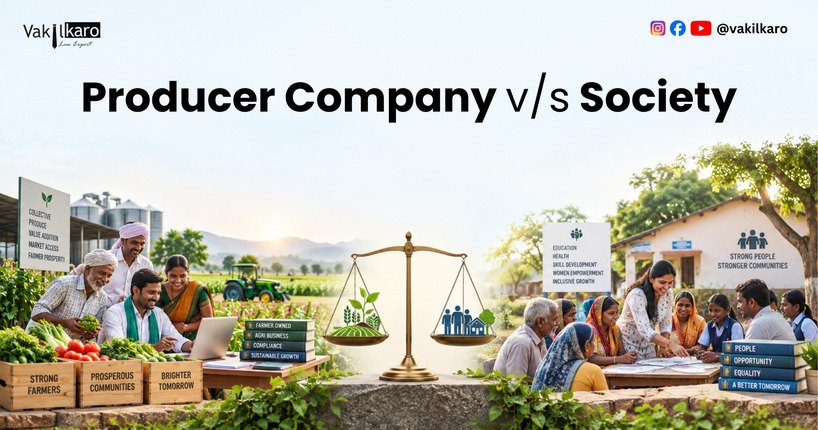
| Particular | Producer Company | Society |
|---|---|---|
| Primary Purpose | Producer-Owned Agricultural Business | Educational, Charitable & Public Benefit Activities |
| Suitable For | Eligible Producers | Groups Pursuing Common Public Objectives |
| Governing Framework | Companies Act, 2013 | Applicable Society Registration Law |
| Ownership | Producer Members | Members of the Society |
| Governance | Board of Directors | Governing Body / Managing Committee |
| Long-Term Focus | Agricultural Business Development | Community & Institutional Development |
What is a Producer Company?
Many founders compare a Producer Company with a Society because both may contribute towards rural development and community welfare.
However, these legal structures are fundamentally different in terms of:
Objectives
Ownership
Governance
Business Activities
Compliance
Long-Term Vision
A Producer Company generally focuses on:
Agricultural Business
Producer Member Development
Collective Procurement
Processing
Marketing
Value Addition
A Society generally focuses on:
Education
Community Development
Charitable Activities
Cultural Promotion
Scientific or Social Objectives
Selecting the correct legal structure from the beginning helps ensure appropriate governance, operational efficiency and long-term organisational sustainability.
A Producer Company is a company incorporated by eligible producers for undertaking producer-related activities under the Companies Act, 2013.
Professional Producer Companies generally focus on:
Agricultural Production
Procurement
Processing
Storage
Marketing
Value Addition
Producer Services
Its primary objective is to strengthen the economic interests of Producer Members through organised agricultural business operations.
Typical Features of a Producer Company
Producer Member Ownership
Agricultural Business Activities
Corporate Governance
Collective Procurement
Value Addition
Professional Management
Organised Compliance
Sustainable Agricultural Enterprise
What is a Society?
A Society is generally an organisation established by a group of individuals for promoting educational, literary, scientific, charitable, cultural, social or other public-benefit objectives under the applicable society registration law.
Professional Societies generally focus on:
Education
Community Development
Social Welfare
Cultural Activities
Scientific Advancement
Public Benefit
The organisation is generally managed by a Governing Body or Managing Committee in accordance with its governing documents and the applicable legal framework.
Typical Features of a Society
Membership-Based Organisation
Governing Body
Public Benefit Objectives
Democratic Administration
Organised Documentation
Institutional Governance
Community Development
Long-Term Social Impact
Comparison Summary Table
Major Differences Overview
Although both structures may work for community development, they are created for different legal and operational purposes.
A Producer Company generally focuses on:
Producer-Owned Agricultural Enterprise
Collective Procurement
Agricultural Value Addition
Producer Prosperity
Market Development
A Society generally focuses on:
Public Benefit
Education
Community Development
Social Welfare
Institutional Service
The correct structure depends upon the founders' long-term objectives rather than the type of beneficiaries alone.
Ownership Orientation
A Producer Company is generally owned collectively by eligible Producer Members.
A Society is generally governed by its members through a Governing Body or Managing Committee.
Business Orientation
Producer Companies generally undertake producer-related agricultural business activities.
Societies generally pursue educational, charitable, cultural, scientific or other public-benefit objectives rather than producer-owned commercial agricultural enterprises.
Long-Term Vision
Producer Companies generally focus on:
Agricultural Business Development
Producer Prosperity
Value Addition
Market Expansion
Societies generally focus on:
Public Welfare
Community Development
Institutional Growth
Long-Term Social Impact
Benefits of Comparing Both Structures
Understanding the differences between these legal structures helps founders:
Select the Appropriate Legal Entity
Align Organisational Objectives with the Correct Structure
Improve Governance Planning
Avoid Future Restructuring
Build Sustainable Institutions
Making the correct legal decision from the beginning generally supports long-term organisational success.
Vakilkaro Insight
Many founders assume that a Producer Company and a Society can be used interchangeably because both may work for community development.
Professionally, they are fundamentally different.
A Producer Company generally supports producer-owned agricultural business.
A Society generally supports educational, charitable, cultural or public-benefit objectives.
Selecting the appropriate legal structure from the beginning creates stronger governance, appropriate compliance and long-term organisational stability.
Founder Decision Box
Before Choosing Between a Producer Company and a Society, Ask:
Is our primary objective agricultural business or public-benefit activities?
Will eligible producers collectively own the organisation?
Do we require a producer-owned governance framework?
Are we establishing an educational or charitable institution?
Which structure best supports our future vision?
Which legal framework aligns with our long-term organisational objectives?
Structure Selection Journey
Define Organisational Objective
↓
Identify Primary Beneficiaries
↓
Evaluate Business or Public-Benefit Purpose
↓
Compare Legal Structures
↓
Review Governance Requirements
↓
Select Appropriate Entity
↓
Build a Sustainable Organisation
Why Choose Vakilkaro?
Vakilkaro helps founders evaluate the most suitable legal structure before registration.
Our services include:
Producer Company Registration
Society Registration
Legal Structure Advisory
Governance Planning
Business Model Advisory
Compliance Guidance
Legal Documentation
Long-Term Organisational Support
Our experts help founders choose the legal structure that best aligns with their objectives, governance model and long-term organisational strategy.
Ownership Comparison
One of the most important differences between a Producer Company and a Society is the ownership and organisational structure.
Although both organisations may serve communities, they are established under different legal frameworks and pursue different objectives.
Producer Company Ownership
A Producer Company is generally owned collectively by its eligible Producer Members.
Professional ownership generally focuses on:
Producer Participation
Collective Decision-Making
Agricultural Business Development
Producer Member Welfare
Long-Term Producer Prosperity
Ownership remains directly connected with producer-related business activities.
Society Membership
A Society is generally formed by members who voluntarily come together for educational, charitable, literary, scientific, cultural or other lawful public-benefit objectives.
Professional societies generally focus on:
Community Participation
Public Welfare
Educational Development
Institutional Growth
Social Objectives
Management is generally carried out through the Governing Body or Managing Committee.
Objective Comparison
The primary objectives of these two legal structures are fundamentally different.
Producer Company Objective
Professional Producer Companies generally focus on:
Agricultural Business
Collective Procurement
Processing
Storage
Marketing
Value Addition
Producer Member Development
Its primary objective is to strengthen the economic interests of Producer Members through organised agricultural business.
Society Objective
Professional Societies generally focus on:
Education
Social Welfare
Community Development
Scientific Activities
Cultural Promotion
Charitable Objectives
The emphasis generally remains on public benefit rather than commercial agricultural enterprise.
Membership Comparison
Participation in these structures differs considerably.
Membership should always comply with the applicable legal framework.
Governance Comparison
The governance framework differs significantly.
Producer Company Governance
Professional Producer Companies generally operate through:
Board of Directors
Producer Member Participation
Corporate Governance
Board Meetings
Organised Compliance
Governance supports producer-owned agricultural enterprises.
Society Governance
Professional Societies generally operate through:
Governing Body
Managing Committee
General Body of Members
Organised Administration
Governance generally focuses on achieving the Society's stated objectives according to the applicable legal framework.
Profit Utilisation Comparison
The utilisation of organisational income differs because the objectives of both structures are different.
Producer Company
A Producer Company generally undertakes producer-related commercial activities.
The treatment of profits, surplus and member benefits is governed by the applicable legal framework and the company's constitutional documents.
Professional organisations generally reinvest earnings to strengthen business operations while complying with the relevant legal provisions.
Society
A Society generally applies its income towards achieving the objectives specified in its governing documents and the applicable legal framework.
Professional organisations should always obtain legal and financial advice regarding the utilisation of Society funds.
Compliance Comparison
Both structures generally have ongoing compliance responsibilities.
Producer Company
Professional Producer Companies generally maintain:
Board Meetings
Financial Statements
Statutory Registers
Corporate Records
Producer Member Records
Organised Compliance
Compliance generally follows the Companies Act, 2013.
Society
Professional Societies generally maintain:
Membership Records
Governing Body Records
Financial Records
Meeting Minutes
Organised Documentation
Compliance generally depends upon the applicable society registration law and other relevant legal requirements.
Funding Comparison
Funding approaches also differ because of the organisations' objectives.
Producer Company
Professional Producer Companies generally strengthen financial sustainability through:
Agricultural Business
Procurement
Processing
Marketing
Value Addition
Producer Participation
Eligible organisations may also explore institutional support according to applicable programme guidelines.
Society
Professional Societies generally strengthen financial sustainability through:
Membership Contributions
Donations
Grants
Charitable Contributions
Other lawful resources
Funding generally depends upon the Society's objectives and the applicable legal framework.
Business Activities Comparison
The operational focus differs significantly.
Producer Company
Professional Producer Companies generally undertake:
Procurement
Processing
Storage
Marketing
Agricultural Value Addition
Producer Services
The emphasis remains on producer-owned agricultural enterprise.
Society
Professional Societies generally undertake:
Educational Programmes
Social Welfare Activities
Community Development
Cultural Programmes
Scientific Activities
Public Benefit Projects
Commercial agricultural business is generally not the primary objective.
Long-Term Vision Comparison
Founder Decision Checklist
Before selecting the appropriate legal structure, consider:
✔ Organisational Objective Clearly Defined
✔ Agricultural or Public-Benefit Purpose Identified
✔ Membership Structure Finalised
✔ Governance Framework Understood
✔ Producer Membership or Society Membership Evaluated
✔ Compliance Responsibilities Reviewed
✔ Funding Strategy Prepared
✔ Long-Term Vision Documented
✔ Operational Model Finalised
✔ Professional Legal Advisory Obtained
Common Founder Mistakes
Many founders select an unsuitable legal structure because of incomplete planning.
Common mistakes include:
Confusing Agricultural Business with Public-Benefit Activities
Choosing Without Defining Organisational Objectives
Ignoring Governance Differences
Weak Long-Term Planning
Selecting Based Only on Funding Opportunities
Poor Legal Advice
Ignoring Future Expansion Strategy
Weak Compliance Planning
Inadequate Governance Planning
Misunderstanding Producer Company Eligibility
Professional legal planning significantly reduces these risks.
Vakilkaro Expert Insight
Many founders compare a Producer Company with a Society because both may contribute to community development.
Professionally, they serve different purposes.
Successful founders generally begin by asking:
Are we building a producer-owned agricultural enterprise?
or
Are we establishing an educational, charitable or community-based institution?
Once this distinction is clearly understood, selecting the appropriate legal structure becomes significantly easier and supports sustainable long-term organisational development.
Advantages & Limitations Comparison
Both a Producer Company and a Society provide organised legal structures, but they are created for fundamentally different purposes.
Rather than asking which structure is universally better, founders should evaluate which legal framework best supports their long-term organisational objectives.
The appropriate structure depends upon:
Organisational Objective
Nature of Activities
Governance Model
Membership Structure
Funding Strategy
Long-Term Vision
Advantages of a Producer Company
A Producer Company is specifically designed for eligible producers carrying on producer-related agricultural business activities.
Professional Producer Companies generally provide advantages such as:
Producer-Owned Enterprise
Collective Agricultural Business
Corporate Governance
Procurement & Marketing
Value Addition
Organised Compliance
Sustainable Agricultural Development
Long-Term Producer Prosperity
The structure generally aligns with producer-owned agricultural enterprises.
Producer-Centric Business Model
Professional Producer Companies generally support:
Collective Procurement
Agricultural Processing
Storage
Marketing
Producer Services
The business model focuses on strengthening the economic interests of Producer Members.
Professional Corporate Governance
Professional Producer Companies generally benefit from:
Board of Directors
Organised Documentation
Financial Transparency
Internal Controls
Structured Compliance
Corporate governance supports long-term institutional growth.
Limitations of a Producer Company
Professional organisations should also consider:
Producer Membership Eligibility
Corporate Governance Responsibilities
Statutory Compliance
Financial Reporting
Organised Documentation
These responsibilities generally become manageable through structured governance systems.
Advantages of a Society
A Society is generally suitable for groups of individuals working together for educational, charitable, cultural, scientific or social objectives.
Professional Societies generally provide advantages such as:
Community Participation
Democratic Membership
Public Benefit Activities
Educational Development
Cultural Promotion
Institutional Governance
Organised Administration
Long-Term Community Development
The structure generally aligns with organisations working for public welfare rather than commercial business.
Community-Oriented Organisation
Professional Societies generally support:
Educational Programmes
Social Welfare Projects
Community Development
Public Awareness Activities
Institutional Services
The emphasis remains on serving members and society rather than conducting producer-owned commercial enterprises.
Democratic Governance
Professional Societies generally benefit from:
Governing Body
General Body Meetings
Collective Decision-Making
Organised Administration
Governance supports institutional continuity and accountability.
Limitations of a Society
Professional organisations should also evaluate:
Governance Responsibilities
Membership Administration
Organised Documentation
Compliance Requirements
Financial Accountability
Professional planning supports sustainable institutional management.
Which Structure Should You Choose?
The appropriate legal structure depends entirely upon your organisational objective.
Choose a Producer Company if Your Goal is:
Producer-Owned Agricultural Enterprise
Collective Procurement
Agricultural Processing
Value Addition
Producer Member Development
Agricultural Market Expansion
Sustainable Producer Prosperity
This structure generally aligns with organised agricultural enterprises owned by eligible producers.
Choose a Society if Your Goal is:
Educational Activities
Community Development
Social Welfare
Cultural Programmes
Scientific Activities
Public Benefit Projects
Institutional Development
This structure generally aligns with organisations established for public-benefit purposes.
Real-Life Use Cases
The following examples illustrate situations where each structure may generally be appropriate.
Example 1 – Collective Agricultural Marketing
Eligible producers wish to:
Procure Agricultural Produce
Process Products
Build a Common Brand
Sell Across National Markets
A Producer Company generally aligns more closely with these agricultural business objectives.
Example 2 – Rural Education Society
Founders wish to:
Establish Schools
Conduct Educational Programmes
Improve Rural Literacy
A Society generally aligns more closely with these educational objectives.
Example 3 – Producer-Owned Food Processing Unit
Producer Members plan to:
Establish Processing Facilities
Improve Product Quality
Expand Agricultural Business
A Producer Company generally provides a suitable legal framework.
Example 4 – Community Skill Development Organisation
A group wishes to:
Conduct Skill Development Programmes
Improve Employment Opportunities
Undertake Social Development Activities
A Society generally aligns more closely with these public-benefit objectives.
Decision Framework
Professional founders generally evaluate the following before selecting a legal structure:
The appropriate structure depends upon the organisation's long-term purpose.
Common Founder Mistakes
Many founders select the wrong legal structure because of incomplete planning.
Common mistakes include:
Confusing Agricultural Business with Public-Benefit Activities
Choosing Without Defining Organisational Objectives
Ignoring Governance Differences
Weak Long-Term Planning
Selecting Based Only on Funding Opportunities
Poor Legal Advice
Ignoring Future Expansion Plans
Weak Compliance Planning
Inadequate Governance Planning
Misunderstanding Producer Company Eligibility
Professional legal planning significantly reduces these risks.
Practical Tips for Founders
Before selecting a legal structure, founders should generally:
Clearly Define Organisational Objectives
Identify Primary Beneficiaries
Evaluate Business or Public-Benefit Activities
Prepare a Long-Term Growth Strategy
Understand Governance Requirements
Review Compliance Responsibilities
Assess Funding Requirements
Prepare an Operational Model
Document Future Expansion Plans
Seek Professional Legal Advice
These practices support informed organisational planning.
Structure Selection Checklist
Before choosing between a Producer Company and a Society, ensure:
✔ Organisational Objective Clearly Defined
✔ Agricultural or Public-Benefit Purpose Identified
✔ Membership Structure Finalised
✔ Governance Framework Understood
✔ Compliance Responsibilities Reviewed
✔ Funding Strategy Prepared
✔ Long-Term Vision Documented
✔ Operational Model Ready
✔ Growth Strategy Prepared
✔ Professional Legal Advisory Obtained
Practical Structure Selection Workflow
Define Organisational Objective
↓
Identify Primary Beneficiaries
↓
Evaluate Business or Public-Benefit Activities
↓
Compare Legal Structures
↓
Review Governance Requirements
↓
Select Appropriate Entity
↓
Build a Sustainable Organisation
Vakilkaro Expert Recommendation
Many founders compare a Producer Company and a Society because both may contribute to community development.
Professionally managed organisations first evaluate:
Organisational Objectives
Nature of Activities
Governance Model
Membership Structure
Long-Term Institutional Vision
Compliance Responsibilities
A Producer Company and a Society are both valuable legal structures, but they are designed for fundamentally different purposes.
The most successful founders choose the legal structure that best aligns with their long-term mission rather than selecting one based solely on familiarity or funding possibilities.
A carefully selected legal structure creates the foundation for strong governance, efficient operations and sustainable long-term organisational development.
Frequently asked questions
What is the main difference between a Producer Company and a Society?+
A Producer Company is generally established by eligible producers to collectively undertake producer-related agricultural business activities under the Companies Act, 2013. A Society is generally established by a group of individuals for educational, charitable, literary, scientific, cultural or other lawful public-benefit purposes under the applicable society registration law.
Which structure is generally better for farmers?+
Where the objective is collective agricultural business, procurement, processing, storage, value addition and marketing by eligible producers, a Producer Company generally aligns more closely with those objectives.
Can a Society undertake agricultural activities?+
A Society may undertake activities that are consistent with its registered objectives and the applicable legal framework. Where the primary objective is producer-owned commercial agricultural business, founders should carefully evaluate whether another legal structure is more appropriate.
Can a Producer Company undertake commercial agricultural activities?+
Yes. A Producer Company is specifically designed to undertake producer-related commercial activities connected with agriculture in accordance with the applicable legal framework.
Who owns a Producer Company?+
A Producer Company is generally owned collectively by its eligible Producer Members according to the applicable legal framework and the company's constitutional documents.
Who manages a Society?+
A Society is generally managed by its Governing Body or Managing Committee, which functions according to the Society's governing documents and the applicable legal framework.
Which structure is based on producer membership?+
A Producer Company generally operates through eligible Producer Members.
Which structure is based on society membership?+
A Society generally operates through its members who collectively pursue the organisation's public-benefit objectives.
Which structure is generally more suitable for agricultural value addition?+
Where the objective is producer-owned procurement, processing, branding and marketing of agricultural produce, a Producer Company generally aligns more closely with those objectives.
Can Vakilkaro help choose the appropriate legal structure?+
Yes. Vakilkaro provides assistance for: Producer Company Registration Society Registration Legal Structure Advisory Governance Planning Compliance Advisory
Which structure is generally more suitable for producer-owned agricultural enterprises?+
A Producer Company generally provides a legal framework specifically designed for producer-owned agricultural enterprises.
Can a Society own property?+
Subject to the applicable legal framework and its governing documents, a Society may generally acquire, hold and administer property for achieving its stated objectives. Professional legal advice should be obtained for property-related matters.
Can a Producer Company receive institutional support?+
Eligible Producer Companies may explore institutional support according to the applicable programme guidelines and organisational eligibility.
Which structure is generally more suitable for educational or community development activities?+
Where the objective is education, community development, social welfare or public-benefit programmes, a Society generally aligns more closely with those objectives.
Do both structures have governance responsibilities?+
Yes. Both structures generally require organised governance, financial management, documentation and compliance according to their respective legal frameworks.
Which structure is generally more suitable for long-term agricultural business expansion?+
Where the objective is building a producer-owned agricultural enterprise with organised governance and collective participation, a Producer Company generally aligns more closely with those objectives.
What is the biggest mistake founders make?+
One of the most common mistakes is selecting a legal structure before clearly defining the organisation's objectives, beneficiaries and long-term operational model.
Why should founders seek professional legal guidance?+
Professional guidance helps: Select the Appropriate Legal Structure Understand Governance Responsibilities Improve Compliance Planning Support Sustainable Organisational Growth
Can an organisation change its legal structure later?+
Changing an organisation's legal structure may involve legal, regulatory and operational considerations depending upon the applicable legal framework. Professional legal advice should generally be obtained before planning any restructuring.
What is the biggest benefit of selecting the correct legal structure?+
Choosing the appropriate legal structure from the beginning generally improves governance, operational efficiency, compliance and long-term organisational sustainability. Common Myths Many founders misunderstand the differences between a Producer Company and a Society. "A Society and a Producer Company are the same." Incorrect. A Producer Company is generally established for producer-owned agricultural business, whereas a Society is generally established for educational, charitable, cultural, scientific or other public-benefit objectives. "A Society is suitable for every agricultural organisation." Incorrect. The appropriate legal structure depends upon the organisation's objectives. Producer-owned agricultural enterprises and public-benefit institutions generally require different legal frameworks. "Any entrepreneur can become a Producer Member." Incorrect. Producer Company membership is generally governed by the applicable legal framework and is intended for eligible producers. Eligibility should always be verified before registration. "Societies and Producer Companies have identical governance." Incorrect. A Producer Company generally operates through a Board of Directors, whereas a Society generally functions through a Governing Body or Managing Committee according to its governing documents and applicable law. "The legal structure should be selected only on the basis of grants or funding." Incorrect. Professional founders generally evaluate: Organisational Objectives Governance Model Nature of Activities Membership Structure Long-Term Strategy before selecting a legal structure. Vakilkaro Expert Opinion Many founders compare a Producer Company and a Society simply because both may contribute to rural or community development. Professionally managed organisations first evaluate: Long-Term Objectives Nature of Activities Beneficiary Structure Governance Requirements Compliance Responsibilities Future Growth Strategy Successful organisations consistently choose the legal structure that aligns with their long-term mission rather than selecting one based solely on funding opportunities or familiarity. A carefully selected legal structure creates the foundation for strong governance, efficient operations and sustainable long-term organisational development. Related Guides Foundation Guides Producer Member Guide Legal Framework Guide FPO Business Model Guide Government Schemes Guide Comparison Hub Producer Company vs Trust Producer Company vs Section 8 Company Producer Company vs Cooperative Society Producer Company vs Private Limited Company Compliance Guides Annual Compliance Guide Governance Guide Accounting Guide Schema Recommendation Implement: FAQ Schema Article Schema Breadcrumb Schema Organization Schema Developer Notes Place the Producer Company vs Society Summary Table within the running main content after the relevant explanatory H2 section. Apply FAQ Schema to all FAQs. Highlight the Founder Structure Selection Checklist as a visual callout. Display the Structure Selection Workflow as a process diagram. Internally link to the Farmer Producer Company Registration Service Page, Society Registration Service Page, Legal Framework Guide, Government Schemes Guide, Governance Guide, Accounting Guide, and Producer Member Guide to strengthen topical authority.
