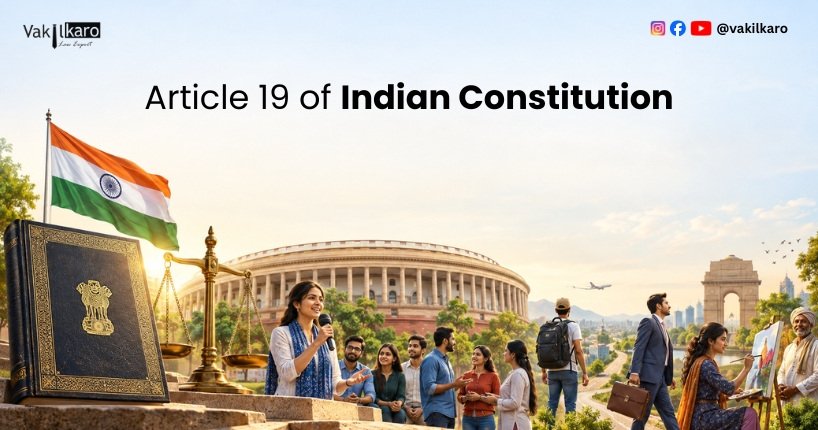
Article 19 of the Indian Constitution protects important freedoms available to Indian citizens, including speech, peaceful assembly, association, movement, residence and profession. These rights support individual liberty and democratic participation. However, they are subject to reasonable restrictions provided by the Constitution.
What Is Article 19 of the Indian Constitution?
Article 19 of the Indian Constitution forms part of Part III, which deals with Fundamental Rights. It protects important civil freedoms available to Indian citizens, including speech, peaceful assembly, association, movement, residence and profession or business.
These freedoms are subject to the reasonable restrictions permitted under Article 19 itself. The official constitutional text can be checked through the Legislative Department, Ministry of Law and Justice.
Article 19 plays an important role in protecting individual liberty, democratic participation and economic freedom in India.
Who Can Claim Rights Under Article 19?
Article 19 expressly grants these freedoms to citizens of India. This is different from certain other fundamental rights, such as Articles 14 and 21, which use broader language and may also protect non-citizens.
A citizen may rely on Article 19 where State action affects one of the protected freedoms. However, the court may also examine the nature of the restriction, its legal basis, the constitutional ground relied upon and whether the restriction is reasonable and proportionate. The official constitutional text can be checked through the Legislative Department, Ministry of Law and Justice.
Six Fundamental Freedoms Under Article 19
Article 19 currently guarantees the following six freedoms to Indian citizens:
| Constitutional Provision | Freedom |
|---|---|
| Article 19(1)(a) | Freedom of speech and expression |
| Article 19(1)(b) | Freedom to assemble peaceably and without arms |
| Article 19(1)(c) | Freedom to form associations, unions or co-operative societies |
| Article 19(1)(d) | Freedom to move freely throughout India |
| Article 19(1)(e) | Freedom to reside and settle in any part of India |
| Article 19(1)(g) | Freedom to practise a profession or carry on any occupation, trade or business |
The Constitution earlier included Article 19(1)(f) relating to the right to property. This provision was omitted by the Constitution (Forty-fourth Amendment) Act, 1978. The right to property is now protected separately under Article 300A and is no longer a fundamental freedom under Article 19.
Article 19(1)(a): Freedom of Speech and Expression
Article 19(1)(a) guarantees Indian citizens the freedom of speech and expression. It protects the right to communicate opinions, ideas and information through speech, writing, publications, art, electronic media and other forms of expression.
This freedom also extends to important areas such as freedom of the press and online expression. Although the Constitution does not separately use the words freedom of the press, the Supreme Court has treated it as part of Article 19(1)(a), including the ability to publish and circulate information.
The right also applies to expression through the internet. In Anuradha Bhasin v. Union of India, the Supreme Court examined restrictions affecting internet-based speech, journalism and trade and recognised that constitutional freedoms may be exercised through digital platforms.
Another important decision is Shreya Singhal v. Union of India, where the Supreme Court struck down Section 66A of the Information Technology Act, 2000. The judgment reinforced protection of online speech and distinguished between discussion, advocacy and incitement. Freedom of speech and expression is not absolute. It remains subject to the reasonable restrictions permitted under Article 19(2).
Reasonable Restrictions on Freedom of Speech – Article 19(2)
Freedom of speech and expression under Article 19(1)(a) is not absolute. Article 19(2) allows reasonable restrictions on grounds such as sovereignty and integrity of India, security of the State, public order, decency or morality, contempt of court, defamation and incitement to an offence. Any restriction must be based on a constitutionally permitted ground and should be reasonable and proportionate.
Article 19(1)(b): Freedom of Peaceful Assembly
Article 19(1)(b) guarantees citizens the right to assemble peaceably and without arms. This freedom protects peaceful public meetings, demonstrations, processions, gatherings and other forms of collective expression.
The right is important in a democratic system because it allows citizens to express common concerns, participate in public debate and organise peaceful protests. However, this freedom is not absolute. Article 19(3) allows the State to impose reasonable restrictions in the interests of sovereignty and integrity of India and public order.
Authorities may also regulate practical matters such as location, timing, traffic, safety and permission requirements where such regulation is supported by law. The right to protest therefore does not mean that every road, public place or property can be occupied without restriction. The legality of a restriction depends on the facts, applicable law and whether the regulation is reasonable.
Article 19(1)(c): Freedom to Form Associations or Unions
Article 19(1)(c) gives citizens the right to form associations, unions and co-operative societies. This freedom supports professional bodies, trade unions, social organisations, clubs and other voluntary groups. The reference to co-operative societies was added by the Constitution (Ninety-seventh Amendment) Act, 2011. Article 19(4) allows reasonable restrictions on this freedom in the interests of sovereignty and integrity of India, public order and morality.
Article 19(1)(d): Freedom of Movement
Article 19(1)(d) gives citizens the right to move freely throughout the territory of India. It protects the freedom to travel between different parts of the country without unjustified State interference. Article 19(5) allows reasonable restrictions in the interests of the general public or for the protection of the interests of any Scheduled Tribe. Any restriction must therefore have a valid legal basis and satisfy the constitutional requirement of reasonableness.
Article 19(1)(e): Freedom to Reside and Settle
Article 19(1)(e) gives citizens the right to reside and settle in any part of India. This freedom allows citizens to choose where they live, subject to reasonable restrictions under Article 19(5). Such restrictions may be imposed in the interests of the general public or for the protection of the interests of Scheduled Tribes.
Article 19(1)(g): Freedom of Profession, Occupation, Trade or Business
Article 19(1)(g) gives citizens the right to practise any profession or carry on any occupation, trade or business.
This freedom supports professionals, traders, entrepreneurs and businesses, but it is not absolute. Article 19(6) allows reasonable restrictions in the interests of the general public and permits laws prescribing professional or technical qualifications.
The Constitution also allows the State or a State-controlled corporation to carry on certain trades, businesses, industries or services, including in cases where citizens may be partly or wholly excluded.
Can the Government Regulate a Business Under Article 19?
Yes. Article 19(1)(g) protects the freedom to practise a profession or carry on an occupation, trade or business, but Article 19(6) allows reasonable regulation in the interests of the general public. Such regulation may relate to licences, professional qualifications, health and safety, consumer protection and industry-specific standards.
A business regulation does not automatically violate Article 19 merely because it creates compliance requirements. The key question is whether the restriction is legally authorised, reasonable and consistent with Article 19(6).
Article 19 and the Right to Property
The right to property is no longer a fundamental freedom under Article 19. Article 19(1)(f), which earlier protected property rights, was removed by the Constitution (Forty-fourth Amendment) Act, 1978.
Property rights are now protected separately under Article 300A, which provides that no person can be deprived of property except by authority of law. Therefore, Article 19 currently protects six fundamental freedoms, not seven.
Is Article 19 Available Against Private Persons?
Article 19 primarily operates as a protection against State action. However, questions involving private persons and fundamental rights can become more complex depending on the nature of the dispute and the remedy sought.
In Kaushal Kishor v. State of Uttar Pradesh, the Supreme Court examined important issues concerning freedom of speech and the scope of Article 19(2).
Whether Article 19 can be relied upon in a dispute involving a private person depends on the facts, applicable law and the constitutional remedy being sought.
Article 19 and Other Fundamental Rights
Article 19 may sometimes operate alongside other Fundamental Rights, depending on the nature of the State action involved.
Relevant constitutional provisions may include:
- Article 14 – equality before law
- Article 21 – protection of life and personal liberty
- Article 25 – freedom of conscience and religion.
Courts may examine constitutional restrictions through principles such as fairness, non-arbitrariness and proportionality rather than viewing each Fundamental Right in complete isolation. Relevant judgments can be researched through the Supreme Court Reports portal.
Article 19 During a National Emergency
Article 358 deals with the effect of a National Emergency on Article 19. Under the current constitutional framework, it applies when the Emergency is proclaimed on the grounds of war or external aggression.
It does not apply merely because an Emergency is declared on the ground of armed rebellion. The Forty-fourth Amendment narrowed the earlier position and introduced important safeguards concerning laws and executive action during such an Emergency. For accuracy, emergency provisions should always be read from the current constitutional text.
Important Supreme Court Principles on Article 19
Several Supreme Court decisions have played an important role in interpreting the scope of Article 19 and the reasonable restrictions that may apply.
Romesh Thappar v. State of Madras
An early constitutional case concerning freedom of speech and the press. It helped establish the importance of free political expression under Article 19(1)(a).
Bennett Coleman & Co. v. Union of India
An important decision concerning freedom of the press and government restrictions affecting newspaper publication and circulation.
Shreya Singhal v. Union of India
The Supreme Court struck down Section 66A of the Information Technology Act, 2000 and strengthened constitutional protection for online speech and expression.
Anuradha Bhasin v. Union of India
The Court examined internet restrictions and the exercise of Article 19 freedoms through digital communication and online platforms.
Himmat Lal K. Shah v. Commissioner of Police
This case considered the regulation of public meetings and the constitutional protection available to peaceful assembly under Article 19(1)(b).
Kaushal Kishor v. State of Uttar Pradesh
A Constitution Bench examined important questions concerning freedom of speech and the scope of restrictions permitted under Article 19(2). Relevant judgments can be researched through the Supreme Court Reports portal.
Article 19: Rights and Restrictions at a Glance
| Freedom | Provision | Restriction Clause |
|---|---|---|
| Speech and expression | Article 19(1)(a) | Article 19(2) |
| Peaceful assembly | Article 19(1)(b) | Article 19(3) |
| Association or union | Article 19(1)(c) | Article 19(4) |
| Movement throughout India | Article 19(1)(d) | Article 19(5) |
| Residence and settlement | Article 19(1)(e) | Article 19(5) |
| Profession, occupation, trade or business | Article 19(1)(g) | Article 19(6) |
The grounds for restriction are different for each Article 19 freedom. For example, defamation is specifically recognised as a ground for restricting freedom of speech under Article 19(2), but it does not automatically apply as a restriction to the other freedoms under Article 19.
How Can an Article 19 Violation Be Challenged?
A person alleging violation of an Article 19 right may seek an appropriate constitutional remedy, depending on the nature of the State action and the facts of the case. Article 32 allows a person to approach the Supreme Court for enforcement of Fundamental Rights, while Article 226 gives High Courts wider writ jurisdiction.
Before challenging a restriction, it is important to examine:
- The law, order or government action involved
- The specific article 19 freedom affected
- The applicable restriction clause
- Whether the action has legal authority
- Whether the restriction is reasonable and proportionate
- The appropriate constitutional or statutory remedy.
Not every disagreement with a government decision amounts to an Article 19 violation. The validity of the restriction depends on its legal basis, purpose and constitutional justification.
Common Misunderstandings About Article 19
Common misconceptions about Article 19 include:
Freedom of Speech Means I Can Say Anything”
Incorrect. Freedom of speech under Article 19(1)(a) is subject to the reasonable restrictions permitted by Article 19(2).
Article 19 Gives Seven Freedoms
Outdated. The former property right under Article 19(1)(f) was removed. Article 19 currently protects six freedoms.
Any Protest Can Be Held Anywhere
Incorrect. Peaceful assembly is protected, but lawful and reasonable restrictions may apply to location, timing, public order and safety.
The Government Cannot Regulate Business
Incorrect. Article 19(6) allows reasonable restrictions and laws relating to professional or technical qualifications.
Article 19 Applies to Everyone in India
Incorrect. Article 19(1) specifically guarantees these freedoms to citizens of India.
Every Restriction on Speech Is Unconstitutional
Incorrect. A restriction may be valid if it falls within Article 19(2) and satisfies constitutional requirements.
Why Is Article 19 Important?
Article 19 protects freedoms that are essential for individual liberty, democratic participation and economic activity in India.
It enables citizens to:
- express opinions and participate in public debate
- organise peaceful meetings and associations
- move freely throughout India
- choose where to reside and settle
- pursue professions, occupations, trades or businesses.
At the same time, these freedoms are not absolute. The Constitution allows reasonable restrictions to protect legitimate interests such as public order, national security, morality and other recognised constitutional concerns.
Article 19 therefore seeks to maintain a balance between individual freedom and lawful regulation.
Conclusion
Article 19 of the Indian Constitution protects six important freedoms available to Indian citizens, including speech and expression, peaceful assembly, association, movement, residence and profession or business.
These freedoms are essential to individual liberty and democratic participation, but they are subject to reasonable restrictions permitted by the Constitution. Understanding both the rights and their limitations is important when examining government action or a possible violation of Fundamental Rights.
Frequently asked questions
What is Article 19 of the Indian Constitution?+
Article 19 is a Fundamental Right provision that guarantees six important freedoms to Indian citizens.
How many freedoms are protected under Article 19?+
Article 19 currently protects six freedoms.
What are the six freedoms under Article 19?+
They are freedom of speech and expression, peaceful assembly, association, movement, residence and profession or business.
Is freedom of speech an absolute right?+
No. Article 19(2) permits reasonable restrictions on specific constitutional grounds.
Does Article 19 protect freedom of the press?+
Yes. The Supreme Court has treated freedom of the press as part of freedom of speech and expression under Article 19(1)(a).
Does Article 19 apply to social media?+
Freedom of expression can apply to online communication, subject to applicable laws and Article 19(2).
What happened to Article 19(1)(f)?+
The former right to property under Article 19(1)(f) was omitted by the Forty-fourth Amendment.
Is the right to property still a fundamental right?+
No. Property is now protected under Article 300A and is not a fundamental right under Article 19.
Can the Government restrict freedom of speech?+
Yes, but restrictions must fall within the grounds permitted by Article 19(2) and satisfy constitutional requirements.
What are the grounds under Article 19(2)?+
They include sovereignty and integrity of India, security of the State, friendly relations with foreign States, public order, decency or morality, contempt of court, defamation and incitement to an offence.
Does Article 19 protect peaceful protests?+
Article 19(1)(b) protects peaceful and unarmed assembly, subject to reasonable restrictions under Article 19(3).
Can authorities regulate public demonstrations?+
Yes. Public meetings and demonstrations may be subject to lawful and reasonable regulation, particularly in relation to public order.
Does Article 19 protect trade unions?+
Article 19(1)(c) protects the freedom to form associations or unions, subject to Article 19(4).
Can an Indian citizen live anywhere in India?+
Article 19(1)(e) protects freedom to reside and settle in any part of India, subject to reasonable restrictions under Article 19(5).
Can citizens freely travel throughout India?+
Article 19(1)(d) protects freedom of movement throughout India, subject to Article 19(5).
Is doing business a fundamental right?+
Article 19(1)(g) protects the freedom to practise a profession or carry on an occupation, trade or business, subject to Article 19(6).
Can the Government require licences or professional qualifications?+
Yes. Article 19(6) allows reasonable restrictions and laws prescribing professional or technical qualifications.
Is internet speech protected under Article 19?+
The Supreme Court has recognised that Article 19 freedoms may be exercised through the internet, subject to lawful restrictions.
Can Article 19 rights be affected during an Emergency?+
Article 358 contains special provisions concerning Article 19 during an Emergency based on war or external aggression.
Where can the official text of Article 19 be checked?+
The current Constitution can be checked through the Legislative Department of the Ministry of Law and Justice and official Government publications.