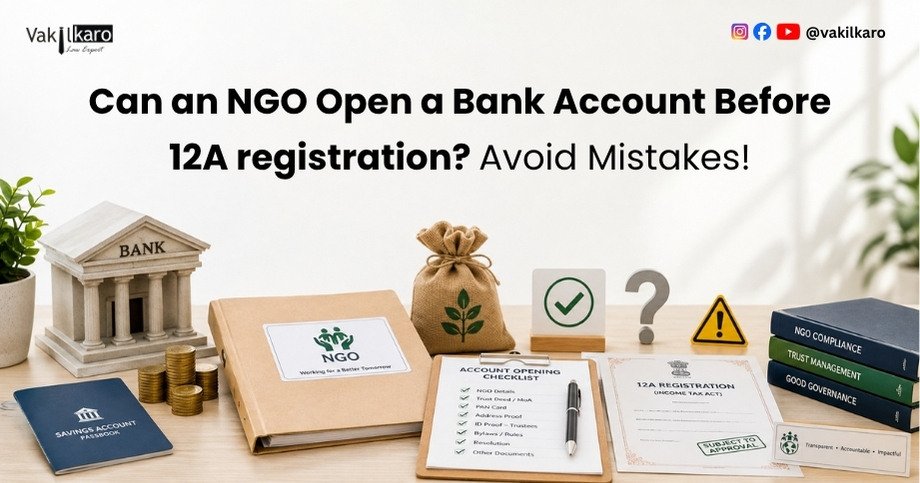
Setting up an NGO in India involves choosing a legal structure and obtaining essential registrations. One common question is whether an NGO can open a bank account before 12A registration. The answer is yes. This blog explores the legal requirements, operational steps, and best practices for NGOs, focusing on Section 8 company registration, NGO registration, and 12A/80G registration, offering key insights for setting up a successful NGO.
Key Takeaways
- One common question is whether an NGO can open a bank account before 12A registration.
- Opening an NGO Bank Account Before 12A Registration: What You Need to Know Establishing an NGO in India requires choosing a legal form—Trust, Society, or Section 8 company—and completing the corresponding registration.
- A common question that arises is whether an NGO can open a bank account before acquiring 12A registration.
- Can an NGO Open a Bank Account Before 12A Registration?
- Best Practices for NGO Banking Before and After 12A Registration Open a Current Account in the NGO’s Legal Name: Avoid using savings or personal accounts for NGO transactions.
Opening an NGO Bank Account Before 12A Registration: What You Need to Know
Establishing an NGO in India requires choosing a legal form—Trust, Society, or Section 8 company—and completing the corresponding registration. While 12A certification from the Income Tax Department grants income tax exemption on funds used for charitable purposes, many founders wonder if they must wait for 12A approval before opening a bank account. The good news is that NGOs can—and should—open their bank accounts as soon as they receive their foundational registration certificate.
A dedicated bank account serves several critical functions. First, it provides the financial records and statements officials review when processing 12A and 80G applications. Second, it enables NGOs to begin receiving domestic donations, membership fees, or grant disbursements immediately. Third, having funds in a separate account from the outset upholds transparency, simplifies bookkeeping, and ensures personal and organizational finances remain distinct.
Banks do not require 12A registration to open an account. Instead, they will ask for proof of legal existence—such as a Trust Deed, Society Registration Certificate, or Section 8 Company Incorporation Certificate—along with the NGO’s PAN card, address proof, board resolution authorizing account opening, and KYC documents for authorized signatories. Section 8 companies often find the process smoother due to their corporate governance structure and audited financials.
Once your account is active, you can pay early operational costs—office rent, utilities, registration fees, or travel expenses—without delay. Later, when you apply for 12A and 80G, you’ll already have an operational bank account and a financial history to support your application. This readiness also appeals to institutional donors and CSR partners who look for organizations with robust financial systems.
In summary, while 12A registration is essential for tax exemption, it is not a prerequisite for opening a bank account. By setting up your bank account immediately after legal registration and following best practices in documentation and recordkeeping, you lay a solid groundwork for both compliance and effective fundraising.
Starting a Non-Governmental Organization (NGO) in India involves navigating a series of well-established steps, each of which plays a crucial role in ensuring that the organization operates legally and effectively. From selecting an appropriate legal structure to securing the necessary registrations for tax exemptions and building donor credibility, the process can be both rewarding and challenging. One of the key concerns for many new NGO founders is understanding the timing and requirements associated with opening a bank account, especially in relation to obtaining crucial registrations like 12A and 80G.
A common question that arises is whether an NGO can open a bank account before acquiring 12A registration. The answer to this is generally yes, but with certain conditions that need to be understood. 12A registration, granted by the Income Tax Department, is essential for securing income tax exemption, but it is not mandatory for opening a bank account for the NGO. This piece of information often surprises many, as there is some confusion about the necessity of 12A registration for conducting basic financial operations.
In this comprehensive guide, we will break down the legal framework and regulatory requirements surrounding NGO banking, particularly focusing on aspects related to Section 8 company registration, NGO registration, and the crucial 12A and 80G registrations. These insights will help NGO founders navigate the complex administrative processes, ensuring they follow the correct procedures and best practices for managing finances from the outset.
Understanding when and how to open a bank account is critical for any NGO, as it facilitates proper financial management, compliance with regulations, and transparency with donors. Furthermore, by gaining a deeper understanding of the interplay between registration processes and banking requirements, NGO founders can ensure a smoother setup, fostering the organization’s growth and long-term sustainability.
Understanding NGO Formation in India
Before discussing banking, it’s important to understand how NGOs are formed in India. An NGO can be registered in one of the following three ways:
Trust
Under the Indian Trusts Act, 1882 (or state-specific acts), a charitable trust is created by executing a trust deed and registering it with the local registrar.
Society
Societies are governed by the Societies Registration Act, 1860, and are usually formed by a group of individuals with a shared charitable objective.
Section 8 Company
A Section 8 company is a non-profit company registered under the Companies Act, 2013. It is formed for promoting commerce, art, science, education, religion, charity, or any other useful object, and profits are not distributed to its members.
Section 8 company registration is considered the most professional and formal structure among the three, with stringent compliance and reporting standards, making it the preferred model for NGOs aiming for long-term growth and donor confidence.
What is 12A Registration and Why is it Important?
12A registration, issued by the Income Tax Department, grants income tax exemption to an NGO. This means the NGO’s income will not be taxed, provided it is used for charitable purposes. Without 12A registration, all income — including donations — is considered taxable.
While 80G registration allows donors to claim deductions on their donations to your NGO, 12A is what protects the NGO’s income from tax.
Key Points:
- 12A registration is not mandatory to operate but essential for tax exemption.
- NGOs can function and even collect donations before 12A registration, but tax will apply.
- Banks do not require 12A registration to open a bank account.
Can an NGO Open a Bank Account Before 12A Registration?
Yes, NGOs can — and in fact must — open a bank account before applying for 12A and 80G registration. Here's why:
- Proof of Financial Operations: The Income Tax Department requires financial details (bank statements, income/expenditure) when evaluating 12A and 80G applications.
- Donation and Grant Management: To receive domestic donations or member contributions, an operational bank account is essential.
- Registration Process: For Section 8 company registration, an NGO must provide details of its bank account during or soon after incorporation.
Note:
Opening the bank account does not require 12A registration, but it does require NGO registration (either as a trust, society, or Section 8 company).
Documents Required to Open an NGO Bank Account
The specific documents vary depending on the legal structure of your NGO, but generally include:
For Trusts:
- Copy of the Trust Deed
- Registration Certificate
- PAN Card of the Trust
- Address proof
- Resolution to open the bank account
- KYC documents of trustees
For Societies:
- Registration Certificate
- Memorandum of Association (MoA) and Rules
- PAN Card
- Resolution passed by the governing body
- KYC of President/Secretary/Treasurer
For Section 8 Companies:
- Certificate of Incorporation
- Memorandum and Articles of Association
- PAN and TAN
- Board resolution to open bank account
- KYC documents of directors and authorized signatories
The Role of Section 8 Company Registration
Section 8 company registration is often seen as the gold standard for NGO setup in India. It not only provides legal recognition but also strengthens the NGO’s credibility in the eyes of banks, government bodies, and donors.
Banks are generally more comfortable opening accounts for Section 8 companies due to the clarity of documentation, compliance, and regulatory oversight involved. Moreover, once the company is incorporated, the Board of Directors can immediately pass a resolution to open a bank account, even without 12A registration.
So, if you're setting up a new NGO and aim to apply for 12A and 80G later, starting with Section 8 company registration ensures a smoother and more professional process.
Why Open a Bank Account Early?
There are several operational and strategic reasons to open a bank account before 12A registration:
To Start Receiving Donations and Membership Fees
Even if the donations are initially taxable (until 12A is obtained), the organization still needs a financial channel to begin functioning.
To Maintain Financial Transparency
Using a dedicated bank account from day one helps keep personal and NGO finances separate. This is crucial for maintaining proper books and records.
To Show Operational Readiness
When applying for 12A and 80G registration, a bank account demonstrates that the NGO is active, credible, and capable of handling finances responsibly.
To Pay for Early Expenses
Even before tax exemption is granted, NGOs have expenses such as office setup, registration fees, travel, communication, etc. A bank account helps facilitate these expenses.
Linking 12A and 80G with NGO Banking
Let’s explore how 12A and 80G registrations interconnect with your NGO’s bank account and finances.
Tax Reporting
Once 12A is obtained, the NGO must report all its financial activities, including income from donations and grants, through audited statements. These reports are based on transactions happening through the bank account.
Donor Preferences
Many institutional donors — especially corporates under CSR — prefer or mandate that the NGO has both 12A and 80G registration, and a transparent banking system to track fund usage.
Foreign Contributions
If your NGO plans to receive foreign donations, it will need FCRA registration and a specific bank account designated for FCRA funds. This account is separate from the domestic bank account and also does not require 12A registration initially, but tax exemption is advisable before large inflows.
Best Practices for NGO Banking Before and After 12A Registration
- Open a Current Account in the NGO’s Legal Name: Avoid using savings or personal accounts for NGO transactions.
- Maintain Proper Records: Even if you're not yet tax-exempt, start maintaining donation receipts, ledgers, and expense records from day one.
- Get PAN and TAN Early: Apply for the NGO’s Permanent Account Number (PAN) and Tax Deduction and Collection Account Number (TAN) for smooth financial operations.
- Apply for 12A and 80G Promptly: You can apply for both together once you have your bank account and books in place.
- Use Digital Tools: Implement accounting software or ERP tools suited for nonprofits to maintain donor databases, expense tracking, and compliance logs.
Misconceptions Around 12A and Bank Accounts: Clearing the Air
When it comes to establishing an NGO in India, there are several myths surrounding the process of obtaining 12A registration and the necessity of having it before opening a bank account. These misconceptions can create confusion and delay the crucial steps involved in setting up the organization. Let’s take a closer look at some of the most common myths and provide clarity on the matter.
Myth 1: NGOs need 12A before opening a bank account.
This is one of the most widespread misconceptions about NGO banking. Many people believe that an NGO cannot open a bank account without first obtaining 12A registration, which grants tax exemption on income. However, this is not the case. The fact is that 12A registration is not a prerequisite for opening a bank account for your NGO. The only requirement is the proper registration of the NGO as either a trust, society, or Section 8 company. Banks typically ask for registration proof, a PAN (Permanent Account Number) for the NGO, and KYC (Know Your Customer) documents of authorized signatories or trustees. Therefore, NGOs can open a bank account without 12A registration.
Myth 2: Banks won’t open accounts without tax-exempt status.
Another common myth is that banks will not open accounts for NGOs unless they have tax-exempt status through 12A registration. This is incorrect. While tax-exempt status is important for many operational purposes, including for claiming exemptions on income and receiving larger donations, it is not required for the initial step of opening a bank account. Banks primarily look for proof of the NGO’s registration, PAN card, and KYC documentation. Therefore, even if an NGO has not yet obtained 12A registration, it can still operate a bank account for its financial transactions.
Myth 3: NGOs cannot accept donations without 12A.
It’s also often believed that NGOs cannot accept donations until they have received 12A registration. This is partially true but needs clarification. While it is true that without 12A registration, the NGO’s income, including donations, will be taxed, donations can still be accepted. The key difference is that until 12A is granted, any donations received will be subject to tax. Once 12A registration is obtained, the NGO can claim tax exemption on its income, including donations, provided those donations are used for its charitable purposes. Therefore, NGOs can begin their fundraising efforts before 12A registration but will need to account for the tax implications in the meantime.
In summary, these misconceptions about 12A and bank accounts can lead to unnecessary delays and confusion during the setup phase of an NGO. By understanding the facts, NGO founders can proceed with greater confidence and avoid potential roadblocks in their organization's financial management.
How Vakilkaro Can Help
If you’re in the early stages of setting up an NGO and feel overwhelmed by documentation, compliance, and tax laws, Vakilkaro can guide you through:
- Section 8 Company Registration
- Trust and Society Registration
- Bank account setup for NGOs
- PAN and TAN application
- 12A and 80G registration
- FCRA advisory
- Annual compliance filing
With our expertise in NGO law and taxation, you can start your social impact journey confidently, with the right legal and financial foundations.
Conclusion
In conclusion, it is clear that NGOs can and should open a bank account even before obtaining 12A registration. In fact, it is highly recommended to take this step early in the process. A dedicated NGO bank account not only provides a professional financial channel but also establishes the organization’s credibility in the eyes of banks, donors, and regulatory bodies. It shows that the NGO is serious about managing its finances and is prepared for operational transparency from the start. This can significantly enhance your organization's reputation and smooth the process for future registrations and compliance.
While 12A registration is crucial for securing tax exemptions on donations and income, and 80G registration is necessary for enabling donors to claim tax deductions, neither of these are prerequisites for opening a bank account. Therefore, NGOs can begin receiving donations, managing grants, and handling operational expenses even before obtaining these important registrations. The financial records maintained through the bank account will be essential when applying for 12A and 80G, providing a strong basis for your application.
Regardless of the legal structure you choose—whether you register as a trust, society, or Section 8 company—prioritizing proper banking and financial practices from day one is vital. Early registration of a bank account not only helps in financial operations but also enables the NGO to be more organized and efficient in its dealings. Once your bank account is set up, timely applications for 12A and 80G registrations will help secure your NGO's tax-exempt status and increase donor trust.
If you're uncertain about the processes involved or if you need expert guidance, consulting professionals like Vakilkaro can help. They can assist with everything from NGO registration and bank account setup to obtaining 12A and 80G certifications, ensuring that all legal requirements are met efficiently. By working with professionals, you can rest assured that your NGO will start with a solid legal and financial foundation, empowering you to focus on your mission of social change with clarity and confidence.
Ready to get started with your NGO’s registration and compliance journey? Contact Vakilkaro today for expert assistance!
Official External Resources
Use these primary/official sources to verify rules, forms, fees, timelines and regulatory updates before publication.
Frequently asked questions
Can an NGO Open a Bank Account Before 12A registration? Avoid Mistakes!+
One common question is whether an NGO can open a bank account before 12A registration. A common question that arises is whether an NGO can open a bank account before acquiring 12A registration.
