Yes. In most cases, one Private Limited Company can manufacture, sell, distribute, import, export or market multiple products in India without creating a separate company for every product. The important condition is that the company's permitted business activities should be properly covered by its Memorandum of Association (MOA), and each product line must comply with the licences, tax rules, quality standards and sector-specific regulations that apply to it.
The legal starting point is Section 4 of the Companies Act, 2013, which requires the MOA to state the objects for which the company is incorporated. MCA's SPICe+ guidance also warns that the object clause should not be vague and that the objects stated at incorporation should be consistent with the business proposed in the filing. Therefore, a company can operate several product lines, but the corporate objects and the actual business should remain aligned.

Does Indian Company Law Allow One Company to Sell Multiple Products?
Indian company law does not require a new company merely because a business introduces a second, third or fifth product. The key legal document is the MOA. Under Section 4(1)(c) of the Companies Act, the memorandum states the objects for which the company is proposed to be incorporated and matters considered necessary in furtherance of those objects. If the proposed product activities fall within those objects, the same company can ordinarily carry them on.
For example, a company incorporated with properly drafted objects for manufacturing, trading and marketing consumer food products may be able to sell several food brands or product variants under the same company. A technology company may offer several software products or SaaS tools. A consumer-products company may operate different brands across approved product categories. The question is not how many products the company has; the question is whether the business activities are legally covered and properly licensed.
The MOA Object Clause Is the First Thing to Check
The Memorandum of Association acts as the company's constitutional charter. When a business plans multiple product lines, the object clause should be drafted with enough clarity to cover the intended commercial activities without becoming vague or artificially broad. MCA's incorporation FAQs specifically caution that objects in the MOA should not be vague and that the NIC code should correspond with the proposed objectives.
- Check the existing main object clause before launching a materially different product category.
- Confirm that manufacturing, trading, distribution, e-commerce, import/export or service activities are covered where relevant.
- Do not assume that a general-sounding company name automatically permits every regulated activity.
- Review whether the new product requires a separate sector approval even if the MOA already covers it.
- Keep the company name, objects, NIC classification and actual business model reasonably consistent
Example: When the Existing MOA Is Usually Broad Enough
If a company is incorporated to design, manufacture, market, distribute and sell home and lifestyle products, it may be able to sell multiple products such as storage items, décor products, kitchen accessories and home-utility products under one company, subject to any product-specific certification that applies.
Example: When the MOA May Need to Be Changed
If a company originally incorporated for software development later decides to manufacture packaged food, the proposed food business may fall outside the existing objects. In that case the company should review and, where necessary, alter the object clause before starting the new activity.
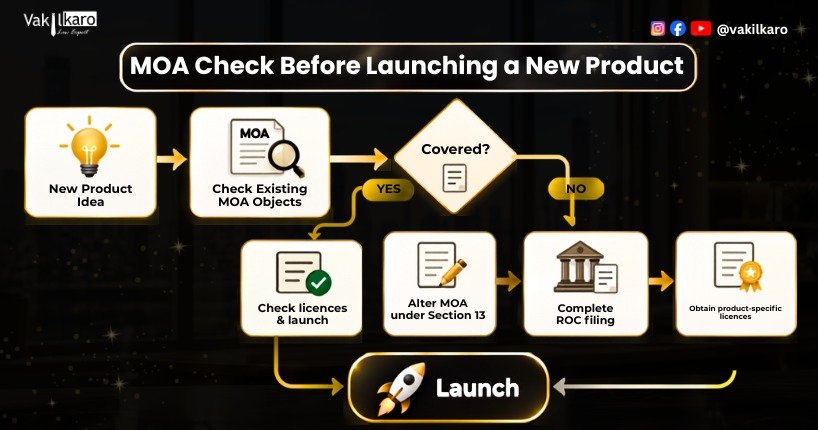
What If the New Product Is Not Covered by the MOA?
A company can change its object clause. Section 13 of the Companies Act permits alteration of the memorandum through the prescribed corporate process, including a special resolution and registration of the alteration with the Registrar. Vakilkaro's MOA Amendment service can be used where an existing company wants to expand into activities that are not adequately covered by its current objects.
The practical sequence normally involves reviewing the present MOA, drafting the proposed object clause, obtaining board and shareholder approvals, passing the required special resolution, filing the relevant ROC form and attachments, and updating the company's constitutional record after the alteration is registered.
A new product should not be launched merely because management has passed an internal board decision if the company's constitutional objects still need to be changed. The corporate approval and ROC registration should be completed in the correct sequence.
Can One Company Use Multiple Brand Names?
Yes. A single Private Limited Company can own and operate multiple brands. The legal company name and the customer-facing brand name do not have to be identical. For example, XYZ Consumer Products Private Limited may own Brand A for snacks, Brand B for beverages and Brand C for personal-care products.
However, each important brand should be checked separately under trademark law. A company should run an IP India trademark search before investing heavily in packaging, advertising or a new product launch. Vakilkaro's Trademark Registration service can help protect different brand names, logos or product identities in the relevant trademark classes.
Trademark protection is class-specific. If one company sells products across different categories, it may need trademark applications in more than one class. One company ownership does not automatically give one trademark registration protection over every type of product.
Can the Same GST Registration Cover Multiple Products?
A company can sell multiple goods or services through the same legal entity, but GST compliance must correctly reflect what is actually supplied. The company should classify each product under the appropriate HSN/SAC treatment, apply the correct tax rate and disclose business details through the GST portal as required. Where a business needs registration or an amendment, GST Registration support can be used to align the tax registration with the operating model.
Different products do not automatically mean different companies. GST registrations are linked to the legal entity and place of business, while product classification and tax treatment are handled within the applicable GST framework. Businesses operating across states, additional places of business or materially different operations should review whether additional GST registrations or amendments are required.
Multiple Products May Mean Multiple Licences
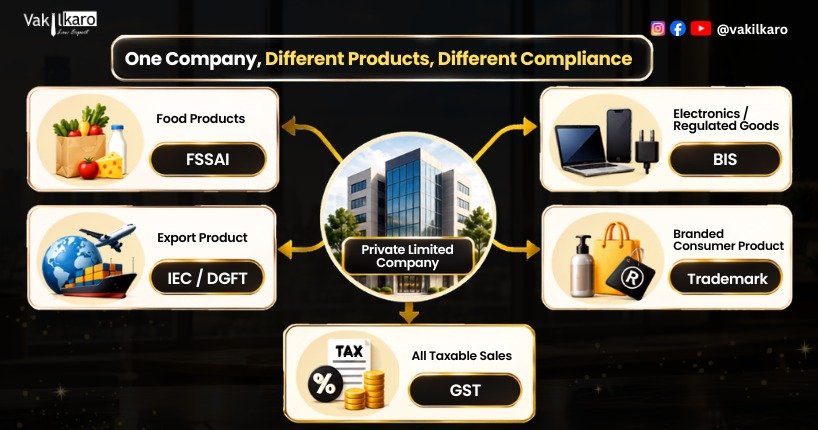
This is where founders often make a mistake. Company incorporation gives the entity a legal identity, but it does not replace product-specific licences. One company can run multiple products, yet each product line must independently satisfy the regulatory rules applicable to that category.
| Product / Activity | Possible Compliance | Why It Matters | Useful Link |
|---|---|---|---|
| Food products | FSSAI registration/licence | Food manufacture, storage, sale or distribution is regulated under food-safety law | FSSAI / FoSCoS |
| Products under mandatory standards | BIS / applicable QCO compliance | Certain notified products require compulsory conformity certification | BIS |
| Imported or exported goods | IEC and customs-related compliance | Commercial cross-border trade may require IEC and customs setup | DGFT / IEC |
| Multiple consumer brands | Trademark registration | Protects brand names/logos for relevant goods/services | IP India |
| Taxable supplies | GST registration / amendment | Ensures correct tax identity, classification and invoicing | GST Portal |
For food businesses, the company's product range should be properly mapped in its FSSAI licence or registration and managed through the official FoSCoS portal. For products covered by compulsory standards, the business should check the BIS list of products under compulsory certification and, where necessary, obtain BIS Registration and Certification.
If the company imports or exports products, it should also evaluate Import Export Code (IEC) Registration and customs setup such as ICEGATE Registration, using the DGFT portal for the applicable trade authorisation framework.
Do You Need a Separate Company for Every Product?
Usually, no. Creating a separate company for every product can increase ROC compliance, accounting work, tax filings, banking arrangements, audit costs and administrative complexity. For many founders, one well-structured company with clear divisions or brands is more efficient.
A separate company may still make commercial sense in some situations:
- Different investor groups will own different product businesses.
- One product carries materially higher legal, regulatory or financial risk.
- A product division is expected to be sold, funded or spun off separately.
- Different promoters want different ownership percentages in different ventures.
- Sector-specific regulation makes a separate entity commercially or legally preferable.
- Separate financial statements, financing or joint-venture arrangements are required.
- An overseas expansion, subsidiary structure or strategic partnership requires ring-fencing
In these cases, the decision is a structuring question rather than a simple incorporation rule. A founder should compare the compliance cost of multiple companies against the benefits of separating ownership, liabilities, investors and future exits.
Can Multiple Products Be Sold From the Same Website or E-Commerce Store?
Yes, if the products are sold by the same legal company and the website, invoices, terms, tax details and product licences correctly identify the seller. A company may operate one umbrella website with several categories or separate websites for different brands.
The customer-facing brand can differ from the registered company name, but legal documents should clearly disclose the entity that is actually selling the product. Packaging, invoices, website terms, GST details, FSSAI details or other regulatory information should be displayed where the applicable law requires it.
Can a Private Limited Company Run Both Products and Services?
Yes, provided both activities are covered by the company's objects and the relevant regulatory framework. For example, a company may sell software products and also provide implementation services, sell machinery and provide maintenance, or manufacture packaged products and provide distribution support.
The MOA should be drafted so that the related product and service activities are legally coherent. If the service business is completely unrelated to the existing objects, an MOA amendment may be advisable before expansion.
Can a Startup Run Several Products Under One Private Limited Company?
Yes. Many startups test several products under one entity before identifying the strongest business line. A properly structured company can reduce the need to create a new legal entity for every experiment. Eligible businesses may separately consider Startup India Registration and verify recognition requirements on the official Startup India portal.
Founders should still keep internal product-level accounts, contracts, intellectual property records and cost centres organised. If one product later raises investment independently or is sold to another buyer, clean records make the restructuring easier.
How Should Accounting Be Managed for Multiple Products?
Even though the company has one PAN and one corporate identity, management should track revenue, inventory, direct costs, marketing spend and profitability by product line. This is not merely an accounting preference; it helps founders understand which product is working and supports investor due diligence, tax reviews and strategic decisions.
- Create separate SKU/product codes.
- Maintain product-wise inventory and purchase records.
- Track HSN/SAC classification and applicable GST rates.
- Use cost centres or departments in accounting software.
- Maintain separate brand and trademark records.
- Record product-specific licences, renewal dates and compliance obligations.
- Keep supplier and customer contracts linked to the correct product division.
What About ISO or Quality Certifications?
A company can hold more than one quality or management-system certification if its operations require them. Where customers, tenders or internal quality systems demand formal certification, businesses can evaluate ISO Certification. ISO certification is different from product-specific statutory certification such as mandatory BIS requirements; founders should not treat one as a substitute for the other.
Practical Examples
Example 1 – Food Brand with Several Products
ABC Foods Private Limited sells biscuits, sauces and ready-to-eat snacks. The company does not need three separate companies merely because it has three product lines. Its MOA should cover the food business, its FSSAI licence should cover the relevant product categories and premises, and each brand should be evaluated for trademark protection.
Example 2 – Technology Company with Three SaaS Products
XYZ Technologies Private Limited operates accounting software, a CRM and an attendance application. If the MOA properly covers software development, licensing and related services, all three products can usually operate under the same company. Separate trademarks can protect each product brand.
Example 3 – Existing IT Company Starting Packaged Food
A software company wants to launch a packaged-food brand. This is a materially different activity. The company should first review whether the MOA permits the proposed food business. If not, it should alter its objects, complete ROC compliance and then obtain the required FSSAI and other product-specific registrations.
Example 4 – Consumer Goods Company Exporting Overseas
A domestic consumer-products company begins exporting two of its brands. It may continue using the same Private Limited Company, while adding the trade-related compliance required for export such as IEC, customs/ICEGATE arrangements and destination-market compliance.
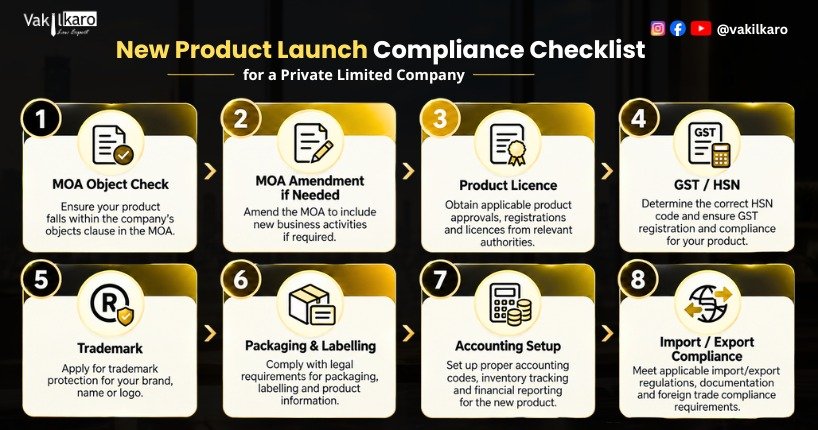
Checklist Before Adding a New Product to an Existing Company
- Read the current MOA object clause.
- Confirm that the new activity is covered by the objects.
- If not covered, complete the required MOA amendment and ROC filing.
- Check whether the product needs FSSAI, BIS, sectoral approval or another licence.
- Review GST classification, rate and registration details.
- Check the proposed brand on the IP India trademark database.
- Decide whether a separate trademark application is needed for the new brand/class.
- Update internal accounting, inventory and compliance systems.
- Review packaging, labels, invoices and website disclosures.
- Obtain IEC/customs registrations if the new product will be imported or exported.
- Consider a separate entity only when ownership, funding, risk or strategic reasons justify it.
Common Mistakes to Avoid
- Launching an unrelated product without checking the MOA.
- Assuming company registration itself is a product licence.
- Using a new brand without checking trademark conflicts.
- Registering a trademark in only one class while selling across unrelated product classes.
- Adding food products to a business without updating the FSSAI product categories/licence where required.
- Assuming every product can use the same BIS licence; BIS certification can be product/standard and manufacturing-location specific.
- Using the wrong HSN code or GST rate for a new product.
- Failing to update website, invoice or packaging disclosures when a new regulated product is launched.
- Creating multiple companies unnecessarily when a single properly structured company would be simpler.
Why Choose Vakilkaro?
Vakilkaro can assist an existing or proposed Private Limited Company in building a legally organised multi-product structure. The support can begin with Private Limited Company Registration or, for an existing entity, a review of its MOA and object clause. If the new activity is outside the existing objects, the team can coordinate the MOA Amendment process.
Related requirements can then be mapped product by product — including Trademark Registration, GST Registration, FSSAI Licence Registration, BIS Registration, IEC Registration and other applicable business registrations.
- One-point review of company objects and proposed product lines.
- Clear identification of corporate vs product-specific compliance.
- Support for MOA amendment where expansion requires it.
- Brand and trademark planning for multiple product names.
- Tax and licence mapping based on product category.
- Support for import/export compliance where products move internationally.
- Post-launch compliance planning and renewal tracking.
Frequently asked questions
Can one Private Limited Company sell different types of products in India?+
Yes. One company can sell multiple products if its MOA covers the relevant business activities and each product complies with applicable tax, licence and regulatory requirements.
Do I need a new company for every product?+
Usually no. A new legal entity is not required merely because a business adds another product. Separate companies are generally considered for ownership, investment, risk or strategic reasons.
What is the most important document to check before adding a new product?+
The MOA, particularly the object clause. It should cover the activity connected with the proposed product.
What if my new product is not covered in the MOA?+
The company can alter its MOA under the Companies Act by following the prescribed approval and ROC filing process before carrying on the new activity.
Can one company have multiple brands?+
Yes. A company can own several brands, but each important brand should be searched and protected through the appropriate trademark applications.
Can one GST number be used for multiple products?+
A legal entity can supply multiple products under its GST registration, subject to the correct state/place-of-business registration position and proper HSN/SAC classification, tax rates and invoicing.
Do different products need separate trademarks?+
Not necessarily one trademark per SKU, but separate brand names/logos and different trademark classes may require separate or multi-class applications depending on the protection strategy.
Can a food company sell multiple food products?+
Yes, but the FSSAI licence or registration should cover the relevant food categories and premises, and other labelling or product-specific rules must also be followed.
Can the same company sell food and software?+
Potentially yes, but this is a very different activity mix. The MOA should be reviewed carefully and may need amendment if one of the activities is not already covered. Separate sector compliance will also apply.
Is BIS required for every product?+
No. BIS certification is voluntary for many products but compulsory for products brought under mandatory certification or Quality Control Orders. The applicable standard must be checked product by product.
Can a company import several products using the same IEC?+
IEC is linked to the entity's PAN, so one company generally uses its IEC for its commercial import/export activity, subject to product restrictions, customs and other regulatory requirements.
Can multiple products operate under one Startup India recognised company?+
Yes, provided the company continues to satisfy the applicable Startup India eligibility conditions. Product expansion does not itself require a separate startup entity.
Should I create a subsidiary for a new product?+
Only where there is a commercial reason such as separate investors, higher risk, a joint venture, planned sale/spin-off or distinct regulatory structure. It is not automatically required.
Does company registration automatically cover product licences?+
No. Incorporation creates the legal entity; product-specific registrations such as FSSAI, BIS or other sector approvals are separate.
Can Vakilkaro review whether my existing company can launch a new product?+
Yes. Vakilkaro can review the existing MOA, proposed product, brand, tax and licence requirements and identify whether an amendment or additional registration is needed.
