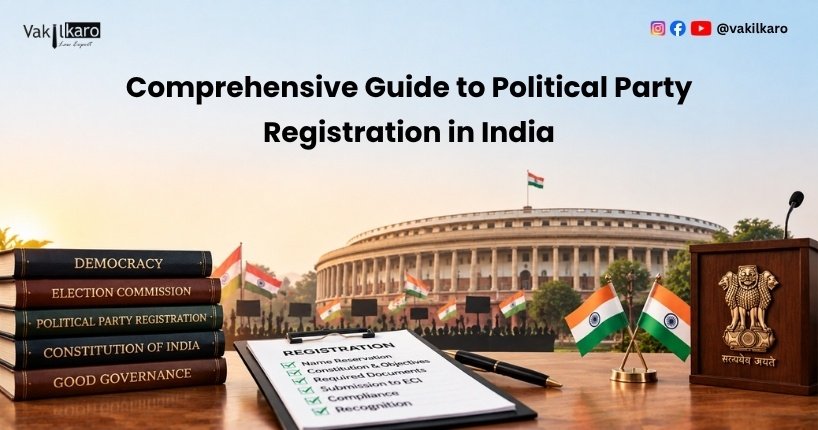
India’s democracy depends on the integrity of political parties. This guide explains political party registration in India, the Election Commission’s role, and how new political party registration online in India works. You’ll learn the full process, from selecting a unique party name and drafting a constitution to publishing notices and submitting documents. Understanding these steps helps avoid delays, ensures compliance, and builds credibility. Whether you plan to start a regional party or a national platform, this comprehensive guide will help you navigate the regulations confidently and launch your party successfully.
Key Takeaways
- Political party registration grants important privileges, including legal recognition, entitlement to a unique election symbol, and eligibility for tax benefits on donations.
- Political party registration is the formal process through which a group of individuals obtains official recognition from the Election Commission of India (ECI) to function as a political party under the law.
- The Legal Framework for Political Party Registration in India The legal foundation for political party registration in India rests on: Section 29A of the Representation of the People Act, 1951: This section details the registration process, documentation, and compliance requirements.
- As the country’s apex electoral authority, the ECI oversees every aspect of political party registration, from scrutinizing documents to issuing the final certificate.
- Moreover, the emergence of semi-digital workflows and online tracking has made new political party registration online in India more accessible than ever before, offering applicants better visibility and transparency throughout the process.
How Political Party Registration Works in India: A Step-by-Step Guide
India’s vibrant democracy relies heavily on political parties that represent diverse interests and ideas. But before any political organization can contest elections, it must be officially registered. The Election Commission of India (ECI), an independent constitutional body established under Article 324, is responsible for registering all political parties in the country. This process ensures that only those committed to democratic principles and transparency can participate in the electoral system.
Political party registration grants important privileges, including legal recognition, entitlement to a unique election symbol, and eligibility for tax benefits on donations. Parties also gain access to electoral rolls and government media time during campaigns, which significantly boosts their visibility. To start the registration process, founders must select a distinctive party name, prepare a detailed constitution outlining aims, membership rules, and internal governance, and gather affidavits from at least 100 members.
Applications require a cover letter, the completed registration form, a processing fee, and copies of all supporting documents. After submission, the ECI mandates that the party publish notices in national and local newspapers to invite objections. If no valid objections arise within 30 days, or once any concerns are addressed, the Commission reviews all materials and issues a Certificate of Registration.
In recent years, the process has become more convenient thanks to digital tools. Although final documents still need to be submitted in hard copy, the ECI’s website allows applicants to download forms, track application status, and find comprehensive guidelines. This blend of offline and online steps makes new political party registration online in India easier and more transparent.
Registering a political party is both a legal requirement and a mark of credibility. With careful preparation and adherence to regulations, your party can establish a strong foundation to engage effectively in India’s democratic process.
India is the world’s largest democracy, and political parties play a pivotal role in shaping its political landscape. From the smallest regional movements to the largest national parties, every political formation must follow specific legal procedures to be recognized officially. But who registers political parties in India?
How does political party registration in India work? What is the procedure for new political party registration online in India? This blog will answer these questions in depth, offering a complete guide for anyone interested in setting up a political party or simply understanding how the system functions.
What is Political Party Registration?
Before diving into the process and the authorities responsible, let’s define political party registration clearly.
Political party registration is the formal process through which a group of individuals obtains official recognition from the Election Commission of India (ECI) to function as a political party under the law. Registration is essential because it:
- Confers legal status on the party.
- Enables access to election symbols.
- Allows the party to contest elections under its banner.
- Makes it eligible for other benefits such as airtime on state media and financial transparency exemptions under certain conditions.
Without proper registration, a political organization cannot participate in elections or claim recognition as a legitimate political entity.
Who Registers Political Parties in India?
The Election Commission of India (ECI) is the sole authority that registers political parties in India.
Established under Article 324 of the Indian Constitution, the ECI is an autonomous constitutional body responsible for:
- Conducting free and fair elections to Parliament, State Legislatures, and the offices of the President and Vice-President.
- Monitoring political parties’ compliance with election laws.
- Registering new political parties and regulating their status (i.e., unrecognized, recognized state parties, or recognized national parties).
So, if you wish to start a new political party, your application goes directly to the ECI.
The Legal Framework for Political Party Registration in India
The legal foundation for political party registration in India rests on:
- Section 29A of the Representation of the People Act, 1951: This section details the registration process, documentation, and compliance requirements.
- Election Symbols (Reservation and Allotment) Order, 1968: This order governs how symbols are allocated to registered parties.
- Model Code of Conduct and Other Guidelines issued by the ECI.
Under these provisions, all associations or bodies of citizens calling themselves political parties must apply for registration within 30 days of their formation.
Why Register a Political Party?
Registration with the ECI is not just a formality. It offers several critical benefits:
✅ Legal Recognition:
Your party is recognized as a legitimate political organization under Indian law.
✅ Symbol Reservation:
Registered parties can reserve a unique election symbol, which becomes their identity on ballots.
✅ Tax Benefits:
Registered parties can avail of tax exemptions on donations received, subject to conditions.
✅ Access to Electoral Rolls and Media Time:
Registered political parties receive copies of electoral rolls and are allocated airtime during elections on Doordarshan and All India Radio.
✅ Transparency and Credibility:
Registration signals that the party complies with democratic principles and financial transparency.
Step-by-Step Guide to Political Party Registration in India
Let’s walk through the process in detail:
Name Selection and Verification
The first step in political party registration in India is choosing a name that:
- Does not resemble or sound similar to existing recognized parties.
- Does not have religious or caste connotations.
- Is not obscene or inflammatory.
You must carefully verify your proposed name against the ECI’s list of existing parties.
Drafting the Party Constitution
Every party must have its own constitution, containing:
- The aims and objectives.
- Details about membership eligibility.
- Organizational structure.
- Internal democracy provisions (e.g., elections to leadership positions).
- Disciplinary procedures.
This constitution must be filed with the ECI as part of the application.
Preparation of the Application
The application to the ECI should include:
- A covering letter signed by the Chief Executive (usually the party president or general secretary).
- A duly filled application form (as per Section 29A).
- A demand draft for ₹10,000 as a processing fee.
- A copy of the party’s constitution.
- An affidavit affirming allegiance to the principles of the Constitution of India.
- Authenticated signatures of 100 party members with their affidavits and identity proofs.
Public Notice
Once the application is filed, the party must publish a notice in:
- Two national daily newspapers.
- Two local daily newspapers.
This notice invites objections from the public within 30 days of publication.
Objection Handling
If any objections are received, the ECI examines them and may ask the applicant party for clarification or amendments.
Verification and Final Approval
The ECI scrutinizes all documents and the party’s constitution. Once satisfied, it issues a Certificate of Registration.
New Political Party Registration Online in India
In recent years, the ECI has moved toward digitization. While the initial submission still requires hard copies, much of the process is now supported through the Election Commission of India’s online portal.
This makes new political party registration online in India more convenient. On the ECI’s website:
- You can access detailed guidelines.
- Download forms and affidavits.
- Track the status of your application.
- Review lists of existing registered parties.
However, you must still send physical copies of critical documents and the processing fee by post or by hand.
Important Considerations in Political Party Registration
Whether applying offline or through new political party registration online, keep in mind:
✅ Timing:
You must apply within 30 days of forming the party.
✅ Completeness:
Any missing or incomplete documents can delay or derail your registration.
✅ Transparency:
Your constitution must include provisions for democratic functioning.
✅ Compliance:
Registered parties must file annual audit reports and contribution reports to maintain their status.
Recognition of Registered Political Parties
Registration does not automatically make a party a recognized state or national party. Recognition is based on electoral performance:
- State Party:
Securing at least 6% of valid votes in a state assembly or Lok Sabha election and winning at least 2 seats.
- National Party:
Recognition in four or more states or meeting specific vote-share criteria nationwide.
Recognition entitles parties to additional benefits, such as reserved symbols and subsidized facilities.
Common Mistakes to Avoid During Political Party Registration
- Copying Constitutions:
Using templates without customizing them to your party’s objectives can lead to rejections.
- Incomplete Affidavits:
Every member affidavit must be correctly notarized and attached with ID proof.
- Name Similarity:
Proposed names sounding like existing parties are often rejected.
- Failure to Publish Notices:
Not publishing the notice in the prescribed newspapers invalidates your application.
Role of Technology in Political Party Registration
While fully digital registration is not yet a reality, the ECI’s platform is a big step forward:
- Applicants can download guidelines and forms.
- Status updates can be tracked in real time.
- Public notices are easier to share and monitor.
This semi-digital system makes new political party registration online in India much more transparent and accessible.
Why Political Party Registration Matters for Democracy?
India has over 2,500 registered political parties. Not all contest elections regularly, but every registration represents:
- Political diversity.
- Citizens’ right to association.
- The spirit of democratic competition.
Registration ensures that every political movement is accountable, transparent, and committed to constitutional values.
Frequently Asked Questions (FAQ)
Q1: Can a political party function without registration?
Yes, but it cannot contest elections or claim benefits like reserved symbols.
Q2: How long does registration take?
Generally, 3–4 months, including the 30-day objection period.
Q3: Can I complete new political party registration online in India?
Partially—while you can download documents and track status online, you must still submit hard copies.
Q4: Who issues the final certificate of registration?
The Election Commission of India.
Q5: What is the fee?
₹10,000 by demand draft in favor of the ECI.
The Future of Political Party Registration in India
The Election Commission is committed to improving transparency and efficiency. Potential improvements include:
- Complete digital filing and e-signature support.
- Faster verification using Aadhaar-based authentication.
- Real-time public feedback through online notice publication.
These changes will make new political party registration online in India even more accessible.
Conclusion
So, who registers political parties in India? The answer is unequivocal: the Election Commission of India (ECI). As the country’s apex electoral authority, the ECI oversees every aspect of political party registration, from scrutinizing documents to issuing the final certificate. This process is intentionally thorough and exacting, designed to ensure that every registered party upholds India’s constitutional principles, maintains internal democracy, and contributes positively to the nation’s democratic fabric.
Whether you are building a grassroots regional platform or laying the groundwork for a nationwide political movement, understanding the ins and outs of political party registration in India is the essential first step. From selecting a compliant name to drafting a robust party constitution, each requirement is critical to demonstrating your party’s credibility and readiness to participate in elections. Moreover, the emergence of semi-digital workflows and online tracking has made new political party registration online in India more accessible than ever before, offering applicants better visibility and transparency throughout the process.
However, the legal, procedural, and administrative details can still be overwhelming, especially for first-time founders. This is where Vakilkaro becomes a valuable partner. Vakilkaro’s team of experienced professionals specializes in political party registration and compliance. They can guide you through every stage—helping you prepare accurate documentation, avoid common pitfalls, and communicate effectively with the Election Commission. Their expertise can save you weeks of confusion and help you address objections or clarifications swiftly.
If you’re considering launching a political party, take these steps seriously. Invest time in crafting clear, democratic rules and assembling complete, compliant paperwork. Engaging a trusted partner like Vakilkaro will not only smooth your journey through registration but also build a foundation of trust, transparency, and legitimacy that your supporters and the public can believe in.
Official External Resources
Use these primary/official sources to verify rules, forms, fees, timelines and regulatory updates before publication.
Frequently asked questions
Comprehensive Guide to Political Party Registration in India+
Political party registration is the formal process through which a group of individuals obtains official recognition from the Election Commission of India (ECI) to function as a political party under the law. The Legal Framework for Political Party Registration in India The legal foundation for political party registration in India rests on: Section 29A of the Representation of the People Act, 1951: This section details the registration process, documentation, and compliance requirements.
