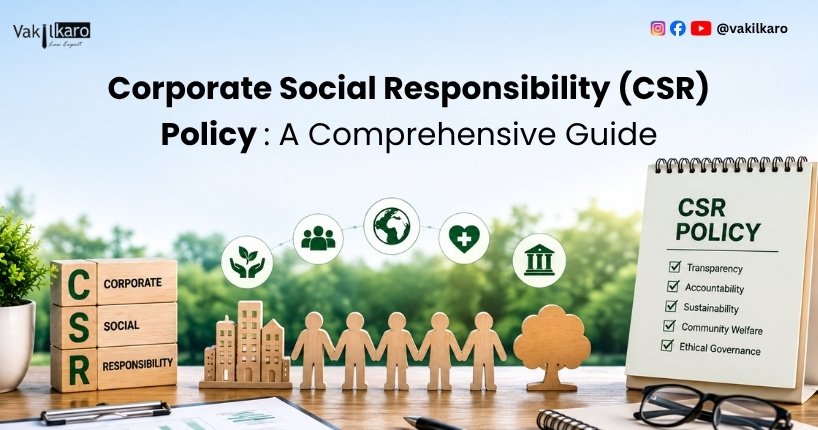
Corporate Social Responsibility (CSR) ensures businesses contribute to social, economic, and environmental well-being by integrating ethical practices into operations. In India, CSR is legally mandated under the Companies Act, 2013, requiring eligible companies to allocate at least 2% of their net profits toward social initiatives. Compliance with CSR India law involves forming CSR policies, reporting expenditures, and partnering with registered NGOs or Section 8 Companies. NGO Registration, Section 8 Company Registration, and obtaining 12A and 80G registration enhance CSR effectiveness by ensuring legal compliance, tax benefits, and credibility. Vakilkaro assists companies in navigating CSR regulations, facilitating impactful and compliant initiatives.
Key Takeaways
- Understanding Corporate Social Responsibility (CSR) in India Corporate Social Responsibility (CSR) is a business approach that ensures companies actively contribute to social, economic, and environmental development while conducting their operations ethically.
- In India, CSR has gained significant importance, particularly after the government introduced specific laws on corporate social responsibility under the Companies Act, 2013.
- CSR India Law: Legal Framework and Compliance CSR in India is governed by Section 135 of the Companies Act, 2013 and the Companies (Corporate Social Responsibility Policy) Rules, 2014.
- CSR Policy Implementation: Key Strategies For a company’s Corporate Social Responsibility (CSR) policy to be truly impactful, it must be implemented strategically.
- Challenges in CSR Compliance Despite the existence of a well-defined legal framework under the Companies Act, 2013, many companies in India face significant challenges in ensuring Corporate Social Responsibility (CSR) compliance.
Understanding Corporate Social Responsibility (CSR) in India
Corporate Social Responsibility (CSR) is a business approach that ensures companies actively contribute to social, economic, and environmental development while conducting their operations ethically. In India, CSR is not just a voluntary initiative but a legal obligation for certain businesses, as mandated under the Companies Act, 2013. This law requires companies meeting specific financial criteria to allocate at least 2% of their average net profits from the last three years toward social welfare projects.
To comply with CSR India law, businesses must develop a CSR policy, establish a dedicated CSR committee, and report their CSR expenditures in their annual financial statements. The legal framework also outlines approved CSR activities, including education, healthcare, environmental sustainability, and poverty alleviation. Many companies partner with NGOs and Section 8 Companies to execute their CSR projects effectively.
For an organization to be eligible for CSR funding, it must be legally registered under one of the recognized structures, such as Trust Registration, Society Registration, or Section 8 Company Registration. Among these, Section 8 Companies are highly preferred due to their structured governance and transparency. Additionally, obtaining 12A and 80G registration helps NGOs gain tax exemptions and attract corporate donations, making CSR implementation more efficient.
Despite a well-defined legal structure, CSR implementation faces challenges such as a lack of awareness, inefficient fund utilization, and regulatory complexities. Businesses must collaborate with legally compliant entities to ensure impactful CSR initiatives. Vakilkaro provides expert legal assistance for CSR compliance, including Section 8 Company Registration, NGO Registration and obtaining 12A and 80G registration. By simplifying regulatory procedures, Vakilkaro enables businesses to focus on meaningful social contributions while ensuring legal compliance and transparency in their CSR programs.
Corporate Social Responsibility (CSR) is an essential framework through which businesses contribute to social, economic, and environmental well-being. It ensures that companies operate ethically, considering the impact of their activities on society. In India, CSR has gained significant importance, particularly after the government introduced specific laws on corporate social responsibility under the Companies Act, 2013. The legal framework mandates eligible companies to allocate a portion of their profits towards CSR activities, fostering sustainable development.
This blog explores the CSR India law, the legal provisions governing CSR, and how NGO registration, Section 8 Company Registration, and 12A and 80G registration play a crucial role in implementing CSR initiatives effectively.
Understanding CSR in India
Corporate Social Responsibility (CSR) is a strategic initiative that encourages businesses to contribute positively to society beyond their primary goal of generating profits. It encompasses a wide range of social, economic, and environmental activities that enhance community well-being and promote sustainable development. CSR initiatives often focus on key areas such as education, healthcare, environmental protection, poverty alleviation, women empowerment, rural development, and skill enhancement programs.
In India, CSR is not just a voluntary practice but a legal requirement for eligible companies, making it one of the few countries to enforce corporate responsibility through legislation. The Companies Act, 2013, under Section 135, mandates that companies meeting specific financial thresholds must allocate a portion of their profits to CSR activities. This regulation ensures that businesses play an active role in addressing social issues and contributing to national development.
The legal framework governing CSR ensures that businesses integrate ethical, social, and environmental concerns into their operational strategies. Companies are required to develop a CSR policy, establish a CSR committee, and ensure proper implementation of their initiatives. The law also outlines a list of approved CSR activities under Schedule VII of the Companies Act, which includes promoting education, providing healthcare, empowering marginalized communities, and fostering environmental sustainability.
Many companies collaborate with NGOs and Section 8 Companies to effectively implement their CSR programs. These legally registered organizations play a crucial role in executing projects, ensuring transparency, and delivering measurable impact. Additionally, NGOs that obtain 12A and 80G registration benefit from tax exemptions and increased donor contributions, making them ideal partners for CSR initiatives.
Overall, CSR in India serves as a bridge between corporate entities and social welfare, ensuring that businesses contribute meaningfully to national and global development goals while maintaining compliance with legal regulations.
CSR India Law: Legal Framework and Compliance
CSR in India is governed by Section 135 of the Companies Act, 2013 and the Companies (Corporate Social Responsibility Policy) Rules, 2014. These laws define CSR obligations for businesses and specify the compliance requirements.
Eligibility for CSR Compliance
According to Section 135, companies meeting the following criteria must comply with CSR rules:
- Companies with a net worth of INR 500 crore or more
- Companies with an annual turnover of INR 1000 crore or more
- Companies with a net profit of INR 5 crore or more in the previous financial year
Such companies must allocate at least 2% of their average net profits from the last three financial years towards CSR initiatives.
Laws on Corporate Social Responsibility: Key Provisions
- CSR Committee Formation – Companies must form a CSR committee consisting of at least three directors, including an independent director.
- CSR Policy Development – The committee must draft and approve a CSR policy outlining the company’s initiatives and implementation strategy.
- Approved CSR Activities – The CSR policy should align with Schedule VII of the Companies Act, 2013, which includes activities like promoting education, healthcare, gender equality, rural development, and environmental sustainability.
- Implementation & Reporting – Companies must report their CSR activities in their annual financial statements and disclose expenditures.
Role of NGOs and Section 8 Companies in CSR Implementation
Corporate Social Responsibility (CSR) initiatives require efficient execution and proper compliance with legal regulations. Many companies choose to collaborate with Non-Governmental Organizations (NGOs) and Section 8 Companies to ensure that their CSR programs are effectively implemented, making a tangible impact on society. These organizations serve as key partners, bridging the gap between corporate entities and communities by delivering services in areas such as education, healthcare, environmental sustainability, and poverty alleviation.
NGO Registration for CSR Implementation
For an NGO to be eligible to receive CSR funding and collaborate with companies, it must be legally registered under one of the following structures:
- Trust Registration under the Indian Trusts Act, 1882 – Suitable for charitable and philanthropic activities, trusts operate based on a deed and require minimal regulatory compliance.
- Society Registration under the Societies Registration Act, 1860 – Ideal for associations focused on social causes, societies function with a governing body and adhere to democratic principles.
- Section 8 Company Registration under the Companies Act, 2013 – Preferred by many corporates for CSR projects due to its well-defined governance structure, higher credibility, and greater transparency.
Section 8 Company Registration and CSR Eligibility
A Section 8 Company is a non-profit entity recognized under the Companies Act, 2013, with a primary focus on advancing social welfare, education, research, healthcare, rural development, and environmental protection. Unlike other business entities, a Section 8 Company is prohibited from distributing profits among its members and must reinvest all income into fulfilling its charitable objectives.
Advantages of a Section 8 Company for CSR Implementation
- Legal Recognition & Compliance – Section 8 Companies follow a structured governance model, making them compliant with CSR rules and corporate funding requirements.
- Higher Credibility – Corporate donors prefer Section 8 Companies due to their legally regulated status, ensuring transparency and responsible fund utilization.
- Tax Benefits – Section 8 Companies can obtain 12A and 80G registration, enabling them to claim tax exemptions and offer tax benefits to donors, attracting more CSR funding.
- Cost-Effective Operations – Section 8 Companies are exempt from certain taxes and regulatory burdens, allowing them to focus resources on CSR project execution rather than administrative costs.
By collaborating with registered NGOs and Section 8 Companies, businesses can ensure that their CSR initiatives are impactful, legally compliant, and aligned with national development goals.
Tax Benefits: 12A and 80G Registration for CSR Funding
For an NGO or a Section 8 Company to receive CSR funding efficiently, obtaining 12A and 80G registration is highly beneficial.
- 12A Registration: Provides tax exemption on the income generated by the NGO, allowing it to utilize funds solely for social development.
- 80G Registration: Enables donors to claim tax deductions on their donations, encouraging more contributions to CSR initiatives.
CSR Policy Implementation: Key Strategies
For a company’s Corporate Social Responsibility (CSR) policy to be truly impactful, it must be implemented strategically. Effective CSR initiatives not only fulfill legal compliance requirements but also create long-term social and environmental benefits. The following key steps help businesses design and execute CSR projects efficiently.
Identifying Focus Areas
The first step in CSR policy implementation is to align CSR activities with community needs and the company’s core values. Businesses should conduct research and stakeholder consultations to determine pressing social issues in areas such as education, healthcare, environmental sustainability, and poverty alleviation. Aligning CSR initiatives with national development goals and the Sustainable Development Goals (SDGs) ensures a meaningful and far-reaching impact.
Choosing Implementation Partners
Collaboration with the right CSR implementation partners is essential for successful project execution. Companies often partner with registered NGOs or Section 8 Companies to ensure compliance with CSR rules. These organizations must have NGO registration under the Trusts Act, Societies Act, or Companies Act and should ideally hold 12A and 80G registration to facilitate tax benefits for donors. Partnering with credible organizations ensures that CSR funds are used efficiently and reach the intended beneficiaries.
Budget Allocation & Fund Utilization
The Companies Act, 2013, mandates eligible companies to allocate at least 2% of their average net profits from the last three years toward CSR activities. To ensure transparency and accountability, businesses should:
- Establish a dedicated CSR fund and track expenditures.
- Allocate resources effectively to maximize social impact.
- Regularly audit and document fund utilization to ensure compliance with CSR laws.
Monitoring & Evaluation
A robust monitoring and evaluation (M&E) framework is crucial for assessing the effectiveness of CSR initiatives. Companies must:
- Set measurable goals and key performance indicators (KPIs) for each CSR project.
- Conduct field visits, surveys, and audits to track project progress.
- Publish annual CSR reports detailing fund utilization, outcomes, and challenges.
- Use third-party evaluations to ensure objectivity and credibility.
Effective monitoring mechanisms help companies identify areas for improvement and enhance the overall impact of their CSR initiatives.
Stakeholder Engagement
CSR success depends on active participation from various stakeholders, including employees, investors, customers, local communities, and government agencies. Companies should:
- Engage employees through volunteer programs and workplace giving initiatives.
- Collaborate with government bodies and community leaders for large-scale projects.
- Communicate CSR efforts transparently through social media, annual reports, and community outreach programs.
- Encourage investor and customer participation by demonstrating a strong commitment to social responsibility.
By following these strategic steps, businesses can ensure that their CSR initiatives are legally compliant, socially impactful, and aligned with corporate values, ultimately contributing to sustainable development.
Challenges in CSR Compliance
Despite the existence of a well-defined legal framework under the Companies Act, 2013, many companies in India face significant challenges in ensuring Corporate Social Responsibility (CSR) compliance. These challenges range from lack of awareness to financial and regulatory hurdles, which can affect the successful implementation of CSR initiatives.
Lack of Awareness
One of the primary obstacles in CSR compliance is that many businesses, especially small and medium enterprises (SMEs), are unaware of the legal and regulatory requirements surrounding CSR. While large corporations have dedicated CSR teams and legal advisors, smaller businesses often lack the necessary knowledge about:
- Eligibility criteria for CSR compliance under Section 135 of the Companies Act, 2013.
- The mandatory 2% CSR spending rule for companies meeting the financial thresholds.
- The importance of forming a CSR committee and drafting a well-structured CSR policy.
- Legal requirements related to NGO registration Section 8 Company Registration, and 12A and 80G registration for proper CSR fund utilization.
As a result, many businesses either fail to meet their CSR obligations or struggle with legal non-compliance, which may lead to penalties.
Inefficient Implementation
Even when companies allocate funds for CSR, improper planning and execution can lead to ineffective initiatives. The common pitfalls in CSR implementation include:
- Poor selection of NGOs or implementation partners who lack the required compliance certifications.
- Lack of monitoring mechanisms, leading to fund mismanagement and ineffective projects.
- Failure to align CSR activities with community needs or national development goals.
- Inadequate documentation and reporting, which results in non-compliance with CSR laws.
Companies often struggle to identify credible NGOs with valid 12A and 80G registration, which are essential for tax benefits and financial transparency. Without proper oversight, CSR projects may fail to deliver the intended social impact.
Tax & Compliance Burdens
NGOs and Section 8 Companies play a crucial role in CSR project execution, but they too face compliance hurdles. Many NGOs struggle with:
- Obtaining 12A and 80G registration, which is essential for tax exemptions and attracting corporate donations.
- Meeting the Foreign Contribution Regulation Act (FCRA) requirements if they receive foreign funding.
- Maintaining proper financial records and reporting to ensure transparency in fund utilization.
Without proper registration and compliance, NGOs lose credibility and find it difficult to secure CSR funds from corporations. Similarly, businesses that donate to non-registered NGOs risk non-compliance with CSR laws, leading to financial and reputational risks.
Limited Resources
While large corporations can allocate significant funds toward CSR initiatives, small and mid-sized companies often struggle with:
- Budget constraints, making it difficult to fulfill the mandatory 2% CSR spending requirement.
- The high cost of setting up CSR monitoring and evaluation systems.
- Difficulty in hiring CSR professionals to design and implement effective CSR strategies.
- Challenges in balancing business growth and social responsibility due to limited financial resources.
For SMEs, outsourcing CSR implementation to registered NGOs or Section 8 Companies with 12A and 80G registration can be a viable solution. However, without proper guidance, many companies fail to optimize their CSR spending effectively.
Conclusion
CSR has become an integral part of corporate governance, requiring businesses to contribute to social and environmental well-being. Adhering to CSR rules, Section 8 Company Registration NGO Registration, and obtaining 12A and 80G registration is crucial for companies and non-profits to effectively implement CSR initiatives.
With a strong regulatory framework in place, companies must collaborate with legally compliant NGOs and Section 8 Companies to maximize their social impact. Vakilkaro simplifies the legal aspects of CSR, ensuring seamless compliance and efficient execution of social responsibility programs. By integrating CSR with legal compliance, businesses can contribute significantly to India’s social and economic development while fulfilling their corporate responsibilities.
The Role of Vakilkaro in CSR Compliance & NGO Registration
Vakilkaro is a leading legal service provider that helps businesses and NGOs navigate the complexities of CSR rules, Section 8 Company Registration, NGO Registration, and 12A and 80G registration. Their expert legal assistance ensures seamless compliance with CSR India law, making CSR initiatives more impactful and legally sound.
Vakilkaro’s Services Include:
- CSR Compliance Advisory – Assistance in developing CSR policies and meeting legal requirements.
- Section 8 Company Registration – Legal guidance for incorporating non-profits eligible for CSR funds.
- NGO Registration Services – Support in registering NGOs under Trust, Society, or Section 8 Company structures.
- 12A and 80G Registration – Helping NGOs obtain tax exemptions and attract more CSR donations.
- Legal Documentation & Compliance – Assistance with CSR reporting, audits, and legal paperwork.
Official External Resources
Use these primary/official sources to verify rules, forms, fees, timelines and regulatory updates before publication.
Frequently asked questions
Corporate Social Responsibility (CSR) Policy: A Comprehensive Guide+
Understanding Corporate Social Responsibility (CSR) in India Corporate Social Responsibility (CSR) is a business approach that ensures companies actively contribute to social, economic, and environmental development while conducting their operations ethically. CSR India Law: Legal Framework and Compliance CSR in India is governed by Section 135 of the Companies Act, 2013 and the Companies (Corporate Social Responsibility Policy) Rules, 2014.
