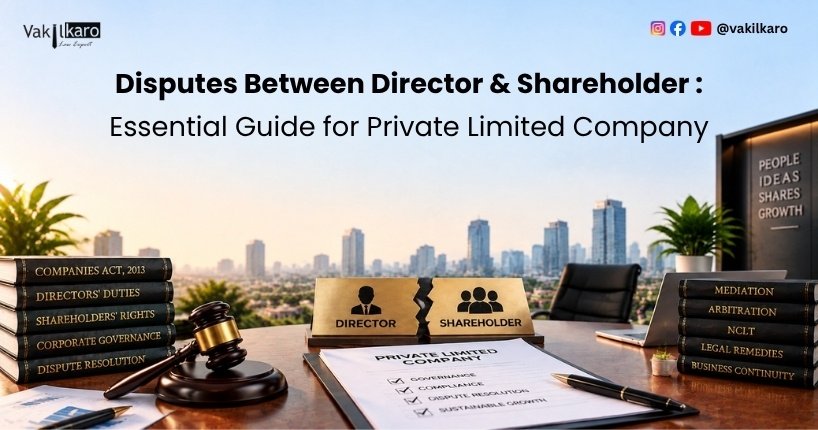
Disputes between directors and shareholders of a Private Limited Company (Pvt Ltd) can arise from issues like governance, shareholding, or financial management. These conflicts, if unresolved, can disrupt operations and attract legal penalties. A strong Shareholders’ Agreement, regular board meetings, and statutory compliance help prevent such disputes. Legal remedies like arbitration, NCLT proceedings, and director removal offer resolution paths. Vakilkaro plays a crucial role in managing these challenges through expert legal support, company registration services, drafting of MOA/AOA, and regulatory filings. Their guidance ensures compliance, reduces risks, and supports business continuity in both Pvt Ltd and Section 8 companies.
Key Takeaways
- Disputes between directors and shareholders of a Private Limited Company (Pvt Ltd) can arise from issues like governance, shareholding, or financial management.
- Resolving Director and Shareholder Disputes in a Private Limited Company Registration: Legal and Practical Insights Conflicts between directors and shareholders in a Private Limited Company Registration (Pvt Ltd) are not uncommon, especially as the company grows and its operations become more complex.
- Common Causes of Disputes in a Private Limited Company Disputes among directors and shareholders in a Private Limited Company (Pvt Ltd) are often rooted in differences of vision, authority, or financial interest.
- Preventive Measures to Minimize Disputes in a Private Limited Company Proactively preventing disputes between directors and shareholders in a Private Limited Company (Pvt Ltd) is critical to maintaining a stable and growth-oriented business environment.
- Role of Financial Reporting and Audits in Preventing Corporate Disputes Financial reporting and audits are vital pillars of corporate governance in any Private Limited Company (Pvt Ltd).
Resolving Director and Shareholder Disputes in a Private Limited Company Registration: Legal and Practical Insights
Conflicts between directors and shareholders in a Private Limited Company Registration (Pvt Ltd) are not uncommon, especially as the company grows and its operations become more complex. These disputes can stem from a variety of issues, including disagreements over management strategies, dissatisfaction with the shareholding pattern, unequal capital contributions, or lack of transparency in business operations and financial reporting. If not addressed promptly, such conflicts may disrupt business continuity, damage reputation, and invite regulatory scrutiny.
A Private Limited Company, being a separate legal entity, operates under the Companies Act, 2013, with its governance and responsibilities clearly defined in the Articles of Association (AOA) and Memorandum of Association (MOA). To minimize disputes, it is vital to have well-drafted corporate documents, including a robust Shareholders’ Agreement that outlines the roles, rights, and responsibilities of each party. Regular board meetings, compliance with Registrar of Companies (ROC) filings, and adherence to statutory requirements further ensure good corporate governance and transparency.
When internal discussions and board resolutions fail to resolve conflicts, legal remedies such as arbitration, mediation, or proceedings before the National Company Law Tribunal (NCLT) under Sections 241 and 242 can be pursued. Directors may also be removed through an Extraordinary General Meeting (EGM) if necessary. Financial transparency—ensured by audits and accurate reporting of the balance sheet, profit and loss account, and cash flow statements—plays a significant role in avoiding misunderstandings.
Vakilkaro offers specialized legal and compliance support in resolving such disputes. From drafting MOA/AOA and Shareholders’ Agreements to representing clients in legal proceedings and managing ROC filings, Vakilkaro’s end-to-end services help startups and SMEs maintain governance, mitigate risks, and stay compliant. With expert assistance, businesses can resolve conflicts effectively and focus on growth with confidence.
As a Private Limited Company (Pvt Ltd) grows, its internal dynamics often become more complex, leading to potential disagreements among directors or shareholders. These disputes are not unusual and may emerge from differences in vision, disagreements over day-to-day management decisions, unequal capital contributions, changes in shareholding patterns, or ambiguities in corporate governance practices. Left unaddressed, such disputes can escalate, negatively impacting business operations, investor confidence, regulatory compliance, and overall reputation.
A Pvt Ltd company, being a separate legal entity under the Companies Act, 2013, is governed by foundational documents like the Memorandum of Association (MOA), Articles of Association (AOA), and shareholder agreements. These documents outline ownership structure, director responsibilities, shareholding rights, and mechanisms for dispute resolution. Despite such legal frameworks, real-world disagreements can still surface—especially when roles are undefined, communication breaks down, or personal interests clash with corporate goals.
Resolving such disputes requires a combination of legal strategy, procedural compliance, and practical negotiation. Common solutions include board resolutions, mediation, buyouts, arbitration, or filing petitions with the National Company Law Tribunal (NCLT) under Sections 241 and 242 for cases of oppression or mismanagement.
This is where Vakilkaro plays a pivotal role. As a leading provider of business incorporation and legal advisory services, Vakilkaro specializes in helping startups, SMEs, and corporate entities handle disputes efficiently and lawfully. Vakilkaro assists in drafting clear shareholder agreements, ensuring regulatory compliance, guiding through ROC filings, and representing parties in legal proceedings. Their expertise reduces the risk of prolonged conflict and ensures alignment with the legal and financial expectations set out under Indian corporate law.
With Vakilkaro's support, companies can navigate internal disputes confidently, maintain smooth governance, and preserve operational stability—ensuring that the focus remains on growth, innovation, and business continuity.
Understanding the Legal Structure of a Private Limited Company
A Private Limited Company (Pvt Ltd) is one of the most preferred forms of business entities in India due to its structured governance, credibility, and legal protections. Governed by the Companies Act, 2013, it is recognized as a separate legal entity, meaning it exists independently of its directors and shareholders. This distinct legal identity enables the company to own assets, incur liabilities, enter into contracts, sue or be sued in its own name—creating a strong shield of limited liability for its stakeholders.
The formation of a Pvt Ltd company begins with company registration through the Ministry of Corporate Affairs (MCA), where it receives a Certificate of Incorporation, a Company Identification Number (CIN), and is officially recognized as a corporate entity. This registration not only brings legal recognition but also facilitates access to banking, credit, fundraising, and market credibility.
At the core of its legal framework are the Memorandum of Association (MOA) and Articles of Association (AOA). The MOA outlines the company’s objectives, scope of operations, and capital structure, while the AOA defines internal rules, governance procedures, director responsibilities, and conflict resolution mechanisms. Together, they form the constitution of the company and serve as guiding documents when disputes or ambiguities arise among directors or shareholders.
In case of disagreements, these foundational documents are examined to determine the intent and authority behind decisions, shareholding rights, and roles of key managerial personnel. Any deviation from the prescribed structure can be legally contested, making their clarity and compliance crucial.
Vakilkaro provides end-to-end assistance in drafting and reviewing MOA, AOA, and shareholder agreements. Their legal experts ensure that your company’s foundational documents are robust, compliant, and designed to minimize future conflicts—offering a proactive layer of protection as your business grows and evolves.
Common Causes of Disputes in a Private Limited Company
Disputes among directors and shareholders in a Private Limited Company (Pvt Ltd) are often rooted in differences of vision, authority, or financial interest. These conflicts can severely impact the governance, efficiency, and reputation of the company if not addressed in a timely and structured manner.
One major cause is divergent visions for corporate strategy. As the company evolves, stakeholders may have conflicting opinions about its future direction—whether to scale rapidly, pursue new markets, or maintain conservative growth. Such strategic disagreements can create tension among board members and derail unified decision-making.
Another common issue arises from unequal capital contributions or dissatisfaction with the shareholding pattern. Shareholders may feel sidelined if their investment does not translate into proportional influence or benefits, leading to disputes over voting rights, dividends, or equity dilution.
Conflicts also occur due to disagreements over board resolutions or director responsibilities. Differences in opinion regarding management decisions, executive roles, and authority levels often lead to a breakdown in communication and trust among directors.
Lack of transparency in financial reporting—such as irregular disclosures, suspicious transactions, or non-compliance with statutory audit requirements—can further fuel mistrust. Stakeholders may feel that the company’s resources are being misused or that they are being kept in the dark about key business operations.
Issues with the transfer of shares or disputes over beneficial ownership are especially sensitive in closely-held companies. Conflicts may arise if shares are sold without consent, or when disputes occur over succession and rights in family-owned businesses.
Finally, a breach of the shareholders’ agreement or employment contracts—whether it involves violating non-compete clauses, profit-sharing terms, or exit provisions—can trigger legal battles.
Resolving such disputes requires a blend of contractual clarity, statutory remedies under the Companies Act, and judicial intervention where necessary. Legal support from platforms like Vakilkaro is crucial, offering expertise in mediation, documentation, and regulatory compliance to safeguard the company’s continuity and stakeholder interests.
Preventive Measures to Minimize Disputes in a Private Limited Company
Proactively preventing disputes between directors and shareholders in a Private Limited Company (Pvt Ltd) is critical to maintaining a stable and growth-oriented business environment. Establishing clear legal, procedural, and governance frameworks can significantly reduce the risk of internal conflict.
One of the most effective ways to prevent disputes is by drafting a comprehensive Shareholders' Agreement and Board Governance Policy. These documents should clearly define the rights, responsibilities, and obligations of each shareholder and director, as well as decision-making protocols, dispute resolution mechanisms, and exit strategies. This creates legal clarity and minimizes ambiguity, especially during high-stakes decisions.
Equally important is the clear definition of roles for the Managing Director, Key Managerial Personnel (KMP), and Company Secretary. A detailed assignment of duties prevents overlap, confusion, or power struggles. Each member’s scope should be laid out in accordance with the Companies Act, 2013, and reflected in the company’s Articles of Association (AOA).
Regular board meetings, Annual General Meetings (AGMs), and Extraordinary General Meetings (EGMs) are essential for transparent governance. These platforms allow for open discussions, approval of major resolutions, and periodic review of the company's performance and policies. Documenting these meetings through board resolutions also creates a legal trail, which is useful in the event of future disputes.
Adhering to secretarial standards and statutory compliance, such as timely filing with the Registrar of Companies (ROC), is vital to maintaining corporate legitimacy. Non-compliance not only leads to penalties but can also become a source of internal conflict.
Additionally, implementing clear protocols for preparing and reviewing financial statements, including the balance sheet, profit and loss account, and auditor's report, ensures financial transparency. This builds trust among stakeholders and reduces suspicions related to fund mismanagement.
Vakilkaro plays a significant role in helping startups and businesses implement these preventive measures. Through expert legal advisory, drafting of governance documents, and compliance services, Vakilkaro ensures that companies operate within a structured legal framework—minimizing the risk of disputes and enhancing operational efficiency.
Internal Resolution Mechanisms
a. Board Discussions
Many conflicts can be addressed through open discussion in board meetings, documented via board resolutions.
b. Mediation by Company Secretary
A neutral Company Secretary or external facilitator can mediate disputes before they escalate.
c. Internal Committees
Establishing grievance redressal or compliance committees helps in resolving matters internally, especially in larger organizations.
Legal Remedies and Statutory Processes
When internal measures fail, the following legal options can be pursued:
a. Arbitration and Mediation
If a Shareholders' Agreement includes an arbitration clause, disputes can be settled privately through Alternative Dispute Resolution (ADR) mechanisms like arbitration or mediation, saving time and legal costs.
b. Oppression and Mismanagement (Section 241 & 242 of Companies Act)
Shareholders who feel oppressed or believe there is mismanagement can file a petition with the National Company Law Tribunal (NCLT).
c. Breach of Director Duties
Directors violating fiduciary duties or indulging in corporate misconduct can be held accountable under the Companies Act, attracting penalties or disqualification.
d. Removal or Replacement of Directors
Using majority consensus in an EGM, directors may be removed or replaced following procedures laid out in the Companies Act.
Role of Financial Reporting and Audits in Preventing Corporate Disputes
Financial reporting and audits are vital pillars of corporate governance in any Private Limited Company (Pvt Ltd). Their importance becomes even more pronounced when it comes to avoiding or resolving disputes between directors and shareholders. Clear, accurate, and timely financial disclosures promote transparency, reduce suspicion, and establish trust among all stakeholders.
A well-maintained set of financial statements—including the balance sheet, profit and loss account, and cash flow statements—offers a comprehensive view of the company’s financial health. These documents help track capital contribution, equity distribution, and working capital utilization, which are often the focal points in shareholder disagreements.
The internal audit process evaluates internal controls, financial practices, and risk management systems. When conducted regularly, it helps detect inconsistencies or potential compliance breaches early. This is particularly useful for spotting mismanagement of funds or unauthorized transactions, which can otherwise trigger disputes among directors or investors.
On the other hand, an external audit, performed by a statutory auditor, serves as an independent review of the company’s financials. It reinforces credibility with shareholders and regulatory bodies by verifying that financial reporting is in line with applicable laws, such as the Companies Act, 2013, and secretarial standards. The Auditor’s Report acts as an impartial statement of financial integrity and is crucial during corporate litigation or regulatory inspections.
Proper audits also support transparency in debt financing, equity funding, and mergers and acquisitions (M&A), minimizing the risk of disputes related to business valuation or exit strategy.
Platforms like Vakilkaro help ensure robust financial reporting by connecting companies with expert auditors and compliance professionals. From selecting a statutory auditor to filing annual returns with the Registrar of Companies (ROC), Vakilkaro supports companies in building a trustworthy financial system—ultimately safeguarding them from avoidable conflicts and legal liabilities.
Shareholding Disputes: Buyouts and Exit Options
Disputes among shareholders can be resolved through:
- Buy-back of shares
- Valuation-based exit strategy
- Transfer of shares to a third party
- Court-ordered exit plans in extreme cases
A proper exit strategy and documented business valuation methods are essential, especially in the context of private equity or venture capital investments.
Special Considerations for Section 8 Company Registration
In Section 8 companies (non-profits), disputes are more mission-driven. Company registration under Section 8 restricts share distribution and focuses on objective-driven governance. Hence, disputes are typically around execution, leadership, and compliance rather than profit.
Resolutions follow the same Companies Act framework but emphasize compliance with the Registrar of Companies (ROC) and audit and assurance standards.
Compliance and Litigation Risks
Unresolved disputes can lead to:
- Breach of compliance
- Legal liabilities
- Corporate litigation
- Regulatory inspections
Non-compliance with annual filing, income tax returns (ITR), or Goods and Services Tax (GST) can attract severe penalties.
Technology and Compliance Management Tools
Digital tools like Corporate Compliance Software, e-Governance portals, and cloud-based document repositories enhance transparency. Platforms like MCA21 (Ministry of Corporate Affairs) simplify tracking of Digital Signature Certificate (DSC), DIN Registration, and compliance submissions.
Vakilkaro’s Role in Dispute Resolution and Compliance
As a premier provider of Business Incorporation Services and Legal Advisory, Vakilkaro supports startups and SMEs in navigating complex corporate disputes.
Vakilkaro assists with:
- Drafting Shareholders’ Agreements and MOA/AOA
- Conducting startup registration and Private Limited Company registration
- Representing clients in NCLT or arbitration proceedings
- Ensuring statutory compliance and ROC filings
- Managing company registration for Section 8 companies
Vakilkaro’s holistic approach helps entrepreneurs maintain ease of doing business, minimize litigation risks, and focus on growth.
Conclusion
Disputes between directors or shareholders are part of the growing pains of any corporate entity. However, with clear documentation, open communication, and legal safeguards, most of these can be resolved amicably. Utilizing internal mechanisms, honoring agreements, and leveraging external arbitration or judicial forums ensures business continuity.
With experts like Vakilkaro by your side, companies can not only handle disputes efficiently but also maintain strong governance and compliance. Whether you're navigating a boardroom standoff or planning a business expansion, timely legal intervention makes all the difference in sustaining the long-term health of a Pvt Ltd company.
Official External Resources
Use these primary/official sources to verify rules, forms, fees, timelines and regulatory updates before publication.
Frequently asked questions
Disputes Between Director & Shareholder: Essential Guide for Private Limited Company+
Disputes between directors and shareholders of a Private Limited Company (Pvt Ltd) can arise from issues like governance, shareholding, or financial management. Resolving Director and Shareholder Disputes in a Private Limited Company Registration: Legal and Practical Insights Conflicts between directors and shareholders in a Private Limited Company Registration (Pvt Ltd) are not uncommon, especially as the company grows and its operations become more complex.
