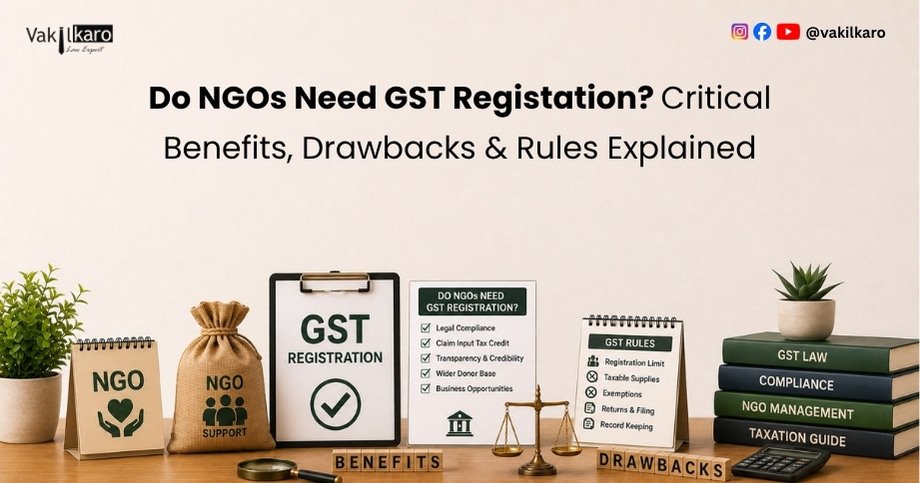
Non-Governmental Organizations (NGOs) contribute significantly to social welfare in India and often operate under Section 8 company registration, NGO registration, and hold 12A and 80G certifications. While charitable activities are mostly exempt from GST, NGOs must register for GST if their annual turnover exceeds prescribed thresholds or if they engage in taxable services such as selling goods or charging fees. Even with 12A and 80G registration, NGOs are not automatically exempt from GST. Compliance with GST regulations—registration, filing returns, and maintaining records—is crucial for NGOs conducting commercial activities to avoid penalties and ensure legal standing.
Key Takeaways
- However, a crucial question that arises for many NGOs is whether they need to register for Goods and Services Tax (GST), and if so, under what conditions.
- In this blog, we will explore whether NGOs need to register for GST, the conditions under which they must do so, and the various provisions applicable to NGOs under the GST framework.
- Specific Exemptions for NGOs under GST While many NGOs may need to register for GST, certain exemptions apply to specific activities carried out by NGOs, which could help them avoid the need for GST registration.
- While 12A and 80G registration help NGOs maintain their charitable status and provide benefits to donors, GST registration is required for certain commercial activities, regardless of the NGO’s tax-exempt status.
- Conclusion In conclusion, NGOs need to evaluate their activities and income thresholds to determine whether they need to register for GST.
Do NGOs Need GST Registration? Key Insights for Section 8, 12A & 80G Registered Entities
Non-Governmental Organizations (NGOs) play a vital role in supporting community development, addressing social issues, and delivering essential services across India. Most NGOs operate under legal frameworks such as Section 8 company registration, NGO registration, and are often granted tax benefits through 12A and 80G registration. These credentials help them function as charitable, non-profit entities. However, a common question arises: are NGOs required to register under the Goods and Services Tax (GST) regime?
The answer depends largely on the nature of the NGO’s activities and their annual turnover. While the primary aim of NGOs is not profit, they may still be liable for GST registration if they offer goods or services in exchange for money and if their revenue exceeds the prescribed GST threshold. Currently, service-based NGOs must register if their annual turnover exceeds ₹20 lakhs (₹10 lakhs in special category states), while those supplying goods have a higher threshold of ₹40 lakhs (₹20 lakhs in special category states).
GST applies only to taxable supplies. So, if an NGO is solely involved in charitable services like education, healthcare, or relief for the poor—as outlined in GST exemptions—they may not be required to register. However, if the NGO sells products, charges for training, conducts events for a fee, or provides consultancy services, it may fall under the taxable category.
It’s important to note that having 12A or 80G registration does not automatically exempt an NGO from GST compliance. These certifications only relate to income tax exemptions and donor benefits. Thus, NGOs must separately evaluate their GST liability and, if applicable, complete the registration, charge appropriate taxes, file GST returns, and maintain compliance. Doing so ensures their legal status remains intact and avoids penalties.
Non-Governmental Organizations (NGOs) play a pivotal role in societal development and community welfare. Whether working to combat poverty, improve healthcare, provide education, or address environmental concerns, NGOs contribute significantly to the welfare of society. In India, NGOs are often governed by specific legal frameworks, such as Section 8 company registration, NGO registration, and 12A and 80G registration. However, a crucial question that arises for many NGOs is whether they need to register for Goods and Services Tax (GST), and if so, under what conditions.
GST is a comprehensive indirect tax that has replaced various forms of indirect taxes, such as VAT, service tax, and excise duties. The introduction of GST aims to streamline and simplify the tax regime in India, but it also brings new compliance requirements for businesses and organizations. Understanding whether an NGO needs to register for GST depends on a range of factors, including the nature of its activities, income thresholds, and the type of NGO registration it holds.
In this blog, we will explore whether NGOs need to register for GST, the conditions under which they must do so, and the various provisions applicable to NGOs under the GST framework.
Understanding GST and its Relevance for NGOs
GST, as mentioned earlier, is an indirect tax levied on the supply of goods and services. It applies to businesses and organizations that engage in the supply of goods or services for consideration. However, NGOs, which often provide services and goods for charitable purposes, may wonder if they fall within the GST ambit.
While NGOs are generally formed with the intent to serve the public good without a profit motive, certain activities performed by these organizations could be taxable under GST. Therefore, it is essential for NGOs to understand their operational model and financial thresholds to determine whether they need to register for GST.
When does an NGO Need to Register for GST?
NGOs are required to register for GST if they meet specific conditions, which are largely based on the nature of the services and goods they provide, their turnover, and whether they are involved in taxable activities. The conditions for mandatory GST registration for NGOs are as follows:
Annual Turnover Exceeds the GST Threshold Limit
The Goods and Services Tax (GST) Act stipulates that any entity, including NGOs, with an annual turnover exceeding a specified limit must register for GST. As of the current GST guidelines, this threshold varies depending on the type of business or entity:
- For service providers: The turnover threshold for GST registration is ₹20 lakhs (₹10 lakhs for special category states).
- For goods suppliers: The turnover threshold for GST registration is ₹40 lakhs (₹20 lakhs for special category states).
This means that if an NGO’s annual income from taxable activities exceeds these limits, it must mandatorily register for GST. However, it’s essential to note that the total turnover includes the income from both taxable and non-taxable activities, so NGOs must carefully track their revenue to determine whether they surpass the threshold.
NGO Engaged in Business Activities or Commercial Services
Another key factor in determining whether an NGO needs to register for GST is whether it engages in business or commercial activities. The GST law applies to organizations that provide goods or services for consideration (i.e., for a price). Many NGOs operate by offering services for free or at a nominal cost. However, NGOs that generate revenue from activities such as selling goods, providing paid services, or engaging in commercial ventures are subject to GST.
Examples of taxable activities that may require GST registration for an NGO include:
- Selling goods, such as clothing, food, or educational materials.
- Charging fees for services like training, education, or workshops.
- Providing consultancy services or running charitable businesses.
- Engaging in events or exhibitions that involve sales or entry fees.
In such cases, the NGO will need to apply for GST registration and comply with the filing requirements.
NGO Providing Services to the Government
If an NGO is involved in providing services to the government or governmental bodies, GST registration may be required. However, if the NGO is providing services that are exempt under the GST Act, it may not need to register. Services provided to the government for a consideration are generally subject to GST unless specifically exempt. Therefore, NGOs must assess whether the services they are providing fall under the exempt category.
For instance, if an NGO receives government funding for a specific project and charges the government for services rendered, the NGO may need to register for GST.
NGO Providing Taxable Services or Goods under GST
Certain services and goods provided by NGOs are exempted from GST, but many are taxable depending on the nature of the activity. For example:
- Educational services: If an NGO provides educational services, it may be exempt from GST if it falls under the criteria for exempted educational institutions.
- Health services: If an NGO operates a hospital or clinic, it might be exempt from GST if the services provided are covered under health-related exemptions.
However, if the NGO is involved in selling products like food, clothing, or books that are taxable under GST, it will need to register and follow the prescribed GST regulations.
Specific Exemptions for NGOs under GST
While many NGOs may need to register for GST, certain exemptions apply to specific activities carried out by NGOs, which could help them avoid the need for GST registration. Here are some important exemptions that may apply to NGOs:
Exemption for Charitable Activities
Under GST, services provided by NGOs for charitable purposes are exempt from tax. According to the GST law, charitable activities include the following:
- Relief to the poor.
- Education services.
- Healthcare services.
- Promotion of religious or spiritual causes.
If an NGO primarily provides these services and does not engage in business activities, it may be exempt from GST registration, provided it meets the criteria established by the government.
Exemption for Educational Services
NGOs that run educational programs or schools may qualify for exemption from GST, provided the services fall under the definition of educational services under the law. For example, if the NGO runs a school or educational institution providing education below the degree level, it may not need to register for GST.
Exemption for Healthcare Services
Similarly, NGOs providing healthcare services or operating hospitals may be exempt from GST, as healthcare services are often excluded from GST under the exemption category.
Donations and Gifts
Donations and gifts received by NGOs are generally not taxable under GST, as they are not considered “supply” under the GST Act. However, if the NGO provides goods or services in return for a donation or gift, GST may apply.
Impact of Section 8 Company Registration on GST
Section 8 company registration refers to the registration of a non-profit organization under the Companies Act, 2013. These organizations are formed for charitable purposes and do not intend to distribute profits. While Section 8 companies are primarily exempt from paying income tax under Section 8 of the Income Tax Act, they are not automatically exempt from GST. If a Section 8 company engages in any taxable activity (such as selling goods or providing paid services), it will still be required to register for GST if its turnover exceeds the prescribed limit.
Section 8 companies must assess whether their activities trigger GST registration requirements. However, as long as the activities remain charitable and fall under the exempt categories, GST registration may not be necessary.
NGO Registration and GST Compliance
NGO registration typically refers to the process of registering as a Trust, Society, or under Section 8 company registration. Once registered, NGOs must determine whether they qualify for GST registration based on the nature of their activities. NGOs that fall within the scope of taxable activities should ensure compliance with GST provisions, including:
- Obtaining GST registration if required.
- Charging GST on taxable services or goods.
- Filing GST returns on time.
- Maintaining accurate records for tax purposes.
Failure to comply with GST requirements may result in penalties and other legal issues, making it crucial for NGOs to stay informed about their obligations under GST.
12A and 80G Registration and GST Compliance
NGOs that are registered under 12A and 80G receive significant tax exemptions, which benefit both the NGO and its donors. However, having 12A and 80G registration does not automatically exempt an NGO from GST obligations if it engages in taxable activities. NGOs with these registrations must still assess their income, turnover, and activities to determine whether GST registration is necessary.
It’s important for NGOs to understand that GST compliance and tax exemptions are separate. While 12A and 80G registration help NGOs maintain their charitable status and provide benefits to donors, GST registration is required for certain commercial activities, regardless of the NGO’s tax-exempt status.
Conclusion
In conclusion, NGOs need to evaluate their activities and income thresholds to determine whether they need to register for GST. If an NGO's turnover exceeds the prescribed limits or if it engages in taxable activities, it must apply for GST registration. However, many charitable activities carried out by NGOs are exempt from GST, including education, healthcare, and certain services related to poverty alleviation.
By understanding the conditions under which GST registration is required, NGOs can ensure compliance with the law while continuing to carry out their essential work. NGOs registered under Section 8, with NGO registration, 12A, or 80G certifications must be aware of the intersection between these tax exemptions and GST obligations to maintain their legal standing and avoid penalties.
Why Choose Vakilkaro for GST and Other Legal Services for NGOs?
Vakilkaro stands out as a trusted partner for NGOs, startups, and businesses seeking reliable legal, compliance, and tax-related solutions in India. Here’s why choosing Vakilkaro for GST registration, Section 8 company registration, 12A and 80G certification, and other legal services is a smart decision:
Expertise in NGO and Compliance Laws
Vakilkaro has a dedicated team of legal experts and consultants who specialize in NGO registration, GST compliance, Section 8 incorporation, and obtaining 12A and 80G certifications. Their in-depth understanding of the legal landscape ensures that NGOs are set up and run smoothly, in full compliance with Indian laws.
End-to-End Legal Solutions
From company formation to tax exemption and GST registration, Vakilkaro offers complete legal support under one roof. Whether you are starting a new NGO, managing an existing one, or expanding your operations, Vakilkaro simplifies the process with hassle-free documentation, timely filing, and personalized legal guidance.
Affordable and Transparent Pricing
Vakilkaro believes in transparency and cost-effectiveness. Their service packages are competitively priced with no hidden costs, making legal compliance accessible even for small NGOs or social enterprises with limited budgets.
Timely and Efficient Service
Understanding the importance of deadlines in legal matters, Vakilkaro ensures swift processing of registrations and compliance filings. Their proactive support team stays in touch through every step, so clients never miss a compliance date.
Client-Centric Support
Vakilkaro values relationships and offers personalized assistance tailored to the specific needs of each NGO. Whether it’s a clarification on GST applicability or help with legal drafting, their support team is always available.
Choosing Vakilkaro means choosing peace of mind, legal accuracy, and expert support for your NGO’s journey.
Official External Resources
Use these primary/official sources to verify rules, forms, fees, timelines and regulatory updates before publication.
Frequently asked questions
Do NGOs Need GST Registation? Critical Benefits, Drawbacks & Rules Explained+
However, a crucial question that arises for many NGOs is whether they need to register for Goods and Services Tax (GST), and if so, under what conditions. Specific Exemptions for NGOs under GST While many NGOs may need to register for GST, certain exemptions apply to specific activities carried out by NGOs, which could help them avoid the need for GST registration.
