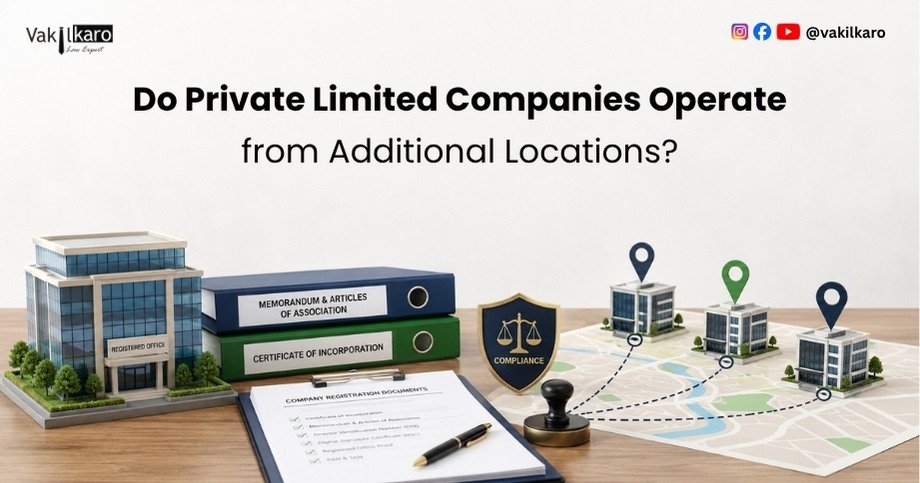
Establishing a Private Limited Company (Pvt Ltd) allows businesses to operate beyond their registered office by opening branches, factories, sales offices, or warehouses. Whether through Private Limited Company registration, Company registration, or Section 8 Company registration, expanding to additional locations requires proper documentation, board resolutions, and ROC compliance. Managing multiple sites strengthens corporate governance, financial reporting, and fundraising opportunities. It also helps with risk management and business strategy. For sustainable expansion and legal security, companies must update GST registrations, financial statements, and comply with the Companies Act. Vakilkaro offers end-to-end support for seamless multi-location compliance.
Key Takeaways
- Whether through Private Limited Company registration, Company registration, or Section 8 Company registration, expanding to additional locations requires proper documentation, board resolutions, and ROC compliance.
- Expanding a Private Limited Company: Managing Additional Business Locations When a Private Limited Company (Pvt Ltd) grows, it often needs to operate from multiple locations such as branches, factories, sales offices, or warehouses.
- For a Private Limited Company (Pvt Ltd) or any registered corporate entity, effectively managing and legally reporting these additional business locations is essential.
- Whether you have recently completed your Private Limited Company registration, opted for general Company registration, or completed a Section 8 Company registration (in the case of non-profit organizations), it is crucial to understand the legal significance, procedural obligations, and documentation requirements for managing additional places of business.
- For a Private Limited Company (Pvt Ltd) or any legally incorporated entity, properly reporting additional locations — such as branches, factories, warehouses, and service centers — is not just a good practice; it is a regulatory necessity.
Expanding a Private Limited Company: Managing Additional Business Locations
When a Private Limited Company (Pvt Ltd) grows, it often needs to operate from multiple locations such as branches, factories, sales offices, or warehouses. After completing Private Limited Company registration, Company registration, or even Section 8 Company registration for non-profits, businesses must ensure that every additional location complies with regulatory requirements.
Opening additional places of business isn’t just about expansion — it demands structured compliance under Indian Company Law. Companies must pass a Board Resolution, notify the Registrar of Companies (ROC) through proper filings like INC-22, and update documents like the Memorandum of Association (MOA) and Articles of Association (AOA) if necessary. For each new branch, supporting documents such as ownership proof, rental agreements, and a No Objection Certificate (NOC) from property owners are required.
Beyond legal formalities, maintaining accurate records of operational locations supports strong corporate governance and aids financial reporting. Proper documentation across sites enhances the company’s credibility with stakeholders, including investors during fundraising rounds, and during venture capital or private equity evaluations. Moreover, clear records help during statutory audits, tax filings like Income Tax Return (ITR) and Goods and Services Tax (GST) compliance.
Managing multiple locations also ties closely to efficient risk management, ensuring that contractual obligations are fulfilled, regulatory inspections are smooth, and potential legal liabilities are minimized. By keeping operations transparent and well-documented, companies also strengthen their case for future growth strategies like Mergers and Acquisitions (M&A) or even a potential Initial Public Offering (IPO).
Partnering with compliance experts like Vakilkaro ensures that companies can easily navigate the complexities of expanding to new locations, fulfilling all statutory obligations, and maintaining a strong corporate foundation for sustained growth.
In today’s rapidly evolving and highly competitive business landscape, many companies find themselves quickly outgrowing their initial operations. To support expansion, scale their reach, or serve new markets, businesses often establish operations across multiple locations — including branches, factories, sales offices, regional offices, and warehouses. Whether it’s driven by increased customer demand, geographic market penetration, or the need for decentralized manufacturing and service delivery, operating from multiple sites is a natural progression for growing businesses.
For a Private Limited Company (Pvt Ltd) or any registered corporate entity, effectively managing and legally reporting these additional business locations is essential. It ensures statutory compliance, strengthens corporate governance, improves operational efficiency, and fosters greater corporate transparency among shareholders, regulators, and investors. In India, these requirements are governed by various provisions under the Companies Act, 2013 and regulations enforced by the Registrar of Companies (ROC).
Whether you have recently completed your Private Limited Company registration, opted for general Company registration, or completed a Section 8 Company registration (in the case of non-profit organizations), it is crucial to understand the legal significance, procedural obligations, and documentation requirements for managing additional places of business. Proper reporting and governance not only ensure compliance but also facilitate smoother audits, support fundraising initiatives, and enhance the organization's public credibility.
In this comprehensive guide, we will delve deep into how companies should approach setting up, documenting, and reporting additional business locations. We will explore the legal responsibilities, the necessary documentation to be filed, the compliance framework, and the strategic importance of multi-location operations in business expansion. Through this, you will gain a complete understanding of how managing additional locations is a key pillar in building a strong, compliant, and future-ready corporate entity.
Understanding the Corporate Structure: Pvt Ltd Companies and Separate Legal Entity Status
A Private Limited Company enjoys the advantage of being a separate legal entity distinct from its owners (shareholders) and Board of Directors. This means it can own property, operate multiple offices, hire employees, and engage in legal proceedings independently.
The concept of limited liability protects shareholders' personal assets from company debts. After incorporation and receiving the Certificate of Incorporation, companies obtain a Company Identification Number (CIN), which is unique to each business entity.
At the time of company registration, businesses provide details of their Registered Office Address, which becomes their principal place of operations. However, they can operate from additional places with due reporting and compliance.
What Are Additional Locations?
In the lifecycle of a growing business, especially a Private Limited Company (Pvt Ltd) or a registered corporate entity, it is often necessary to expand operations beyond the primary Registered Office Address. These expanded operational bases are known as additional locations. In simple terms, an additional location refers to any premises — apart from the registered office — from which the company actively conducts its business activities, manages its production, or provides services.
Additional locations can encompass a wide variety of operational setups, including:
- Branch Offices: These are separate offices established to extend the company’s operations geographically, providing services, marketing, customer support, or administrative functions in new regions.
- Factories and Manufacturing Units: For companies engaged in production, having dedicated manufacturing facilities separate from the corporate office is crucial for operational efficiency.
- Sales Offices: Set up primarily to handle regional or local sales, marketing, and customer engagement activities.
- Warehouses and Storage Units: Used for storing inventory, raw materials, and finished goods, warehouses often support both sales operations and logistics.
- Regional Offices: Larger companies may establish regional offices to act as administrative hubs for different geographic zones within the country.
- Service Centers: Particularly important for companies offering after-sales support, maintenance, or warranty services.
Each of these additional premises must be properly documented and, depending on the nature and extent of operations, may need to be registered or updated with the Registrar of Companies (ROC). Compliance with ROC filings ensures that the company's corporate profile remains accurate and transparent, reflecting its true operational footprint.
Failing to appropriately document or declare these locations can result in statutory compliance issues, penalties, or complications during audits and fundraising. Thus, a clear, proactive approach to managing additional locations is a hallmark of sound corporate governance and long-term operational success.
Importance of Reporting Additional Business Locations
As businesses grow and diversify, maintaining accurate records of all operational locations becomes essential to uphold transparency and meet regulatory expectations. For a Private Limited Company (Pvt Ltd) or any legally incorporated entity, properly reporting additional locations — such as branches, factories, warehouses, and service centers — is not just a good practice; it is a regulatory necessity.
Firstly, Statutory Compliance demands it. Under the Companies Act, 2013, companies must inform the Registrar of Companies (ROC) about their principal and additional places of business. Filing the necessary forms, like INC-22, ensures that the company’s legal records are updated and correct. Failure to comply with these requirements can attract penalties, regulatory scrutiny, and impact the company’s standing with government authorities.
Secondly, proper reporting strengthens Corporate Governance. Transparent disclosure of operational sites reflects the company’s commitment to ethical management practices. It assures stakeholders — including investors, shareholders, and regulators — that the company operates responsibly, maintains clear records, and adheres to the principles of good governance.
From a Financial Reporting perspective, operations from multiple locations can influence how a company structures its Financial Statements, including the Balance Sheet and Profit and Loss Account. Accurate segmentation and reporting of income, expenses, and assets across various sites help maintain clean and audit-ready financial records.
Moreover, Audit and Assurance processes demand full visibility into all operational centers. Both internal auditors and statutory auditors need to verify the existence, functioning, and financial impact of each location. Undisclosed locations can raise red flags during audits and damage the company's credibility.
Finally, robust Risk Management practices emphasize documenting all locations to minimize exposure to legal liabilities, regulatory non-compliance, and operational risks. Proper reporting ensures smoother regulatory inspections, better preparedness during disputes, and stronger protection against unexpected compliance breaches.
In short, accurate and timely reporting of additional business locations is fundamental to legal compliance, financial health, corporate integrity, and sustainable business growth.
Legal Requirements for Declaring Additional Locations
When a Pvt Ltd or Section 8 Company opens a branch or additional office, it must:
- Pass a Board Resolution approving the new place of business.
- Notify the Registrar of Companies (ROC) using prescribed forms such as INC-22.
- Update changes in the MOA and AOA, if required.
- Reflect additional locations in Annual Returns and Annual Filing with ROC.
- Update GST registration (different locations may require different GSTINs).
Failure to report can attract penalties, breach of statutory compliance, and even regulatory actions.
Documentation Required for Additional Locations
Documents generally required include:
- Proof of ownership (Sale Deed) or rent agreement
- No Objection Certificate (NOC) from the property owner
- Utility Bill (not older than 2 months)
- Board Resolution approving the use of additional premises
- GST registration update (if applicable)
Board of Directors and KMP Responsibilities
The Board of Directors, including the Managing Director and Key Managerial Personnel (KMP) like the Company Secretary, must ensure that:
- Proper authorization is obtained for new offices.
- Filing is done on time with the ROC.
- Director Identification Number (DIN) is properly updated in all filings.
- Minutes of Board Meetings, AGMs, and EGMs reflect decisions regarding additional locations.
Shareholding Pattern and Additional Locations
While opening new locations does not directly affect the shareholding pattern, it impacts the overall operational structure. Transparency in managing Equity Shares, Preference Shares, Authorized Capital, and Paid-up Capital becomes vital when the business scales operations.
Statutory Compliance and Financial Reporting
Operating from multiple locations impacts:
- Annual Filing (AOC-4, MGT-7)
- Financial Statements (Balance Sheet, Profit and Loss Account)
- Auditor’s Report
- Cash Flow Management across locations
- Working Capital planning and management
It also becomes crucial for taxation compliance, especially for Goods and Services Tax (GST) and Income Tax Return (ITR) filings.
Financial Impact of Additional Locations
Financial implications include:
- Managing Debt Financing and Equity Financing across branches.
- Allocating budgets for rent, payroll, and operational costs at different sites.
- Cash Flow and liquidity management across multiple accounts.
- Preparing consolidated Auditor’s Reports for multiple operational locations.
Corporate Strategy and Business Operations
Managing multiple operational locations demands a robust corporate strategy, including:
- Setting up distinct corporate bank accounts if needed.
- Drafting vendor agreements and employment contracts for staff at different branches.
- Protecting innovations via Intellectual Property Rights (IPR).
- Managing compliance through Corporate Compliance Software.
Risk Management at Additional Locations
Operating from several sites introduces risks, including:
- Contractual Obligations with landlords and suppliers.
- Legal Liabilities arising from local disputes.
- Regulatory Inspections and Breach of Compliance.
- Managing Corporate Litigation, if issues arise.
Companies should also prepare strategies for crisis management and dispute resolution mechanisms like arbitration and mediation.
Fundraising and Business Expansion
Investors and venture capital firms closely examine operational structures during fundraising rounds. Well-managed branches or factories:
- Boost business valuation.
- Facilitate Private Equity and Mergers & Acquisitions (M&A).
- Lay groundwork for eventual Initial Public Offering (IPO), if planned.
SME Compliance, Ease of Doing Business, and Entrepreneurship
In today’s startup ecosystem, adhering to SME compliance rules and promoting ease of doing business is vital. New entrepreneurs benefit from streamlined Startup Registration, better business incorporation services, and faster approvals for additional branches.
How Vakilkaro Can Help?
At Vakilkaro, we specialize in:
- Private Limited Company registration
- Section 8 Company registration
- Managing ROC compliance for additional offices
- Drafting Board Resolutions and NOC letters
- GST registration updates for new locations
- Legal advisory on expanding corporate presence
Our experienced team ensures end-to-end assistance in setting up and legally managing multiple business locations, boosting your company’s growth while staying compliant.
Conclusion
Expanding your business operations through additional branches, factories, warehouses, or offices is a natural part of business growth. However, for a Private Limited Company (Pvt Ltd), ensuring that every location is legally compliant and properly documented is critical for protecting the company’s separate legal entity status, maintaining limited liability, and supporting long-term business ambitions.
Proper reporting, updating the Registrar of Companies (ROC), adhering to Company Law, maintaining clean Financial Statements, and following best practices in corporate governance and risk management ensure a stable foundation for growth.
If your company is planning expansion or already operating through multiple locations, it’s wise to consult legal and compliance experts like Vakilkaro to safeguard your operational footprint and unlock greater success.
Official External Resources
Use these primary/official sources to verify rules, forms, fees, timelines and regulatory updates before publication.
Frequently asked questions
Do Private Limited Companies Operate from Additional Locations?+
Whether through Private Limited Company registration, Company registration, or Section 8 Company registration, expanding to additional locations requires proper documentation, board resolutions, and ROC compliance. Expanding a Private Limited Company: Managing Additional Business Locations When a Private Limited Company (Pvt Ltd) grows, it often needs to operate from multiple locations such as branches, factories, sales offices, or warehouses.
