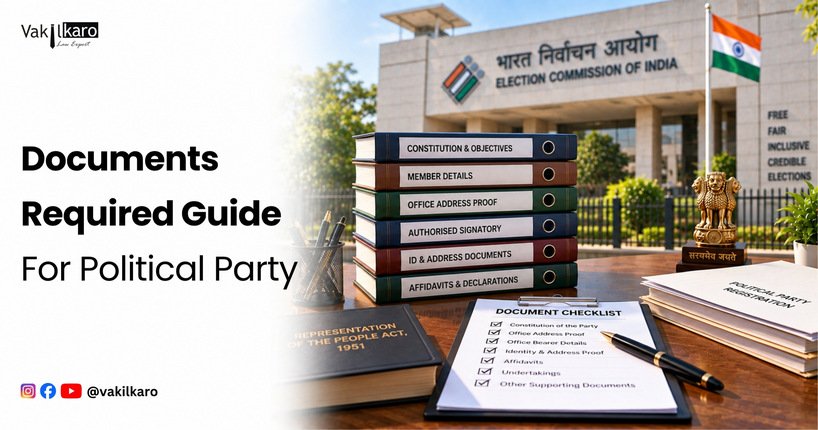
Why Proper Documentation is Important
The Election Commission evaluates the registration application on the basis of the information and supporting documents submitted by the applicant.
Professionally prepared documentation generally helps:
- Improve Application Quality
- Reduce Procedural Delays
- Strengthen Legal Compliance
- Improve Organisational Credibility
- Support Long-Term Governance
Incomplete documentation may result in additional clarification requests.
Document Summary Table
Complete Documents Required
Although the exact documentation depends upon the applicable legal framework and Election Commission requirements, applicants generally prepare the following categories of documents.
1. Organisational Documents
Professional applications generally include:
- Political Party Constitution
- Registration Application
- Resolution for Formation
- Party Objectives
- Organisational Structure
These documents establish the identity of the proposed political party.
2. Founding Member Documents
Founding members generally provide:
- Identity Proof
- Address Proof
- Passport-size Photograph
- Contact Details
The information should remain consistent throughout the application.
3. Office Bearer Documents
Professional applications generally include details of:
- President
- Vice-President
- General Secretary
- Treasurer
- Other Office Bearers
Supporting identity documentation should also be maintained.
4. Registered Office Documents
Applicants generally prepare:
- Office Address Proof
- Ownership or Occupancy Documents
- Utility Documents (where applicable)
The office should be capable of receiving official correspondence.
5. Party Constitution
The Party Constitution generally contains:
- Objectives
- Membership Rules
- Governance Structure
- Internal Elections
- Financial Administration
- Disciplinary Procedure
- Amendment Process
It is one of the most important documents submitted during registration.
6. Affidavits & Declarations
Professional applications generally include the affidavits, declarations and undertakings prescribed under the applicable Election Commission guidelines.
These documents should be prepared carefully and reviewed before submission.
Vakilkaro Insight
Many applications experience delays because founders focus only on collecting documents instead of ensuring that all documents are internally consistent.
A professionally reviewed document set generally improves both registration readiness and long-term governance.
Founder Checklist
Before filing the application, ensure:
✔ Party Constitution Finalised
✔ Founding Members Verified
✔ Office Bearers Finalised
✔ Office Address Documents Ready
✔ Affidavits Prepared
✔ Identity Documents Verified
✔ Application Reviewed
✔ Legal Consistency Checked
✔ Documents Organised
✔ Professional Legal Review Completed
Step-by-Step Documents Required for Political Party Registration
Preparing complete and accurate documentation is one of the most important stages of political party registration.
The Election Commission of India (ECI) examines the application together with the supporting documents to determine whether the proposed political party satisfies the applicable legal requirements.
A professionally organised document file generally:
- Improves Application Quality
- Reduces Processing Delays
- Strengthens Legal Compliance
- Improves Organisational Credibility
Category 1 – Registration Application
The registration application is the primary document submitted before the Election Commission.
A professionally prepared application generally contains:
- Name of the Political Party
- Registered Office Address
- Contact Details
- Organisational Information
- Authorised Representative Details
Every detail should remain consistent with the supporting documents.
Category 2 – Political Party Constitution
The Party Constitution is one of the most important documents submitted during registration.
It generally explains:
- Party Objectives
- Membership Rules
- Rights & Responsibilities
- Organisational Structure
- Office Bearers
- Internal Elections
- Financial Administration
- Disciplinary Procedure
- Amendment Process
A professionally drafted constitution improves governance and organisational stability.
Category 3 – Founding Member Details
The Election Commission generally requires information relating to the founding members of the proposed political party.
Professional documentation generally includes:
- Full Name
- Address
- Contact Details
- Identity Documents
- Signature (where required)
All information should remain accurate and consistent.
Category 4 – Office Bearer Details
Applicants generally provide information relating to the office bearers responsible for managing the political party.
Typical positions may include:
- President
- Vice-President
- General Secretary
- Treasurer
- Other Office Bearers
Professional documentation improves administrative clarity.
Category 5 – Identity Documents
Identity documents generally help establish the identity of the founding members and office bearers.
Applicants generally prepare:
- Government-Issued Identity Proof
- Recent Photograph
- Supporting Identification Documents
The identity information should match all other records submitted with the application.
Category 6 – Address Proof
Applicants generally submit address-related documentation for:
Founding Members
- Residential Address Proof
Office Bearers
- Residential Address Proof
Registered Office
- Office Address Proof
Professional verification reduces documentation inconsistencies.
Category 7 – Registered Office Documents
Every political party generally requires an official correspondence address.
Supporting documentation may generally include:
- Ownership Documents
- Rent Agreement (where applicable)
- No Objection Certificate (where applicable)
- Utility Bill (where applicable)
The office address should be capable of receiving official communication.
Category 8 – Resolution of Formation
The founders generally prepare a resolution recording the decision to establish the political party.
The resolution generally records:
- Formation Decision
- Adoption of Constitution
- Appointment of Office Bearers
- Authorisation for Registration
Professional documentation improves organisational governance.
Category 9 – Affidavits
Applicants generally submit affidavits where prescribed under the applicable Election Commission guidelines.
Professional affidavits should be:
- Properly Executed
- Accurate
- Consistent with the Application
- Legally Reviewed
Incorrect affidavits may delay the registration process.
Category 10 – Declarations & Undertakings
Professional applications generally include declarations regarding:
- Legal Compliance
- Constitutional Commitment
- Organisational Information
- Authenticity of Documents
Applicants should carefully review every declaration before submission.
Category 11 – Supporting Documents
Depending upon the applicable legal framework and the circumstances of the application, additional supporting documents may also be required.
Professional preparation generally includes organising every supporting document systematically before submission.
How to Organise the Documents
Professional document preparation generally follows a structured sequence.
Folder 1
Application Documents
Folder 2
Party Constitution
Folder 3
Founding Members
Folder 4
Office Bearers
Folder 5
Identity Documents
Folder 6
Registered Office Documents
Folder 7
Affidavits
Folder 8
Declarations
Folder 9
Supporting Documents
Organised documentation improves administrative efficiency.
Common Documentation Mistakes
Many applications experience delays because of avoidable documentation errors.
Common mistakes generally include:
- Inconsistent Information
- Missing Signatures
- Incorrect Addresses
- Incomplete Constitution
- Missing Affidavits
- Incorrect Office Bearer Details
- Poor Document Organisation
- Unverified Identity Documents
- Weak Legal Review
- Incomplete Application
Professional legal verification significantly reduces these risks.
Document Preparation Checklist
Before submitting the application, ensure:
✔ Registration Application Completed
✔ Party Constitution Finalised
✔ Founding Member Details Verified
✔ Office Bearer Information Complete
✔ Identity Documents Verified
✔ Address Proof Available
✔ Registered Office Documents Organised
✔ Resolution Prepared
✔ Affidavits Executed
✔ Declarations Signed
✔ Supporting Documents Attached
✔ Professional Legal Review Completed
Best Practices
Professionally managed political organisations generally:
- Verify every document before submission.
- Maintain identical information across all records.
- Number every supporting document.
- Preserve certified copies where required.
- Maintain digital backups.
- Keep signed originals securely.
- Review documentation before filing.
- Respond promptly to clarification requests.
- Update records whenever organisational changes occur.
- Maintain long-term document management systems.
These practices improve registration readiness and future governance.
Vakilkaro Expert Insight
Many political party registration applications are delayed not because documents are unavailable, but because they are inconsistent, incomplete or poorly organised.
Professional document preparation should focus on:
- Accuracy
- Consistency
- Organisation
- Legal Compliance
- Governance Readiness
A properly prepared document set not only improves the chances of smooth registration before the Election Commission but also creates a strong administrative foundation for the political party's future operations.
Why Proper Documentation Matters
A political party registration application is evaluated primarily on the basis of the information and supporting documents submitted before the Election Commission of India (ECI).
Proper documentation is not only important for obtaining registration but also for building a professionally governed political organisation.
A well-prepared documentation system generally helps:
- Improve Legal Compliance
- Reduce Processing Delays
- Strengthen Organisational Governance
- Build Public Credibility
- Support Long-Term Administration
Benefits of Maintaining Proper Documentation
Professional documentation provides several long-term organisational advantages.
Strong Legal Foundation
Proper documentation establishes a clear legal record of:
- Party Formation
- Organisational Structure
- Office Bearers
- Membership
- Governance
A strong legal foundation reduces future uncertainty.
Faster Registration Process
Applications supported by complete and properly organised documents generally experience fewer procedural issues.
Professional document preparation helps:
- Reduce Clarification Requests
- Improve Application Quality
- Strengthen Legal Readiness
Better Governance
Well-maintained records improve governance by creating transparency.
Professional organisations generally maintain:
- Membership Records
- Office Bearer Records
- Constitution
- Meeting Records
- Financial Documentation
Good governance begins with good documentation.
Improved Organisational Credibility
Professionally maintained documentation generally inspires confidence among:
- Members
- Volunteers
- Donors
- Public Authorities
- Supporters
Institutional credibility develops through transparency and organised administration.
Long-Term Administrative Stability
Political organisations often continue for many years.
Organised documentation generally supports:
- Leadership Transition
- Institutional Memory
- Organisational Continuity
- Decision-Making
Professional record keeping strengthens long-term sustainability.
Practical Challenges
Although document preparation appears straightforward, many organisations experience practical difficulties.
Common challenges generally include:
- Missing Documents
- Inconsistent Information
- Poor Organisation
- Weak Record Maintenance
- Delayed Updates
Professional document management significantly reduces these issues.
Document Management Framework
Professional political organisations generally maintain structured documentation systems.
These systems generally include:
- Registration Records
- Constitution Records
- Membership Records
- Governance Records
- Financial Records
- Compliance Records
Organised documentation improves operational efficiency.
Registration Records
Professional organisations generally preserve:
- Registration Application
- Acknowledgements
- Official Correspondence
- Registration Documents
These records form part of the permanent organisational archive.
Membership Records
Professional membership records generally include:
- Member Register
- Membership Applications
- Membership Approvals
- Membership Status
Accurate records improve organisational administration.
Office Bearer Records
Professional organisations generally maintain:
- Appointment Records
- Tenure Details
- Contact Information
- Governance Responsibilities
Proper documentation improves leadership continuity.
Meeting Records
Professional political parties generally preserve:
- General Meeting Minutes
- Executive Meeting Minutes
- Attendance Records
- Resolutions
Meeting documentation supports governance transparency.
Financial Documentation
Professional financial records generally include:
- Bank Statements
- Receipts
- Payment Records
- Accounting Books
- Audit Documents
Financial transparency strengthens public confidence.
Compliance Records
Professional organisations generally maintain:
- Compliance Calendar
- Statutory Filings
- Legal Notices
- Government Correspondence
Compliance documentation reduces future legal risks.
Digital Document Management
Modern political organisations increasingly adopt digital record management systems.
Professional digital systems generally improve:
- Document Storage
- Searchability
- Security
- Accessibility
- Backup
Digital systems should always complement proper physical record management.
Record Preservation
Professional organisations generally preserve important documents securely.
Good document preservation generally includes:
- Secure Storage
- Digital Backup
- Controlled Access
- Periodic Review
Proper preservation supports long-term organisational continuity.
Common Documentation Mistakes
Many organisations experience unnecessary delays because of weak document management.
Common mistakes generally include:
- Incomplete Records
- Duplicate Information
- Incorrect Details
- Missing Signatures
- Poor File Organisation
- Weak Backup Systems
- Delayed Record Updates
- Unverified Documents
- Missing Governance Records
- Inconsistent Documentation
Professional administration significantly reduces these risks.
Best Practices
Professionally managed political parties generally:
- Maintain separate files for each category of documents.
- Preserve original records securely.
- Maintain certified copies where required.
- Create digital backups.
- Review records periodically.
- Update membership records promptly.
- Record organisational decisions properly.
- Maintain financial transparency.
- Preserve historical governance records.
- Obtain professional legal review whenever major documentation changes occur.
Founder Documentation Checklist
Before operating a registered political party, ensure:
✔ Registration Documents Safely Preserved
✔ Party Constitution Updated
✔ Membership Register Maintained
✔ Office Bearer Records Current
✔ Financial Documents Organised
✔ Meeting Minutes Recorded
✔ Compliance Records Updated
✔ Digital Backup Available
✔ Physical Records Protected
✔ Professional Legal Review Completed
Vakilkaro Expert Insight
Many political organisations concentrate on obtaining registration but fail to establish an organised document management system.
Professionally managed political parties generally maintain documentation as a continuous governance activity rather than a one-time registration requirement.
Strong documentation improves:
- Governance
- Transparency
- Compliance
- Organisational Stability
- Public Confidence
A well-organised documentation system protects the organisation throughout its entire lifecycle.
Frequently asked questions
What documents are required for Political Party Registration?+
The exact documentation depends on the applicable legal framework and the Election Commission of India (ECI) requirements. Generally, applicants prepare: • Registration Application • Party Constitution • Founding Member Details • Office Bearer Details • Identity & Address Proof • Registered Office Documents • Affidavits • Declarations • Supporting Documents A professionally organised document file generally improves registration readiness.
Is the Party Constitution mandatory?+
Yes. The Party Constitution is one of the most important documents submitted during Political Party Registration. It generally explains: • Objectives • Membership • Governance • Internal Elections • Financial Administration • Disciplinary Rules A professionally drafted constitution strengthens both registration and long-term governance.
Are identity documents required for founders?+
Yes. Founding members and office bearers generally submit identity-related documents according to the applicable Election Commission requirements. Applicants should ensure that all details remain accurate and consistent throughout the application.
Is address proof required?+
Yes. Applicants generally provide address-related documents for: • Founding Members • Office Bearers • Registered Office The registered office should be capable of receiving official correspondence.
Why are office bearer details required?+
The Election Commission generally requires details of the persons responsible for managing the political party. Professional documentation generally includes: • Name • Designation • Contact Information • Supporting Documents
Is a registered office compulsory?+
Yes. Every political party generally requires an official correspondence address together with supporting documentation as prescribed under the applicable Election Commission guidelines.
Are affidavits required?+
Professional applications generally include affidavits wherever prescribed under the applicable Election Commission guidelines. Affidavits should be carefully prepared and legally reviewed before submission.
What declarations are generally required?+
Applications generally include declarations relating to: • Authenticity of Information • Legal Compliance • Organisational Details • Constitutional Commitment Applicants should carefully verify every declaration before signing.
Why is document consistency important?+
All submitted documents should contain consistent information. Differences in: • Names • Addresses • Designations • Dates • Organisational Details may result in clarification requests or delays.
Can Vakilkaro help prepare the documents?+
Yes. Vakilkaro provides assistance with: • Documentation • Constitution Drafting • Application Preparation • Legal Review • Compliance Planning
Should documents be arranged in a particular order?+
Yes. Professional applications generally organise documents into logical categories such as: • Application • Constitution • Founding Members • Office Bearers • Office Documents • Affidavits • Supporting Documents Organised files improve administrative review.
Should digital copies also be maintained?+
Yes. Professional organisations generally maintain: • Original Documents • Certified Copies (where required) • Digital Backups Digital record management improves long-term administration.
Can incomplete documentation delay registration?+
Yes. Incomplete or inconsistent documentation is one of the most common reasons for procedural delays. Professional legal review generally reduces such issues.
Are financial documents required during registration?+
Depending upon the applicable legal framework and the circumstances of the application, certain financial information or banking-related documentation may be required. Applicants should verify the latest Election Commission requirements.
Why should every document be legally reviewed?+
Professional legal review generally helps: • Improve Accuracy • Remove Inconsistencies • Strengthen Compliance • Improve Registration Readiness
Can supporting documents differ from case to case?+
Yes. Certain supporting documents may vary depending upon: • Organisational Structure • Office Arrangements • Election Commission Requirements • Individual Circumstances Applicants should always verify the latest documentation requirements.
Why should organisations maintain copies after registration?+
Professional organisations should preserve: • Registration Documents • Constitution • Affidavits • Correspondence • Financial Records Long-term record preservation supports governance and compliance.
Can documents be updated after registration?+
Where organisational changes occur, documentation should generally be updated according to the applicable legal framework and organisational procedures. Professional legal advice should be obtained whenever significant changes are proposed.
Why is document management important?+
Professional document management generally improves: • Governance • Accountability • Compliance • Transparency • Administrative Efficiency Good documentation supports long-term organisational stability.
What is the biggest benefit of organised documentation?+
Professionally organised documentation generally: • Improves Registration Quality • Reduces Delays • Strengthens Governance • Improves Public Credibility • Supports Long-Term Compliance
Should meeting records also be maintained?+
Yes. Professional organisations generally preserve: • Meeting Notices • Attendance Records • Minutes • Resolutions Meeting records strengthen governance and organisational transparency.
Why should membership records be maintained?+
Membership records generally help maintain: • Organisational Accuracy • Governance • Accountability • Administrative Continuity Professional membership management supports institutional stability.
Are document checklists useful?+
Yes. Professional document checklists generally help applicants: • Avoid Missing Documents • Improve Organisation • Reduce Errors • Strengthen Registration Readiness
What are the most common documentation mistakes?+
Common mistakes generally include: • Missing Documents • Inconsistent Information • Incorrect Names • Missing Signatures • Weak Constitution • Poor Organisation • Missing Affidavits • Unverified Details Professional review significantly reduces these risks.
Can professional advisors review existing documents?+
Yes. Professional advisors may assist in reviewing: • Constitution • Registration Documents • Affidavits • Governance Records • Supporting Documentation Review generally improves document quality.
Why should originals be preserved?+
Original records generally support: • Legal Verification • Governance • Organisational Continuity • Future Compliance Secure preservation is recommended.
Can digital record management improve administration?+
Yes. Professional digital systems generally improve: • Document Retrieval • Backup • Record Management • Administrative Efficiency Digital systems complement proper physical record keeping.
Why should applicants prepare documents before filing?+
Professional preparation generally: • Improves Accuracy • Reduces Delays • Strengthens Compliance • Improves Registration Quality Preparation supports a smoother application process.
How can applicants avoid documentation delays?+
Applicants should generally: • Verify every document • Maintain consistency • Organise files properly • Obtain legal review • Respond promptly to clarification requests Professional preparation significantly improves registration efficiency.
Why choose Vakilkaro for documentation support?+
Vakilkaro provides end-to-end documentation assistance including: • Political Party Registration Documentation • Constitution Drafting • Application Preparation • Legal Review • Compliance Guidance • Governance Documentation • Organisational Structuring • Long-Term Legal Support Our experts help applicants prepare professionally organised, legally compliant documentation that supports successful Political Party Registration. Common Myths "Collecting documents is enough for registration." Incorrect. Documents must not only be complete but also accurate, internally consistent and prepared according to the applicable Election Commission requirements. "The Constitution is the only important document." Incorrect. The registration process generally requires multiple categories of documents, each serving a different legal and administrative purpose. "Document order does not matter." Incorrect. Professionally organised files improve administrative review and reduce the likelihood of missing information. "Digital copies are unnecessary." Incorrect. Maintaining secure digital copies generally improves long-term document management and organisational continuity. "Professional legal review is optional." Incorrect. Professional review generally reduces drafting errors, documentation inconsistencies and compliance-related issues before submission. Related Guides Foundation Guides • Political Party Registration Service Page • Election Commission Registration Guide • Party Constitution Guide • Founding Members Guide • Party Name & Symbol Guide • Legal Framework Guide Growth Guides • Benefits Guide • Digital Political Party Guide • Donation & Funding Guide Compliance Guides • Annual Compliance Guide • Accounting & Audit Guide • Governance Guide Schema Recommendation Implement: • FAQ Schema • Article Schema • Breadcrumb Schema • Organization Schema Developer Notes • Place the Document Summary Table within the running main content after the relevant explanatory H2 section. • Apply FAQ Schema to all FAQs. • Highlight the Document Preparation Checklist as a visual callout. • Internally link to the Political Party Registration Service Page, Election Commission Registration Guide, Party Constitution Guide, Governance Guide, Accounting Guide, Annual Compliance Guide, and Founding Members Guide.
