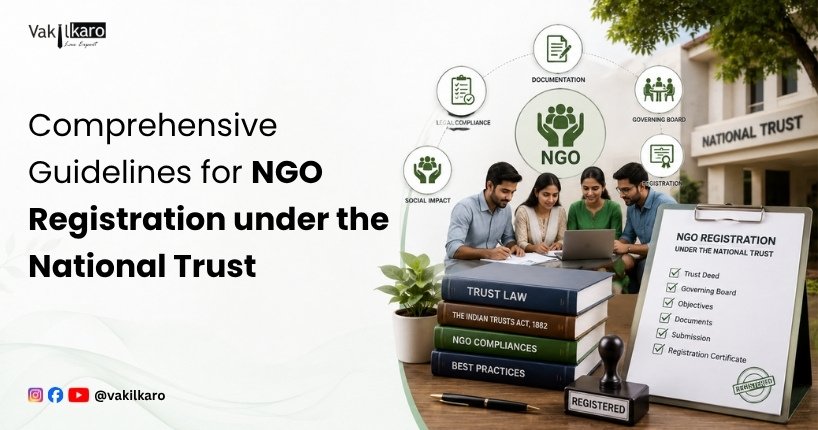
Registering an NGO with the National Trust is crucial for organizations that support individuals with disabilities. The process now requires only the online submission of scanned documents. Eligible NGOs must serve individuals with autism, cerebral palsy, intellectual disabilities, or multiple disabilities. Key requirements include legal registration, governing body details, financial records, and proof of activities. NGOs must meet financial and operational criteria, including a minimum income of Rs. 3 lakhs annually. Compliance with guidelines is crucial to avoid blacklisting. By fulfilling these requirements, NGOs can contribute effectively to disability welfare while ensuring smooth registration under the National Trust.
Key Takeaways
- NGO Registration Under the National Trust Registering a Non-Governmental Organization (NGO) with the National Trust is a crucial step for organizations dedicated to supporting persons with disabilities.
- Eligibility Criteria for NGO Registration To register under the National Trust, an NGO must be actively engaged in supporting and working for the welfare of persons with disabilities (PwDs).
- Required Documents for NGO Registration To successfully register under the National Trust, NGOs must submit a set of mandatory documents to establish their legal status, financial credibility, and operational transparency.
- Previous Certificate of Registration under the National Trust – If the NGO was registered earlier, a copy of the old certificate must be provided.
- Whether you are seeking NGO registration under the National Trust, company incorporation, trademark registration, or compliance with tax and corporate laws, Vakilkaro provides expert guidance, seamless processing, and cost-effective solutions.
NGO Registration Under the National Trust
Registering a Non-Governmental Organization (NGO) with the National Trust is a crucial step for organizations dedicated to supporting persons with disabilities. To streamline the process, the requirement for physical document submission has been eliminated, and applicants must now upload scanned copies online for registration or renewal.
Only NGOs that work with individuals affected by autism, cerebral palsy, intellectual disabilities, or multiple disabilities are eligible for registration. Organizations outside these categories cannot apply. To be considered, NGOs must provide legal and institutional documents, including a Memorandum of Association (MOA) or Trust Deed, certified bylaws, and a registration certificate under the Rights of Persons with Disabilities (RPwD) Act, 2016. Additionally, all governing body members must submit Aadhaar cards, and if applicable, disability certificates for members with disabilities or their dependents.
Annual reports detailing past activities, along with photographic evidence, must be submitted to demonstrate an NGO’s commitment to serving persons with disabilities. Financial transparency is essential, requiring the submission of audited financial statements from the past two years, including income, expenditure, balance sheets, and an auditor’s report. PAN card details of the organization must also be provided.
For registration, NGOs must meet financial and operational requirements, such as a minimum annual income and expenditure of Rs. 3 lakh, serving at least 20 individuals with Unique Disability ID (UDID) cards, and receiving a minimum of 20% of their income from donations or CSR funds. Additional guidelines ensure compliance, with strict penalties for false information, including registration cancellation and blacklisting.
By adhering to these requirements and ensuring accurate documentation, NGOs can successfully register under the National Trust, enabling them to continue providing essential services to persons with disabilities and contributing positively to their well-being.
Registering a Non-Governmental Organization (NGO) under the National Trust is a vital process for organizations committed to supporting persons with disabilities (PwDs). NGOs play a crucial role in advocating for the rights, welfare, and development of individuals with disabilities, ensuring they have access to essential services, education, healthcare, and social inclusion initiatives.
To make the registration process more efficient and accessible, the National Trust has implemented significant reforms. Previously, organizations were required to submit physical copies of documents, making the process time-consuming and cumbersome. However, with recent updates, the entire registration and renewal process has been shifted online. Now, NGOs must upload scanned copies of all necessary documents through the official portal, eliminating the need for hard copy submissions. This digital transformation not only enhances convenience but also ensures greater transparency and faster processing of applications.
For organizations seeking to register, it is essential to understand the detailed requirements and procedural guidelines. This includes eligibility criteria that define which organizations can apply, a comprehensive list of mandatory documents needed for submission, and compliance requirements that must be met to maintain registration. Ensuring proper documentation and adherence to legal regulations will help NGOs secure approval without delays or complications.
This guide provides a step-by-step breakdown of the registration process, covering all essential aspects from eligibility and documentation to financial obligations and compliance measures. By following these guidelines, NGOs can successfully register under the National Trust and continue their vital mission of improving the lives of persons with disabilities, empowering them with the support and resources they need to lead independent and fulfilling lives.
Eligibility Criteria for NGO Registration
To register under the National Trust, an NGO must be actively engaged in supporting and working for the welfare of persons with disabilities (PwDs). However, not all disability-focused NGOs are eligible for registration. The National Trust specifically caters to organizations that work with individuals affected by certain types of disabilities. Therefore, only NGOs that provide services, rehabilitation, advocacy, or support to persons with one or more of the following disabilities are eligible for registration:
Autism Spectrum Disorder (ASD)
Autism Spectrum Disorder is a neurological and developmental disorder that affects communication, social interaction, and behavior. NGOs working with individuals diagnosed with ASD focus on early intervention, therapy, skill development, education, and vocational training to help them lead independent lives.
Cerebral Palsy (CP)
Cerebral Palsy is a group of disorders that affect movement, muscle tone, and posture due to abnormal brain development or damage. NGOs serving individuals with CP provide physiotherapy, speech therapy, assistive devices, medical care, and educational support to improve their quality of life and mobility.
Intellectual Disabilities (ID)
Intellectual disabilities refer to limitations in intellectual functioning and adaptive behaviors, affecting an individual’s ability to learn, communicate, and perform daily activities. NGOs focused on ID offer special education, skill-building programs, and community inclusion initiatives to support individuals with intellectual disabilities.
Multiple Disabilities (MD)
Multiple Disabilities refer to the presence of two or more disabilities in a single individual, such as a combination of intellectual disability and physical disability. NGOs working with persons with multiple disabilities provide holistic care, therapy, assistive technology, and customized educational programs to cater to their diverse needs.
Organizations that do not specifically work with individuals affected by these disabilities do not qualify for registration under the National Trust. The eligibility criteria are set to ensure that registered NGOs align with the objectives of the National Trust and focus on improving the lives of persons with these specific disabilities. Therefore, NGOs must carefully assess their service areas before applying for registration to avoid rejection.
Required Documents for NGO Registration
To successfully register under the National Trust, NGOs must submit a set of mandatory documents to establish their legal status, financial credibility, and operational transparency. The submission process is now entirely online, requiring scanned copies of documents to be uploaded in the prescribed format. Below is a detailed breakdown of the required documentation.
Legal and Institutional Documentation
To ensure the NGO's legitimacy and compliance with legal requirements, the following documents must be submitted:
- Memorandum of Association (MOA) or Trust Deed – A legally binding document that outlines the organization’s objectives, governance structure, and operational guidelines. A clear scanned copy must be provided, displaying the official stamp of the Registrar of Societies or Trust.
- Bylaws of the Organization – These should define the organization’s internal regulations, including:
- Objectives of the NGO – A detailed description of the mission and purpose of the organization.
- List of Current Governing Body Members – A certified list of the individuals responsible for the organization’s management and decision-making.
- Certificate of Registration under the Rights of Persons with Disabilities (RPwD) Act, 2016 – This confirms that the NGO is legally recognized to operate in the disability sector and aligns with government policies.
Documents Related to Governing Body/Managing Committee
These documents verify the identity and background of the organization’s key decision-makers:
- Aadhaar Cards of all Governing Body/Managing Committee/Managing Trustees members – This is necessary to authenticate the identity of individuals managing the NGO.
- Disability Certificate (if applicable):
- If a Governing Body member has a disability, their disability certificate must be submitted as proof.
- If a parent is a member of the committee, they must provide a disability certificate of their child to establish their eligibility under the National Trust framework.
- Undertaking by the Head of the Organization – This document (generated from the online system) must be signed, affirming that:
- Neither the NGO nor any of its Governing Body members have been blacklisted by the National Trust, Government of India, or any State Government.
- No current Governing Body member was previously associated with an organization that was blacklisted.
Documents Related to NGO Activities
To demonstrate the NGO’s past contributions and engagement in disability-related services, the following must be submitted:
- Annual Report of Activities (for the past year) – This report must be in Hindi or English and should contain:
- A general introduction to the organization, including its mission and areas of focus.
- Detailed descriptions of activities undertaken specifically for persons with disabilities covered under the National Trust.
- Photographic evidence showcasing the NGO’s programs, events, or beneficiary interactions.
Financial Documents (Past Two Years)
Financial transparency is critical for registration approval. The NGO must provide:
- Audited Receipt and Payment Statement – This outlines the organization’s financial transactions.
- Audited Income and Expenditure Statement – A record of all income sources and expenditures over the last two financial years.
- Audited Balance Sheet – This reflects the financial health of the organization, detailing assets, liabilities, and overall net worth.
- Auditor’s Report – Must be stamped and signed by a certified auditor, confirming the authenticity of financial statements.
- PAN Card of the Organization – This serves as official proof of the NGO’s financial registration with tax authorities.
- Example: If applying in FY 2023-24, the NGO must submit audited accounts for both FY 2022-23 and FY 2021-22.
Mandatory Online Submission Documents
All required documents must be uploaded in PDF format with a maximum size of 5 MB per document. The following must be submitted online:
- Undertaking on the NGO’s official letterhead, signed and stamped by the authorized signatory.
- Memorandum of Association (MOA) or Trust Deed – As mentioned in legal documentation.
- Certificate of Registration under the Societies Act, Companies Act, or Public Charitable Trust Act – Proof of legal incorporation.
- Certificate of Registration under the RPwD Act, 2016 – Mandatory for disability-focused NGOs.
- Previous Certificate of Registration under the National Trust – If the NGO was registered earlier, a copy of the old certificate must be provided.
- Proof of ownership or lease of the NGO’s premises – To confirm the organization’s operational base.
- PAN Card of the Organization – Reiterated for tax compliance.
- Aadhaar Cards of Staff Members – If applicable, proof of identity for employees involved in service delivery.
- Aadhaar Cards of Governing Body Members – For identity verification.
- Form E – Must be signed and stamped on each page by the authorized signatory to confirm compliance with National Trust guidelines.
Financial and Operational Requirements for Registration
For Voluntary Organizations
NGOs applying under the category of voluntary organizations must meet the following minimum requirements for the past two years:
- Minimum Annual Income: Rs. 3 lakh
- Minimum Annual Expenditure: Rs. 3 lakh
- Minimum Beneficiaries Served: 20 individuals with Unique Disability ID (UDID)
- Minimum Donation & CSR Fund Received: At least 20% of the total income
- 12A & 80G Certification (Optional but recommended)
For Parent Associations & Associations of Persons with Disabilities (AoPwD)
- Minimum Beneficiaries: 20 individuals with UDID card or UDID Enrollment Number along with a disability certificate
Classification of NGOs Based on Organizational Structure
When applying for registration, NGOs must select the correct category based on the following criteria:
Important Compliance and Guidelines
Avoidance of False Information
- Providing false information will lead to immediate cancellation of registration.
- The NGO will be blacklisted from future registrations under the National Trust.
Compliance with Modification Requests
- If modifications are requested after form submission, the NGO must comply within 60 days.
- Failure to comply will result in rejection of the application, and the processing fee will be forfeited.
- NGOs should regularly check their login page for modification requests.
Reapplication After Rejection
- If an application is rejected, the NGO must wait 6 months before reapplying.
- A new processing fee will be required for reapplication.
Document Submission Format
- All documents must be uploaded only in PDF format.
- Maximum file size allowed is 5 MB per document.
Conclusion
Registering a Non-Governmental Organization (NGO) under the National Trust is a crucial step for organizations committed to empowering and improving the lives of persons with disabilities (PwDs). This process not only grants the NGO legal recognition but also enables it to access government support, funding opportunities, and other resources essential for delivering effective services to the disability sector.
This guide has provided a comprehensive overview of the registration process, including eligibility criteria, required documents, financial obligations, and compliance guidelines. By thoroughly understanding these requirements, NGOs can ensure that they meet the necessary standards and avoid unnecessary delays or rejections. The streamlined online application process simplifies registration, but it requires NGOs to be meticulous in uploading scanned copies of mandatory documents in the prescribed format.
Proper financial documentation and governance compliance are critical in demonstrating an NGO’s credibility and sustainability. The National Trust places a strong emphasis on transparency and accountability, requiring NGOs to submit audited financial statements, activity reports, and governing body details. Any misinformation or failure to meet the stipulated requirements can result in rejection, blacklisting, or delays in approval.
To facilitate a hassle-free registration experience, NGOs should conduct a self-audit of their documents, ensure their activities align with National Trust disability categories, and maintain a clear financial record. Staying updated with National Trust guidelines and compliance requirements will help organizations secure their registration efficiently and continue their impactful work in serving persons with disabilities.
For further details, official guidelines, and application procedures, NGOs are encouraged to visit the official National Trust website. Ensuring adherence to all regulations before applying will lead to a smooth registration process and contribute to the long-term success of the organization in creating a more inclusive society for persons with disabilities.
Why Choose Vakilkaro for NGO Registration and Other Legal Services?
When it comes to legal and compliance services, Vakilkaro stands out as a trusted partner for NGOs and businesses alike. Whether you are seeking NGO registration under the National Trust, company incorporation, trademark registration, or compliance with tax and corporate laws, Vakilkaro provides expert guidance, seamless processing, and cost-effective solutions.
Expertise in NGO Registration & Compliance
Vakilkaro specializes in legal registration and compliance for NGOs, ensuring that your organization meets all eligibility criteria and documentation requirements. Their team of professionals assists in preparing error-free applications, preventing rejection or unnecessary delays.
End-to-End Legal Assistance
Beyond NGO registration, Vakilkaro offers comprehensive legal services, including:
- Company Incorporation: Private Limited Company Registration, LLP, OPC, Section 8 Company, and more
- Trademark Registration & Protection: Trademark registration and filing, renewal, licensing, and selling
- GST & Tax Compliance: GST registration filing, and advisory
- Microfinance & RBI Licensing: Assistance in obtaining Section 8 Microfinance Company registration and RBI approvals
- Legal Drafting & Documentation: Agreements, contracts, and compliance reports
Affordable & Hassle-Free Process
Vakilkaro offers affordable pricing and transparent processes, ensuring that clients receive quality legal services without hidden costs. Their expert team handles the complex paperwork, making legal registrations and compliance stress-free.
Personalized Consultation & Support
Unlike generic legal service providers, Vakilkaro offers personalized consultation to address specific legal requirements. Their dedicated customer support ensures timely updates, follow-ups, and guidance throughout the process.
By choosing Vakilkaro, you ensure a smooth, compliant, and efficient registration process, allowing your NGO or business to operate legally and focus on growth.
Official External Resources
Use these primary/official sources to verify rules, forms, fees, timelines and regulatory updates before publication.
Frequently asked questions
Comprehensive Guidelines for NGO Registration under the National Trust+
Eligibility Criteria for NGO Registration To register under the National Trust, an NGO must be actively engaged in supporting and working for the welfare of persons with disabilities (PwDs). Required Documents for NGO Registration To successfully register under the National Trust, NGOs must submit a set of mandatory documents to establish their legal status, financial credibility, and operational transparency.
