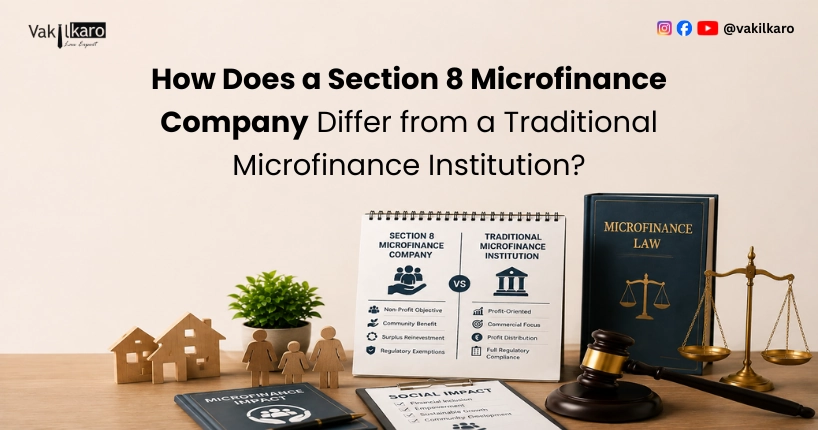
Section 8 Microfinance Companies and traditional MFIs both promote financial inclusion but differ in focus and structure. Section 8 Companies are non-profit entities under the Companies Act, 2013, prioritizing social welfare by offering affordable financial services to marginalized communities, often paired with developmental initiatives. They reinvest earnings into their missions, enjoy tax benefits, and rely on grants and donations, operating under the Ministry of Corporate Affairs without RBI oversight. Traditional MFIs, including NBFC-MFIs, are profit-driven, regulated by the RBI, and focus on scalability and financial sustainability. They serve broader audiences, offering diverse financial products funded through equity and debt. Borrowers seeking affordable, development-focused services may prefer Section 8 Companies, while entrepreneurs needing larger loans might opt for traditional MFIs. Together, they create a complementary microfinance ecosystem addressing diverse needs.
Key Takeaways
- Section 8 Microfinance Companies and traditional MFIs both promote financial inclusion but differ in focus and structure.
- Comparing Section 8 Microfinance Companies and Traditional MFIs Section 8 Microfinance Company and traditional microfinance institutions (MFIs) both aim to promote financial inclusion but operate with distinct objectives and frameworks.
- Choosing Between Section 8 Microfinance Companies and Traditional MFIs For borrowers, investors, and stakeholders, the choice between a Section 8 Microfinance Company and a traditional MFI depends on their priorities: Borrowers: Those seeking affordable loans with a focus on development-oriented programs may prefer Section 8 Companies.
- VakilKaro stands out as a trusted partner for Section 8 Microfinance Company registration due to its expertise, personalized service, and comprehensive support.
- With its proven track record in supporting businesses and non-profits, VakilKaro is the ideal choice for establishing a Section 8 Microfinance Company.
Comparing Section 8 Microfinance Companies and Traditional MFIs
Section 8 Microfinance Company and traditional microfinance institutions (MFIs) both aim to promote financial inclusion but operate with distinct objectives and frameworks. Section 8 Companies are non-profit entities registered under the Companies Act, 2013, with a primary focus on social welfare. They provide affordable financial services to underserved communities, often integrating developmental programs such as education and skill-building. Operating without the need for Reserve Bank of India(RBI) registration, they reinvest all earnings into their mission and benefit from significant tax exemptions.
Their funding largely depends on grants, donations, and CSR initiatives. In contrast, traditional MFIs, including NBFC-MFIs, are often profit-oriented and regulated by the RBI. They cater to a broader audience, offering diverse financial products like microloans and savings schemes. Funded through equity, debt, and market borrowings, these institutions emphasize scalability and financial sustainability while maintaining compliance with stringent regulatory requirements.
Borrowers seeking low-cost, development-centric financial solutions are likely to prefer Section 8 Companies, whereas entrepreneurs or micro-entrepreneurs needing larger, flexible loans may gravitate towards traditional MFIs. While Section 8 Companies focus on social impact and affordability, traditional MFIs balance financial inclusion with commercial viability. Together, these institutions form a complementary ecosystem, addressing diverse financial needs and contributing to economic development.
Microfinance institutions (MFIs) have provided financial services to the underserved and economically weaker sections of society. By extending small loans, promoting savings, and facilitating micro-enterprise development, these institutions empower individuals and communities to break free from the cycle of poverty. However, the landscape of microfinance is diverse, with various organizational models operating under different regulatory and legal frameworks. Section 8 Microfinance Companies stand out for their unique characteristics and objectives.
This blog explores the key differences between Section 8 Microfinance Companies and traditional microfinance institutions. By understanding these distinctions, stakeholders can make informed decisions about their financial needs or investment opportunities while gaining insights into India's diverse approaches to microfinance.
What is a Section 8 Microfinance Company?
A Section 8 Company is a non-profit organization registered under the Companies Act, 2013. These entities operate with the primary objective of promoting social welfare, including areas like education, health, and financial inclusion. Section 8 Microfinance Companies specifically focus on providing financial services to marginalized communities. Since they are non-profit entities, their income and profits are reinvested into their objectives rather than distributed as dividends to members.
Key characteristics of Section 8 Microfinance Companies include:
- Non-Profit Orientation: Their primary goal is social development rather than profit generation.
- Tax Benefits: They are eligible for various tax exemptions under the Income Tax Act
- Regulatory Compliance: They operate under the purview of the Ministry of Corporate Affairs (MCA) and do not require registration with the Reserve Bank of India (RBI) as a Non-Banking Financial Company (NBFC).
- Focus on Development: These companies often collaborate with NGOs, government agencies, and international organizations to promote financial inclusion.
What is a Traditional Microfinance Institution?
Traditional MFIs include a range of organizations, such as Non-Banking Financial Company Microfinance Institutions (NBFC-MFIs), cooperatives, self-help groups (SHGs), and trust-based organizations. These institutions are typically profit-driven and focus on extending small loans to individuals or groups who lack access to formal banking channels.
Key characteristics of traditional MFIs include:
- Profit Orientation: While their services promote financial inclusion, these institutions are often driven by financial sustainability and profitability.
- Regulatory Oversight: Most MFIs, particularly NBFC-MFIs, are regulated by the RBI and must comply with its guidelines on interest rates, loan sizes, and repayment tenures.
- Diverse Models: Traditional MFIs can operate as for-profit or not-for-profit entities, depending on their structure and objectives.
Commercial Funding: They rely on equity investments, bank loans, and other commercial sources of funding.
Key Differences Between Section 8 Microfinance Companies and Traditional MFIs
Objective and Mission
- Section 8 Microfinance Companies: Operate with the sole aim of promoting social welfare. Their mission often encompasses broader developmental goals, such as poverty alleviation, women’s empowerment, and skill development.
- Traditional MFIs: While they contribute to financial inclusion, their primary focus is on financial sustainability and profitability. Their objectives may align with social goals but are driven by commercial interests.
Legal and Regulatory Framework
- Section 8 Microfinance Companies: Registered under the Companies Act, 2013, these entities are regulated by the Ministry of Corporate Affairs. They do not require RBI registration as NBFCs.
- Traditional MFIs: Depending on their structure, they may be regulated by the RBI (e.g., NBFC-MFIs) or operate under state-level cooperative laws or trust regulations.
Profit Distribution
- Section 8 Microfinance Companies: Prohibited from distributing profits to members or shareholders. All earnings are reinvested into their social objectives.
- Traditional MFIs: Profit distribution is allowed. For-profit MFIs distribute dividends to shareholders, while not-for-profit MFIs reinvest their earnings.
Tax Benefits
- Section 8 Microfinance Companies: These companies enjoy significant tax exemptions and benefits under the Income Tax Act as they are considered charitable organizations.
- Traditional MFIs: For-profit MFIs are subject to standard corporate taxation. Not-for-profit MFIs may receive some tax benefits, but these are less extensive than those available to Section 8 Companies.
Funding Sources
- Section 8 Microfinance Companies: Primarily rely on grants, donations, and government funding. They may also secure funding from international aid organizations and CSR (Corporate Social Responsibility) initiatives.
- Traditional MFIs: Depend on a mix of equity, debt, and deposits. They often raise capital from private investors, financial institutions, and market borrowings.
Target Audience
- Section 8 Microfinance Companies: Focus on the most vulnerable and underserved sections of society. Their services are typically extended to individuals who cannot afford to pay market-based interest rates.
- Traditional MFIs: Serve a wider audience, including low-income groups and micro-entrepreneurs who can manage higher interest rates and repayment schedules.
Operational Approach
- Section 8 Microfinance Companies: Tend to have a more holistic approach to development, integrating financial services with capacity-building programs, education, and healthcare initiatives.
- Traditional MFIs: Primarily focus on delivering financial products such as microloans, savings, and insurance. Developmental activities, if any, are often secondary.
Advantages of Section 8 Microfinance Companies
- Social Impact: Their primary focus on social welfare ensures greater outreach to marginalized communities.
- Cost-Effective Operations: With access to grants and tax benefits, they can offer services at lower costs.
- Collaborative Opportunities: Partnerships with NGO, government programs, and CSR initiatives amplify their impact.
- Flexibility: Lack of stringent RBI regulations allows them to experiment with innovative models for financial inclusion.
Advantages of Traditional MFIs
- Scalability: Access to commercial funding enables rapid expansion and scalability.
- Diverse Products: They offer a range of financial products tailored to the needs of low-income groups.
- Financial Sustainability: Profit orientation ensures long-term viability.
- Technological Adoption: Many traditional MFIs leverage technology for efficient operations and customer outreach.
Challenges Faced by Section 8 Microfinance Companies
- Limited Funding: Dependence on grants and donations can restrict growth.
- Regulatory Overlaps: Despite being exempt from RBI regulations, they may face challenges in navigating other compliance requirements.
- Operational Constraints: Limited resources may hinder the adoption of advanced technologies and expansion.
Challenges Faced by Traditional MFIs
- High Interest Rates: To sustain operations, they often charge higher interest rates, which can burden borrowers.
- Regulatory Scrutiny: Compliance with stringent RBI guidelines can be resource-intensive.
- Social Criticism: Profit-driven motives sometimes attract criticism for prioritizing financial gains over social welfare.
Choosing Between Section 8 Microfinance Companies and Traditional MFIs
For borrowers, investors, and stakeholders, the choice between a Section 8 Microfinance Company and a traditional MFI depends on their priorities:
- Borrowers: Those seeking affordable loans with a focus on development-oriented programs may prefer Section 8 Companies. Entrepreneurs requiring larger loans and diverse financial products might lean toward traditional MFIs.
- Investors: Impact investors prioritizing social returns may find Section 8 Companies more appealing, while those seeking financial returns may opt for traditional MFIs.
- Policy Makers and NGOs: Collaborations for social programs might align better with Section 8 Companies due to their non-profit orientation.
Conclusion
Both Section 8 Microfinance Companies and traditional microfinance institutions play crucial roles in promoting financial inclusion and fostering economic development. While Section 8 Companies focus on social welfare and holistic development, traditional MFIs bring scalability, innovation, and financial sustainability to the table. By complementing each other, these models create a robust microfinance ecosystem that addresses the diverse needs of underserved communities in India. Understanding their differences helps stakeholders choose the right partner to achieve their financial and developmental goals.
Why Choose VakilKaro for Section 8 Microfinance Company Registration?
VakilKaro stands out as a trusted partner for Section 8 Microfinance Company registration due to its expertise, personalized service, and comprehensive support. With in-depth knowledge of legal, financial, and regulatory frameworks, VakilKaro ensures a seamless registration process while adhering to the Companies Act, 2013. Their team of professionals offers end-to-end guidance, including drafting a Memorandum of Association (MOA) and Articles of Association (AOA), preparing necessary documents, and obtaining essential approvals.
VakilKaro’s focus on client satisfaction is evident through its tailored solutions, addressing unique operational and compliance needs for microfinance initiatives. Additionally, VakilKaro provides insights into tax benefits, funding options, and best practices for running a non-profit organization. By choosing VakilKaro, clients gain access to a dedicated team committed to simplifying complexities and helping achieve their goals in social welfare and financial inclusion. With its proven track record in supporting businesses and non-profits, VakilKaro is the ideal choice for establishing a Section 8 Microfinance Company.
Why Choose VakilKaro for Your Business and Legal Needs?
VakilKaro is a one-stop solution for a wide range of professional services designed to meet the diverse needs of businesses, startups, and non-profits. With expertise spanning microfinance company registrations GST return filing intellectual property protection, compliance management, and legal documentation, VakilKaro simplifies complex processes and ensures compliance with legal and regulatory requirements.
Their team of experts offers personalized assistance tailored to specific needs, whether it’s drafting contracts, obtaining licenses, managing tax compliance, or navigating mergers and acquisitions. VakilKaro stands out for its customer-centric approach, providing end-to-end guidance, transparent pricing, and prompt support. They also leverage technology to streamline services like e-invoicing and bookkeeping, ensuring efficiency and accuracy.
By choosing VakilKaro, clients gain a reliable partner dedicated to empowering their business journey through expert advice, seamless execution, and a commitment to excellence. Whether you're starting a new venture, protecting your intellectual property, or managing legal complexities, VakilKaro delivers solutions that drive success.
Official External Resources
Use these primary/official sources to verify rules, forms, fees, timelines and regulatory updates before publication.
Frequently asked questions
How Does a Section 8 Microfinance Company Differ from a Traditional Microfinance Institution?+
Section 8 Microfinance Companies and traditional MFIs both promote financial inclusion but differ in focus and structure. Comparing Section 8 Microfinance Companies and Traditional MFIs Section 8 Microfinance Company and traditional microfinance institutions (MFIs) both aim to promote financial inclusion but operate with distinct objectives and frameworks.
