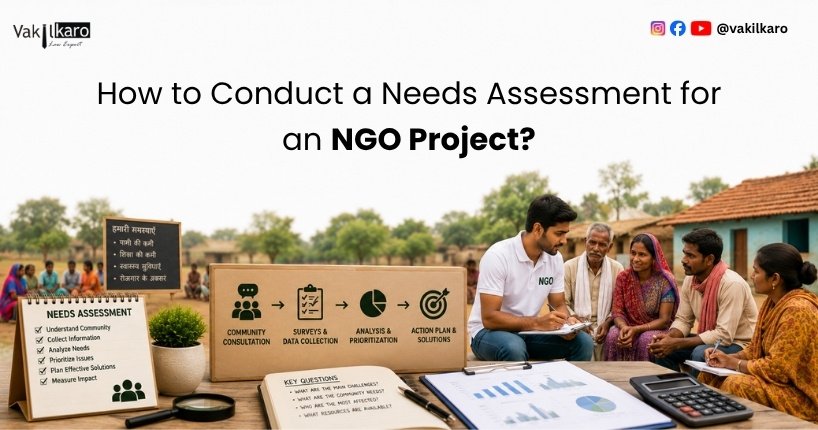
A well-executed needs assessment is the backbone of any successful NGO project. Whether your organization has completed its NGO registration or holds Section 8 company registration and 12A and 80G registration, identifying real community needs is vital. This systematic process pinpoints gaps between current and desired conditions, ensuring projects are impactful, resource-efficient, and legally compliant. It strengthens donor trust, supports evidence-based planning, and aligns with reporting obligations under the Companies Act and Income Tax laws. In this blog, we guide NGOs—especially those with or seeking Section 8 company registration—through the steps of conducting a meaningful and effective needs assessment.
Key Takeaways
- A well-executed needs assessment is the backbone of any successful NGO project.
- Before initiating any NGO project, understanding the significance of a needs assessment is essential.
- Project Relevance A needs assessment ensures that your NGO’s mission and projects are in sync with the actual needs of the target community.
- Building Trust Through Inclusion By making stakeholder engagement an integral part of the needs assessment process, your NGO not only ensures that your project is well-informed but also cultivates a sense of inclusion and partnership.
- Step 7: Validate Findings with the Community – Building Trust and Ensuring Accuracy Before your NGO moves forward with finalizing any project plans or funding proposals, it’s essential to circle back to the community and validate the findings from your needs assessment.
The Importance of Conducting a Needs Assessment for NGO Projects
A comprehensive needs assessment is the foundation for developing any effective NGO initiative. Regardless of whether your organization has just completed its NGO registration or already possesses Section 8 company registration along with 12A and 80G registration, identifying and understanding the actual needs of your target community is critical. This structured approach allows NGOs to bridge the gap between current conditions and desired outcomes, ensuring that the projects they implement are not only relevant but also impactful.
For NGOs, a needs assessment is more than just a preparatory exercise—it’s a strategic process that provides clarity on where to focus resources and how to make the greatest difference. It helps align an organization’s mission with the real-world challenges of beneficiaries, ensuring that the projects are rooted in facts rather than assumptions. This, in turn, leads to stronger community engagement, better fundraising results, and improved outcomes.
Additionally, a needs assessment enhances transparency and accountability, two core values necessary for NGOs, especially those that enjoy tax exemptions through 12A and 80G registration. It demonstrates to donors, government bodies, and stakeholders that the NGO operates with due diligence and professionalism. For entities with Section 8 company registration, it also supports legal compliance with the Companies Act, 2013, and plays a vital role in corporate-style project planning and governance.
Through this blog, we’ll walk you through the steps involved in conducting a successful needs assessment—from defining the scope to engaging stakeholders, collecting and analyzing data, and translating insights into actionable project plans. Whether your NGO is newly registered or well-established, applying this process effectively ensures your work remains impactful, legally sound, and aligned with donor and community expectations. Conducting a needs assessment is not just best practice—it’s an essential step toward driving real social change.
In the field of social development, one of the most crucial steps before launching any project is conducting a thorough needs assessment. This foundational activity helps NGOs clearly understand the challenges, expectations, and aspirations of the communities they aim to serve. Whether your organization is newly formed with fresh NGO registration or an experienced entity operating under Section 8 company registration with 12A and 80G registration for tax exemptions, the value of a well-executed needs assessment cannot be overstated.
A needs assessment is a structured process that identifies the gap between the current state of a community and its desired goals or “needs.” It involves gathering data, engaging stakeholders, analyzing problems, and prioritizing actions. For NGOs, this process ensures that every intervention is purposeful and directly responsive to real issues faced by the target population. Rather than acting on assumptions, NGOs use needs assessments to build evidence-based projects that truly create change.
Moreover, conducting a needs assessment also plays a vital role in enhancing credibility and accountability. For NGOs with 12A and 80G registration, documenting this process supports tax exemption claims and satisfies donor expectations. For those with Section 8 company registration, it demonstrates corporate-level responsibility and helps in fulfilling compliance requirements under the Companies Act, 2013. It also increases eligibility for CSR partnerships, government grants, and international funding.
This blog offers a detailed, step-by-step guide on how NGOs can carry out an effective needs assessment. From defining goals and engaging the community to data collection, analysis, and report writing, we will explore how each phase contributes to the success of your initiative. Especially for organizations pursuing or holding regulatory approvals like NGO registration, Section 8 company registration, and 12A and 80G certification, mastering this process is key to creating sustainable and impactful social interventions.
Why Conduct a Needs Assessment?
Before initiating any NGO project, understanding the significance of a needs assessment is essential. It’s more than just a preliminary step—it is the backbone of effective program planning and execution. Whether your organization is newly established or has already secured Section 8 company registration, NGO registration, and obtained 12A and 80G registration, a thorough needs assessment lays the groundwork for impactful and sustainable development initiatives.
Project Relevance
A needs assessment ensures that your NGO’s mission and projects are in sync with the actual needs of the target community. Without this alignment, there’s a risk of launching initiatives that are disconnected from the ground realities or that fail to solve meaningful problems. By engaging directly with community members and analyzing their challenges, your NGO can craft solutions that are not only effective but also welcomed and supported by the beneficiaries. This improves the likelihood of long-term success and measurable social impact.
Donor Confidence
For NGOs, credibility is a key asset, especially when seeking support from donors and CSR partners. A well-documented needs assessment demonstrates your commitment to due diligence and strategic planning. For NGOs with 12A and 80G registration, this credibility is even more crucial, as donors often require proof that their funds are being directed toward genuine, well-identified community needs. A clear and data-backed needs assessment enhances your trustworthiness and increases your chances of securing grants and tax-deductible donations.
Efficient Use of Resources
Most NGOs operate with limited budgets, manpower, and time. A needs assessment helps you make informed decisions about how to best allocate these scarce resources. It enables you to prioritize the most pressing issues, streamline your operations, and avoid duplication of efforts. As a result, your NGO can operate more efficiently and deliver maximum impact with the resources available.
Evidence-Based Planning
Sound planning is rooted in evidence. A needs assessment provides a factual basis for designing, implementing, and evaluating projects. By using real data collected through surveys, interviews, and community engagement, your NGO can avoid assumptions and make informed choices. This leads to more targeted interventions, better outcomes, and improved accountability—all of which are attractive to stakeholders, including government bodies and international donors.
Compliance Support
For NGOs registered under the Companies Act, 2013 as Section 8 companies, or those benefiting from tax exemptions under 12A and 80G, regulatory compliance is a legal necessity. A comprehensive needs assessment can serve as supporting documentation during audits and evaluations. It helps meet reporting obligations with the Ministry of Corporate Affairs (MCA) and tax authorities, ensuring that your organization maintains good standing and continues to qualify for exemptions and grants.
Step 1: Define the Purpose and Scope of the Needs Assessment
The first and most crucial step in conducting a needs assessment is to clearly define its purpose and scope. Without a well-articulated objective, the entire process can become vague, inefficient, and directionless. Defining your purpose sets the stage for a structured and meaningful assessment that leads to actionable results.
Clarifying the Objective
Start by asking: Why are we conducting this needs assessment? The answer to this question should be specific and aligned with your NGO’s mission. For example, your organization might be planning to launch a new education initiative for dropout youth, or perhaps you're looking to address maternal health issues in remote villages. The objective should reflect the nature of the problem you intend to investigate and resolve.
This step is particularly important for NGOs with Section 8 company registration or those applying for CSR funds, as it demonstrates professional planning and governance in line with corporate standards. A clearly stated purpose not only focuses the assessment but also enhances your organization’s credibility when communicating with stakeholders such as donors, local authorities, and the community.
Real-Life Example
Consider an NGO that is registered as a Section 8 company and aims to empower women in underprivileged communities through skill development. The needs assessment in this case would focus on identifying:
- The most in-demand vocational skills in that region
- The education level and existing skills of potential participants
- The barriers (economic, social, or cultural) they face in accessing training
This clarity allows for designing a program that directly addresses the most relevant and practical needs.
Determining the Scope
Once the purpose is set, you must define the scope—the boundaries within which the needs assessment will operate. This includes:
- Geographic Area: Will your assessment cover a single village, an entire district, or a specific urban slum?
- Target Population: Who are the primary beneficiaries? Are you focusing on women, children, farmers, or tribal communities?
- Project Duration: Is this a short-term pilot project or a long-term intervention? The timeframe affects how deeply you explore the issues.
- Available Resources: Consider the budget, manpower, time, and tools you have. This will influence how extensive and detailed your data collection can be.
Defining the scope ensures that your needs assessment is realistic, focused, and manageable. It helps avoid wasted effort and ensures that the findings are directly applicable to the project you intend to implement.
In summary, a well-defined purpose and scope provide the foundation for every other step in the needs assessment process. They help guide data collection, stakeholder engagement, analysis, and ultimately, the success of your NGO project.
Step 2: Engage Stakeholders in the Needs Assessment
Once the purpose and scope of the needs assessment are defined, the next crucial step is to engage stakeholders—the individuals, groups, and institutions who are directly or indirectly affected by or have an interest in the project. Effective stakeholder engagement ensures that the assessment is inclusive, grounded in reality, and reflective of multiple perspectives.
Why Stakeholder Engagement Matters
Stakeholders provide critical insights, lived experiences, and contextual knowledge that may not be visible through data alone. Involving them ensures that your NGO’s intervention is not only relevant but also supported by the people it aims to serve. Moreover, this step helps in building trust, credibility, and community ownership—key ingredients for project sustainability.
For NGOs that have recently completed NGO registration, stakeholder engagement is a vital strategy to integrate into the local landscape and gain the confidence of the community. For those with 12A and 80G registration, involving stakeholders demonstrates transparency and inclusiveness, qualities that are highly valued by institutional donors, CSR partners, and government agencies. This phase can also enhance your organization’s ability to receive tax-deductible donations and CSR grants, which often require evidence of participatory planning.
Key Stakeholders to Consult
- Beneficiaries – Understand their needs, challenges, aspirations, and priorities directly from them.
- Local Leaders – Gain insights into cultural, social, and political dynamics that can affect project implementation.
- Partner NGOs – Learn from their experiences and identify opportunities for collaboration.
- Donors – Align your goals with funding priorities and gather input that may improve proposal success.
- Government Officials – Ensure your project aligns with government schemes and regulatory expectations.
Tools for Stakeholder Engagement
To collect meaningful feedback, NGOs can use a mix of participatory methods:
- Focus Group Discussions (FGDs): Small, facilitated group discussions that allow beneficiaries to voice opinions in a safe and structured setting.
- Stakeholder Interviews: One-on-one interviews with key individuals such as community leaders, health workers, or government representatives to gather in-depth insights.
- Community Meetings: Public forums where larger groups can discuss needs openly, promoting transparency and shared understanding.
Each tool serves a unique purpose and should be selected based on the context, literacy level, and cultural sensitivity of the stakeholders involved.
Building Trust Through Inclusion
By making stakeholder engagement an integral part of the needs assessment process, your NGO not only ensures that your project is well-informed but also cultivates a sense of inclusion and partnership. This approach lays the foundation for long-term impact and community support—both essential for a thriving NGO, particularly those with Section 8 company registration aiming to uphold high standards of governance and compliance.
Step 3: Collect Data – Building the Evidence Base
Data collection forms the core of any effective needs assessment, serving as the foundation upon which all analysis, planning, and decision-making are built. At this stage, your NGO systematically gathers both qualitative and quantitative information to better understand the realities on the ground. The goal is to identify existing conditions, resource availability, prevailing challenges, and community aspirations, thereby enabling your organization to design interventions that are fact-based and impactful.
What Kind of Data to Collect
To ensure a comprehensive understanding of the community and its needs, NGOs should focus on multiple categories of data:
- Demographic Data: Information on population size, age distribution, gender ratios, literacy rates, and household structures to understand the target population.
- Economic Indicators: Income levels, employment rates, occupation types, and poverty indicators that help assess economic challenges.
- Access to Services: Availability and quality of basic services such as education, healthcare, water, sanitation, and transportation.
- Social Issues: Qualitative insights into problems like gender discrimination, caste-based disparities, unemployment, substance abuse, or domestic violence.
Methods for Data Collection
A variety of methods should be employed to gather robust and diverse data:
- Surveys and Questionnaires: Structured tools that can capture a wide range of information from a large group, especially useful for demographic and economic data.
- Interviews: In-depth, one-on-one conversations with key informants such as community leaders, health workers, and educators provide context-rich insights.
- Observations: Direct field visits help assess environmental and infrastructural conditions and validate self-reported data.
- Secondary Research: Reviewing existing literature, including census data, government publications, academic studies, and NGO reports, offers a cost-effective way to supplement primary data.
Special Consideration for Section 8 Companies
For NGOs registered as Section 8 companies, meticulous data collection plays a dual role. Apart from informing project design, it also helps in meeting regulatory and reporting obligations under the Companies Act, 2013. These organizations are expected to demonstrate transparency, accountability, and due diligence in their operations. Detailed, on-ground data helps them prepare accurate reports for the Ministry of Corporate Affairs (MCA), especially when filing annual returns, activity reports, and financial disclosures.
In addition, NGOs holding 12A and 80G registration can use this data to create compelling narratives for grant applications, CSR funding proposals, and donor reporting. The more grounded and data-driven your proposal is, the greater your chances of building donor confidence and securing long-term support.
Step 4: Analyze the Data – Turning Information into Insight
Once the data has been gathered through surveys, interviews, focus groups, and secondary research, the next step in the needs assessment process is to analyze the data. This step is crucial, as it converts raw information into meaningful insights that can guide decision-making and project planning.
Data analysis involves examining the information for patterns, trends, correlations, and gaps. It helps you understand not only what the issues are, but also why they exist and how they affect different sections of the community. A well-executed analysis leads to accurate identification of community needs and ensures that your interventions are grounded in evidence rather than assumptions.
Key Analytical Questions to Explore
When analyzing the data, NGOs should focus on several key questions:
- What are the most pressing needs of the community?
Determine which issues are recurring across different data sources and stakeholder inputs.
- Are there existing solutions or projects in place?
Identify what interventions are already active in the area and whether they are effective or falling short.
- What are the root causes of the problems?
Move beyond surface-level symptoms and dig into the underlying structural or social factors causing the issues.
- What resources are available and what is lacking?
Understand what community assets can be leveraged and where there are gaps in services, skills, infrastructure, or funding.
The Role of Analytical Tools and Methods
You can use a variety of tools for analysis, such as SWOT analysis (Strengths, Weaknesses, Opportunities, Threats), problem trees, comparative charts, and GIS mapping for spatial understanding. Qualitative data from interviews and focus groups should be coded and thematically analyzed, while quantitative data from surveys can be examined using statistical techniques.
Importance for Registered NGOs
For NGOs with 12A and 80G registration, thorough data analysis is essential for preparing detailed reports for donors, CSR partners, and government bodies. These reports not only strengthen the case for funding but also support your compliance with audit and regulatory requirements. Similarly, NGOs with Section 8 company registration benefit by producing analysis that aligns with professional standards of governance and transparency expected under the Companies Act, 2013.
A solid data analysis framework showcases your NGO’s ability to make informed decisions, implement effective programs, and achieve measurable outcomes—qualities that are critical for sustaining long-term partnerships and institutional trust.
Step 5: Prioritize Needs – Turning Data into Direction
After thoroughly analyzing the collected data, the next step in the needs assessment process is to prioritize the identified needs. This is a critical phase where your NGO determines which issues deserve immediate attention and resources, ensuring that your interventions are strategic, impactful, and aligned with your mission. Without proper prioritization, even well-intentioned efforts may fall short of creating meaningful change.
Why Prioritization Matters
Not all needs can be addressed simultaneously due to limited time, manpower, and financial resources. Prioritizing helps your organization focus on the most urgent and high-impact issues, thereby increasing operational efficiency and effectiveness. It also improves your credibility with stakeholders by showing a clear, data-driven rationale behind your project choices.
Key Criteria for Prioritization
To effectively rank and select needs, NGOs should consider the following criteria:
- Severity of the Issue: How critical is the problem? Does it affect survival, health, education, or livelihood?
- Number of People Affected: How widespread is the issue? Will solving it benefit a large segment of the population?
- Availability of Resources: Do you have—or can you easily obtain—the resources (human, financial, technical) required to address the issue?
- Donor Interest: Are there funding sources or CSR partners who are interested in addressing this specific need?
- Strategic Relevance: Does the issue align with your NGO’s vision, mission, and long-term goals?
Special Considerations for Section 8 Companies
For NGOs with Section 8 company registration, this step is particularly important as they are expected to follow structured, corporate-style governance practices. Prioritizing needs based on strategic logic enhances your ability to create logical frameworks, project budgets, and implementation plans that meet professional standards. It also boosts your chances of receiving support from institutional donors, including those offering CSR funding or foreign contributions.
Furthermore, NGOs registered under 12A and 80G can present well-prioritized needs in their grant proposals and donor reports to show that they are deploying funds judiciously and ethically. This strengthens donor confidence and ensures continued tax benefits and funding eligibility.
Outcome of Effective Prioritization
By the end of this step, your NGO should have a ranked list of needs backed by evidence and logical reasoning. This list serves as the foundation for project planning, proposal writing, budgeting, and partnership building. It turns raw data into actionable strategy and prepares your organization to move forward with confidence and clarity.
Step 6: Develop Actionable Recommendations – Bridging Analysis and Implementation
After completing the data analysis and prioritizing the community’s most urgent needs, the next critical step is to translate findings into actionable recommendations. These are the practical, on-the-ground solutions your NGO will propose or implement to address the identified problems. Recommendations act as a roadmap that links research with tangible impact.
The goal is to move from insight to action in a way that is specific, realistic, measurable, and aligned with your NGO’s mission and capacity. Vague or overly ambitious recommendations may not resonate with stakeholders or funders. Instead, your suggestions should be grounded in the realities uncovered during data collection and analysis.
Characteristics of Strong Recommendations
An effective recommendation should be:
- Specific: Clearly define what is to be done, who will benefit, and who will execute the activity.
- Measurable: Include indicators to track progress and outcomes (e.g., number of beneficiaries, reduction in dropout rates).
- Realistic: Reflect available resources, expertise, and logistical capabilities.
- Time-bound: Set a timeframe for implementation, review, or completion.
Example Recommendations
Based on prioritized needs, actionable recommendations might include:
- Launch a mobile healthcare unit in rural areas
To address the lack of access to medical services in remote communities.
- Set up a digital literacy program for school dropouts
Aimed at enhancing employability and bridging the digital divide in low-income neighborhoods.
- Provide micro-financing support for women entrepreneurs
To promote financial independence and reduce economic vulnerability among underprivileged women.
These recommendations should directly stem from the data gathered and analyzed, ensuring they respond to actual community conditions rather than assumptions.
Importance of Documentation
At this stage, thorough documentation becomes crucial. All recommendations should be compiled into a formal report or proposal that outlines:
- The rationale behind each recommendation
- Evidence supporting the proposed intervention
- Expected outcomes and impact
- Resource requirements
- Timelines and implementation strategies
This document serves several key purposes:
- For NGOs with 12A and 80G registration, it can be used to strengthen applications for grants and CSR partnerships. Well-documented needs and recommendations help justify funding requests and prove that your projects are evidence-based.
- It also supports Section 8 companies in complying with governance norms under the Companies Act, 2013. These entities are expected to demonstrate transparency, strategic planning, and impact-focused programming—qualities that strong documentation can showcase.
- Additionally, a detailed recommendations report serves as a foundation for project planning, stakeholder alignment, and performance evaluation.
Step 7: Validate Findings with the Community – Building Trust and Ensuring Accuracy
Before your NGO moves forward with finalizing any project plans or funding proposals, it’s essential to circle back to the community and validate the findings from your needs assessment. This step is not just a formality—it plays a pivotal role in ensuring that the insights you’ve gathered genuinely reflect the realities, priorities, and aspirations of the people you aim to serve.
Validation is about closing the feedback loop. It allows community members and stakeholders to confirm or challenge the data and conclusions you’ve drawn, ensuring that your NGO’s proposed actions are both accurate and socially acceptable. It also helps prevent costly mistakes or misaligned interventions down the road.
Why Community Validation Matters
- Ensures Accuracy: Local residents can highlight inconsistencies or provide missing context that makes your data more complete and reliable.
- Encourages Ownership: When community members feel involved in shaping solutions, they are more likely to participate actively in implementation.
- Builds Trust and Transparency: Openly sharing your findings demonstrates that your NGO values local input and is committed to working with the community rather than for it.
- Strengthens Credibility: For NGOs with Section 8 company registration, this participatory approach aligns with the principles of transparency and good governance. It also enhances your appeal to institutional donors and CSR partners who expect community engagement as part of due diligence.
Methods for Validation
To validate your findings effectively, consider using one or more of the following participatory methods:
- Community Feedback Sessions
Organize small group meetings with beneficiaries where you present your findings and ask for reactions, clarifications, and suggestions. Keep the sessions inclusive—consider gender, age, and cultural sensitivities.
- Public Validation Workshops
Conduct larger events where you present key data insights, proposed recommendations, and give attendees opportunities to ask questions or suggest changes. Use visual aids and simple language to ensure accessibility.
- Peer Review with Other NGOs or Experts
Share your findings with fellow organizations, academics, or field experts for an external perspective. This helps test the robustness of your conclusions and adds credibility to your final report.
Outcomes of Validation
- Updated or refined findings based on local input
- Adjusted project goals or strategies to reflect community priorities
- Enhanced buy-in from beneficiaries and other stakeholders
- A validation report or annexure that can be attached to funding proposals
For NGOs with 12A and 80G registration, including documentation of community validation in project reports can boost transparency and strengthen your position with both domestic and international donors. It’s a sign that your organization practices participatory development—a principle highly valued in both the nonprofit and CSR sectors.
Step 8: Document the Needs Assessment Report – Building a Foundation for Transparency, Strategy, and Compliance
The final step in your NGO’s needs assessment process is to create a comprehensive and well-structured report. This document not only consolidates everything you've learned during the assessment process but also becomes a critical reference for future planning, audits, funding applications, and stakeholder communication.
Proper documentation ensures that your findings are preserved and accessible, especially as teams evolve or projects expand. It also reinforces your organization’s commitment to transparency and evidence-based decision-making—a core expectation for NGOs operating in India, especially those with Section 8 company registration, or registered under 12A and 80G.
What to Include in the Report
A well-documented needs assessment report typically consists of the following sections:
- Executive Summary
A concise overview of the purpose, methodology, key findings, and actionable recommendations. This helps donors, partners, and board members quickly grasp the essentials without reading the entire report.
- Purpose and Methodology
Clearly explain why the assessment was conducted and how it was carried out. Include the scope (geographic area, population, project duration) and the tools used (surveys, interviews, focus groups, etc.).
- Data Analysis
Present the findings from your data collection and interpretation. Use charts, graphs, and tables where appropriate to highlight trends, gaps, and community needs. Make sure the analysis aligns with the original objectives of the assessment.
- Prioritized Needs
Based on your analysis and stakeholder inputs, list the needs in order of urgency and impact. Provide a rationale for why these needs were given priority.
- Recommendations
Outline specific, actionable steps that your NGO plans to take in response to the identified needs. These should be practical, realistic, and tied directly to the findings.
- Annexures
Attach supporting documents such as:
- Survey forms and templates
- Interview transcripts
- Raw data or statistical summaries
- Meeting notes from stakeholder consultations
- Photos, maps, or any visual evidence collected
Why This Step Is So Important
- Institutional Knowledge
The report becomes part of your NGO’s internal knowledge base, which is invaluable for onboarding new staff, designing future programs, or responding to stakeholder queries.
- Regulatory Compliance
For Section 8 companies, this documentation supports compliance with annual reporting requirements under the Companies Act, 2013. It also serves as evidence of due diligence in project planning and implementation.
- Transparency and Audits
NGOs with NGO registration are often required to show how their activities are aligned with community needs. This report strengthens your position during evaluations or third-party audits.
- Donor and CSR Alignment
For NGOs with 12A and 80G registration, a detailed report reinforces your credibility with tax authorities and corporate donors. It assures them that their funds are being directed based on real, verified community needs.
- Grant Applications
Funders often require a recent needs assessment as part of your proposal package. A well-crafted report can give your application a competitive edge.
Step 9: Integrate Findings into Project Planning – Turning Insights into Impact
After completing a thorough needs assessment, the next logical step is to translate those insights into concrete, actionable projects. This stage involves using your findings to shape every aspect of your upcoming initiatives—from setting goals to allocating resources. It's where research turns into real-world impact.
For NGOs, especially those with Section 8 company registration or 12A and 80G registration, this integration step is essential. It demonstrates strategic alignment, sound planning, and due diligence, all of which are vital for maintaining credibility with regulators, donors, and CSR partners.
Why Integration Is Key
A needs assessment is not just a research exercise—it is the foundation for responsible and effective program development. Integrating these findings ensures your projects are responsive, community-driven, and funder-ready. It also boosts your ability to measure success against clearly defined needs.
Key Steps to Integrate Findings into Project Planning
- Set Project Goals and Objectives
Use your prioritized needs to establish clear, measurable, and achievable goals. Goals should address the most critical gaps identified, while objectives should break these down into smaller, time-bound results.
- Example Goal: Improve women’s access to income-generating opportunities in XYZ district.
- Objective: Train 300 women in tailoring and digital marketing over the next 12 months.
- Develop a Logical Framework or Results Chain
Create a framework that links inputs, activities, outputs, outcomes, and impact. This results-based planning approach ensures accountability and clarity throughout the project cycle.
- Inputs: Staff, equipment, training materials
- Activities: Skill development workshops
- Outputs: Number of women trained
- Outcomes: Increase in employment or self-employment
- Impact: Enhanced household income and economic empowerment
- Prepare a Budget Aligned with Priority Needs
Your financial planning should mirror your identified priorities. Break down costs by activity and justify each expense with reference to the needs assessment. This approach builds donor confidence and improves your chances of funding approval.
- Assign Roles and Responsibilities
Define who will do what, when, and how. Assign project leaders, community liaisons, M&E officers, and financial managers. Clear roles ensure smoother implementation and enhance internal accountability.
Linking It to Donor Submissions and Compliance
When submitting a proposal for CSR funding or foreign donations, clearly reference your needs assessment. Highlight how your proposed activities respond directly to community demands and are backed by data. This is particularly effective for:
- Section 8 companies, which must show strategic governance and alignment with their objectives under the Companies Act.
- NGOs with 12A and 80G registration, whose proposals must reflect a transparent and logical use of tax-exempt funds.
Include relevant sections from your needs assessment in your proposal's annexure to further reinforce your due diligence.
Step 10: Monitor and Update Periodically – Keeping Your Needs Assessment Alive
A needs assessment is not a one-time exercise. Community needs evolve over time due to changes in demographics, economic conditions, policies, and other factors. That’s why it’s essential to treat your needs assessment as a living document—one that is regularly reviewed, updated, and refined to ensure your NGO’s work remains relevant, responsive, and impactful.
This step is critical for all NGOs, but particularly important for those with Section 8 company registration and 12A and 80G registration, where compliance, transparency, and accountability play a central role in operations and fundraising.
Why Periodic Monitoring and Updates Matter
- Sustained Relevance: Community needs can shift due to natural disasters, migration, economic changes, or new government policies. Updated assessments help you stay aligned with the current context.
- Improved Impact: Regular updates help fine-tune project design, ensuring interventions continue to address real issues rather than outdated problems.
- Compliance and Reporting: Section 8 companies must file annual reports with the Ministry of Corporate Affairs. Updated assessments provide valuable data for these filings.
- Donor Confidence: NGOs with 12A and 80G registration need to show continuous need and impact to justify tax-exempt status and attract recurring funding. Updated assessments help build this trust.
Key Monitoring Practices
- Mid-Term Reviews
- Conduct internal reviews during the middle of a project cycle to evaluate whether initial assumptions still hold true.
- Make course corrections based on current realities.
- Helps in resource reallocation if priorities have shifted.
- Feedback from the Community
- Keep communication channels open with your beneficiaries through regular community meetings, suggestion boxes, and follow-up interviews.
- This real-time input ensures you remain grounded in the people’s evolving concerns.
- Re-Surveys Every Few Years
- Plan a comprehensive review every 2–3 years to assess new trends, challenges, and opportunities.
- This can involve re-administering surveys, conducting new focus groups, or revisiting stakeholder interviews.
- The updated findings can then guide the development of new programs or the redesign of existing ones.
Institutional Advantages of Periodic Updates
- For Section 8 Companies: Updated assessments enrich your Annual Report and help justify CSR partnerships. They also strengthen the governance structure and strategic planning required by the Companies Act, 2013.
- For NGOs with 12A and 80G: Updated documentation supports continued eligibility for tax exemptions. It can also enhance your NGO’s attractiveness to both domestic and international donors seeking data-backed, evidence-driven projects.
How to Systematize Updates
- Include a review timeline in your organizational SOPs or project design documents.
- Assign dedicated team members or departments for Monitoring & Evaluation (M&E).
- Maintain a centralized database for storing raw data, reports, and feedback forms for easier reference during future reviews.
Common Challenges and How to Overcome Them
- Limited Resources: Small NGOs with new NGO registration may lack funds for a full-scale assessment.
- Solution: Use simple tools like Google Forms or local volunteers.
- Language Barriers: Communication gaps can hinder data collection.
- Solution: Involve local translators or bilingual staff.
- Data Reliability: Inaccurate data leads to ineffective planning.
- Solution: Cross-verify data using multiple sources.
- Lack of Expertise: Especially for new organizations, planning assessments can be overwhelming.
- Solution: Partner with legal or consultancy firms like VakilKaro for end-to-end support.
Conclusion
A well-conducted needs assessment is more than just a planning tool—it’s the cornerstone of an impactful NGO project. Whether you’re applying for Section 8 company registration, maintaining your 12A and 80G status, or simply ensuring that your NGO is creating real value for the community, this process cannot be overlooked.
With proper planning, community engagement, and expert support, NGOs in India can use needs assessments to drive meaningful change, optimize their resources, and build lasting credibility with donors, partners, and the government.
How VakilKaro Can Help
VakilKaro provides holistic support for NGOs at all stages—from NGO registration to conducting effective needs assessments.
Services include:
- NGO registration (Trust, Society, or Section 8 company)
- Section 8 company registration under the Companies Act
- 12A and 80G registration for tax exemption
- FCRA registration for foreign donations
- Legal compliance, audits, and project documentation
By working with experts, NGOs can ensure that their needs assessments are not only legally compliant but also strategically sound, helping them attract more funding and deliver greater impact.
Official External Resources
Use these primary/official sources to verify rules, forms, fees, timelines and regulatory updates before publication.
Frequently asked questions
How to Conduct a Needs Assessment for an NGO Project?+
Project Relevance A needs assessment ensures that your NGO’s mission and projects are in sync with the actual needs of the target community. Building Trust Through Inclusion By making stakeholder engagement an integral part of the needs assessment process, your NGO not only ensures that your project is well-informed but also cultivates a sense of inclusion and partnership.
