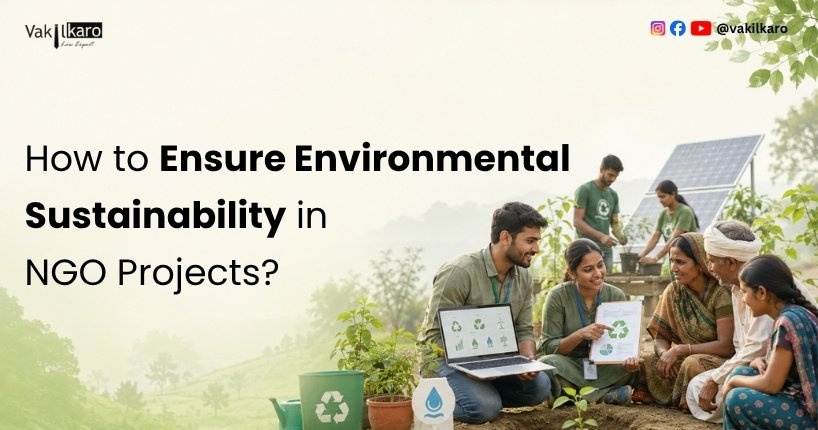
Environmental sustainability is a critical responsibility for NGOs working in development and welfare sectors. Whether addressing health, education, or women's empowerment, NGOs must consider the environmental impact of their actions. In India, aligning with sustainability enhances donor trust and credibility—especially for those with NGO registration, Section 8 company registration, or 12A and 80G certification. These legal statuses reinforce transparency and ethical responsibility. Sustainable practices not only support ecological balance but also strengthen organizational governance. This blog explores practical steps NGOs can take to incorporate sustainability into their projects, from design to execution, while staying legally compliant and mission-driven.
Key Takeaways
- Promoting Environmental Sustainability in NGO Projects: A Legal and Practical Guide Environmental sustainability has become an essential responsibility for all organizations, especially Non-Governmental Organizations (NGOs) that aim to create long-lasting social and developmental impact.
- Whether it’s through sustainable farming initiatives, health programs that promote eco-friendly practices, or education campaigns that teach environmental conservation, NGOs must ensure that their projects do not deplete natural resources but instead help conserve them for future generations.
- Moreover, for NGOs that have achieved proper registration—whether through NGO registration under the Indian Trusts Act, Societies Registration Act, or as Section 8 companies under the Companies Act—environmental sustainability plays an even more significant role.
- When an NGO’s operations align with these legal and ethical guidelines, they ensure that their work in environmental sustainability is built on a foundation of trust, transparency, and compliance.
- Monitor, Evaluate, and Report Sustainability Metrics Monitoring and evaluation (M&E) are crucial to track the environmental performance of NGO projects.
Promoting Environmental Sustainability in NGO Projects: A Legal and Practical Guide
Environmental sustainability has become an essential responsibility for all organizations, especially Non-Governmental Organizations (NGOs) that aim to create long-lasting social and developmental impact. NGOs engaged in sectors such as health, education, women’s empowerment, and community upliftment must also consider how their operations affect the environment. In today’s climate-conscious world, integrating sustainability into project planning and implementation is both a moral and strategic imperative.
In India, NGOs that have completed their legal registrations—such as NGO registration under the Trust, Society, or Companies Act; Section 8 company registration under the Companies Act, 2013; and 12A and 80G registration for tax exemptions—are already aligned with structures that promote accountability and governance. These legal frameworks not only legitimize the NGO’s operations but also elevate their credibility among donors, government agencies, and CSR partners. An organization that aligns environmental awareness with legal compliance is more likely to build trust and secure sustainable funding.
Adopting environmentally friendly practices allows NGOs to reduce their ecological footprint while enhancing the communities they serve. From using renewable energy and encouraging waste reduction to promoting water conservation and eco-conscious livelihoods, sustainable project models are key to long-term impact. Furthermore, legal certifications like 12A and 80G Registration help NGOs demonstrate their commitment to transparency and responsible practices—important factors for attracting support.
This blog highlights actionable strategies for NGOs to embed environmental responsibility into every stage of their projects, from assessment and planning to execution, reporting, and monitoring. It also emphasizes how legal compliance, such as through Section 8 company registration and 80G certification, supports these sustainability goals. With the right blend of legal structure, community participation, and eco-friendly innovation, NGOs can drive meaningful change while preserving the environment for future generations.
In today’s interconnected world, environmental sustainability has moved beyond being a mere global challenge; it has become an essential responsibility for all organizations. Non-Governmental Organizations (NGOs), which have long been at the forefront of addressing social issues such as health, education, women's empowerment, and community development, must also acknowledge the environmental impact of their work. NGOs are often involved in initiatives that shape communities and influence public health, economic development, and social welfare. However, it’s increasingly clear that such efforts must not come at the cost of the environment. Whether it’s through sustainable farming initiatives, health programs that promote eco-friendly practices, or education campaigns that teach environmental conservation, NGOs must ensure that their projects do not deplete natural resources but instead help conserve them for future generations.
For NGOs operating in India, aligning their activities with the principles of environmental sustainability is not just an ethical or moral responsibility—it is an effective way to build trust and credibility. Increasingly, donors, funding organizations, and the general public are scrutinizing the environmental impact of NGO projects. NGOs that commit to sustainable practices stand a higher chance of securing long-term support, as donors are more likely to contribute to organizations that align with their values of responsibility and eco-consciousness.
Moreover, for NGOs that have achieved proper registration—whether through NGO registration under the Indian Trusts Act, Societies Registration Act, or as Section 8 companies under the Companies Act—environmental sustainability plays an even more significant role. Legal frameworks such as Section 8 company registration, and certifications like 12A and 80G, which offer tax exemptions and benefits, provide a foundation of credibility. These legal structures not only confirm the legitimacy of the NGO but also reinforce its commitment to transparency and responsible governance. When an NGO’s operations align with these legal and ethical guidelines, they ensure that their work in environmental sustainability is built on a foundation of trust, transparency, and compliance.
This blog delves into practical strategies for NGOs to integrate environmental sustainability into their projects. It covers everything from the planning and execution stages to monitoring, reporting, and ensuring compliance with environmental regulations. Additionally, it explores how NGOs, particularly those with NGO registration, Section 8 company registration, and 12A and 80G certification, can enhance their sustainable practices while adhering to legal frameworks that ensure their work is impactful, ethical, and compliant. By aligning with these guidelines, NGOs can play a significant role in driving sustainable development, benefiting both the communities they serve and the environment at large.
Understand the Importance of Environmental Sustainability
Environmental sustainability refers to responsible interaction with the environment to avoid depletion or degradation of natural resources and ensure long-term ecological balance. For NGOs, this is important because:
- It protects the communities they serve.
- It aligns with global development goals like the UN Sustainable Development Goals (SDGs).
- It attracts eco-conscious donors and partners.
Whether your NGO works on education or rural livelihoods, every activity leaves an environmental footprint. By integrating sustainability principles, NGOs can minimize harm and maximize long-term positive impact.
Start with a Legally Compliant Framework
Before diving into project strategies, NGOs should ensure they have the proper legal structure. This includes:
- NGO registration under the Indian Trust Act, Societies Registration Act, or as a Section 8 Company under the Companies Act.
- Applying for 12A and 80G registration to receive tax exemptions and offer tax benefits to donors.
These registrations not only legitimize operations but also strengthen funding opportunities and public trust, both of which are essential for implementing sustainable projects.
Conduct an Environmental Impact Assessment (EIA)
Before launching any new project, NGOs should assess its potential environmental impact. An Environmental Impact Assessment helps in:
- Identifying risks to natural resources.
- Planning mitigation strategies.
- Ensuring regulatory compliance.
Section 8 companies and NGOs with formal registration are often required to adhere to such assessments, especially when working in sensitive or rural environments.
Design Eco-Friendly Project Models
Sustainability begins at the design phase. NGOs should integrate environmental considerations into the core structure of their projects. This can include:
- Promoting renewable energy sources (solar, wind).
- Encouraging water conservation techniques.
- Using biodegradable and recyclable materials.
- Incorporating eco-education into community programs.
Projects designed under an eco-conscious framework not only serve immediate needs but also leave a lasting, positive footprint.
Promote Community Participation in Sustainability
True environmental sustainability cannot be achieved without grassroots support. NGOs should:
- Conduct workshops and awareness campaigns on eco-friendly practices.
- Empower communities to take ownership of local environmental issues.
- Encourage sustainable farming, rainwater harvesting, and waste management.
Such inclusive models are often favored by donors and government bodies when NGOs apply for 12A and 80G registration.
Adopt Green Office Practices
Sustainability should start at the organizational level. NGOs can lead by example by:
- Reducing paper use and promoting digital documentation.
- Implementing energy-saving devices in office spaces.
- Encouraging waste segregation and recycling.
Section 8 companies, in particular, are held to higher governance standards. Maintaining a green workplace aligns with these standards and enhances the NGO’s credibility.
Collaborate with Environmental Experts and NGOs
Partnerships can significantly boost an NGO's capacity to implement sustainable practices. Collaborate with:
- Environmental NGOs for shared learning.
- Government agencies for compliance and support.
- CSR partners who prioritize eco-conscious projects.
Such partnerships are easier to forge for legally recognized NGOs with 12A and 80G registration, as they are eligible to receive CSR funds.
Monitor, Evaluate, and Report Sustainability Metrics
Monitoring and evaluation (M&E) are crucial to track the environmental performance of NGO projects. Use key metrics like:
- Reduction in carbon footprint.
- Volume of water conserved.
- Quantity of waste recycled.
Reporting these outcomes transparently builds trust with stakeholders, especially donors and government agencies that review compliance under Section 8 company registration norms.
Ensure Legal and Environmental Compliance
NGOs should familiarize themselves with environmental laws such as:
- The Environment Protection Act, 1986
- The Water (Prevention and Control of Pollution) Act, 1974
- The Forest Conservation Act, 1980
Being legally compliant not only prevents litigation but also enhances the NGO’s standing when applying for 12A and 80G certification or CSR partnerships.
Use Technology for Sustainable Solutions
Incorporating technology can make projects more efficient and sustainable. Examples include:
- Solar-powered water pumps.
- Mobile apps for waste collection and tracking.
- GIS tools for forest mapping or agricultural planning.
These innovations showcase a forward-thinking approach, crucial for NGOs looking to scale and attract large donors.
Create Internal Sustainability Guidelines
Draft and implement an internal environmental policy. Include:
- Clear sustainability goals.
- Operational checklists.
- Training for staff and volunteers.
Having formal guidelines is often a best practice for Section 8 companies and NGOs seeking 12A and 80G renewals.
Communicate Your Sustainability Efforts
Effective communication is key. Highlight your eco-initiatives in:
- Annual reports
- Social media
- Grant applications
This visibility helps during audits and enhances your profile for potential funders. Section 8 companies and 80G-certified NGOs are often reviewed based on transparency.
NGO Darpan: Enhancing Transparency and Access for NGO Registration in India
NGO Darpan is an online platform developed by the NITI Aayog, Government of India, to facilitate the registration and management of Non-Governmental Organizations (NGOs) in India. It serves as a comprehensive database for NGOs, enabling them to register and maintain their profile in a standardized manner. This platform provides a unique ID to NGOs, ensuring transparency and credibility. It is particularly relevant for NGOs that wish to apply for government grants and collaborate with various ministries, as the registration on NGO Darpan is often a prerequisite for accessing financial support and participating in government schemes. Additionally, it offers NGOs a centralized space to update their activities and key information, enhancing their visibility and accountability. In essence, NGO Darpan plays a vital role in the formalization and recognition of NGOs in India, making them eligible for a wide range of government programs and fostering a streamlined approach to NGO operations and governance.
Conclusion
In today's world, environmental sustainability is no longer just a best practice for NGOs; it has become a core principle that must be integrated into the heart of every organization’s operations. The importance of environmental sustainability extends far beyond the ethical obligation of protecting the planet—it directly enhances an NGO’s impact, improves its credibility, and fosters long-term, sustainable funding opportunities. By embedding eco-friendly practices into all aspects of project planning, execution, and internal operations, NGOs can make a more responsible and lasting difference. Whether it's through adopting energy-efficient technologies, promoting sustainable farming, or reducing waste, these initiatives not only help the environment but also foster goodwill among donors, volunteers, and beneficiaries.
When NGOs prioritize environmental sustainability, they also build stronger relationships with stakeholders. In today’s conscious world, donors, government bodies, and community members are increasingly looking for organizations that demonstrate a genuine commitment to both social and environmental well-being. NGOs that practice sustainability not only mitigate their environmental footprint but also enhance their public image, making them more attractive to potential donors and partners.
Moreover, legal frameworks such as NGO registration, Section 8 company registration, and the certifications of 12A and 80G play a vital role in ensuring that NGOs operate responsibly and transparently. These legal structures are not just about regulatory compliance—they are fundamental to ensuring the organization remains accountable, fosters trust, and gains long-term credibility in the eyes of stakeholders. Section 8 company registration, in particular, holds NGOs to higher governance standards, encouraging them to implement sustainable practices that align with both national and international goals for sustainable development.
With the right legal and operational framework in place, NGOs can work with confidence, knowing that they are contributing positively to both society and the environment. Partnering with Vakilkaro ensures that your NGO meets all required legal and environmental standards. From obtaining necessary registrations to creating comprehensive compliance documentation, Vakilkaro provides end-to-end legal support, allowing you to focus on making a lasting, impactful, and sustainable difference in the communities you serve.
Official External Resources
Use these primary/official sources to verify rules, forms, fees, timelines and regulatory updates before publication.
Frequently asked questions
How to Ensure Environmental Sustainability in NGO Projects?+
Promoting Environmental Sustainability in NGO Projects: A Legal and Practical Guide Environmental sustainability has become an essential responsibility for all organizations, especially Non-Governmental Organizations (NGOs) that aim to create long-lasting social and developmental impact. When an NGO’s operations align with these legal and ethical guidelines, they ensure that their work in environmental sustainability is built on a foundation of trust, transparency, and compliance.
