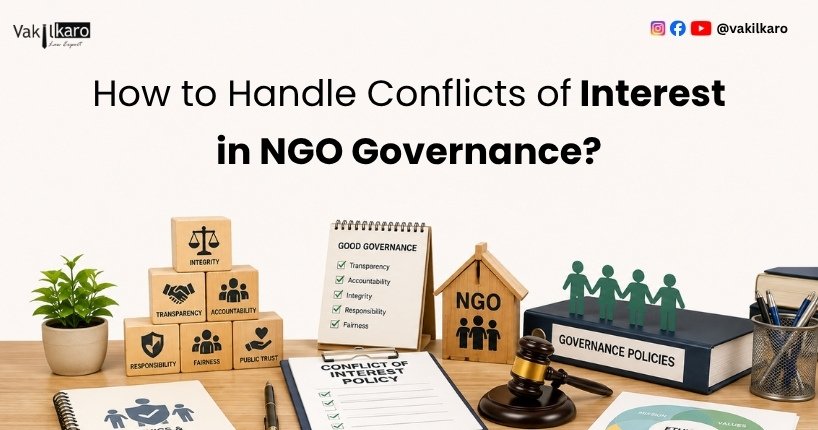
Non-Governmental Organizations (NGOs) in India play a vital role in social development and must operate with high standards of transparency and accountability. Whether registered as a trust, society, or under Section 8 company registration, managing conflicts of interest is crucial to maintain public trust and legal compliance. Conflicts arise when personal interests interfere with organizational decisions, potentially affecting 12A and 80G registration status and donor confidence. Establishing clear policies and transparent governance practices is essential for long-term credibility. This guide outlines key steps to identify and manage conflicts, ensuring ethical operations aligned with NGO registration and compliance requirements.
Key Takeaways
- Managing Conflicts of Interest in NGO Governance: A Guide for Ethical Compliance Conflicts of interest can pose serious challenges to the governance and credibility of Non-Governmental Organizations (NGOs) in India.
- Managing conflicts of interest with diligence ensures that all decisions are made in the best interest of the NGO, helping it maintain credibility and long-term impact in the communities it serves.
- Steps to Handle Conflicts of Interest in NGO Governance 1.
- Conduct Periodic Governance Training Regular training sessions should be organized to educate the board and senior staff about ethical governance, including how to identify and handle conflicts of interest.
- Conclusion Effectively managing conflicts of interest is a cornerstone of strong NGO governance.
Managing Conflicts of Interest in NGO Governance: A Guide for Ethical Compliance
Conflicts of interest can pose serious challenges to the governance and credibility of Non-Governmental Organizations (NGOs) in India. These situations arise when individuals in decision-making positions, such as trustees, board members, or senior staff, allow their personal or financial interests to interfere with the NGO’s mission. Whether an organization operates as a trust, society, or has obtained Section 8 company registration, it is essential to manage these conflicts effectively to maintain integrity and legal compliance.
For NGOs, particularly those relying on 12A and 80G registration to secure tax benefits and attract donor support, ethical governance is not optional—it is a legal and operational imperative. Unmanaged conflicts can undermine stakeholder trust and result in penalties, reputational damage, or even loss of registration. Hence, NGOs must adopt proactive measures to prevent such scenarios.
Establishing a well-defined conflict of interest policy is a fundamental step. This policy should outline what constitutes a conflict, procedures for disclosure, and clear protocols for recusal from decision-making processes. Organizations registered under Section 8 company registration are also bound by the Companies Act, which mandates formal disclosures of interests under Section 184.
Regular declarations by board members, proper documentation of decisions, and transparency in procurement practices are essential governance practices. Additionally, conducting annual training for board and staff, maintaining a conflict of interest register, and including independent board members can greatly enhance ethical oversight.
By aligning governance practices with legal frameworks such as NGO registration, Section 8 registration, and maintaining valid 12A and 80G registration, organizations can reinforce stakeholder confidence and uphold their mission. Managing conflicts of interest with diligence ensures that all decisions are made in the best interest of the NGO, helping it maintain credibility and long-term impact in the communities it serves.
In the nonprofit sector, values such as integrity, transparency, and accountability are not just guiding principles—they are essential pillars that uphold the credibility and trustworthiness of an organization. Non-Governmental Organizations (NGOs), by their very nature, are dedicated to serving the public interest and improving society in various ways. However, as these organizations grow and their operations become more complex, one of the most sensitive and potentially damaging challenges they can face is the issue of conflicts of interest within their governance structures.
A conflict of interest arises when individuals in positions of authority—such as trustees, board members, or senior staff—stand to benefit personally or professionally from decisions made in their organizational role. If not identified and managed properly, such conflicts can jeopardize the organization’s reputation, cause internal friction, affect donor confidence, and even lead to legal consequences.
This risk is particularly relevant regardless of an NGO's legal structure—be it a trust, society, or an entity established through Section 8 company registration under the Companies Act, 2013. In all cases, the potential for conflicts must be addressed with clear policies, transparency, and ethical decision-making processes.
Moreover, effective conflict of interest management is not just good governance—it is a compliance requirement. NGOs looking to obtain or renew NGO registration, along with important tax-exempt statuses such as 12A and 80G registration, must demonstrate sound governance practices. Regulatory authorities scrutinize the decision-making processes and financial dealings of NGOs, especially when there are indications of insider influence or private benefit.
This comprehensive guide aims to explore how NGOs can effectively identify, handle, and resolve conflicts of interest. It highlights legal obligations, best practices, and strategic steps to help organizations strengthen their internal governance while ensuring continued public and donor trust through full compliance with applicable laws and registrations.
Understanding Conflict of Interest in NGOs
A conflict of interest in the context of NGOs refers to any situation where an individual in a decision-making position—such as a board member, trustee, or senior staff member—has a personal interest that could compromise, or appear to compromise, their ability to act in the best interests of the organization. These interests may be financial (such as ownership in a vendor company), familial (like hiring a relative), or professional (such as consulting for a partner organization).
In nonprofit governance, even the perception of biased decision-making can lead to serious reputational and legal consequences. For instance, if a trustee involved in project procurement awards a contract to a company in which they hold shares, this creates a potential conflict. Even if the service provided is competitive and the decision was made objectively, the lack of transparency and disclosure can give the impression of self-dealing or misuse of authority.
This issue becomes even more sensitive when the NGO operates under a legal framework like Section 8 company registration, where corporate governance rules are stricter and more closely monitored under the Companies Act, 2013. Furthermore, NGOs that have secured or are seeking 12A and 80G registration from the Income Tax Department must uphold high ethical and operational standards to retain their tax exemptions and donor credibility. Any sign of undisclosed conflicts could lead to regulatory scrutiny, denial of renewals, or even revocation of these certifications.
Therefore, understanding what constitutes a conflict of interest—and proactively preventing or managing it—is crucial for any NGO, especially those seeking to maintain transparency, uphold donor trust, and ensure compliance with legal frameworks like NGO registration, Section 8 registration, and 12A/80G certifications.
Why Conflict of Interest Management is Crucial?
- Legal and Regulatory Compliance: NGOs registered under the Indian Trust Act, Societies Registration Act, or Section 8 company registration under the Companies Act, 2013, must comply with specific governance standards. Failure to disclose and manage conflicts of interest may result in penalties, loss of registration, or denial of renewal for 12A and 80G registration.
- Protecting Public Trust: Donors, beneficiaries, and stakeholders expect NGOs to act with the highest ethical standards. Any appearance of impropriety can deter donor support, affect funding, and harm the organization's reputation.
- Safeguarding Mission Integrity: Conflicts of interest can divert the NGO from its mission. Proper management ensures that decisions are made solely based on the best interest of the organization and its objectives.
Steps to Handle Conflicts of Interest in NGO Governance
Establish a Conflict of Interest Policy Every NGO, regardless of its legal structure, should adopt a written conflict of interest policy. This document should define what constitutes a conflict, outline disclosure procedures, and specify actions to be taken when conflicts arise.
Organizations with Section 8 company registration are legally required to maintain a code of conduct, which includes conflict of interest provisions. Integrating this into your compliance efforts is also essential when applying for or renewing 12A and 80G registration.
- Mandate Annual Disclosures Board members and key management personnel should complete a disclosure form annually, detailing any affiliations or financial interests that might lead to a conflict. These disclosures should be reviewed and updated regularly.
- Record and Review All Disclosures Maintain a register of interest disclosures, which should be reviewed periodically by an independent governance or ethics committee. This is especially important for NGOs operating under Section 8 company registration, as they are subject to corporate governance norms under the Companies Act.
- Recusal from Decision-Making When a conflict is identified, the individual concerned must recuse themselves from all related discussions and decisions. This must be documented in meeting minutes and recorded for compliance reporting, especially if the NGO seeks to maintain its 12A and 80G registration.
- Engage Independent Board Members Having independent members on the board helps provide objective perspectives and reduces the likelihood of biased decision-making. It also reflects positively on the NGO’s governance during NGO registration or Section 8 company registration assessments.
- Conduct Periodic Governance Training Regular training sessions should be organized to educate the board and senior staff about ethical governance, including how to identify and handle conflicts of interest.
- Transparency in Contracts and Procurement Establish clear policies for procurement and contracting. All proposals and bids should be evaluated fairly, with complete documentation. Avoid awarding contracts to board members or their associates unless it is demonstrably in the NGO’s best interest and approved by disinterested board members.
Legal Framework and Best Practices
Section 8 Company Registration: NGOs registered under Section 8 are governed by the Companies Act, 2013, which mandates stringent governance practices. Directors must disclose their interests under Section 184 of the Act. Failure to comply can lead to disqualification, penalties, and loss of tax-exempt status.
NGO Registration: For NGOs registered as trusts or societies, while the statutory obligations may differ, following the best practices of transparency and documentation is still critical to ensure compliance with regulatory bodies and to maintain public trust.
12A and 80G Registration: To qualify and retain 12A and 80G registration, the Income Tax Department scrutinizes governance practices. Unmanaged conflicts of interest can be grounds for denying or revoking these certifications. Proper documentation, transparent financial transactions, and ethical decision-making are crucial to passing scrutiny.
Case Examples
Example 1: Procurement Conflict An NGO registered under Section 8 company registration faced scrutiny when a board member’s company was awarded a construction contract. Although the board member abstained from voting, the lack of a documented conflict of interest policy resulted in negative publicity. The NGO had to overhaul its governance structure and reapply for 80G registration.
Example 2: Family Appointments A society registered NGO appointed the founder's relative to a paid position without open recruitment. This raised concerns during a 12A renewal process. As a result, the NGO was asked to submit a compliance explanation and was temporarily denied donor tax benefits.
Practical Checklist for NGOs
- Adopt and circulate a written conflict of interest policy.
- Conduct annual disclosures of financial interests.
- Keep a conflict of interest register.
- Enforce recusal and document it in meeting minutes.
- Include conflict of interest clauses in procurement policies.
- Train board members and staff regularly.
- Review policies annually and update as needed.
- Consult legal experts to align with Section 8 company, 12A, and 80G compliance norms.
Conclusion
Effectively managing conflicts of interest is a cornerstone of strong NGO governance. Whether your organization operates under trust law, society registration, or Section 8 company registration, it must adopt a proactive approach to identifying and mitigating risks. Conflicts of interest, if left unchecked, can jeopardize your NGO's credibility, legal standing, and funding potential.
Integrating conflict of interest management into your NGO’s broader legal framework—from initial NGO registration to securing and maintaining 12A and 80G registration—is essential. By fostering a culture of transparency and accountability, NGOs can build long-term trust with stakeholders and ensure sustained impact in the communities they serve.
For expert guidance on setting up conflict-free governance practices, legal compliance, and registrations including Section 8 company registration and 12A/80G certification, consider partnering with professionals who understand the nuances of nonprofit law and operations in India.
Why Choose Vakilkaro for Your NGO Legal and Compliance Needs?
Vakilkaro is a trusted legal service provider dedicated to simplifying the complex legal landscape for NGOs, startups, and businesses across India. Here’s why NGOs and nonprofit organizations should partner with Vakilkaro for services like Section 8 company registration, NGO registration, 12A and 80G registration, and ongoing compliance:
✅ Expert Legal Guidance
Vakilkaro’s team comprises experienced legal professionals who specialize in nonprofit law, company law, and tax compliance. They provide accurate and timely legal advice tailored to the unique structure of your NGO—whether it’s a trust, society, or Section 8 company.
✅ End-to-End Support
From incorporation to compliance, Vakilkaro offers end-to-end services. Whether you’re looking to register under Section 8 of the Companies Act, apply for 80G tax exemption, or ensure proper documentation for 12A registration, Vakilkaro handles it all with precision.
✅ Hassle-Free Process
Vakilkaro simplifies the legal process through a transparent and step-by-step approach. Their online system ensures that your paperwork is accurate, deadlines are met, and you're always compliant with statutory requirements.
✅ Affordable and Transparent Pricing
Legal services shouldn’t be a financial burden—especially for NGOs. Vakilkaro offers cost-effective solutions with no hidden charges, making it easier for nonprofits to access quality legal help without straining their budget.
✅ Compliance-First Approach
Maintaining credibility through proper conflict of interest management, ethical governance, and statutory filings is crucial. Vakilkaro ensures your organization remains in good standing, helping you secure and retain 12A/80G certification, maintain donor trust, and build long-term sustainability.
Official External Resources
Use these primary/official sources to verify rules, forms, fees, timelines and regulatory updates before publication.
Frequently asked questions
How to Handle Conflicts of Interest in NGO Governance?+
Managing Conflicts of Interest in NGO Governance: A Guide for Ethical Compliance Conflicts of interest can pose serious challenges to the governance and credibility of Non-Governmental Organizations (NGOs) in India. Steps to Handle Conflicts of Interest in NGO Governance 1.
