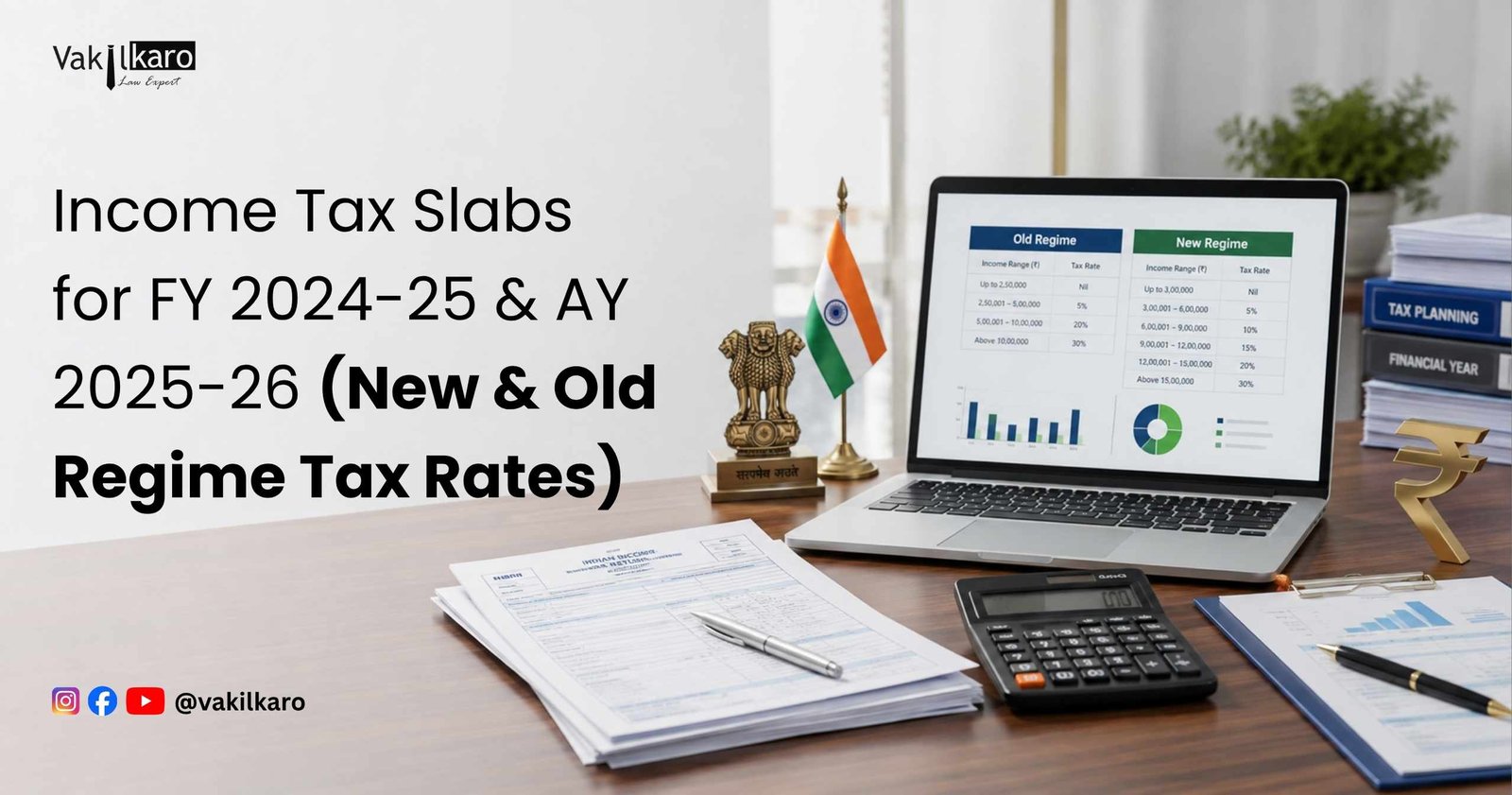
Understanding income tax slabs for FY 2024-25 (AY 2025-26) is crucial for financial planning. The Indian tax system offers two regimes: the old regime, which allows deductions like Section 80C, 80D, HRA, and LTA, and the new regime, which has lower tax rates but fewer exemptions. The new tax regime has slabs ranging from nil for income up to ₹2.5 lakh to 30% for income above ₹15 lakh, with a ₹50,000 standard deduction. The old regime follows similar slabs but allows deductions. Tax calculation involves applying applicable brackets, adding surcharge and cess. Understanding these structures ensures efficient tax planning.
Key Takeaways
- New Regime Understanding the income tax slabs for FY 2024-25 (Assessment Year 2025-26) is essential for taxpayers to plan their finances effectively.
- Income Tax Slabs for FY 2024-25 (New Tax Regime) For individuals opting for the new tax regime, the following tax slabs apply: The standard deduction 2024 of ₹50,000 is also available under the new tax regime.
- Income Tax Slabs for FY 2024-25 (Old Tax Regime) For taxpayers choosing the old regime, the following federal tax brackets 2024 apply: Deductions like 80C (₹1.5 lakh), 80D, HRA, and LTA apply under this regime.
- For the Financial Year (FY) 2024-25 (Assessment Year 2025-26), the tax slabs follow the structure outlined under both the old tax regime and the new tax regime.
- This means that taxpayers can expect the same income tax rates and structures, with the new tax regime offering lower tax rates but fewer deductions, while the old tax regime continues to allow deductions under various sections such as 80C, 80D, and HRA.
Income Tax Slabs for FY 2024-25 & AY 2025-26: Old vs. New Regime
Understanding the income tax slabs for FY 2024-25 (Assessment Year 2025-26) is essential for taxpayers to plan their finances effectively. The Indian tax system offers two regimes: the old tax regime, which provides various deductions and exemptions, and the new tax regime, which features lower tax rates but fewer benefits. Choosing the right regime depends on an individual’s income structure and tax-saving preferences.
The new tax regime has simplified slabs, with no tax on income up to ₹2.5 lakh. The tax rate is 5% for income between ₹2.5 lakh and ₹5 lakh, 10% for ₹5 lakh to ₹7.5 lakh, and increases progressively to 30% for income above ₹15 lakh. Additionally, a standard deduction of ₹50,000 is available under this regime. While this system offers lower tax rates, it removes common deductions like 80C, 80D, HRA, and LTA, making it suitable for individuals with fewer investments or exemptions.
On the other hand, the old tax regime follows a similar structure but allows deductions and exemptions. Income up to ₹2.5 lakh is tax-free, while the tax rate is 5% for ₹2.5 lakh to ₹5 lakh, 20% for ₹5 lakh to ₹10 lakh, and 30% for income above ₹10 lakh. Taxpayers opting for this regime can claim deductions under sections like 80C (₹1.5 lakh), 80D (health insurance), and HRA, making it beneficial for those with significant tax-saving investments.
To calculate tax, individuals should apply the relevant tax slabs, consider deductions (if applicable), add surcharge (if any), and include a 4% cess. Staying informed about these structures ensures efficient tax planning and compliance with the latest tax regulations.
Taxpayers must understand the income tax slabs for the financial year (FY) 2024-25 and the corresponding assessment year (AY) 2025-26 to plan their finances efficiently. Income tax is levied based on income brackets, and the Government of India provides two taxation regimes—each with its own set of benefits and limitations. Choosing the right tax regime depends on individual financial goals, tax-saving investments, and eligible deductions.
The old tax regime allows taxpayers to claim deductions and exemptions, reducing taxable income. It includes benefits like Section 80C deductions (up to ₹1.5 lakh), House Rent Allowance (HRA), medical insurance deductions under Section 80D, and Leave Travel Allowance (LTA), among others. Although the tax rates are higher compared to the new regime, individuals can significantly lower their tax liability by utilizing various tax-saving options.
The new tax regime, introduced to simplify tax compliance, features lower tax rates but eliminates most deductions and exemptions. It provides a straightforward tax calculation method, benefiting individuals who do not have significant tax-saving investments. The standard deduction of ₹50,000 is applicable under this regime, but popular exemptions like HRA, 80C investments, and 80D medical insurance benefits are not available.
This guide provides a detailed breakdown of the income tax brackets for FY 2024-25, explains the differences between the two regimes, and outlines the tax calculation process. By understanding these aspects, taxpayers can make informed decisions about which regime to opt for, ensuring effective financial planning and tax compliance.
Income Tax Regimes: Old vs. New
The Indian taxation system offers two regimes:
- Old Tax Regime: Allows deductions like standard deduction 2024, Section 80C, 80D, HRA, and other tax-saving instruments.
- New Tax Regime: Offers lower income tax brackets but removes most deductions.
Income Tax Slabs for FY 2024-25 (New Tax Regime)
For individuals opting for the new tax regime, the following tax slabs apply:
The standard deduction 2024 of ₹50,000 is also available under the new tax regime.
Income Tax Slabs for FY 2024-25 (Old Tax Regime)
For taxpayers choosing the old regime, the following federal tax brackets 2024 apply:
Deductions like 80C (₹1.5 lakh), 80D, HRA, and LTA apply under this regime.
How to Calculate Tax for FY 2024-25?
Calculating income tax accurately is essential for financial planning and ensuring compliance with tax laws. The process varies depending on whether a taxpayer opts for the old tax regime (which allows deductions and exemptions) or the new tax regime (which offers lower tax rates but fewer deductions). Here’s a step-by-step guide to calculating your tax liability for the financial year 2024-25:
Step 1: Determine Taxable Income
- For the Old Tax Regime: Start by calculating your gross total income, which includes salary, business income, rental income, capital gains, and any other sources. Then, subtract eligible deductions such as Section 80C (₹1.5 lakh for investments like PPF, EPF, life insurance, etc.), Section 80D (medical insurance premiums), HRA (House Rent Allowance), LTA (Leave Travel Allowance), and other exemptions. The remaining amount is your taxable income.
- For the New Tax Regime: No deductions are allowed except the standard deduction of ₹50,000. Simply add up all your income sources to arrive at your total taxable income.
Step 2: Apply the Applicable Tax Brackets
- Identify the income tax slab that corresponds to your taxable income.
- Apply the respective tax rates based on the old or new tax regime.
- Ensure that the tax is calculated progressively, meaning each portion of income is taxed at its respective rate.
Step 3: Add Surcharge and Cess (If Applicable)
- If your taxable income exceeds ₹50 lakh, a surcharge is levied as per government norms.
- A 4% health and education cess is applied on the total tax amount (including surcharge).
Step 4: Use an Income Tax Calculator
For accuracy, use an online income tax calculator. It ensures precise calculations by incorporating tax slabs, deductions, and additional charges like surcharge and cess. This helps in tax planning and determining the exact tax liability.
By following these steps, taxpayers can efficiently compute their tax dues, ensuring compliance while optimizing their tax burden based on their chosen tax regime.
Capital Gains Tax Rates for FY 2024-25
Capital gains tax is levied on the profit earned from the sale of capital assets such as stocks, mutual funds, real estate, and other investments. The tax rate depends on the type of asset and the duration for which it was held before being sold. Capital gains are classified into Short-Term Capital Gains (STCG) and Long-Term Capital Gains (LTCG) based on the holding period.
Short-Term Capital Gains (STCG)
Short-term capital gains apply when assets are sold within a short duration after purchase. The holding period criteria vary depending on the asset class:
- Listed Equity Shares & Equity-Oriented Mutual Funds: If sold within 12 months of purchase, the gains are classified as short-term and taxed at 15% under Section 111A. This rate applies uniformly, irrespective of the income tax slab of the taxpayer.
- Debt Mutual Funds, Real Estate & Other Assets: For most other assets, if sold within 36 months (3 years) of purchase, the gains are considered short-term and taxed as per the individual’s income tax slab under the applicable tax regime.
Long-Term Capital Gains (LTCG)
Long-term capital gains apply when assets are held beyond the specified period before being sold:
- Listed Equity Shares & Equity-Oriented Mutual Funds: If held for more than 12 months, the gains qualify as long-term capital gains. LTCG up to ₹1 lakh per financial year is exempt from tax, but any amount exceeding ₹1 lakh is taxed at 10% without indexation benefits under Section 112A.
- Real Estate & Debt Mutual Funds: If held for more than 36 months, the gains are taxed at 20% with indexation benefits, which help adjust for inflation and reduce taxable gains.
Understanding these tax rates helps investors plan their finances and choose the most tax-efficient investment strategies.
Federal Tax Brackets 2024 vs. 2025 Tax Brackets
The income tax brackets for a given financial year determine how much tax individuals and businesses need to pay based on their income levels. These brackets are subject to periodic revision by the government, typically during the annual budget announcement. For the Financial Year (FY) 2024-25 (Assessment Year 2025-26), the tax slabs follow the structure outlined under both the old tax regime and the new tax regime.
As of now, the tax brackets for FY 2025-26 are expected to remain unchanged from FY 2024-25, unless the government introduces modifications through policy changes in the upcoming budget. This means that taxpayers can expect the same income tax rates and structures, with the new tax regime offering lower tax rates but fewer deductions, while the old tax regime continues to allow deductions under various sections such as 80C, 80D, and HRA.
However, taxpayers should stay informed about any updates from the Ministry of Finance or the Income Tax Department, as revisions in tax slabs can impact tax planning, deductions, and overall financial planning for the next financial year. If the government announces changes, they could include adjustments in income thresholds, modifications in standard deductions, or revisions in tax rates to provide relief to taxpayers or improve revenue collection.
For now, individuals and businesses should continue using the existing 2024-25 tax brackets to estimate their tax liabilities for FY 2025-26, unless an official notification states otherwise.
Standard Deduction 2024 vs. Standard Deduction 2023
The standard deduction is a fixed amount that taxpayers can deduct from their total income before calculating taxable income. It was introduced to simplify tax filing and reduce taxable income without requiring specific proof of expenses.
In 2023, the standard deduction stood at ₹50,000 for salaried individuals and pensioners. This deduction applies irrespective of the tax regime chosen. The same standard deduction of ₹50,000 continues in the Financial Year (FY) 2024-25 (Assessment Year 2025-26), benefiting taxpayers by reducing their taxable income and, consequently, their tax liability.
For individuals opting for the old tax regime, the standard deduction remains available along with other deductions like Section 80C (₹1.5 lakh), 80D (medical insurance), HRA, and LTA. In the new tax regime, which initially did not allow for standard deductions, a revision in Budget 2023 included the ₹50,000 standard deduction for salaried individuals and pensioners to provide some tax relief.
This continuity ensures stability for taxpayers and allows them to plan their taxes effectively, whether they choose the old or new tax regime. If the government makes any future changes to the standard deduction, it would likely be announced in the next Union Budget. Until then, the ₹50,000 deduction remains unchanged, helping salaried employees and pensioners lower their tax burden efficiently.
Conclusion
Understanding income tax brackets and taxable income slabs is crucial for effective financial planning and tax management. Whether an individual opts for the old tax regime with multiple deductions and exemptions or the new tax regime with lower tax rates and a simplified structure, making an informed choice is essential to optimize tax savings.
With tax laws evolving each year, staying updated on the latest tax regulations ensures that taxpayers can maximize benefits and minimize tax liabilities. The new tax regime introduced in Budget 2025 provides higher tax-free income thresholds and reduced tax rates, making it more attractive for many individuals. However, those who claim significant deductions under Sections 80C, 80D, HRA, and other exemptions may still find the old tax regime more beneficial.
Proper tax planning involves analyzing income sources, eligible deductions, and applicable tax rates before selecting the most suitable tax structure. Using an income tax calculator can simplify the process and help determine precise tax liabilities under both regimes. Additionally, taxpayers should consider factors such as investment planning, retirement savings, and long-term financial goals when choosing a tax regime.
With the right knowledge and timely planning, individuals can legally reduce their tax burden, increase savings, and ensure smooth tax compliance. Whether salaried employees, business owners, or self-employed professionals, every taxpayer must stay informed about the latest tax reforms, standard deductions, and changes in tax slabs to make financially sound decisions.
Why Choose Vakilkaro for ITR-1 Return Filing and Other Services?
Vakilkaro is a trusted legal and financial service provider offering hassle-free and expert-assisted tax filing solutions, including ITR-1 return filing. With a team of experienced professionals, Vakilkaro ensures accurate, timely, and compliant tax filing, minimizing the risk of penalties and errors.
Key Benefits of Choosing Vakilkaro for ITR-1 Return Filing:
- Expert Assistance – Get professional guidance to file your Income Tax Return (ITR-1) with accuracy, ensuring compliance with the latest tax laws.
- Quick & Hassle-Free Process – Vakilkaro simplifies tax filing with a fast, seamless, and paperless online process.
- Maximized Tax Savings – Identify eligible deductions and tax-saving opportunities under various sections like 80C, 80D, and HRA to minimize tax liabilities.
- Error-Free Filing – Vakilkaro ensures accurate filing with a thorough review process to avoid mistakes, discrepancies, or tax notices.
- 24/7 Customer Support – Get dedicated assistance from experts before, during, and after the tax filing process.
- Affordable Pricing – Vakilkaro offers cost-effective pricing with no hidden charges, making it a budget-friendly choice for taxpayers.
Other Services Provided by Vakilkaro
Apart from ITR-1 return filing, Vakilkaro provides a wide range of legal and financial services, including:
- GST Filing & Compliance – End-to-end GST return filing, registration, and compliance management.
- Company Registration – Private Limited Company Registration, LLP Registration, OPC Registration, and startup incorporation services.
- Trademark Registration & Protection – Trademark filing, opposition, renewal, and licensing.
- Legal Documentation & Drafting – Agreements, contracts, wills, and business legal documents.
- Microfinance & RBI Licenses – Assistance in Section 8 Microfinance company registration and RBI licensing compliance.
- Accounting & Bookkeeping – Professional tax, payroll, and financial reporting services.
With Vakilkaro’s expertise and customer-centric approach, individuals and businesses can ensure smooth, compliant, and stress-free tax filing and legal services.
Official External Resources
Use these primary/official sources to verify rules, forms, fees, timelines and regulatory updates before publication.
Frequently asked questions
Income Tax Slabs for FY 2024-25 & AY 2025-26 (New & Old Regime Tax Rates)+
New Regime Understanding the income tax slabs for FY 2024-25 (Assessment Year 2025-26) is essential for taxpayers to plan their finances effectively. For the Financial Year (FY) 2024-25 (Assessment Year 2025-26), the tax slabs follow the structure outlined under both the old tax regime and the new tax regime.
