Yes. Entrepreneurs do not have to manage every incorporation step alone. A professional company-registration service provider can assist with name selection, document review, Digital Signature Certificates, director details, SPICe+ preparation, e-MOA/e-AOA, filing coordination and post-incorporation compliance. Vakilkaro provides Private Limited Company Registration support in India through a legal-tech service model and qualified professionals, helping founders organise the incorporation journey from the first name check to the compliance handover.
The legal incorporation itself is completed through the Ministry of Corporate Affairs (MCA) under the Companies Act, 2013. Professional assistance does not replace the government process; it helps the applicant prepare the information correctly, avoid preventable errors, understand what is being filed and respond efficiently if the Registrar of Companies asks for clarification or resubmission.
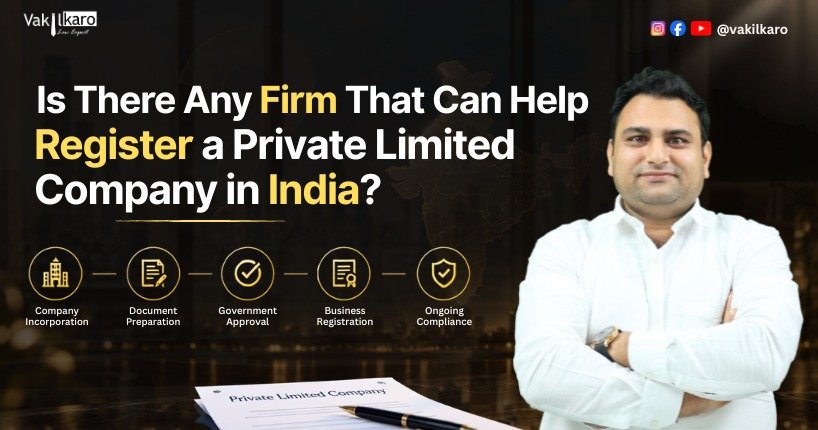
Can a Firm Really Handle Private Limited Company Registration for You?
A registration provider can coordinate most of the practical work involved in incorporation, while the statutory filing remains subject to MCA rules, professional certification requirements and approval by the Registrar of Companies. The current incorporation route uses the integrated SPICe+ system, which allows name reservation and incorporation-related services to be handled through a connected digital workflow.
For a founder, the real value of professional assistance is not merely filling a form. It is ensuring that the proposed name, business objects, capital structure, director and shareholder details, registered-office documents and linked filings are consistent with one another before submission.
What a Good Company Registration Provider Should Help With
- Private Limited Company structure evaluation based on the founder's ownership, funding and growth plans.
- Preliminary company-name screening and suggestions for alternative names.
- Trademark search before relying on a brand name that may conflict with an existing mark.
- Digital Signature Certificate coordination for proposed signatories.
- Director and subscriber information review, including DIN-related details where applicable.
- Drafting and review of the company's main objects for the Memorandum of Association.
- Preparation of e-MOA and e-AOA and coordination of subscriber signatures.
- SPICe+ incorporation filing and linked filing preparation.
- Review of registered-office proof, utility bills, rent agreement and owner consent/NOC where required.
- Follow-up for clarification or resubmission if the Registrar raises an observation.
- Post-incorporation handover covering the Certificate of Incorporation, CIN, PAN/TAN and next-step compliance.
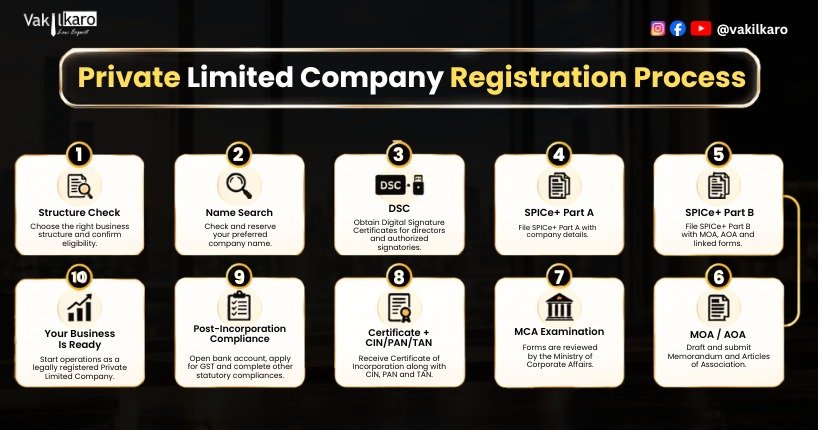
Why Founders Often Prefer Professional Registration Assistance
Company incorporation is online, but online does not mean error-proof. Most delays are not caused by the absence of a portal; they are caused by inconsistent documents, unsuitable names, unclear objects, incorrect shareholding details, incomplete registered-office evidence or a filing that does not match the supporting records.
1. A Better Name Check Before Filing
A proposed company name should be checked from two different angles. First, it should satisfy MCA naming rules and avoid confusing similarity with an existing company or LLP. Second, founders should check whether the same or similar brand is already protected as a trademark. The official IP India trademark search resources are useful for this second check, while a separate trademark registration strategy may be appropriate when the proposed company name is also intended to become the long-term brand.
A name can be technically available for incorporation and still create a branding dispute later. Treating company-name approval and trademark availability as two separate checks can reduce avoidable rebranding risk.
2. Cleaner Documentation and Fewer Mismatches
Names, addresses, dates, identity details and ownership information should remain consistent across PAN, Aadhaar/passport, address proofs, registered-office documents and incorporation forms. A professional reviewer can identify mismatches before the filing reaches MCA.
3. Better Drafting of Business Objects Provide
The objects in the Memorandum of Association should reflect the activities the company actually intends to carry on. Overly vague, contradictory or unsuitable objects can create questions during incorporation and may also become inconvenient when the business later approaches banks, investors, licensing authorities or counterparties.
4. Proper Ownership and Founder Documentation
Founders should not treat shareholding percentages as a last-minute entry. The initial ownership structure can affect control, future investment and founder relationships. Where two or more founders are involved, a Founders Agreement can document roles, vesting concepts, intellectual-property ownership, decision-making and exit expectations. Once outside investors or a more detailed ownership framework is involved, a Shareholders Agreement may also become relevant.
What Is a Private Limited Company and Why Is It Commonly Chosen?
A Private Limited Company is an incorporated legal entity governed by the Companies Act, 2013. It has a legal identity separate from its shareholders and directors. The company can own property, enter into contracts, open bank accounts, borrow, employ people and hold intellectual property in its own name.
For growth-oriented businesses, this structure is popular because ownership is represented through shares and the entity continues despite changes in shareholders or directors. It is commonly considered by technology startups, e-commerce businesses, manufacturers, consulting companies, export-oriented ventures and founders planning to raise external investment.
Key reasons businesses consider a Private Limited Company
- Separate legal identity.
- Limited liability for shareholders, subject to law and specific circumstances.
- Perpetual succession.
- Formal shareholding and governance structure.
- Better suitability for equity investment compared with unincorporated structures.
- Professional credibility with banks, enterprise customers, vendors and strategic partners.
- Potential eligibility for Startup India recognition where the entity satisfies the applicable DPIIT criteria.
- Ability to build a transferable corporate business rather than operating only in the founder's personal name.
What Documents Will a Registration Firm Normally Ask For?
The exact document set depends on the directors, shareholders, registered office and whether any person is a foreign national or non-resident. For a straightforward Indian incorporation, the following categories are commonly reviewed.
| Category | Typical Documents / Details | Why It Matters |
|---|---|---|
| Directors / Shareholders | PAN, Aadhaar or passport, photograph, email, mobile, current address proof | Identity, KYC and subscriber/director details |
| Registered Office | Recent utility bill, rent/lease document where applicable, owner NOC/consent, ownership proof where relevant | To establish the company's official registered address |
| Company Information | Proposed names, business activities, capital structure, shareholding ratio, director roles | Used to prepare incorporation forms and constitutional documents |
| Business Objects | Clear description of intended products/services and main activities | Forms the basis of the MOA object clause |
Step-by-Step: How a Firm Can Assist With the Registration Process
- Understand the business model, number of founders, proposed ownership and future funding plans.
- Shortlist suitable company names and check MCA naming risk.
- Run a trademark availability check when the proposed company name will also be used as the brand.
- Collect and verify director, shareholder and registered-office documents.
- Coordinate Digital Signature Certificates for the persons required to sign electronically.
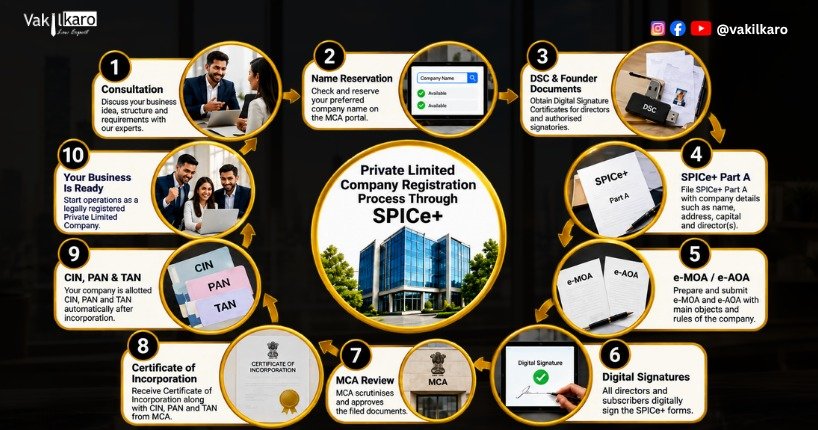
- Prepare SPICe+ Part A for name reservation or combine the name and incorporation workflow where appropriate.
- Prepare SPICe+ Part B and linked incorporation information, including director/subscriber details, capital, address and PAN/TAN data.
- Prepare e-MOA and e-AOA based on the intended objects and governance structure.
- Arrange professional certification and digital signatures where required.
- Submit the incorporation package and track the application for approval, resubmission or clarification.
- Receive and review incorporation outputs such as the Certificate of Incorporation and CIN, and guide the founders on immediate post-incorporation actions.
MCA's official SPICe+ incorporation FAQs explain that SPICe+ is the integrated web form used for new company incorporation and that Part A relates to name reservation while Part B covers incorporation and integrated services such as CIN, DIN, PAN and TAN, with GSTIN available as an optional linked service where applied for.
How Much Does Professional Help Cost?
There is no single universal price for Private Limited Company registration because the total outlay may include government charges, state-specific stamp duty, Digital Signature Certificate costs and professional/service fees. The amount can also change with authorised capital, the number of applicants, document complexity and whether special drafting or additional registrations are required. For a deeper breakdown, founders can review Vakilkaro's guide on the cost of registering a Private Limited Company and the detailed explanation of Private Limited Company registration charges in India.
A good provider should give a written scope before payment. The quotation should distinguish professional fees from government fees or statutory charges and should state whether DSC, name application, MOA/AOA, PAN/TAN, stamp duty, GST registration or post-incorporation filings are included.
How Long Does Private Limited Company Registration Take?
There is no guaranteed statutory approval time for every application. The timeline depends on document readiness, name availability, digital signatures, state stamp-duty requirements, MCA workload and whether the Registrar raises a resubmission. Vakilkaro's current service-page estimate for a standard, document-ready incorporation is generally around 7-10 working days, but actual processing can be shorter or longer.
Founders should be cautious of anyone promising an unconditional same-day or guaranteed approval. A service provider can control preparation quality and follow-up; it cannot control the Registrar's final decision or the time taken by government systems.ation in India. Such firms assist the founders by facilitating the understanding of documentation needs, the regulatory procedures, online filings, and compliance obligations related to incorporation. If you are searching for online private company registration, want to register a pvt ltd firm, or simply trying to understand the company registration process in India, professional help can be great to make your journey easier and also to reduce the risk of making costly mistakes.
Can You Register a Private Limited Company Yourself?
Yes, the MCA process is digital and applicants can access the MCA portal. However, self-filing still requires correct interpretation of the forms, supporting documents, digital signatures and professional certification wherever applicable. The choice between self-filing and professional assistance therefore depends on the founder's familiarity with company law, filing systems and documentation.
If the company has a simple ownership structure, standard objects and clean documents, the process can be relatively straightforward. Where there are multiple founders, foreign subscribers, complex business objects, brand conflicts, investor considerations or unusual registered-office arrangements, professional review becomes more valuable.
How to Choose the Right Firm or Registration Provider
The lowest quoted price should not be the only decision factor. A registration provider is handling the legal foundation of the business, so founders should check what is actually included and who will review the filing.
- Ask for a written scope of work and deliverables.
- Confirm whether government/statutory charges are included or separate.
- Check whether name and trademark screening are both discussed.
- Ask who will draft or review the MOA and AOA.
- Confirm how resubmission or MCA clarification will be handled.
- Verify what happens after incorporation: bank-account documents, commencement filing, GST, Startup India, Udyam, trademark and annual compliance.
- Avoid providers that promise guaranteed government approval.
- Use a provider that communicates the limits of its role and involves qualified professionals where professional certification or advice is required.
Red Flags to Avoid
- A package price that does not explain statutory charges.
- No discussion of registered-office proof or NOC.
- No trademark check despite the founder planning to use the company name as a brand.
- Promising approval without checking name availability or documents.
- Using generic business objects that do not match the business.
- No post-incorporation compliance handover.
- Refusing to share copies of filed forms or incorporation documents.
What Happens After the Company Is Registered?
The Certificate of Incorporation is the beginning of the company's compliance journey, not the end. A founder should immediately create a post-incorporation checklist so that the company becomes operational, tax-ready, banking-ready and compliant.
Depending on the company's facts, the next steps may include opening the current account, bringing in subscribed capital, and completing the applicable Commencement of Business (INC-20A) filing. Directors should also track recurring DIN-related requirements such as DIN eKYC filing when applicable.
Tax and operational registrations should be evaluated separately. A company that becomes liable under GST or chooses registration where permitted can use GST registration support and verify statutory procedures on the official GST portal.Eligible enterprises may consider Udyam registration, while innovation-led businesses that meet the criteria can evaluate Startup India registration assistance and the official DPIIT Startup Recognition framework. Brand protection should also be considered early. If the company is building a distinctive name, logo or product brand, a trademark registration can help create a separate intellectual-property right rather than relying only on the company's incorporation name.
Private Limited Company vs Other Business Structures
Professional assistance is useful only if the structure itself is suitable. Some businesses should consider alternatives before incorporating a Private Limited Company.
| Structure | Best Suited For | Ownership | Key Consideration |
|---|---|---|---|
| Private Limited Company | Startups and scalable businesses | 2 or more shareholders | Formal corporate compliance; strong equity structure |
| One Person Company | Solo entrepreneur seeking corporate form | Single member + nominee | Useful where one founder wants a company structure |
| LLP | Professional/service partnerships | 2 or more partners | Flexible internal management; no share capital structure |
| Sole Proprietorship | Very small or owner-operated business | Single owner | Simple structure but no separate corporate personality |
A solo founder can compare a One Person Company (OPC); two or more professionals may evaluate a Limited Liability Partnership (LLP); and a small owner-operated venture may initially consider a Sole Proprietorship.
Limited Liability Partnership (LLP); and a small owner-operated venture may initially consider a Sole Proprietorship. Vakilkaro's overview of different company and business registration structures can also help founders understand the available options before filing.
Why Choose Vakilkaro for Private Limited Company Registration Support?
Vakilkaro offers a structured, pan-India registration-support workflow for founders who want assistance with Private Limited Company incorporation and related legal, documentation and compliance requirements. Vakilkaro operates as a legal-tech platform and provides consultancy and registration support through qualified professionals such as Advocates, Chartered Accountants and Company Secretaries.
- Pre-filing structure and document review.
- Company-name and brand-risk discussion.
- DSC, director/subscriber and registered-office document coordination.
- SPICe+ and linked incorporation support.
- MOA/AOA preparation and filing coordination.
- MCA follow-up and resubmission support where required.
- Post-incorporation assistance for INC-20A, GST, Startup India, trademark and other business registrations.
- Support for founder and shareholder documentation as the ownership structure evolves.
Frequently asked questions
Is there any firm that can help register a Private Limited Company in India?+
Yes. Company-registration service providers and qualified professionals can assist with documentation, name reservation, DSC coordination, SPICe+ filing, MOA/AOA and post-incorporation guidance. The final incorporation is approved by the Registrar of Companies through the MCA system.
Can Vakilkaro help with Private Limited Company registration?+
Vakilkaro provides company-registration consultancy and filing support through qualified professionals, including assistance with documents, name selection, SPICe+ coordination and post-registration compliance.
Is Private Limited Company registration completely online?+
The MCA incorporation workflow is primarily digital and uses online forms and Digital Signature Certificates. Some underlying documents may still need to be executed, notarised or otherwise authenticated depending on the applicant and circumstances.
How many directors and shareholders are required?+
A standard Private Limited Company generally requires at least two directors and two shareholders. The same individuals can act as both directors and shareholders where legally permissible, and the applicable resident-director requirement must be satisfied.
Is minimum paid-up capital mandatory?+
There is no prescribed statutory minimum paid-up capital for incorporating a Private Limited Company. Founders should still select an authorised and subscribed capital structure appropriate to the business.
Can my home address be used as the registered office?+
A residential address can generally be used if the company can provide acceptable address proof and the required owner consent or NOC, where applicable.
Should I check a trademark before finalising the company name?+
Yes, especially when the company name will also be the customer-facing brand. MCA name availability and trademark availability are different checks, and both should be considered.
Does a registration provider guarantee MCA approval?+
No professional service provider can guarantee a government approval. A provider can improve preparation quality and manage follow-up, but the Registrar of Companies makes the final decision.
How long does registration usually take?+
A clean and straightforward incorporation may often be completed within several working days, but actual time varies based on documents, name approval, government processing and resubmission requirements.
Are PAN and TAN obtained separately?+
PAN and TAN are integrated into the company incorporation workflow under SPICe+ for new companies.
Do I need GST registration immediately after incorporation?+
Not every company requires GST registration on day one. Liability depends on the nature of supplies, turnover, location and other provisions of GST law. The company should evaluate GST separately after incorporation.
What is INC-20A?+
INC-20A is the declaration for commencement of business applicable to certain companies having share capital, subject to the Companies Act and prescribed timelines. Founders should verify whether and when it applies to their company.
Can a Private Limited Company obtain Startup India recognition?+
A Private Limited Company may apply for DPIIT Startup Recognition if it satisfies the applicable eligibility conditions under the Startup India framework.
Do founders need a Founders Agreement?+
It is not a substitute for incorporation documents, but it can be useful where multiple founders want to document roles, ownership expectations, IP, vesting, decision-making and exits.
What should I receive after registration?+
At minimum, founders should retain the Certificate of Incorporation, CIN and incorporation forms/constitutional documents, along with PAN/TAN details and a clear post-incorporation compliance checklist.