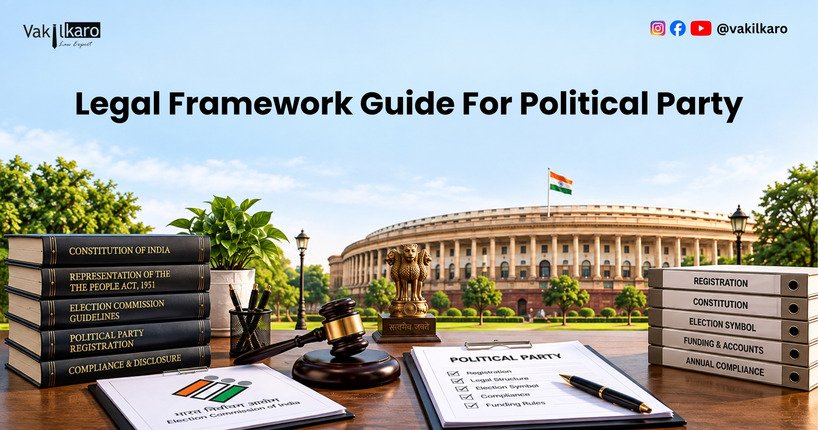
| Particular | Details |
|---|---|
| Primary Authority | Election Commission of India |
| Principal Law | Representation of the People Act, 1951 |
| Constitutional Basis | Constitution of India |
| Registration Provision | Section 29A |
| Regulatory Scope | Registration & Governance |
| Objective | Democratic & Lawful Political Organisation |
Constitutional Foundation
Political parties are essential institutions within India's democratic system.
To ensure transparency, accountability and orderly democratic participation, political parties function within a structured legal framework.
This framework generally consists of:
- Constitutional Principles
- Parliamentary Legislation
- Election Commission Guidelines
- Internal Governance Rules
Understanding these legal principles helps organisations operate responsibly.
India's democratic framework is based upon the Constitution of India.
Political parties generally function within constitutional values such as:
- Democracy
- Equality
- Rule of Law
- Constitutional Governance
- Public Accountability
Every political organisation should remain consistent with these constitutional principles.
Representation of the People Act, 1951
The Representation of the People Act, 1951 provides the statutory framework relating to elections and includes provisions relating to the registration of political parties.
The Act forms one of the primary legal foundations for political party registration in India.
Section 29A
Section 29A provides the legal framework under which political parties may apply for registration before the Election Commission of India.
Applicants should understand that:
- Registration follows the applicable legal process.
- Registration is separate from recognition.
- Election symbols are governed separately.
Role of the Election Commission
The Election Commission generally:
- Receives Applications
- Reviews Documentation
- Examines Compliance
- Processes Registration
- Issues Guidelines
The Commission functions as the regulatory authority for political party registration.
Legal Framework Summary Table
Why Legal Compliance Matters
Professional legal compliance generally helps:
- Improve Registration Readiness
- Strengthen Governance
- Reduce Procedural Issues
- Improve Organisational Credibility
- Support Long-Term Stability
Vakilkaro Insight
Many founders focus only on registration formalities.
However, professionally managed political organisations understand the legal framework before beginning the registration process.
A strong legal foundation supports sustainable governance.
Founder Checklist
Before applying for registration, ensure:
✔ Constitutional Principles Understood
✔ Applicable Laws Reviewed
✔ Party Constitution Prepared
✔ Governance Framework Established
✔ Registration Documents Ready
✔ Legal Review Completed
✔ Compliance Planning Prepared
✔ Office Bearers Identified
✔ Organisational Structure Finalised
✔ Registration Strategy Ready
Legal Framework Journey
Understand Constitution
↓
Study Election Laws
↓
Review Section 29A
↓
Prepare Constitution
↓
Prepare Documents
↓
Submit Registration Application
Why Choose Vakilkaro?
Vakilkaro assists organisations with:
- Political Party Registration
- Legal Advisory
- Constitution Drafting
- Documentation
- Governance Planning
- Compliance Guidance
- Election Law Advisory
Our experts help founders understand and comply with the legal framework governing political party registration.
Understanding the Legal Framework for Political Party Registration
The legal framework governing Political Party Registration in India consists of constitutional principles, statutory provisions and guidelines issued by the Election Commission of India (ECI).
Every organisation intending to establish a political party should understand these legal principles before submitting its registration application.
A strong understanding of the legal framework generally helps:
- Improve Registration Readiness
- Strengthen Governance
- Reduce Legal Risks
- Improve Compliance
- Support Long-Term Organisational Stability
Constitutional Foundation
India follows a democratic constitutional system.
Political parties function within the constitutional framework established by the Constitution of India.
Professional political organisations generally operate while respecting constitutional principles such as:
- Democracy
- Equality
- Rule of Law
- Justice
- Liberty
- Secularism
- Integrity of India
Every political organisation should remain committed to these constitutional values.
Representation of the People Act, 1951
The Representation of the People Act, 1951 is one of the principal laws governing elections and political party registration in India.
The Act generally provides the legal framework relating to:
- Registration of Political Parties
- Electoral Process
- Election Administration
- Other election-related matters
Applicants should always comply with the applicable provisions of the Act.
Section 29A Explained
One of the most important provisions relating to Political Party Registration is Section 29A of the Representation of the People Act, 1951.
This provision generally governs:
- Registration Application
- Eligibility for Registration
- Registration Procedure
- Election Commission Authority
Professional legal guidance helps applicants understand the practical application of Section 29A.
Role of the Election Commission of India
The Election Commission of India (ECI) is the constitutional authority responsible for administering Political Party Registration.
During the registration process, the Commission generally:
- Receives Applications
- Reviews Documentation
- Examines Compliance
- Requests Clarifications (where required)
- Decides Registration Applications
The Commission also issues registration guidelines from time to time.
Election Commission Guidelines
Applicants should carefully follow the applicable Election Commission guidelines during registration.
Professional compliance generally includes:
- Proper Documentation
- Constitution Preparation
- Office Bearer Details
- Organised Records
- Accurate Declarations
Ignoring procedural guidelines may delay the registration process.
Rights of a Registered Political Party
After registration, political parties generally acquire certain rights under the applicable legal framework.
These rights should always be exercised responsibly and in accordance with the law.
Professional governance generally helps organisations exercise these rights effectively.
Responsibilities of a Registered Political Party
Registration also creates continuing responsibilities.
Professional organisations generally maintain:
- Good Governance
- Financial Transparency
- Proper Documentation
- Organisational Records
- Compliance Systems
Responsible administration strengthens public confidence.
Legal Compliance Requirements
Professional political organisations generally establish compliance systems covering:
- Constitution Implementation
- Membership Administration
- Governance Records
- Financial Documentation
- Internal Administration
- Organisational Policies
Continuous compliance supports long-term organisational stability.
Governance Under the Legal Framework
The legal framework generally expects political organisations to maintain organised governance.
Professional governance generally includes:
- Office Bearers
- Internal Democracy
- Membership Structure
- Decision-Making Procedures
- Organisational Accountability
Good governance reduces administrative uncertainty.
Internal Democracy
Internal democratic functioning generally forms an important part of professionally governed political organisations.
Professional constitutions generally provide:
- Leadership Selection
- Internal Elections
- Member Participation
- Organisational Accountability
Transparent governance improves credibility.
Financial Compliance
Political organisations should establish professional financial systems from the beginning.
Professional financial governance generally includes:
- Dedicated Banking
- Accounting Records
- Financial Documentation
- Audit
- Internal Controls
Financial transparency supports long-term institutional development.
Documentation Compliance
Professional organisations generally maintain:
- Registration Records
- Constitution
- Membership Records
- Meeting Minutes
- Office Bearer Records
- Financial Records
Proper documentation improves governance and legal readiness.
Common Legal Mistakes
Many organisations experience avoidable legal difficulties because of inadequate planning.
Common mistakes generally include:
- Poor Understanding of the Legal Framework
- Weak Constitution
- Incomplete Documentation
- Ignoring Election Commission Guidelines
- Weak Governance
- Missing Financial Records
- Inadequate Internal Democracy
- Delayed Compliance
- Poor Record Maintenance
- Lack of Professional Legal Advice
Professional legal planning significantly reduces these risks.
Legal Compliance Checklist
Before applying for Political Party Registration, ensure:
✔ Constitutional Principles Understood
✔ Representation of the People Act Reviewed
✔ Section 29A Requirements Understood
✔ Party Constitution Prepared
✔ Governance Structure Established
✔ Office Bearers Identified
✔ Documentation Organised
✔ Financial Framework Prepared
✔ Compliance Planning Completed
✔ Professional Legal Review Conducted
Best Practices
Professionally managed political organisations generally:
- Understand the applicable legal framework before registration.
- Draft a strong Party Constitution.
- Maintain organised governance.
- Preserve accurate records.
- Follow Election Commission guidelines carefully.
- Maintain financial transparency.
- Conduct internal democratic processes.
- Review compliance periodically.
- Respond promptly to regulatory communications.
- Seek professional legal advice whenever required.
Vakilkaro Expert Insight
Many applicants believe that Political Party Registration is merely a documentation exercise.
In reality, it is a legal process governed by:
- Constitutional Principles
- Election Laws
- Election Commission Guidelines
- Organisational Governance
A professionally managed political organisation should understand these legal principles before registration rather than attempting to address compliance issues later.
Strong legal understanding creates stronger governance, reduces future legal risks and supports sustainable political participation.
Benefits of Understanding the Legal Framework
A strong understanding of the legal framework governing political parties is essential for establishing and operating a professionally managed political organisation.
The legal framework is not merely relevant during registration. It also guides the party's governance, administration, compliance and long-term functioning.
Professional legal awareness generally helps:
- Improve Organisational Stability
- Strengthen Governance
- Reduce Legal Risks
- Improve Public Confidence
- Support Sustainable Political Participation
Provides a Strong Legal Foundation
Every political party operates within India's constitutional and legal framework.
Understanding the applicable laws helps founders:
- Establish the Organisation Properly
- Prepare Better Documentation
- Build Organised Governance
- Improve Registration Readiness
A strong legal foundation supports long-term organisational growth.
Improves Governance
Professional governance depends upon understanding legal responsibilities.
Founders generally establish:
- Leadership Structure
- Office Bearers
- Membership Rules
- Internal Committees
- Decision-Making Process
A legally informed governance system improves organisational efficiency.
Reduces Legal Disputes
Many organisational disputes arise because legal responsibilities were never properly understood.
A good understanding of the legal framework generally reduces disputes relating to:
- Membership
- Leadership
- Internal Elections
- Governance
- Financial Administration
- Organisational Procedures
Professional planning creates greater certainty.
Improves Registration Quality
Applicants who understand the applicable legal provisions generally prepare:
- Better Applications
- Stronger Constitutions
- Complete Documentation
- Organised Governance Records
This often results in a smoother registration process.
Strengthens Public Credibility
Political organisations that demonstrate legal compliance generally build greater confidence among:
- Citizens
- Members
- Volunteers
- Public Authorities
- Media
Good governance strengthens institutional credibility.
Practical Limitations
Understanding the law alone does not ensure successful organisational management.
Professional organisations should also establish:
- Governance Systems
- Financial Controls
- Documentation Standards
- Internal Policies
- Compliance Procedures
The legal framework provides the rules—the organisation must implement them effectively.
Governance Under the Legal Framework
The legal framework generally encourages organised governance.
Professional governance generally includes:
- Clearly Defined Leadership
- Office Bearers
- Committee Structure
- Internal Democracy
- Organisational Accountability
Strong governance supports institutional stability.
Leadership Framework
Professional organisations generally define:
- Leadership Roles
- Authority
- Responsibilities
- Reporting Structure
- Accountability
Clear governance reduces administrative uncertainty.
Internal Democracy
Professional political organisations generally establish:
- Democratic Leadership Selection
- Member Participation
- Transparent Elections
- Organisational Accountability
Internal democracy strengthens institutional legitimacy.
Organisational Accountability
Accountability generally improves when organisations maintain:
- Meeting Records
- Membership Records
- Governance Documentation
- Financial Transparency
Professional accountability strengthens public trust.
Financial Governance
The legal framework expects political organisations to maintain organised financial administration.
Professional financial governance generally includes:
- Dedicated Bank Account
- Accounting Records
- Financial Documentation
- Internal Controls
- Audit
- Compliance Monitoring
Strong financial systems improve transparency.
Banking Discipline
Professional organisations generally maintain:
- Organised Banking
- Documented Transactions
- Financial Approvals
- Record Preservation
Good banking discipline supports long-term governance.
Accounting Systems
Professional accounting generally helps:
- Improve Transparency
- Monitor Finances
- Support Decision-Making
- Strengthen Compliance
Accurate accounting supports institutional credibility.
Audit Framework
Professional financial review generally improves:
- Financial Accuracy
- Governance
- Accountability
- Public Confidence
Regular audits strengthen organisational discipline.
Documentation & Record Management
Legal compliance depends upon proper record maintenance.
Professional organisations generally preserve:
- Registration Documents
- Party Constitution
- Membership Register
- Office Bearer Records
- Meeting Minutes
- Financial Records
- Compliance Records
Good documentation protects the organisation.
Common Legal Mistakes
Many organisations experience avoidable legal issues because of weak planning.
Common mistakes generally include:
- Poor Understanding of Election Laws
- Weak Constitution
- Undefined Leadership Roles
- Missing Governance Policies
- Incomplete Documentation
- Weak Financial Controls
- Poor Record Maintenance
- Ignoring Compliance Responsibilities
- Delayed Organisational Review
- No Professional Legal Guidance
Professional planning significantly reduces these risks.
Best Practices
Professionally managed political organisations generally:
- Understand the legal framework before registration.
- Maintain organised governance.
- Preserve complete documentation.
- Conduct internal democratic processes.
- Maintain financial transparency.
- Review compliance periodically.
- Keep leadership responsibilities clearly documented.
- Update governance records promptly.
- Respond to regulatory requirements on time.
- Seek professional legal guidance before major organisational decisions.
Founder Legal Checklist
Before operating a registered political party, ensure:
✔ Constitutional Principles Understood
✔ Applicable Election Laws Reviewed
✔ Governance Framework Established
✔ Party Constitution Properly Implemented
✔ Office Bearers Clearly Defined
✔ Financial Governance Established
✔ Documentation Organised
✔ Compliance Calendar Prepared
✔ Record Management System Established
✔ Professional Legal Advisory Available
Vakilkaro Expert Insight
Many political organisations focus only on registration and overlook the importance of understanding the legal framework that governs their future operations.
A professionally managed political party generally succeeds because it combines:
- Legal Compliance
- Strong Governance
- Internal Democracy
- Financial Transparency
- Organised Documentation
- Responsible Leadership
The legal framework should be viewed not as a regulatory burden but as a governance framework that supports institutional credibility, public confidence and long-term organisational success.
Frequently asked questions
What is the legal framework for Political Party Registration in India?+
The legal framework for Political Party Registration in India primarily consists of: • Constitution of India • Representation of the People Act, 1951 • Election Commission of India (ECI) Guidelines • Applicable election laws and notifications These legal provisions regulate the registration and functioning of political parties in India.
Which authority regulates Political Party Registration?+
The Election Commission of India (ECI) is the authority responsible for registering political parties and issuing guidelines relating to the registration process.
Which law governs Political Party Registration?+
Political Party Registration is primarily governed by the Representation of the People Act, 1951, particularly the provisions relating to registration, along with the applicable guidelines issued by the Election Commission.
What is Section 29A?+
Section 29A of the Representation of the People Act, 1951 provides the legal framework under which an association or body of citizens may apply for registration as a political party before the Election Commission of India.
Why should founders understand the legal framework?+
Understanding the legal framework generally helps founders: • Prepare better documentation • Draft a stronger constitution • Improve governance • Reduce procedural errors • Strengthen legal compliance
Does Political Party Registration automatically grant recognition?+
No. Registration and recognition are separate legal processes. Recognition as a State Party or National Party depends upon separate legal criteria prescribed by the Election Commission.
Is the Constitution of India relevant for political parties?+
Yes. Political parties function within the constitutional framework of India and should uphold constitutional values such as democracy, equality, secularism, rule of law and national integrity.
Are Election Commission Guidelines important?+
Yes. Applicants should comply with the applicable Election Commission guidelines while preparing and submitting the registration application. Professional legal review generally improves compliance.
Can Vakilkaro assist with legal compliance?+
Yes. Vakilkaro assists with: • Political Party Registration • Constitution Drafting • Legal Documentation • Governance Planning • Compliance Advisory
Why is legal compliance important?+
Professional legal compliance generally: • Reduces Registration Delays • Strengthens Governance • Improves Public Credibility • Supports Long-Term Organisational Stability
What role does the Party Constitution play?+
The Party Constitution establishes: • Governance Framework • Membership Rules • Leadership Structure • Internal Elections • Financial Administration It serves as the principal governing document of the political party.
Why should governance follow the legal framework?+
Governance consistent with the applicable legal framework generally improves: • Accountability • Organisational Discipline • Transparency • Administrative Efficiency Strong governance supports institutional credibility.
What legal responsibilities arise after registration?+
Registered political parties generally have continuing responsibilities relating to: • Governance • Documentation • Financial Administration • Organisational Records • Compliance Professional management helps fulfil these responsibilities effectively.
Does the legal framework require proper documentation?+
Yes. Professional organisations generally maintain: • Registration Records • Constitution • Membership Records • Office Bearer Records • Financial Documentation • Meeting Minutes Good documentation supports compliance.
Is financial transparency part of the legal framework?+
Yes. Professional financial governance generally includes: • Organised Banking • Accounting • Financial Documentation • Internal Controls Financial transparency strengthens public confidence.
Why is internal democracy important?+
Professional political organisations generally promote: • Transparent Leadership • Organised Elections • Member Participation • Accountability Internal democracy supports institutional legitimacy.
Can governance structures differ between political parties?+
Yes. While every party should comply with the applicable legal framework, the detailed governance structure is generally established through the Party Constitution.
Should organisations obtain professional legal advice?+
Yes. Professional legal advice generally helps: • Interpret Applicable Laws • Improve Documentation • Reduce Registration Errors • Strengthen Governance • Improve Compliance
What are the common legal mistakes?+
Common mistakes generally include: • Weak Constitution • Poor Governance Planning • Incomplete Documentation • Ignoring Election Commission Guidelines • Weak Financial Controls • Missing Organisational Records Professional planning significantly reduces these risks.
Can the legal framework change over time?+
Yes. Election laws, Election Commission guidelines and related legal requirements may change from time to time. Political parties should periodically review applicable legal requirements and update their internal systems where necessary.
Why should records be preserved?+
Professional record preservation generally supports: • Governance • Accountability • Compliance • Organisational Continuity Good record management strengthens institutional stability.
Why should organisations maintain compliance calendars?+
Compliance calendars generally help: • Track Important Dates • Improve Governance • Reduce Delays • Strengthen Administrative Planning Professional planning improves compliance management.
Can digital governance support legal compliance?+
Yes. Professional digital systems generally improve: • Record Management • Documentation • Communication • Governance • Compliance Monitoring Technology strengthens organised administration.
Why should founders understand Election Commission procedures?+
Understanding the registration procedure generally helps: • Improve Documentation • Reduce Errors • Strengthen Registration Readiness • Improve Organisational Planning Preparation supports smoother registration.
Can legal compliance improve public confidence?+
Yes. Professional legal compliance generally improves: • Public Trust • Organisational Credibility • Transparency • Institutional Reputation Good governance creates stronger political organisations.
Why is accountability important?+
Professional accountability generally improves: • Leadership Quality • Decision-Making • Financial Discipline • Governance Accountability supports long-term organisational success.
Why should political parties regularly review legal compliance?+
Regular legal review generally helps organisations: • Stay Updated • Improve Governance • Reduce Legal Risks • Maintain Organisational Discipline Continuous compliance supports sustainable growth.
Can Vakilkaro review legal documentation?+
Yes. Vakilkaro assists with reviewing: • Party Constitution • Registration Documents • Governance Policies • Compliance Documentation • Organisational Records Professional review improves legal readiness.
What is the biggest benefit of understanding the legal framework?+
A strong understanding of the legal framework generally creates: • Better Governance • Improved Registration Readiness • Stronger Compliance • Reduced Legal Risk • Long-Term Organisational Stability
Why choose Vakilkaro for legal advisory?+
Vakilkaro provides comprehensive assistance including: • Political Party Registration Advisory • Election Law Guidance • Constitution Drafting • Governance Planning • Documentation Review • Compliance Advisory • Long-Term Legal Support Our experts help organisations build legally compliant, professionally governed and sustainable political parties. Common Myths "Political Party Registration is governed only by one law." Incorrect. The legal framework includes the Constitution of India, the Representation of the People Act, 1951, Election Commission guidelines and other applicable legal provisions. "Registration completes all legal responsibilities." Incorrect. Registration is only the beginning. Political parties generally have continuing governance, documentation and compliance responsibilities. "Internal governance is separate from the legal framework." Incorrect. Professional governance should always operate within the applicable legal framework and the Party Constitution. "Financial management is unrelated to election law." Incorrect. Financial governance, transparency and proper record maintenance are important aspects of professionally managed political organisations. "Professional legal guidance is unnecessary." Incorrect. Professional legal advisory generally improves documentation quality, governance standards, compliance and long-term organisational stability. Related Guides Foundation Guides • Political Party Registration Service Page • Election Commission Registration Guide • Party Constitution Guide • Documents Required Guide • Founding Members Guide • Party Name & Symbol Guide Growth Guides • Benefits Guide • Digital Political Party Guide • Donation & Funding Guide Compliance Guides • Annual Compliance Guide • Accounting & Audit Guide • Governance Guide Schema Recommendation Implement: • FAQ Schema • Article Schema • Breadcrumb Schema • Organization Schema Developer Notes • Place the Legal Framework Summary Table within the running main content after the relevant explanatory H2 section. • Apply FAQ Schema to all FAQs. • Highlight the Legal Compliance Checklist as a visual callout. • Display the Legal Framework Journey as a process diagram. • Internally link to the Political Party Registration Service Page, Election Commission Registration Guide, Party Constitution Guide, Documents Required Guide, Founding Members Guide, Governance Guide, Accounting Guide, and Annual Compliance Guide.
