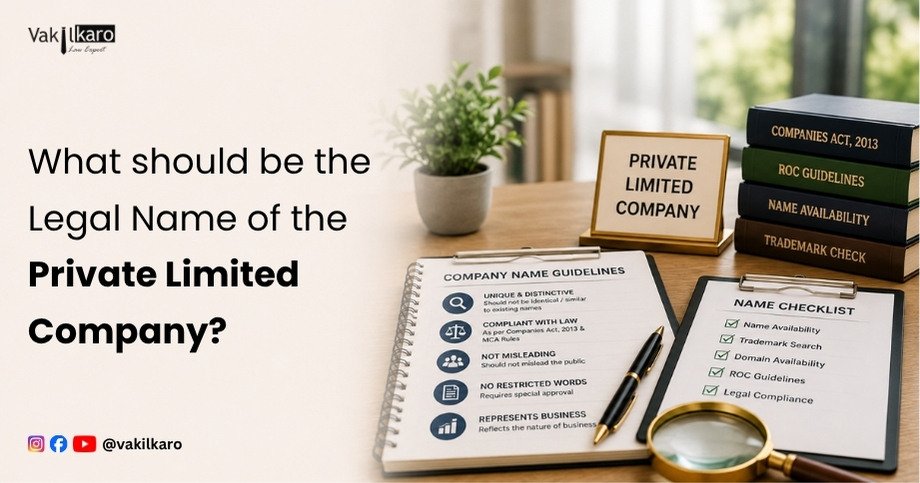
Choosing the right legal name for a Private Limited Company (Pvt Ltd) is a foundational decision for any entrepreneur. It reflects the company's separate legal identity, ownership structure, and compliance standing under the Ministry of Corporate Affairs (MCA). A Pvt Ltd enjoys limited liability, requires Company Registration, and must follow Corporate Governance principles, financial reporting standards, and statutory compliance norms. The company’s legal name appears in critical documents like the Certificate of Incorporation, MOA, AOA, and all operational contracts, ensuring trust, credibility, and legal protection throughout its growth journey.
Key Takeaways
- Choosing the right legal name for a Private Limited Company (Pvt Ltd) is a foundational decision for any entrepreneur.
- The Importance of Choosing the Legal Name for a Private Limited Company Selecting the legal name of a Private Limited Company (Pvt Ltd) is a crucial step for any entrepreneur beginning their business journey.
- Especially for a Private Limited Company (Pvt Ltd), which enjoys the benefits of a separate legal entity status and limited liability protection, the legal name becomes central to how it is recognized and operates in the corporate ecosystem.
- In this article, we will explore the critical aspects of Private Limited Companies, the deeper significance of choosing an appropriate legal name, and how this decision impacts the company's ownership model, governance framework, operational execution, and long-term business success.
- Thus, the legal name of the Private Limited Company, as mentioned in the Certificate of Incorporation, becomes the official and recognized name under which the company operates.
The Importance of Choosing the Legal Name for a Private Limited Company
Selecting the legal name of a Private Limited Company (Pvt Ltd) is a crucial step for any entrepreneur beginning their business journey. More than just a label, the legal name forms the company's official identity, recognized by law. It represents the company’s distinct legal standing, offering a separate existence from its owners and ensuring limited liability protection. This separation means shareholders are not personally responsible for the company’s debts or legal obligations.
The process of incorporating a Private Limited Company involves registering the chosen name with the Ministry of Corporate Affairs (MCA) and obtaining vital documentation like the Certificate of Incorporation. Essential records such as the Memorandum of Association (MOA) and Articles of Association (AOA) are filed during registration, and the company is allotted a unique Company Identification Number (CIN). This legal name is used consistently across all company activities, including opening bank accounts, entering into vendor agreements, signing contracts, and filing tax returns.
Beyond incorporation, the legal name plays a significant role in corporate governance, compliance management, and financial reporting. Directors and Key Managerial Personnel (KMP) operate under this name, passing board resolutions and conducting statutory meetings like the Annual General Meeting (AGM). Proper use of the legal name across compliance filings, audits, and financial disclosures enhances the company's credibility and strengthens stakeholder trust.
Moreover, maintaining a consistent legal identity is vital when pursuing fundraising opportunities, attracting private equity investments, or planning mergers and acquisitions (M&A). As companies expand and evolve, the legal name remains a critical component of brand reputation and operational legitimacy. In the modern digital era, ensuring the legal name’s compliance and protection under MCA regulations is not just a legal necessity but a strategic advantage for sustainable business growth.
In the intricate and highly regulated world of business incorporation, one of the very first and most significant decisions an entrepreneur must make is: "What should be the legal name of the Private Limited Company?" At first glance, this may seem like a simple administrative task, but in reality, it carries far-reaching legal, financial, and strategic implications. The legal name of a company is much more than just a formality; it defines the company’s identity in the eyes of law, regulators, customers, and investors. Especially for a Private Limited Company (Pvt Ltd), which enjoys the benefits of a separate legal entity status and limited liability protection, the legal name becomes central to how it is recognized and operates in the corporate ecosystem. It must comply with regulatory norms laid down by authorities like the Ministry of Corporate Affairs (MCA) and should align with the broader objectives of the business. Furthermore, the company’s name influences everything from branding and reputation to shareholding patterns, governance structures, and compliance obligations. Selecting a clear, compliant, and future-proof name is, therefore, not just a legal requirement but a foundational step towards building a credible and resilient corporate entity. In this article, we will explore the critical aspects of Private Limited Companies, the deeper significance of choosing an appropriate legal name, and how this decision impacts the company's ownership model, governance framework, operational execution, and long-term business success.
General Company Structure
A Private Limited Company (Pvt Ltd) stands out as one of the most favored and reliable corporate structures for startups, entrepreneurs, and expanding businesses, especially across India and other jurisdictions that follow common law principles. This structure offers a balance of flexibility, control, and credibility, making it an ideal choice for businesses looking to scale while protecting their owners' personal interests.
Upon successful incorporation, the company is recognized as a Corporate Entity that enjoys a Separate Legal Entity status distinct from its founders and shareholders. This legal separation is fundamental, as it ensures Limited Liability — meaning the personal assets of the shareholders are shielded from the company’s debts, losses, or legal disputes. Shareholders are only liable to the extent of their shareholding, providing a crucial layer of financial security.
The journey toward incorporation starts with Company Registration, a formal legal process governed by the Registrar of Companies (ROC) under the oversight of the Ministry of Corporate Affairs (MCA). Entrepreneurs must prepare and submit key constitutional documents such as the Memorandum of Association (MOA), which defines the company’s fundamental objectives, and the Articles of Association (AOA), which outlines the rules and regulations for internal management.
Once the ROC reviews and approves these submissions, it issues a Certificate of Incorporation, officially marking the creation of the company. Along with this, the company is assigned a unique Company Identification Number (CIN), which serves as an identity number for tracking and regulatory purposes.
Thus, the legal name of the Private Limited Company, as mentioned in the Certificate of Incorporation, becomes the official and recognized name under which the company operates. It is the foundation for all legal contracts, financial transactions, compliance filings, and business operations, reinforcing the company's authenticity, credibility, and trustworthiness in the market.
Ownership & Shareholding
In a Private Limited Company (Pvt Ltd), ownership is vested in its Shareholders, who are individuals or entities holding the company’s shares. Unlike partnerships or sole proprietorships, where ownership is often direct and unlimited, the shareholding structure in a Pvt Ltd is well-defined, offering clear distinctions of ownership percentages, voting rights, and financial entitlements.
The Shareholding Pattern is a critical document that outlines how ownership is distributed among shareholders. This pattern may include holders of Equity Shares, which typically come with voting rights, allowing shareholders to influence important corporate decisions. On the other hand, companies may also issue Preference Shares, which grant shareholders a preferential right to receive dividends or capital repayment but usually restrict or limit their voting powers.
Ownership within a Private Limited Company is flexible and can change over time through the Transfer of Shares. This transfer process is typically governed by a Shareholders' Agreement, a legal contract among shareholders that sets out the rights, obligations, and restrictions related to share transfers. It ensures smooth ownership transitions while protecting the company's and existing shareholders' interests.
An essential concept within ownership structures is Beneficial Ownership. Even when shares are registered in the name of a nominee or custodian, the person who enjoys the true benefits of ownership — such as receiving dividends or influencing decisions — is considered the beneficial owner. Accurate disclosure of beneficial ownership is critical for transparency and regulatory compliance.
Additionally, every company must specify its Authorized Capital, which represents the maximum amount of share capital it is permitted to issue, and its Paid-up Capital, which is the actual amount received from shareholders against the shares issued. These capital contributions are crucial for the company's day-to-day operations, financial strength, and ability to attract investors or lenders.
Therefore, the legal name of the company holds paramount importance as it appears in all ownership documents, share certificates, and regulatory filings, acting as a formal identifier in legal, financial, and operational contexts.
Management & Governance
In a Private Limited Company (Pvt Ltd), the overall management and strategic direction are entrusted to the Board of Directors. These directors are elected by the Shareholders to represent their interests and ensure that the company is operated effectively and ethically. To be eligible to serve as a director, each individual must obtain a Director Identification Number (DIN) — a unique identification number issued by the Ministry of Corporate Affairs (MCA) — ensuring transparency and traceability in corporate governance.
Directors are bound by a wide array of Director Responsibilities outlined under the Companies Act and other relevant regulations. They are expected to act in good faith, exercise due diligence, avoid conflicts of interest, and prioritize the company's welfare over personal gain. Their role is not merely administrative but strategic, influencing major policies, approving budgets, managing risks, and guiding the company toward its long-term objectives.
The company’s governance framework is firmly built on principles of Corporate Governance, which emphasize fairness, accountability, responsibility, and transparency. Critical decisions affecting the company's future — such as approving mergers, appointing auditors, raising capital, or launching new projects — are made through Board Resolutions passed during formal Board Meetings. These meetings are essential for maintaining an organized decision-making process, allowing directors to deliberate, debate, and decide on key matters collectively.
While the Board provides overall leadership, the Managing Director and other Key Managerial Personnel (KMP) — such as the Chief Financial Officer (CFO) and Company Secretary (CS) — handle day-to-day operations, compliance tasks, and internal governance.
Periodic meetings like the Annual General Meeting (AGM) and Extraordinary General Meeting (EGM) are crucial for engaging shareholders, discussing financial results, electing directors, and seeking approval for special business decisions. These meetings reinforce accountability and ensure that management remains aligned with shareholder interests.
Maintaining proper governance under the company's legal name is vital. It not only fosters trust among investors, regulators, and customers but also ensures that the company stays on the right side of regulatory compliance, strategic planning, and corporate ethics, thereby paving the way for sustainable growth and success.
Compliance & Legal
Operating as a Private Limited Company (Pvt Ltd) comes with the responsibility of adhering to a comprehensive set of Statutory Compliance requirements. These obligations are primarily governed by the Companies Act and other associated Regulatory Frameworks, all under the supervision and oversight of the Ministry of Corporate Affairs (MCA). Compliance is not just a legal formality but a critical aspect of maintaining the company’s credibility, legal standing, and operational legitimacy.
Key compliance activities that every Pvt Ltd must undertake include filing statutory returns with the Registrar of Companies (ROC) at prescribed intervals. These filings keep the ROC updated on important company changes, such as alterations in shareholding, board structure, or financial health. Companies are also required to submit Annual Filing documents, including the Annual Return (Form MGT-7) and Financial Statements (Form AOC-4), ensuring that their internal affairs and financial position are disclosed transparently to regulators.
Beyond ROC filings, companies must engage in timely Audit and Assurance processes. Conducting Internal Audits helps monitor operational risks and compliance gaps internally, while External Audits performed by a registered Statutory Auditor assure stakeholders of the company's financial integrity and regulatory adherence.
Other vital compliance measures include Financial Reporting — presenting an accurate picture of the company's financial performance — and fulfilling Corporate Taxation obligations, including filing Income Tax Returns (ITR) annually. Companies must also comply with Goods and Services Tax (GST) regulations, ensuring proper tax collection, payment, and reporting.
Moreover, adherence to Secretarial Standards, particularly related to board meetings, general meetings, and company records, strengthens the company’s internal governance practices and minimizes operational risks.
Non-compliance or delays in meeting these legal requirements can lead to severe penalties, legal prosecution, and damage to the company’s reputation. Since all compliance activities are tied to the company’s legal name, maintaining accurate records and timely filings is essential to preserving the company’s standing in the eyes of the law, regulators, investors, and business partners.
Finance & Accounting
The financial health of a Private Limited Company (Pvt Ltd) is the backbone of its sustainability, growth, and overall market credibility. Sound financial management and transparent reporting are not only essential for internal decision-making but are also crucial for building trust with investors, regulatory bodies, lenders, and other stakeholders.
Every Private Limited Company must prepare and maintain a set of standard financial reports to demonstrate its financial position and performance. These core reports include: Financial Statements: A comprehensive overview of the company’s financial activities over a specific period. Balance Sheet: A snapshot of the company's assets, liabilities, and shareholders' equity at a given point in time, reflecting its financial stability. Profit and Loss Account (P&L): A report showing the company’s revenues, expenses, and net profit or loss over an accounting period, crucial for evaluating operational performance. Auditor’s Report: An independent opinion provided by a Statutory Auditor confirming whether the company's financial statements present a true and fair view in accordance with accounting standards and regulatory requirements.
Both Internal Audits and External Audits are mandatory for ensuring financial transparency and regulatory compliance. Internal audits focus on evaluating internal controls, risk management processes, and operational efficiency. Meanwhile, external audits, carried out by registered Chartered Accountants, provide an unbiased assessment of the company’s financial disclosures.
Effective financial management strategies such as Cash Flow Management, Working Capital optimization, Debt Financing, and Equity Financing help companies maintain liquidity, fund expansion, and navigate financial challenges. Managing cash flows ensures the company can meet its short-term obligations, while balanced debt and equity strategies strengthen the overall capital structure.
Importantly, all financial transactions, audit reports, filings, and tax submissions are performed under the company’s official legal name. This not only cements the company’s accountability but also establishes a strong, trustworthy identity in the market, facilitating easier access to funding, partnerships, and sustainable business growth.
Operational & Practical Terms
Business operations under a Private Limited Company framework cover various areas:
- Opening a Corporate Bank Account
- Signing Vendor Agreements
- Drafting Employment Contracts
- Executing Non-Disclosure Agreements (NDAs)
- Managing Intellectual Property Rights (IPR)
Adopting Technology Solutions for Compliance Management and Crisis Management is becoming increasingly important. Strategies for Business Expansion and Corporate Strategy are also critical for scaling operations.
The company's legal name appears in all operational documents, contracts, and agreements, ensuring legal enforceability.
Risk & Legal Issues
No matter how efficiently a Private Limited Company (Pvt Ltd) is managed, it is never completely shielded from facing various risks and legal challenges. Effective Risk Management is a vital part of corporate governance, involving the identification, assessment, and mitigation of risks that could negatively impact the company's financial health, operations, or reputation.
One of the key areas requiring attention is the management of Contractual Obligations. A Pvt Ltd frequently enters into numerous agreements — with vendors, customers, employees, and other stakeholders — that carry legal responsibilities. Non-compliance with the terms of these contracts can result in breaches, penalties, or even lawsuits, exposing the company to financial and reputational damage.
Legal Liabilities also loom large over any corporate entity. These may arise from employment disputes, environmental compliance failures, consumer complaints, tax matters, or breaches of regulatory norms. Directors and officers must exercise caution to prevent the company from being entangled in unnecessary legal trouble.
In addition, Corporate Litigation is a reality that many companies face at some point. Whether it’s contractual disputes, shareholder disagreements, or intellectual property infringements, legal battles can be time-consuming, costly, and damaging to a company's brand if not managed properly.
Periodic Regulatory Inspections by government authorities such as the Registrar of Companies (ROC), the Income Tax Department, and GST authorities also pose potential risks. Non-compliance discovered during inspections can lead to penalties, prosecution, or even suspension of business activities.
To manage disputes more efficiently, companies often rely on Dispute Resolution mechanisms like Arbitration and Mediation. These methods provide structured, faster, and often more cost-effective alternatives to traditional court litigation, helping resolve issues while minimizing reputational harm.
All these risks, obligations, litigations, and compliance matters are handled under the legal name of the company. This highlights the vital role the legal name plays in liability management, making it essential for companies to maintain clear, consistent, and compliant use of their legal identity in every official matter.
Growth & Exit
A Private Limited Company often attracts investment through:
- Fundraising
- Private Equity
- Venture Capital
Scaling the company may lead to Mergers and Acquisitions (M&A) or, occasionally, an Initial Public Offering (IPO) when transitioning to a public company.
Before exiting, the company undergoes Business Valuation exercises to establish fair value for shareholding interests.
Throughout these processes, the consistency of the legal name ensures seamless transactions and clear brand identity.
Bonus: Modern Business Keywords
With the rise of entrepreneurship, terms like Startup Registration, SME Compliance, and Ease of Doing Business dominate the corporate lexicon. Business Incorporation Services now simplify the setup process, including obtaining a Digital Signature Certificate (DSC) for e-filing and accessing e-Governance for Companies platforms administered by the MCA.
Advanced Corporate Compliance Software also automates compliance tasks, helping entrepreneurs maintain their Pvt Ltd with ease.
In the digital age, maintaining a clean and compliant legal identity through the proper use of the company's legal name is a strategic asset.
Conclusion
The legal name of a Private Limited Company is not just a formality — it embodies the entity's legal standing, operational integrity, and brand identity. From Incorporation to Growth & Exit, every major business activity pivots around this official name.
A strong understanding of the Private Limited Company structure — including ownership, management, compliance, finance, operations, risks, and growth — helps entrepreneurs build resilient businesses that thrive in competitive markets.
Therefore, when setting up a company, choosing, registering, and protecting your legal name with the Ministry of Corporate Affairs (MCA) is a foundational step toward long-term success.
Official External Resources
Use these primary/official sources to verify rules, forms, fees, timelines and regulatory updates before publication.
Frequently asked questions
What should be the Legal Name of the Private Limited Company?+
The Importance of Choosing the Legal Name for a Private Limited Company Selecting the legal name of a Private Limited Company (Pvt Ltd) is a crucial step for any entrepreneur beginning their business journey. Especially for a Private Limited Company (Pvt Ltd), which enjoys the benefits of a separate legal entity status and limited liability protection, the legal name becomes central to how it is recognized and operates in the corporate ecosystem.
