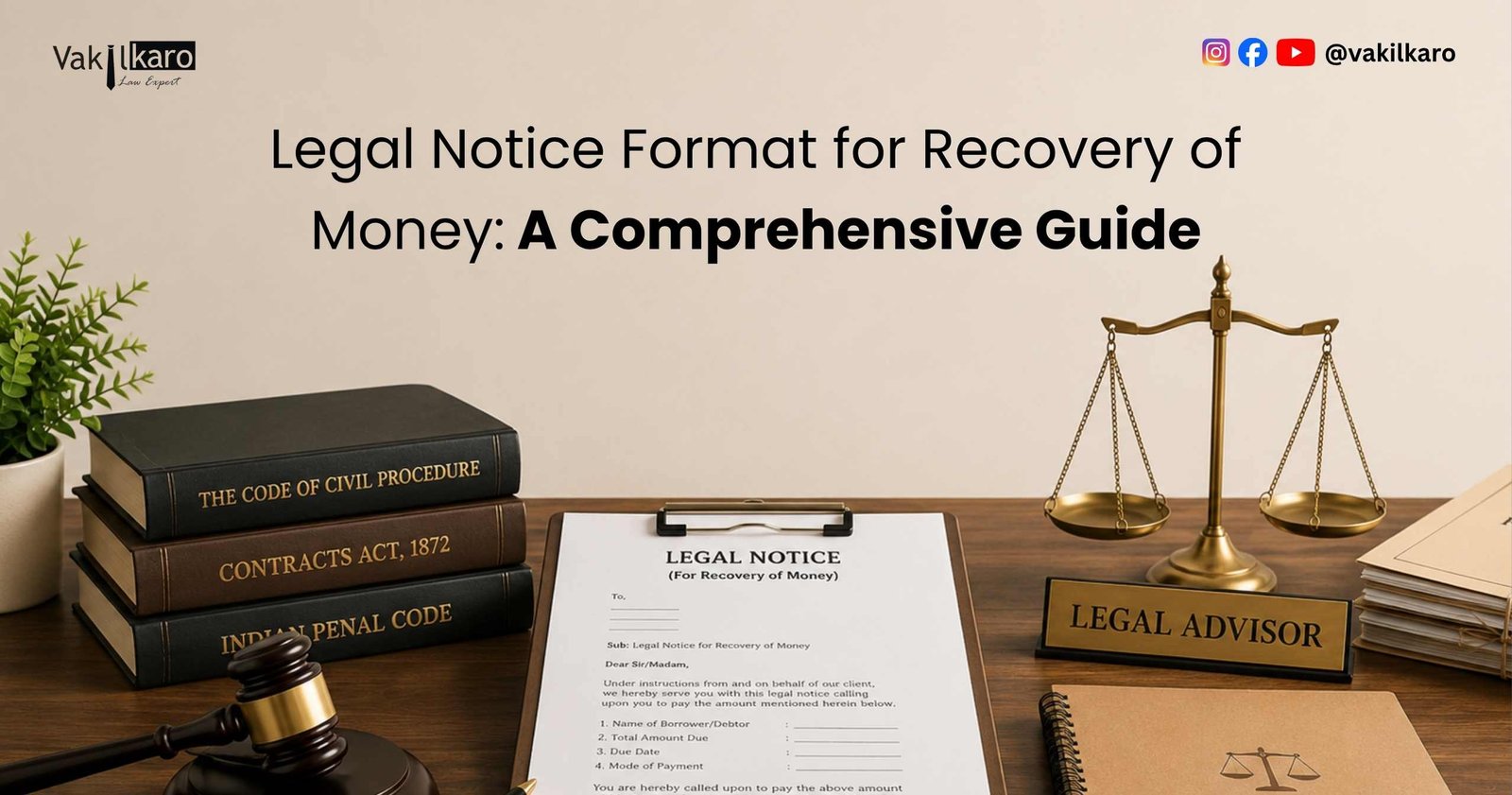
A legal notice for the recovery of money is a crucial step when informal requests fail to settle unpaid debts or outstanding dues. It serves as a formal warning to the debtor, emphasizing the seriousness of the claim and the potential legal consequences of non-payment. A well-drafted legal notice includes essential details such as the sender's and recipient’s information, the amount due, the nature of the transaction, and a clear demand for payment within a specified period. If the debtor fails to respond, legal action, including civil suits or criminal proceedings, may follow to ensure the recovery of the amount.
Key Takeaways
- A legal notice for the recovery of money is a crucial step when informal requests fail to settle unpaid debts or outstanding dues.
- Legal Notice for Recovery of Money: A Crucial Step in Debt Resolution When informal efforts to recover unpaid debts or outstanding dues fail, sending a legal notice for recovery of money becomes necessary.
- A legal notice for money recovery not only formalizes the demand but also increases the chances of an amicable settlement.
- Importance of a Legal Notice for Recovery of Money A legal notice serves as the first step in initiating legal proceedings against a defaulter.
- Conclusion A legal notice for recovery of money is a vital instrument in financial disputes, ensuring that defaulters are held accountable for their outstanding obligations.
Legal Notice for Recovery of Money: A Crucial Step in Debt Resolution
When informal efforts to recover unpaid debts or outstanding dues fail, sending a legal notice for recovery of money becomes necessary. This formal communication acts as a final warning to the debtor, urging them to clear their dues before legal action is taken. It highlights the seriousness of the claim and serves as a legal record of the demand, strengthening the creditor's position if the matter escalates to court.
A well-structured legal notice should include essential details such as the sender’s and recipient’s names, addresses, and contact details. It must also specify the nature of the financial transaction, the amount due, and the date of default. Additionally, the notice should clearly state the legal grounds for the claim, citing relevant laws, and set a deadline for payment. By outlining the legal consequences of non-payment, it compels the debtor to settle the dues to avoid litigation.
If the recipient fails to respond within the stipulated period, the creditor has multiple legal options. These include filing a civil suit under the Civil Procedure Code, 1908, or a summary suit under Order 37 of the CPC for a faster resolution. In cases involving fraud or dishonesty, criminal proceedings can be initiated under Section 420 of the IPC. If the issue pertains to consumer transactions, a complaint under the Consumer Protection Act, 2019, may be filed.
A legal notice for money recovery not only formalizes the demand but also increases the chances of an amicable settlement. Seeking professional legal assistance ensures that the notice is legally sound, strengthening the case and expediting the recovery process. Taking the right legal steps can help protect financial interests and enforce accountability.
In the world of financial transactions, disputes over unpaid debts, outstanding dues, and loan defaults are quite common. Individuals and businesses often lend money or provide services on credit, expecting timely repayment. However, when borrowers or clients fail to meet their financial obligations, it can lead to serious financial strain and legal complications. In such cases, creditors initially attempt informal means such as reminders, emails, and verbal requests to recover the dues. When these efforts fail, sending a legal notice for recovery of money becomes a necessary step.
A legal notice is a formal communication that serves as a warning to the debtor. It informs them of the outstanding amount and urges them to make the payment within a stipulated period to avoid further legal consequences. The notice also acts as documented proof that the creditor made genuine efforts to recover the dues before initiating legal proceedings. This is crucial in case the matter escalates to a civil or criminal lawsuit.
Legal notices are not just about demanding payment—they also establish the creditor’s intent to take legal action if necessary. For the recipient, receiving a legal notice is a serious matter, as non-compliance may lead to court proceedings, additional financial liabilities, or even legal penalties. In many cases, debtors choose to settle the dispute after receiving the notice, making it an effective tool for recovering unpaid dues without lengthy litigation.
This blog delves into the importance, structure, and legal implications of a legal notice for money recovery. It provides insights into drafting an effective notice, key legal provisions, and the steps to follow if the debtor fails to respond. Understanding this process is essential for individuals and businesses to protect their financial interests and ensure timely recovery of dues.
Importance of a Legal Notice for Recovery of Money
A legal notice serves as the first step in initiating legal proceedings against a defaulter. It has the following advantages:
- Legal Standing: Establishes a formal record of the demand.
- Avoids Litigation: Encourages the debtor to settle the dispute amicably.
- Admissible Evidence: Acts as proof in court if the matter proceeds to litigation.
- Demonstrates Seriousness: Warns the debtor of legal consequences.
When to Send a Legal Notice for Recovery of Money?
A legal notice is required in various scenarios, including:
- Unpaid Loans: When a borrower fails to repay an amount.
- Business Transactions: Non-payment by clients, vendors, or partners.
- Salary Dues: When an employer does not clear outstanding wages.
- Personal Borrowings: Friends or relatives failing to return borrowed money.
- Rental Issues: Unpaid rent by tenants.
Essential Components of a Legal Notice
A well-drafted legal notice must include the following elements:
- Sender’s Details: Full name, address, and contact details of the person sending the notice.
- Recipient’s Details: Name, address, and contact details of the defaulter.
- Date: The date when the notice is being issued.
- Subject Line: A clear subject indicating the intent of the notice.
- Detailed Description: Nature of the transaction, amount due, and date of default.
- Legal Grounds: Relevant legal provisions supporting the claim.
- Demand for Payment: Specific demand for settlement within a stipulated period.
- Legal Consequences: Implications of failing to comply with the notice.
- Signature: Signature of the sender or the advocate representing the sender.
Legal Notice Format for Recovery of Money
[Your Name/Your Company Name]
[Your Address]
[City, State, Zip Code]
[Your Contact Information]
[Your Email Address]
[Date]
To,
[Recipient’s Name]
[Recipient’s Address]
[City, State, Zip Code]
[Recipient’s Contact Information]
Subject: Legal Notice for Recovery of Outstanding Dues
Dear [Recipient’s Name],
Under instructions and on behalf of my client, [Your Name/Company Name], residing at [Your Address], I hereby serve you with this legal notice as follows:
- That my client had entered into a financial arrangement with you on [Date of Agreement], wherein you agreed to pay an amount of [Total Due Amount] for [Specify Transaction Details].
- That despite repeated reminders and verbal requests, you have failed to fulfill your financial obligation, and the outstanding dues remain unpaid to date.
- That my client has made multiple attempts to recover the said amount through amicable means, but you have neglected to comply with the terms of repayment.
- That under Section [Relevant Legal Provision] of the Indian Contract Act, 1872 and other applicable laws, you are legally bound to settle the said amount without any further delay.
- That my client hereby demands the immediate payment of [Total Due Amount] within [Number of Days] from the date of receipt of this notice.
- That failure to comply with this demand within the stipulated time will leave my client with no alternative but to initiate legal proceedings against you in the appropriate court of law for the recovery of the amount along with interest, costs, and other legal charges.
- That this notice is being sent to you as a final opportunity to clear your dues before litigation is pursued.
You are requested to treat this notice with urgency and make the necessary payment at the earliest.
A copy of this notice has been retained for future legal reference.
Yours sincerely,
[Your Name]
[Your Advocate’s Name (if applicable)]
[Advocate’s Contact Information]
Steps to Follow After Sending a Legal Notice
- Send via Registered Post: Ensure delivery via registered post or courier with an acknowledgment receipt.
- Retain a Copy: Keep a copy of the notice and delivery proof for legal records.
- Wait for Response: Allow the stipulated time for the recipient to respond.
- Initiate Legal Proceedings: If no response is received, proceed with a civil suit for money recovery.
Legal Remedies for Non-Compliance
If the debtor does not respond or refuses to pay, the following legal actions can be pursued:
- Filing a Civil Suit: Under the Civil Procedure Code, 1908, a money recovery suit can be filed.
- Filing a Summary Suit: Under Order 37 of CPC, if there is a written contract, a summary suit can be filed for faster resolution.
- Criminal Action: If fraud or cheating is involved, a criminal complaint can be lodged under Section 420 of IPC.
- Consumer Complaint: If the default is related to services or product transactions, a case can be filed under the Consumer Protection Act, 2019.
Conclusion
A legal notice for recovery of money is a vital instrument in financial disputes, ensuring that defaulters are held accountable for their outstanding obligations. When informal requests and repeated reminders fail, a legal notice acts as a final warning, compelling the debtor to settle their dues before facing potential legal consequences. It is often an effective way to resolve disputes quickly, as many debtors prefer to clear their liabilities rather than engage in time-consuming and costly litigation.
By issuing a legal notice, the creditor formally establishes a claim and creates a legal record of their demand. This strengthens their position if the matter escalates to court. A well-drafted legal notice clearly states the amount due, the reason for the demand, relevant legal provisions, and the consequences of non-payment. Including all essential details ensures clarity and minimizes the chances of misinterpretation, increasing the likelihood of a favorable response from the debtor.
While a legal notice is a powerful tool, seeking professional legal assistance can significantly improve its effectiveness. Lawyers with expertise in financial disputes and debt recovery can draft precise notices, ensuring compliance with legal requirements and maximizing the chances of resolution. Additionally, legal professionals can guide creditors on the next steps if the debtor fails to respond, whether it involves filing a civil suit, initiating arbitration, or taking criminal action in cases of fraud.
Ultimately, a legal notice serves as both a deterrent and a means to recover money efficiently. Understanding its significance and using it strategically can protect individuals and businesses from financial losses while promoting responsible financial practices in commercial and personal dealings.
Why Choose Vakilkaro for Comprehensive Legal Services?
Vakilkaro is a trusted legal services provider known for its expertise, reliability, and client-centric approach. Whether you need assistance with section 8 microfinance company registration copyright registration services, ITR -1 Return filing for tax compliance, microfinance licensing, or legal documentation, Vakilkaro ensures seamless and hassle-free solutions.
Here’s why Vakilkaro stands out for all your legal needs:
- Expert Guidance – Vakilkaro’s team of experienced professionals, including lawyers, chartered accountants, and legal advisors, ensures accurate legal solutions tailored to your requirements.
- End-to-End Support – From consultation to documentation and compliance, Vakilkaro provides comprehensive assistance, ensuring smooth legal procedures.
- Affordable & Transparent Pricing – Vakilkaro offers cost-effective legal solutions with complete transparency, eliminating hidden charges.
- Quick & Hassle-Free Process – With a streamlined workflow, Vakilkaro simplifies complex legal procedures, saving you time and effort.
- Customer-Centric Approach – Personalized legal services and dedicated support make Vakilkaro a preferred choice for businesses and individuals alike.
Whether you're looking for business registration, intellectual property protection, tax advisory, or compliance support, Vakilkaro ensures efficient, legally sound, and professional services tailored to your needs.
Official External Resources
Use these primary/official sources to verify rules, forms, fees, timelines and regulatory updates before publication.
Frequently asked questions
Legal Notice Format for Recovery of Money: A Comprehensive Guide+
A legal notice for the recovery of money is a crucial step when informal requests fail to settle unpaid debts or outstanding dues. Legal Notice for Recovery of Money: A Crucial Step in Debt Resolution When informal efforts to recover unpaid debts or outstanding dues fail, sending a legal notice for recovery of money becomes necessary.
