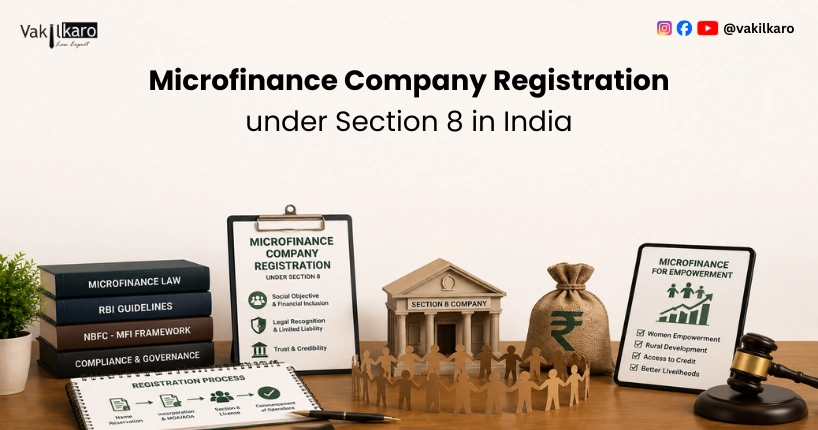
Key Features: No RBI Approval Required: Unlike traditional NBFCs, Section 8 Microfinance Companies can operate without prior RBI approval, making the Microfinance Company Registration process more straightforward and less bureaucratic, ensuring that the necessary support reaches the communities in need without excessive delays. Benefits of Establishing a Section 8 Microfinance Company Simplified Regulatory Process: The procedures for Microfinance Company Registration are comparatively less stringent than those of Non-Banking Financial Company (NBFC) This streamlining encourages more organizations to enter the microfinance space, thus enhancing service availability to underserved communities.
Key Takeaways
- This article will delve into the regulatory framework, key advantages, and a step-by-step Microfinance Company Registration process necessary for establishing a Section 8 Microfinance Company in India.
- Key Features: No RBI Approval Required: Unlike traditional NBFCs, Section 8 Microfinance Companies can operate without prior RBI approval, making the Microfinance Company Registration process more straightforward and less bureaucratic, ensuring that the necessary support reaches the communities in need without excessive delays.
- Benefits of Establishing a Section 8 Microfinance Company Simplified Regulatory Process: The procedures for Microfinance Company Registration are comparatively less stringent than those of Non-Banking Financial Company (NBFC) This streamlining encourages more organizations to enter the microfinance space, thus enhancing service availability to underserved communities.
- Registration Process for a Section 8 Microfinance Company Embarking on the journey to establish a Section 8 Microfinance Company involves a structured and detailed process under the Companies Act, 2013.
- Final Thoughts on Microfinance Company Registration In conclusion, the journey to setting up a Section 8 Microfinance Company encompasses meticulous planning, adherence to legal frameworks, and a strong commitment to the social missions it aims to achieve.
Microfinance Company Registration
A Section 8 Microfinance Company operates as a non-profit organization under the Companies Act, 2013, providing vital financial services to underserved communities. These entities focus on empowering low-income groups through accessible credit, savings, and micro-loans, aligning with the Reserve Bank of India(RBI) and the government's financial inclusion objectives.
This article will delve into the regulatory framework, key advantages, and a step-by-step Microfinance Company Registration process necessary for establishing a Section 8 Microfinance Company in India.
What is a Section 8 Microfinance Company?
Section 8 Microfinance Companies are dedicated legal entities that provide financial assistance, such as loans and credit, to individuals and small businesses that lack access to traditional banking services. Unlike traditional Non-Banking Finance Companies (NBFCs), which aim for profit, these organizations operate on a non-profit model, prioritizing social impact over financial gain.
This unique structure allows Section 8 Microfinance Companies to focus purely on developmental goals rather than shareholder profit.
Key Services Offered:
- Microloans: Unsecured loans of up to ₹50,000 in rural areas and ₹1,25,000 in urban settings assist those in dire need. This makes it easier for individuals to start small businesses or meet emergency financial needs without the burden of high-interest rates associated with traditional loans.
- Savings Support: Offering practical financial solutions for individuals and small enterprises promotes disciplined savings habits. Encouraging saving initiatives such as group savings accounts helps cultivate financial literacy among underserved populations.
- Financial Inclusion: Catering specifically to low-income groups who often find it challenging to navigate conventional banking systems allows these organizations to play a pivotal role in enhancing the economic condition of marginalized communities.
Section 8 Microfinance Companies operate under strict RBI guidelines regarding interest rates, processing fees, and repayment structures, ensuring that their services remain transparent and fair. This cautious oversight is crucial in maintaining the viability and reputation of microfinance entities, which are pivotal in social empowerment.
Objectives of Section 8 Microfinance Companies
The fundamental objectives of a Section 8 Microfinance Company revolve around social and economic upliftment.
- Empowering Low-Income Groups: Providing essential financial tools and opportunities for self-reliance. The emphasis is on nurturing entrepreneurship amongst the youth and women, allowing them to contribute to their families and communities.
- Promoting Entrepreneurship: Facilitating accessible credit that fuels small business growth and trade development. By injecting capital into these businesses, Section 8 Microfinance Companies stimulate local economies and create jobs.
- Women’s Empowerment: Extending comprehensive financial support to women entrepreneurs encourages economic participation, providing them not just financial independence, but also improving their social standing within communities.
- Improving Livelihoods: Supporting various self-employment ventures and job creation avenues promotes stability and improves the quality of life for many families.
- Healthcare Financing: Facilitating access to healthcare by providing timely financial assistance ensures that families do not have to choose between financial ruin and essential medical care.
By pursuing these objectives, Section 8 Microfinance Companies directly contribute to the broader goal of sustainable development and economic growth within India.
Features and Regulatory Exemptions of Section 8 Microfinance Companies
Understanding the key features and regulatory exemptions associated with Section 8 Microfinance Companies can further illustrate their pivotal role in India's financial landscape.
Key Features:
- No RBI Approval Required: Unlike traditional NBFCs, Section 8 Microfinance Companies can operate without prior RBI approval, making the Microfinance Company Registration process more straightforward and less bureaucratic, ensuring that the necessary support reaches the communities in need without excessive delays.
- No Minimum Capital Requirement: The absence of a ₹5 crore minimum capital requirement lowers the entry barrier for non-profit organizations looking to engage in microfinance activities, thereby increasing the potential for diverse organizations to enter the space.
- Unsecured Loans: With the ability to provide unsecured loans, companies can help individuals with limited access to collateral, significantly improving their ability to secure funds for essential needs such as business ventures or education.
- Adherence to RBI Pricing Guidelines: These companies must follow RBI norms concerning interest rates and processing fees, ensuring that borrowers are not exploited. This commitment promotes ethical lending practices that foster trust and transparency.
- Legal Authority for Loan Recovery: Recognized as legitimate financial entities, Section 8 Microfinance Companies are empowered to recover dues from defaulting borrowers. This legal standing reinforces the importance of accountability and responsible lending.
- RBI Exemptions: Under the RBI Act, these companies are exempt from sections 45-IA, 45-IB, and 45-IC, provided they focus primarily on micro-lending without accepting public deposits. This exemption allows them to operate more freely than traditional banks and financial institutions.
Benefits of Establishing a Section 8 Microfinance Company
- Simplified Regulatory Process: The procedures for Microfinance Company Registration are comparatively less stringent than those of Non-Banking Financial Company (NBFC) This streamlining encourages more organizations to enter the microfinance space, thus enhancing service availability to underserved communities.
- Financial Inclusion: These companies play a crucial role in bridging the financial gap for underserved communities by providing tailored financial services. Their operation directly contributes to elevating the economic status of low-income families, allowing them to access credit, save money, and invest in their futures.
- High Repayment Rates: Research indicates that borrowers in microfinance programs often demonstrate strong credit discipline. The closer relationships that microfinance organizations maintain with their clients, combined with community peer support, lead to higher repayment rates, thus increasing the sustainability of the Microfinance Company.
- Support for Entrepreneurs: Microfinance services are vital for fostering entrepreneurship by providing critical financial assistance to aspiring business owners who otherwise may not qualify for traditional loans. By facilitating access to capital, these companies help spark job creation and economic development at the grassroots level.
- Diverse Loan Products: Section 8 Microfinance Companies often provide a range of credit products, including emergency loans, working capital, personal loans, and housing loans. This diversity enables them to meet varying customer needs, ensuring that individuals and small businesses can access the specific support they require.
- Government Support: Various favorable government policies and regulatory frameworks empower these entities, making them more viable and impactful in their efforts to support economic development. Additionally, organizations might also avail themselves of various grants and funding opportunities provided by the government for non-profit entities.
RBI Guidelines for Section 8 Microfinance Companies (Revised)
The Reserve Bank of India (RBI) routinely revises its guidelines to adapt to changing economic conditions and to enhance the operational scope and impact of Section 8 Microfinance Companies. The highlights of the most recent updates include:
- Expanded Definition of Microfinance Loans: The recent revisions acknowledge the need for financial assistance among low-income families. Loans are now categorized as collateral-free for households with an annual income of up to ₹3,00,000, widening the eligibility net.
- Repayment Cap: To prevent borrower over-indebtedness, RBI has stipulated that monthly repayment obligations should not exceed 50% of the borrower’s household income. This critical guideline helps maintain a balance between lending practices and borrower welfare.
- Higher Loan Limits: The cap on loans for eligible borrowers has increased to ₹2,40,000, allowing for greater financial flexibility and support for more substantial endeavors, thereby better catering to the financial needs of the community.
- Interest Rate Oversight: RBI plays an active role in ensuring that interest rates remain reasonable. Regular audits help maintain fairness in financial practices, reassuring borrowers of the ethicalness of the services provided.
- Loan Card Issuance: Each borrower will now receive a loan card that details the loan amount granted, the applicable interest rate, repayment schedules, and any penalties for late payments. This transparency fosters a better relationship between the organization and its borrowers.
- Conversion to NBFC-MFI: If any Section 8 Microfinance Company’s asset size exceeds ₹100 crore, it is required to convert into a Non-Banking Financial Company - Micro Finance Institution (NBFC-MFI) within three months. This conversion underscores the importance of maintaining strict regulatory compliance as these organizations grow.
Registration Process for a Section 8 Microfinance Company
Embarking on the journey to establish a Section 8 Microfinance Company involves a structured and detailed process under the Companies Act, 2013. Careful adherence to these steps not only enhances compliance but also ensures the long-term viability of the organization.
Step 1: Obtain DSC and DIN
- Digital Signature Certificate (DSC): Essential for signing electronic forms, the DSC serves as a digital identification for all official submissions related to the company’s operations.
- Director Identification Number (DIN): Each director associated with the company must apply for a DIN, which ensures that the directors’ identities and qualifications are verifiable within the administrative framework.
Step 2: Name Approval
- It is important to submit a name approval application using Form INC-1, ensuring that the proposed name reflects the entity’s non-profit nature. The name should ideally contain indicative words such as “foundation,” “trust,” or “microcredit,” aligning it with its objectives.
Step 3: Draft MOA and AOA
- Memorandum of Association (MOA): Clearly defining the objectives of the microfinance company is paramount. The MOA should emphasize its commitment to the financial empowerment of lower-income groups and detail how the organization plans to accomplish its goals.
- Articles of Association (AOA): This document outlines the governance structure and operational rules of the company. Specifying how the company operates supports transparency and accountability in its processes.
Step 4: File Documents
To complete the registration, various documents must be submitted for incorporation, including:
- PAN and ID Proof of Directors: Each director must provide their Permanent Account Number (PAN) along with a valid form of identification, such as an Aadhaar card or passport. These measures ensure the legitimacy of the individuals in managerial positions.
- Address Proof of Registered Office: A valid address proof for the registered office of the company must be provided. This could include utility bills, rental agreements, or lease documents, which verify the location from where the company will operate.
- NOC from Property Owner: If the registered office is not owned by the directors of the company, a No Objection Certificate (NOC) from the property owner is required. This document authorizes the organization to use the premises for its operations.
- State Stamp Duty Payment: Payment of the applicable state stamp duty is necessary, and proof of this payment should also be included in the incorporation documents. Each state has different regulations and rates for stamp duty, so it's crucial to be aware of local requirements.
Step 5: License and Certificate of Incorporation
- Upon submission of Form INC-12 along with the required documents for approval, organizations will receive a license to operate as a Section 8 Microfinance Company. After the application is reviewed and approved, the Ministry of Corporate Affairs (MCA) will issue a Certificate of Incorporation, marking the official establishment of your organization.
Restrictions on Section 8 Microfinance Companies
While the establishment of Section 8 Microfinance Companies offers significant opportunities, there are critical restrictions that must be adhered to in accordance with recent guidelines from the Ministry of Corporate Affairs (MCA):
- Limitations on Formation for Microfinance Activities: As per current guidelines, organizations cannot form a Section 8 Company explicitly for microfinance activities without fulfilling certain requirements. Existing Section 8 Companies are also restricted from modifying their object clauses to include microfinance purposes without prior government approval.
- Compliance Requirement: Organizations that are newly formed or looking to adapt their modus operandi must consult with legal or compliance specialists to ensure they adhere to existing regulations. This oversight ensures that all aspects of their operations align with regulatory expectations.
- Focus on Non-Profit Objectives: All activities executed by a Section 8 Microfinance Company must align with its non-profit objectives. Any deviation from this mission could lead to legal consequences, and the company risks being reclassified as a profit-oriented entity, which would incur different obligations and regulations.
Conclusion
Establishing a Section 8 Microfinance Company Registration presents not only a powerful financial opportunity but also a profound responsibility toward enhancing financial inclusion and empowering marginalized communities. The simplified regulatory framework, lack of minimum capital requirements, and legal exemptions create an inviting environment for non-profit organizations seeking to deliver essential financial services.
Before proceeding with Microfinance Company Registration, it’s crucial for organizations to examine their operational limitations and stay informed about recent regulatory developments. Engaging with expert professionals of Vakilkaro offers you valuable guidance to navigate the registration process, ensuring compliance and maximizing impact.
Potential Impact and Future of Microfinance in India
The future of microfinance in India is bright, given the immense potential for improving the lives of millions through financial inclusion. With an increasingly supportive regulatory environment, combined with growing awareness among individuals about their financial rights and options, there is a promising landscape for Section 8 Microfinance Companies to thrive.
Grassroots innovations in microfinance services, such as leveraging technology for mobile banking and online loan management, can further enhance operational efficiency. The ongoing commitment to community engagement and financial education will empower borrowers, increase the effectiveness of lending programs, and foster a sustainable microfinance ecosystem.
For those motivated to enact social change in the economic landscape, now remains an opportune time to act. Establishing a Section 8 Microfinance Company is not merely about providing loans—it's about enabling individuals and communities to build better futures through financial empowerment, self-sufficiency, and economic resilience.
By adhering to the guidelines, providing ethical services, and maintaining transparency, Section 8 Microfinance Companies can continue to play a critical role in driving financial integration, fostering entrepreneurship, and uplifting the standard of living for millions across India.
Final Thoughts on Microfinance Company Registration
In conclusion, the journey to setting up a Section 8 Microfinance Company encompasses meticulous planning, adherence to legal frameworks, and a strong commitment to the social missions it aims to achieve. Understanding the complexities of Microfinance Company Registration is key to empowering your organization to make informed decisions and ultimately drive significant change within the communities it serves.
By prioritizing transparency, ethical lending, and community engagement, Section 8 Microfinance Companies not only contribute to the economic well-being of individuals but also to the broader objective of sustainable development and poverty alleviation in India.
With ample opportunity for positive impact, this is the moment for aspiring entrepreneurs and established organizations alike to embark on this fulfilling path. Together, we can harness the power of microfinance to foster inclusive growth and empower those who seek to improve their social and economic circumstances.
Why Choose Vakilkaro for Microfinance Company Registration?
Vakilkaro is a trusted partner for organizations looking to establish a Section 8 Microfinance Company in India. With extensive experience in company registration and compliance, Vakilkaro offers expert guidance through the intricacies of the registration process, ensuring that every step is handled efficiently and accurately. Our team of skilled professionals understands the unique regulatory requirements associated with microfinance organizations and is committed to providing customized solutions tailored to your specific needs.
By choosing Vakilkaro, you gain access to comprehensive services that cover everything from obtaining Digital Signature Certificates (DSC) and Director Identification Numbers (DIN) to drafting essential documents such as the Memorandum of Association (MOA) and Articles of Association (AOA).
We prioritize transparency and communication, keeping you informed at every stage of the process. Our commitment to customer satisfaction means that you can trust us to navigate the complexities of compliance and provide ongoing support even after registration.
With Vakilkaro, you not only simplify the Microfinance Company Registration process but also position your organization for long-term success in empowering communities through financial inclusion. Together, we can make a difference in the lives of those in need. Top of Form
Official External Resources
Use these primary/official sources to verify rules, forms, fees, timelines and regulatory updates before publication.
Frequently asked questions
Microfinance Company Registration under Section 8 in India+
Key Features: No RBI Approval Required: Unlike traditional NBFCs, Section 8 Microfinance Companies can operate without prior RBI approval, making the Microfinance Company Registration process more straightforward and less bureaucratic, ensuring that the necessary support reaches the communities in need without excessive delays. Benefits of Establishing a Section 8 Microfinance Company Simplified Regulatory Process: The procedures for Microfinance Company Registration are comparatively less stringent than those of Non-Banking Financial Company (NBFC) This streamlining encourages more organizations to enter the microfinance space, thus enhancing service availability to underserved communities.
