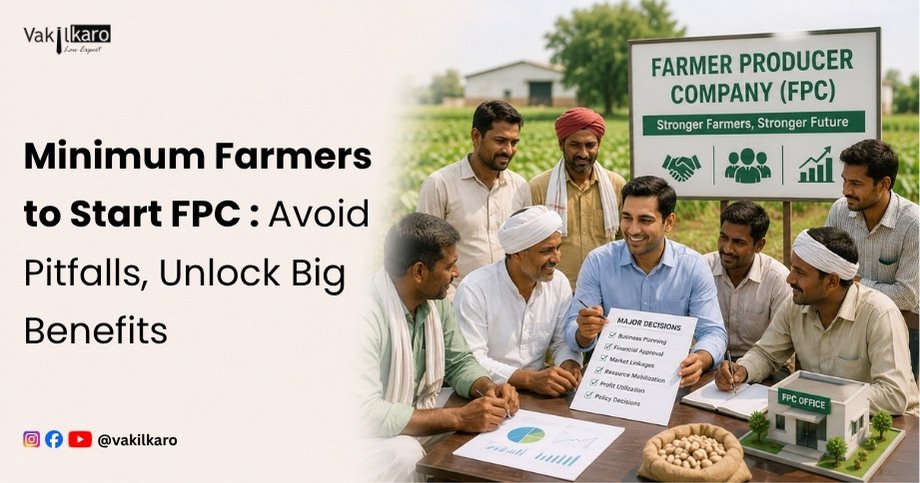
India’s agriculture sector is evolving with initiatives like the Farmer Producer Company (FPC) model, designed to empower small and marginal farmers through collective enterprise. Legally, a minimum of 10 farmers or 2 producer institutions can register an FPC under the Companies Act, 2013, governed by the Ministry of Corporate Affairs (MCA). This blog explains the eligibility, registration process, documents required, tax and government benefits, and how to efficiently register a Farmer Producer Company online. Learn how Vakilkaro simplifies the entire process, making FPC registration in India faster, compliant, and accessible to rural communities.
Key Takeaways
- Legally, a minimum of 10 farmers or 2 producer institutions can register an FPC under the Companies Act, 2013, governed by the Ministry of Corporate Affairs (MCA).
- Knowing the minimum number of farmers required, along with understanding the documents needed, registration fees, and benefits of Farmer Producer Companies, is the first step in building a sustainable, farmer-led business model for rural growth.
- A common question arises in this context: What is the minimum number of farmers required to register an FPC?
- Minimum Number of Farmers Required to Register an FPC To answer the primary question: A minimum of 10 individual farmers is required to form and register a Farmer Producer Company in India.
- Conclusion So, what is the minimum number of farmers required to register an FPC?
Minimum Number of Farmers Required to Register a Farmer Producer Company in India
India’s agriculture sector is undergoing rapid transformation to support small and marginal farmers, and one of the most impactful developments has been the introduction of Farmer Producer Companies (FPCs)). These entities allow farmers to come together, pool resources, and operate as a formal business entity. But a fundamental question remains—how many farmers are needed to form an FPC?
As per the legal guidelines established under Part IXA of the Companies Act, 1956, which continue under the Companies Act, 2013, a minimum of 10 individual farmers or 2 producer institutions are required to form and register a Farmer Producer Company in India. These can also be a combination of individual producers and institutions. The entity must be registered with the Ministry of Corporate Affairs (MCA), which oversees FPC registration in India.
Farmers eligible to form an FPC must be involved in primary production activities such as agriculture, horticulture, animal husbandry, fisheries, forestry, beekeeping, or allied sectors. Once registered, an FPC allows them to operate collectively to access better markets, reduce costs, and benefit from government schemes and financial support.
The Farmer Producer Company registration process includes several steps: obtaining Digital Signature Certificates (DSCs), Director Identification Numbers (DINs), name reservation, filing incorporation documents, and receiving a Certificate of Incorporation. With online portals and legal service providers like Vakilkaro, it’s now easier than ever to register a Farmer Producer Company online with full compliance.
An FPC not only strengthens farmers economically but also enhances their legal and institutional standing. Knowing the minimum number of farmers required, along with understanding the documents needed, registration fees, and benefits of Farmer Producer Companies, is the first step in building a sustainable, farmer-led business model for rural growth.
India's agriculture sector has long been the backbone of the economy, but small and marginal farmers still face numerous structural challenges—fragmented landholdings, limited access to markets, poor bargaining power, and insufficient institutional support. To address these concerns, the Government of India has introduced several initiatives, one of the most impactful being the Farmer Producer Company (FPC)) model. These companies allow farmers to unite under a common legal structure to pursue collective business interests.
A common question arises in this context: What is the minimum number of farmers required to register an FPC? In this blog, we will explore the legal eligibility, the Farmer Producer Company registration process, documentation, costs, compliance, and the broader benefits of this powerful business model. We will also discuss how to register a Farmer Producer Company in India, including digital options such as Farmer Producer Company registration online, and how Vakilkarocan help you simplify the process.
Understanding a Farmer Producer Company (FPC)
A Farmer Producer Company is a hybrid organization that combines the economic benefits of a private limited company with the mutual support principles of cooperative societies. It enables farmers to work collectively and professionally, gaining access to credit, markets, and technology that would otherwise be inaccessible individually.
Legal Structure of a Farmer Producer Company
The concept of FPCs was introduced through an amendment to the Companies Act, 1956. Although this Act has since been replaced by the Companies Act, 2013, the specific provisions under Part IXA continue to govern Farmer Producer Company registration under Companies Act. The regulatory body responsible for overseeing these companies is the Ministry of Corporate Affairs (MCA).
Thus, any group interested in FPC registration in India must ensure they meet the legal requirements laid out in this legislation.
Minimum Number of Farmers Required to Register an FPC
To answer the primary question: A minimum of 10 individual farmers is required to form and register a Farmer Producer Company in India. Alternatively, two or more producer institutions (such as cooperatives, self-help groups, or other FPCs) can also form an FPC. A combination of individual farmers and producer institutions is also permitted.
Who Qualifies as a Farmer?
A "farmer" or "producer" must be engaged in primary agricultural activities, including:
- Farming
- Animal husbandry
- Horticulture
- Floriculture
- Fisheries
- Poultry
- Forestry
- Beekeeping
- Agro-processing
These primary producers come together to form a company with a collective vision for economic growth and sustainability. Understanding the eligibility for Farmer Producer Company is the first step in the registration process.
Why Farmers Should Form a Farmer Producer Company?
There are several compelling reasons why farmers should form a Farmer Producer Company:
- Enhanced Market Access: FPCs have greater bargaining power in both input and output markets.
- Economies of Scale: Collective procurement reduces input costs.
- Better Price Realization: Aggregated marketing fetches better returns.
- Eligibility for Government Schemes: Numerous subsidies and support programs are available exclusively for FPCs.
- Access to Credit and Technology: Institutions like NABARD and SFAC support FPCs through grants and low-interest loans.
These are just a few of the Farmer Producer Company benefits for farmers, making it an ideal legal model for rural agribusiness.
How to Start a Farmer Producer Company?
If you're wondering how to start a Farmer Producer Company, here is a comprehensive guide from ideation to incorporation.
Farmer Producer Company Registration Process
Setting up an FPC involves several legal steps. Below are the key FPC company registration steps:
Obtain Digital Signature Certificates (DSC)
All proposed directors must obtain DSCs for secure online filing.
Apply for Director Identification Numbers (DIN)
Each director must have a DIN, issued by the Ministry of Corporate Affairs.
Name Reservation
Use the MCA's RUN (Reserve Unique Name) service to propose a company name ending with "Producer Company Limited".
Draft MoA and AoA
Prepare the Memorandum of Association (MoA) and Articles of Association (AoA) stating the company’s objectives.
Submit Incorporation Form
File the SPICe+ (Simplified Proforma for Incorporating a Company Electronically Plus) form along with required documents.
Certificate of Incorporation
Once verified, the Registrar of Companies (ROC) issues a Certificate of Incorporation, making the FPC a legal entity.
This answers the common query, "How to register a Farmer Producer Company in India?"
Documents Required for Farmer Producer Company Registration
Here’s a checklist of documents required for Farmer Producer Company registration:
- PAN and Aadhar of all members
- Address proof (Utility bills, Passport, Voter ID)
- Passport-sized photos
- Proof of registered office address
- NOC from property owner
- MoA and AoA
- DIN and DSC for directors
These documents ensure a smoother process during Farmer Producer Company incorporation.
Farmer Producer Company Registration Fees
The Farmer Producer Company registration fees can vary based on:
- Authorized capital
- Number of directors
- Professional service fees (if hiring a consultant like Vakilkaro)
Typically, registration fees can range between ₹7,000 and ₹15,000. Vakilkaro offers budget-friendly packages for Farmer Producer Company registration with Vakilkaro, including documentation, filings, and post-incorporation compliance.
Farmer Producer Company Registration Online
With digital transformation, it’s now easy to register a Farmer Producer Company online. Platforms like Vakilkaro provide end-to-end support, including:
- DSC and DIN application
- Name approval
- Document drafting
- Filing with the MCA
- Compliance advisory
Choosing Farmer Producer Company registration online helps save time, reduce paperwork, and ensure accuracy.
Farmer Producer Company vs Cooperative Society
It’s important to distinguish between an FPC and a cooperative:
For growth-focused farmer groups, FPCs offer a more robust and scalable legal structure than cooperatives.
Farmer Producer Company Business Model
The Farmer Producer Company business model focuses on:
- Aggregating and marketing farm produce
- Procuring quality inputs
- Offering training and technical support
- Setting up processing units
- Export facilitation
- Accessing institutional funding
This model ensures that farmers are not just producers but active participants in the agri-business value chain.
Farmer Producer Company and Tax Benefits
Some key tax benefits FPCs enjoy include:
- Exemption on agricultural income
- Lower corporate tax rates under certain conditions
- MSME registration benefits, including interest subsidies and protection from delayed payments
- GST exemptions on specific agri-products
These Farmer Producer Company and tax benefits enhance profitability and make FPCs a financially viable model.
Government Schemes for Farmer Producer Companies
There are several government schemes for Farmer Producer Companies, including:
- SFAC Equity Grant and Credit Guarantee Scheme
- NABARD support for FPOs
- PM FME Scheme for food processing
- Agriculture Infrastructure Fund (AIF)
- eNAM Market Integration
- PKVY Scheme for organic farming
To qualify for these, proper Farmer Producer Company registration under MCA and adherence to compliance norms are essential.
Farmer Producer Company Compliance Requirements
After incorporation, FPCs must fulfill several compliance duties:
- Obtain PAN and TAN
- Register under MSME and GST (if applicable)
- Maintain statutory registers
- File annual returns with the ROC
- Conduct regular board meetings and AGMs
- Maintain financial statements
Understanding Farmer Producer Company compliance requirements ensures long-term sustainability and regulatory protection.
How Much Time Does It Take to Register a Farmer Producer Company?
Typically, the registration process takes 10–15 working days, provided all documents are in order and filings are accurate. With Vakilkaro’s assistance, the timeline can be further streamlined for faster approvals.
Farmer Producer Organization (FPO) Registration
While often used interchangeably with FPCs, Farmer Producer Organization (FPO) registration includes a broader range of structures—such as cooperatives and trusts. However, registering as a Farmer Producer Company under the Companies Act is considered more effective for scaling operations and accessing finance.
Benefits of Farmer Producer Company
To summarize, here are the top benefits of Farmer Producer Company registration:
- Strengthens collective bargaining
- Reduces cost and risk
- Enhances market access
- Promotes sustainable farming
- Offers tax and credit benefits
- Increases eligibility for government schemes
These Farmer Producer Company benefits for farmers make FPCs a game-changer in rural India.
Conclusion
So, what is the minimum number of farmers required to register an FPC? As per Indian law, at least 10 individual farmers or 2 producer institutions can jointly register a Farmer Producer Company. This number forms the legal foundation for building a structured, farmer-owned enterprise that can participate competitively in the agri-market.
By understanding the Farmer Producer Company registration process, gathering the necessary documents, and choosing the right professional support like Vakilkaro, farmer groups can form successful FPCs. They not only gain financial empowerment but also contribute significantly to India’s vision of inclusive and sustainable agricultural development.
If you're considering how to start a Farmer Producer Company, now is the perfect time. Let Vakilkaro assist you in every step—from Farmer Producer Company incorporation to post-registration compliance—making your journey smooth, legal, and future-ready.
Official External Resources
Use these primary/official sources to verify rules, forms, fees, timelines and regulatory updates before publication.
Frequently asked questions
Minimum Farmers to Start FPC: Avoid Pitfalls, Unlock Big Benefits+
Legally, a minimum of 10 farmers or 2 producer institutions can register an FPC under the Companies Act, 2013, governed by the Ministry of Corporate Affairs (MCA). Knowing the minimum number of farmers required, along with understanding the documents needed, registration fees, and benefits of Farmer Producer Companies, is the first step in building a sustainable, farmer-led business model for rural growth.
