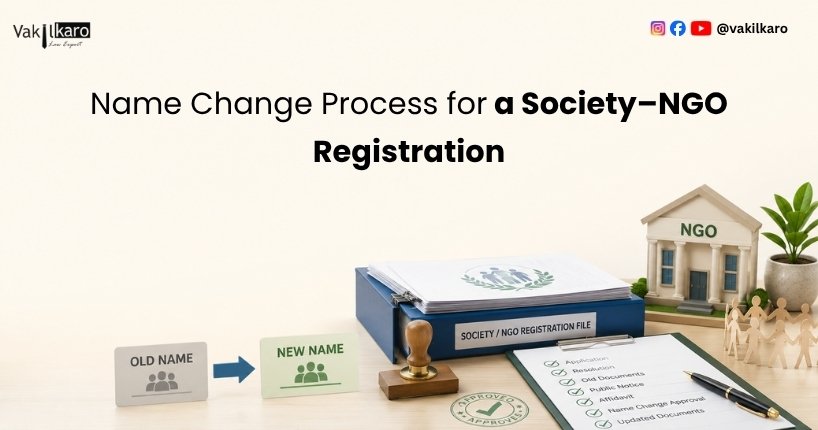
A non-profit organisation plays a vital role in social development through fundraising, grant writing, and community outreach. If an NGO (non-governmental organisation) registered as a society wishes to change its name, it must follow a legal process, including a General Body Meeting, drafting an amendment proposal, notifying the Registrar of Societies, and updating financial records. Section 8 company registration, 12A and 80G registration, and compliance with legal frameworks ensure credibility. NGOs contribute to civil society through advocacy and community support. Proper non-profit registration and governance enhance transparency, helping NGOs sustain their mission effectively.
Key Takeaways
- If an NGO (non-governmental organisation) registered as a society wishes to change its name, it must follow a legal process, including a General Body Meeting, drafting an amendment proposal, notifying the Registrar of Societies, and updating financial records.
- Name Change Process for a Society – Legal Steps and Compliance for NGOs A non-profit organisation plays a crucial role in social development by addressing societal issues through fundraising, grant writing, and community engagement.
- When an NGO registered as a society wishes to change its name, it must adhere to a formal legal process to maintain transparency and comply with government regulations.
- Detailed Steps to Change the Name of a Society Changing the name of a society registered as a non-profit organisation (NGO) involves a systematic legal process to ensure compliance with the regulations set by the Registrar of Societies.
- Whether an NGO operates as a non-governmental organisation (NGO), a charitable trust, a Section 8 company, or a non-profit corporate, ensuring transparency in the name change process is crucial.
Name Change Process for a Society – Legal Steps and Compliance for NGOs
A non-profit organisation plays a crucial role in social development by addressing societal issues through fundraising, grant writing, and community engagement. These non-governmental organisations (NGOs) work towards various causes and rely on structured governance to ensure credibility and efficiency. When an NGO registered as a society wishes to change its name, it must adhere to a formal legal process to maintain transparency and comply with government regulations.
The process begins with a General Body Meeting, where members must pass a special resolution approving the name change. Following this, an amendment proposal is drafted, outlining the new name and the reasons behind the decision. The society must then notify the Registrar of Societies, submitting the required documents, including the existing NGO registration certificate and an updated Memorandum of Association. In some states, the change must be publicly announced in newspapers. Once the Registrar verifies and approves the request, a new registration certificate is issued, and the NGO must update its legal and financial records, including bank accounts and charitable trust registrations.
For NGOs seeking a structured legal framework, Section 8 company registration is a suitable option, providing governance benefits and financial transparency. Additionally, obtaining 12A and 80G registration is essential, as it offers tax exemptions and makes the organisation eligible for grants and donations. Many non-profit consultancy services assist organisations in fulfilling these legal and financial obligations.
Beyond compliance, NGOs play a significant role in policy advocacy, community development, and crisis intervention. By ensuring proper legal procedures and transparent financial management, these organisations can sustain their operations effectively. A well-structured non-profit registration process strengthens credibility, allowing NGOs to focus on their mission of social impact and community service.
A non-profit organisation (NGO) plays a fundamental role in driving social change by addressing various societal challenges such as poverty, education, healthcare, environmental conservation, and human rights. These organisations operate without the intent of generating profits for personal gain; instead, they reinvest their funds into programs and initiatives that benefit communities. Their work is largely sustained through fundraising, grant writing, and generous contributions from individuals, corporations, and government bodies. Through effective community outreach, NGOs create awareness, mobilise resources, and implement impactful solutions to improve the quality of life for underserved populations.
At times, an NGO (non-governmental organisation) registered as a society may find it necessary to change its name due to rebranding, expansion of services, legal requirements, or a shift in mission and objectives. Since these organisations operate under strict government and non-government organisation regulations, the name change process must be carried out systematically to ensure compliance. Failing to follow proper procedures could lead to legal complications, loss of credibility, or financial disruptions.
The name change process involves multiple steps, beginning with a formal decision by the organisation’s governing body. A General Body Meeting must be held where members discuss and approve the proposed name change through a special resolution. Once the resolution is passed, an amendment proposal is prepared, clearly stating the reason for the change and the intended new name. This proposal, along with supporting documents, must be submitted to the Registrar of Societies, which oversees the legal framework for NGOs. Some jurisdictions also require the name change to be announced in public newspapers to ensure transparency.
By adhering to this structured legal process, NGOs uphold their credibility and continue their operations without legal hindrances. Maintaining transparency in governance is crucial for sustaining trust among donors, stakeholders, and the communities they serve.
Detailed Steps to Change the Name of a Society
Changing the name of a society registered as a non-profit organisation (NGO) involves a systematic legal process to ensure compliance with the regulations set by the Registrar of Societies. The process is designed to maintain transparency and avoid any administrative or financial discrepancies. Below are the detailed steps involved in successfully executing a name change for a society.
Hold a General Body Meeting
The first and most crucial step is to convene a General Body Meeting (GBM) with all the society’s members. During this meeting, the proposal to change the name must be discussed, along with the justification for the change. Members must reach a consensus, and a special resolution must be passed, agreeing to the modification. This resolution serves as the official decision of the organisation and is mandatory for proceeding with legal formalities.
Draft an Amendment Proposal
Once the resolution is approved, the society must prepare an Amendment Proposal that outlines the details of the name change. This document should include:
- The society’s current name and the proposed new name
- The reasons for the change (such as rebranding, expansion, or legal requirements)
- The date and details of the General Body Meeting where the resolution was passed
- Signatures of the authorised members or office bearers
This proposal ensures that the name change is well-documented and officially recognised within the organisation.
Notify the Registrar of Societies
After drafting the amendment proposal, the society must submit an application to the Registrar of Societies, which is the governing body responsible for overseeing registered NGOs and societies. The application must include:
- The society’s existing NGO registration certificate
- The amended Memorandum of Association (MoA) reflecting the new name
- A copy of the special resolution passed during the General Body Meeting
- Any other supporting documents required by state-specific regulations
The Registrar will review the documents to ensure that the name change complies with legal requirements and does not conflict with the names of other registered entities.
Publication in Newspapers
In some states, it is mandatory to publish a public notice in one or more newspapers (both in English and the local language) to announce the proposed name change. This step serves as a transparency measure, allowing any objections from the public or stakeholders to be raised before final approval. The notice typically includes:
- The current name of the society
- The new proposed name
- A statement allowing objections within a specified period
- Contact details for any inquiries
Approval from the Registrar
Once the application is processed and no objections are raised, the Registrar of Societies will verify and approve the name change request. Upon successful approval, a new registration certificate reflecting the updated name will be issued. This certificate serves as the legal proof of the name change and must be used in all further documentation updates.
Update Legal and Financial Documents
After receiving the new certificate, the society must update its details across all legal and financial documents to avoid any operational issues. This includes:
- Bank accounts: Notify the bank and update account details to reflect the new name
- Charitable trust registrations: If applicable, update any existing charitable trust records
- Tax and compliance documents: Update details with relevant tax authorities, including 12A and 80G registrations for tax exemptions
- Government records: Inform relevant government departments, including the Ministry of Corporate Affairs (if registered as a Section 8 company)
- Legal contracts and agreements: Revise any agreements, leases, or MoUs with the new name
- Website and official communications: Update the NGO’s website, letterheads, brochures, and other branding materials
By carefully following these steps, NGOs and civil society organisations can smoothly transition to a new name while maintaining compliance with regulatory bodies. Ensuring that all records are updated correctly helps maintain transparency and credibility, reinforcing the organisation’s mission and trust with donors, stakeholders, and beneficiaries.
Compliance for Non-Profit Registration
Setting up a non-profit organisation (NGO) requires adherence to legal and regulatory frameworks to ensure smooth operations and credibility. Compliance with registration laws not only establishes the organisation’s legitimacy but also enables it to receive tax benefits, grants, and donations.
Section 8 Company Registration – A Structured Alternative
For those looking to start an NGO (non-governmental organisation), registering as a Section 8 company under the Companies Act, 2013 is a viable option. A Section 8 company is a non-profit corporate entity that promotes charitable activities such as education, social welfare, healthcare, environmental protection, and more. This registration offers several advantages:
- Legal Recognition: A Section 8 company is governed by the Ministry of Corporate Affairs (MCA), making it more structured than a trust or society.
- Limited Liability: Members enjoy limited liability protection, ensuring personal assets remain secure.
- No Minimum Capital Requirement: Unlike other corporate entities, a Section 8 company does not require a minimum capital investment.
- Tax Benefits: The company is eligible for tax exemptions under 12A and 80G registration if approved by tax authorities.
- Credibility with Donors: Many international donors, corporate sponsors, and government bodies prefer funding Section 8 companies due to their stringent compliance standards.
12A and 80G Registration – Tax Benefits & Donor Attraction
For NGOs and charitable trusts, obtaining 12A and 80G registration is crucial:
- 12A Registration: Exempts the NGO from paying income tax on surplus revenue, allowing it to utilize all funds for its objectives.
- 80G Registration: Provides tax deductions for donors, making the organisation more attractive to corporate and individual contributors.
These registrations significantly enhance fundraising efforts, as donors are more likely to support NGOs that offer tax-saving benefits.
Role of Non-Profit Consultancy Services
Navigating the legal requirements for non-profit registration can be complex, especially for first-time founders. Many organisations seek assistance from non-profit consultancy services that specialize in:
- Registration Processes: Helping NGOs choose the appropriate legal structure (trust, society, or Section 8 company).
- Tax and Compliance Guidance: Ensuring adherence to income tax laws, foreign funding regulations (FCRA compliance), and periodic filings.
- Grant Writing and Fundraising Strategies: Assisting with proposals for government and private funding.
By ensuring proper legal compliance, NGOs can operate efficiently, build trust with stakeholders, and secure sustainable funding for their social initiatives.
Role of NGOs in Society
Non-governmental organisations (NGOs) play a crucial role in shaping society by addressing pressing social, economic, and environmental challenges. While they are often associated with charitable work, their impact extends far beyond mere philanthropy. NGOs actively engage in policy advocacy, community development, and crisis intervention, serving as a bridge between the government, private sector, and civil society. Their efforts contribute to sustainable growth, social justice, and the empowerment of vulnerable communities.
Policy Advocacy – Driving Social and Legislative Change
One of the key responsibilities of NGOs is to advocate for policies that promote human rights, environmental sustainability, healthcare, education, and economic equity. Many NGOs work with governments and international bodies to influence policies, push for legal reforms, and ensure that marginalized voices are heard. This includes:
- Conducting research and publishing reports to highlight critical social issues.
- Lobbying for changes in laws and regulations to protect vulnerable populations.
- Engaging in public awareness campaigns to educate citizens about their rights.
- Partnering with legal experts and policymakers to draft and propose new legislation.
Community Development – Creating Sustainable Solutions
NGOs play a vital role in community development by implementing programs that enhance the well-being of underprivileged groups. This includes initiatives in education, healthcare, women empowerment, rural development, environmental conservation, and skill training. Examples include:
- Establishing free schools, vocational training centers, and scholarship programs.
- Providing healthcare services, medical camps, and awareness programs.
- Supporting rural communities with clean water, sanitation, and agricultural assistance.
- Running entrepreneurship programs to help individuals achieve financial independence.
Through grassroots interventions, NGOs empower communities to become self-sufficient and break the cycle of poverty.
Crisis Intervention – Responding to Emergencies
NGOs also play a critical role in disaster relief and crisis intervention, providing urgent aid during natural calamities, conflicts, pandemics, and humanitarian crises. Their rapid response teams deliver food, shelter, medical assistance, and psychological support to affected populations. Notable efforts include:
- Distributing relief supplies to victims of earthquakes, floods, and hurricanes.
- Setting up temporary shelters and healthcare facilities during pandemics.
- Assisting refugees and displaced individuals with rehabilitation programs.
- Conducting mental health and trauma recovery programs for survivors.
NGOs work alongside government agencies and international organizations like the United Nations (UN), Red Cross, and World Health Organization (WHO) to ensure effective disaster response.
Financial Sustainability – The Role of Fundraising and Donor Management
To sustain their activities, NGOs rely on fundraising, grant writing, and donor management. They secure financial support from individual donors, corporate sponsors, government grants, and international funding agencies. Proper financial governance ensures that funds are used efficiently, maintaining transparency and accountability. Effective donor management strategies include:
- Organizing fundraising events, charity drives, and online donation campaigns.
- Applying for government and private sector grants.
- Partnering with corporate social responsibility (CSR) programs.
- Providing tax benefits to donors through 12A and 80G registrations.
By ensuring strong governance and financial planning, NGOs can maintain long-term sustainability and continue making a meaningful impact on society.
Conclusion
Changing the name of a registered society is a detailed and structured process that requires careful adherence to legal frameworks and proper documentation. This ensures that the organisation remains compliant with government regulations while maintaining transparency in its operations. A well-executed name change not only aligns the NGO with its evolving goals but also strengthens its credibility among stakeholders, donors, and the communities it serves.
Whether an NGO operates as a non-governmental organisation (NGO), a charitable trust, a Section 8 company, or a non-profit corporate, ensuring transparency in the name change process is crucial. Fulfilling the legal requirements—such as holding a General Body Meeting, passing a special resolution, notifying the Registrar of Societies, and updating all legal and financial records—demonstrates the organisation’s commitment to accountability. Many non-profits seek professional assistance from non-profit consultancy services to efficiently handle compliance matters and ensure a smooth transition.
Moreover, beyond just changing the name, an NGO must also focus on maintaining compliance with non-profit registration regulations such as 12A and 80G registrations. These certifications play a vital role in securing tax benefits and attracting potential donors, further strengthening financial sustainability. Keeping all documentation up to date, including bank accounts, tax filings, and fundraising records, prevents legal complications and ensures seamless operations.
Ultimately, the proper setup and governance of a non-profit organisation play a crucial role in ensuring its long-term impact and effectiveness. A well-structured NGO can efficiently deliver services to the community, advocate for social causes, and implement meaningful programs that drive sustainable development. Maintaining transparency, accountability, and compliance allows the organisation to build trust, expand its outreach, and continue making a positive difference in society.
Official External Resources
Use these primary/official sources to verify rules, forms, fees, timelines and regulatory updates before publication.
Frequently asked questions
Name Change Process for a Society–NGO Registration+
If an NGO (non-governmental organisation) registered as a society wishes to change its name, it must follow a legal process, including a General Body Meeting, drafting an amendment proposal, notifying the Registrar of Societies, and updating financial records. When an NGO registered as a society wishes to change its name, it must adhere to a formal legal process to maintain transparency and comply with government regulations.
