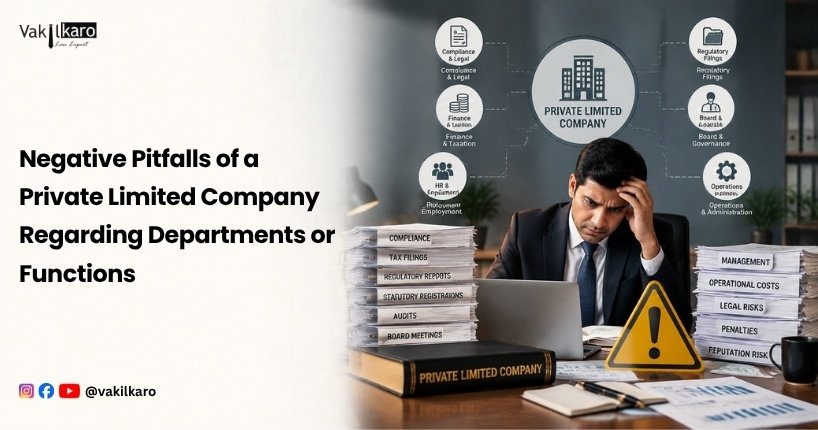
Explore the hidden pitfalls of Private Limited Company structures. Understand how departmental breakdown impacts compliance, governance, and growth. This guide reveals negative aspects such as operational risks, legal liabilities, and financial complexities that can harm a Pvt Ltd if overlooked. Learn why clarity in functions—from Board of Directors to Finance, HR, Legal, and IT—is essential for transparency and efficiency. Discover how poor role definition can lead to disputes, regulatory breaches, and stalled expansion. Whether planning incorporation or scaling your business, knowing these challenges helps you build a resilient corporate entity and avoid costly mistakes.
Key Takeaways
- Explore the hidden pitfalls of Private Limited Company structures.
- Hidden Challenges in Private Limited Company Structures Setting up a Private Limited Company registration might appear straightforward, but beneath the surface lie several potential pitfalls tied to departmental roles and functions.
- Introduction When you embark on the journey of Private Limited Company registration, one of the most important considerations is understanding how your business will be structured internally.
- Understanding the Framework: The Private Limited Company as a Separate Legal Entity Before delving into departments, remember that a Private Limited Company is a separate legal entity, distinct from its shareholders and directors.
- If you are planning Private Limited Company registration, Section 8 company registration, or transitioning from a startup to a structured corporate entity, now is the time to define your functions carefully.
Hidden Challenges in Private Limited Company Structures
Setting up a Private Limited Company registration might appear straightforward, but beneath the surface lie several potential pitfalls tied to departmental roles and functions. Clear internal structure is essential, as it forms the backbone of operational efficiency, legal compliance, and strategic growth. Without it, companies risk encountering issues that can severely disrupt their progress.
One critical area involves the Board of Directors and senior management. If their responsibilities are not clearly defined and regularly reviewed, decision-making can become inconsistent. This confusion often trickles down to key functions like finance, where accurate financial reporting, taxation compliance, and managing capital contributions must be meticulously maintained. Any oversight here could result in regulatory penalties or loss of investor confidence.
The Legal and Compliance department also plays a vital role in protecting the company from contractual disputes, intellectual property issues, and breaches of corporate law. A lack of clarity in legal processes may lead to unnecessary litigation, delayed business expansion, or failed mergers and acquisitions. Human Resources further contributes to this complex environment by overseeing employment contracts, compensation structures, and grievance management, all of which can trigger liability if not handled transparently.
Departments like Operations, Sales, and IT are equally important. Inefficiencies or blurred responsibilities in these functions can reduce profitability, expose sensitive data, or damage customer relationships. Risk Management, often underestimated, is crucial for anticipating legal and operational threats that could undermine stability.
Ultimately, having a well-defined departmental structure ensures smoother statutory compliance, clearer accountability, and a stronger foundation for sustainable growth. Whether you are registering a new company, scaling an established business, or planning a strategic exit, understanding these hidden challenges empowers you to build a resilient organization while avoiding costly mistakes that can arise from neglecting internal clarity.
When you embark on the journey of Private Limited Company registration, one of the most important considerations is understanding how your business will be structured internally. A clear breakdown by departments or functions isn’t merely a bureaucratic formality—it fundamentally defines your corporate entity’s ability to operate efficiently, comply with statutory regulations, and build a foundation for long-term success in a competitive market.
Whether you are launching a new Pvt Ltd venture, exploring Section 8 microfinance company registration for a not-for-profit initiative, or planning the evolution of a startup into a mature corporate structure, establishing clarity in departmental responsibilities helps ensure robust corporate governance, smooth regulatory compliance, and transparent financial reporting. Each department, from Finance and Legal to Human Resources and Operations, plays a distinct role in driving growth while safeguarding against risks.
This clarity becomes even more vital as companies scale. Poorly defined roles can lead to delays in statutory filings, conflicts among directors and shareholders, tax errors, and vulnerabilities in contracts or intellectual property. Conversely, well-organized functions strengthen trust among investors, lenders, and regulators, and improve your company’s readiness for expansion, funding rounds, or even an eventual exit strategy such as an IPO.
Partnering with experts like Vakilkaro adds tremendous value to this process. Vakilkaro’s experienced professionals specialize in Company Registration, compliance management, and strategic advisory services. They help founders and management teams draft accurate Articles of Association (AOA) and Memorandum of Association (MOA), define shareholding patterns, and set up strong internal policies that align with the Companies Act. Their end-to-end support—from incorporation to annual filings—ensures your departments are structured correctly, your compliance obligations are met, and your business remains protected from avoidable pitfalls.
In this article, we will explore in detail:
- What functional departments are typically present in a Private Limited Company
- How these departments align with compliance under the Companies Act
- Why departmental clarity matters for Company Registration and incorporation
- How each function supports strategic objectives like business expansion, risk management, and fundraising
We will also cover essential concepts such as Board of Directors, Company Secretary, financial statements, corporate taxation, and much more—so you can build a Private Limited Company with confidence and resilience, supported by Vakilkaro’s expert guidance.
Understanding the Framework: The Private Limited Company as a Separate Legal Entity
Before delving into departments, remember that a Private Limited Company is a separate legal entity, distinct from its shareholders and directors. Once you complete Company registration, you receive a Certificate of Incorporation, a Company Identification Number (CIN), and become subject to the comprehensive regulatory framework of Indian corporate law.
This separate legal entity status creates a shield of limited liability for owners. But it also demands rigorous compliance and clear internal systems. The breakdown by functions ensures that:
- Every statutory obligation—annual filing, audit and assurance, GST, and Income Tax Return (ITR)—is properly handled.
- Decision-making is well-documented through board resolutions, AGMs, and EGMs.
- All capital-related activities—equity financing, debt financing, and fundraising—are transparent and traceable.
Let’s look at each functional area that makes up the backbone of a Pvt Ltd company.
Board of Directors and Corporate Governance Department
Board of Directors is the apex decision-making body. Their function goes beyond symbolic leadership—they ensure that your company is run in the interests of shareholders, in line with the Companies Act and the company’s MOA and AOA.
Key Functions:
- Appointing Key Managerial Personnel (KMP) like the Managing Director and Company Secretary
- Approving budgets and major contracts
- Passing board resolutions on strategic matters, e.g., Mergers and Acquisitions (M&A), business valuation, or capital infusion
- Ensuring compliance with Secretarial Standards, regular board meetings, and proper maintenance of statutory registers
- Reviewing corporate litigation risks and contractual obligations
Every director must hold a valid Director Identification Number (DIN)
This department often coordinates with legal advisors and external consultants offering business incorporation services, legal advisory, and corporate compliance software to streamline governance.
Finance and Accounting Department
Your Finance Department oversees all monetary transactions, taxation, and statutory filings:
Core Responsibilities:
- Maintaining the balance sheet and profit and loss account
- Overseeing internal audit and liaising with the statutory auditor for the auditor’s report
- Handling corporate taxation, including GST Registration and Income Tax Return (ITR)
- Managing working capital, cash flow, equity financing, and debt financing
- Tracking capital contribution, authorized capital, and paid-up capital
- Managing payments to vendors and employees
For investors and regulators alike, robust financial controls reflect sound corporate practices and support the company’s ease of doing business credentials.
Legal and Compliance Department
A dedicated legal department is essential, especially as your Private Limited Company scales.
What it Manages:
- Drafting and maintaining shareholders’ agreements, vendor agreements, employment contracts, and non-disclosure agreements (NDAs)
- Overseeing Intellectual Property Rights (IPR) protection
- Coordinating with the Registrar of Companies (ROC) for all statutory compliance matters
- Handling dispute resolution, arbitration, or corporate litigation
- Ensuring alignment with Secretarial Standards, Company Law, and sector-specific regulations
- Managing digital signature certificates (DSC) and e-Governance for Companies platforms
If you plan business expansion or an exit strategy such as an IPO, this department becomes indispensable.
Human Resources (HR) Department
No corporate entity functions without a well-structured HR department:
Responsibilities:
- Recruitment and onboarding of employees
- Drafting and enforcing employment contracts
- Administering compensation, benefits, and compliance management under labor laws
- Managing training and development
- Handling employee grievances and disciplinary procedures
- Contributing to corporate strategy by shaping the company culture
This department also liaises with Finance on payroll taxation and with Legal for compliance and contracts.
Operations Department
In a Pvt Ltd, Operations refers to the core activity that generates revenue:
Functions:
- Overseeing production or service delivery
- Vendor management and procurement
- Supply chain and logistics coordination
- Quality assurance
- Business process optimization and technology adoption
An efficient Operations team helps your company maintain profitability and readiness for fundraising rounds with venture capital or private equity.
Sales and Marketing Department
Revenue generation is the lifeblood of any Private Limited Company.
Key Responsibilities:
- Developing marketing strategies
- Managing advertising campaigns
- Overseeing sales channels and performance
- Customer relationship management
- Supporting business valuation through sustained growth
Especially for startups and SMEs, this department often works closely with founders to establish brand recognition and build market share.
IT and Technology Department
Digital transformation is no longer optional:
Core Functions:
- Implementing corporate compliance software for statutory obligations
- Managing IT infrastructure and cybersecurity
- Developing internal tools and automating workflows
- Supporting e-Governance for Companies compliance
- Facilitating digital record-keeping and cloud-based financial reporting
A robust IT function underpins smooth operations, regulatory compliance, and data security.
Risk Management Department
Risk is inherent in business. This department ensures resilience:
Core Areas:
- Identifying and mitigating operational and financial risks
- Monitoring legal liabilities and regulatory inspections
- Drafting policies for crisis management and breach of compliance scenarios
- Handling insurance policies and contingency planning
- Overseeing compliance with health and safety regulations
This function supports your Board of Directors in upholding fiduciary responsibilities.
Secretarial Department
Often overlooked, the Secretarial Department plays a critical role:
Duties:
- Maintaining statutory registers and records
- Coordinating board meetings, AGMs, and EGMs
- Ensuring timely annual filing with the ROC
- Drafting and filing resolutions and compliance documents
- Acting as the primary interface between the company and regulators
A qualified Company Secretary is a mandatory Key Managerial Personnel (KMP) in many companies, depending on thresholds of paid-up capital and turnover.
Strategy and Business Development Department
Forward-looking companies invest in strategic planning and growth functions:
Focus Areas:
- Identifying M&A opportunities
- Developing and refining the exit strategy (including potential IPO)
- Building strategic alliances and partnerships
- Exploring new markets for business expansion
- Shaping long-term corporate strategy
For startups, this is also the team that drives fundraising, investor relations, and business valuation.
Why Departmental Breakdown Matters During Incorporation
When you proceed with Private Limited Company registration, a clear functional breakdown helps in:
✅ Drafting the MOA and AOA accurately
✅ Assigning roles and responsibilities to directors and KMPs
✅ Setting up the right statutory registers and compliance mechanisms
✅ Designing a shareholding pattern aligned with control and governance goals
✅ Facilitating transparent financial reporting
This clarity strengthens investor confidence, ensures ease of doing business, and reduces legal risk.
Leveraging Technology for Departmental Efficiency
Modern Private Limited Companies increasingly adopt:
- Corporate compliance software to track statutory deadlines
- Digital platforms for annual filing and ROC submissions
- Cloud-based financial reporting tools
- e-Governance for Companies portals for faster approvals
Technology adoption is not just about efficiency; it signals professionalism to stakeholders.
How Departments Align with the Shareholding Structure
Your functional departments also interact closely with shareholders and their rights:
- Equity Shares: Common shareholders usually influence appointments to key functions
- Preference Shares: Holders may have specific rights tied to financial functions
- Transfer of Shares: The legal team ensures compliance during any share movement
- Beneficial Ownership: The Secretarial Department tracks ultimate ownership
A transparent shareholding pattern aligns everyone’s expectations.
From Startup Registration to Maturity
When you first undertake startup registration, you may combine multiple functions under one or two founders. Over time, the business matures:
- HR becomes specialized
- Finance grows into a dedicated department with internal controls
- Legal functions become critical as you sign more vendor agreements and protect IPR
- Strategy evolves into a driver of business expansion and fundraising
Even SMEs must evolve these functions to remain compliant and competitive.
Conclusion
Incorporating a Private Limited Company is far more than a formality—it is the first step toward building a compliant, credible, and resilient business. A clear breakdown by departments or functions is critical to ensuring:
✅ Consistent and accurate statutory compliance under the Companies Act, avoiding penalties and regulatory setbacks
✅ Effective corporate governance led by the Board of Directors and supported by well-defined internal policies
✅ Transparent and efficient financial reporting, which boosts investor confidence and simplifies fundraising
✅ Stronger risk management practices and readiness to handle crises without disrupting operations
✅ Strategic clarity and alignment of departmental efforts with overall shareholder objectives
Whether you are engaging business incorporation services, seeking specialized legal advisory, or adopting corporate compliance software to automate your obligations, structuring your internal functions with precision is what positions your company for sustainable growth.
This is where Vakilkaro plays a vital role. From day one, Vakilkaro’s team of corporate law professionals and compliance experts guide you through every stage of establishing and managing your Private Limited Company. They help you prepare accurate Articles of Association (AOA) and Memorandum of Association (MOA), define responsibilities across departments, and set up robust frameworks for annual filings, statutory audits, and governance practices. Vakilkaro also supports you in drafting essential agreements, safeguarding your intellectual property, and implementing compliance systems that scale as your business grows.
If you are planning Private Limited Company registration, Section 8 company registration, or transitioning from a startup to a structured corporate entity, now is the time to define your functions carefully. Vakilkaro can make this process smoother, faster, and fully compliant—so you can focus on building your vision with confidence.
Remember, the solid foundations you establish today will lead to resilience, credibility, and lasting success tomorrow.
Official External Resources
Use these primary/official sources to verify rules, forms, fees, timelines and regulatory updates before publication.
Frequently asked questions
Negative Pitfalls of a Private Limited Company Regarding Departments or Functions+
Hidden Challenges in Private Limited Company Structures Setting up a Private Limited Company registration might appear straightforward, but beneath the surface lie several potential pitfalls tied to departmental roles and functions. Understanding the Framework: The Private Limited Company as a Separate Legal Entity Before delving into departments, remember that a Private Limited Company is a separate legal entity, distinct from its shareholders and directors.
