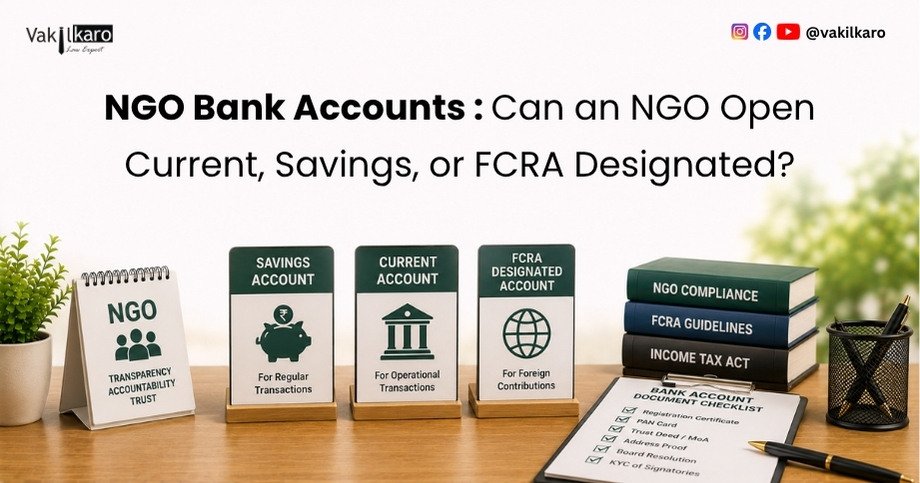
Choosing the right bank account is crucial for NGOs to manage funds transparently. Whether your organization is in the process of NGO registration, Section 8 company registration, or securing 12A and 80G registration, selecting between a current, savings, or FCRA designated account depends on your funding structure, transaction volume, and compliance needs. Current accounts offer flexibility for daily operations, savings accounts are ideal for storing idle funds with interest, and FCRA designated accounts are legally required for foreign donations. Understanding each option helps NGOs meet regulatory obligations, maintain credibility, and optimize fund management while focusing on their charitable mission.
Key Takeaways
- Whether your organization is in the process of NGO registration, Section 8 company registration, or securing 12A and 80G registration, selecting between a current, savings, or FCRA designated account depends on your funding structure, transaction volume, and compliance needs.
- Current accounts offer flexibility for daily operations, savings accounts are ideal for storing idle funds with interest, and FCRA designated accounts are legally required for foreign donations.
- Understanding the Right Bank Account for Your NGO: Current, Savings, or FCRA Designated When setting up an NGO, one of the most essential steps is opening the right type of bank account.
- Can an NGO open a current, savings, or FCRA-designated account?
- There are three main types of bank accounts an NGO can open: Current Account Savings Account FCRA Designated Account Each of these accounts comes with specific benefits, limitations, and regulatory requirements that may vary depending on the organization’s legal structure and purpose.
Understanding the Right Bank Account for Your NGO: Current, Savings, or FCRA Designated
When setting up an NGO, one of the most essential steps is opening the right type of bank account. This ensures financial operations are conducted transparently and in compliance with Indian laws. Whether your NGO is formed through NGO registration, Section 8 company registration, or has obtained 12A and 80G registration, selecting the right bank account helps maintain financial clarity, donor trust, and legal credibility.
NGOs generally have three banking options—current accounts, savings accounts, and FCRA designated accounts—each catering to specific operational needs.
A current account is ideal for NGOs that handle frequent transactions. It allows unrestricted deposits and withdrawals, making it perfect for daily operations such as paying salaries, utility bills, or vendor charges. NGOs registered as a Section 8 company or through any formal NGO registration structure must provide legal documents like the registration certificate, board resolution, and PAN to open this account.
In contrast, a savings account suits NGOs that don’t require frequent access to funds but want to store donations securely while earning interest. Though it offers fewer transaction capabilities than a current account, it is useful for storing large one-time grants or donations meant for future use. It also comes with lower banking fees and risks.
For NGOs receiving foreign donations, an FCRA designated account is mandatory. This account can only be opened after receiving FCRA registration from the Ministry of Home Affairs. It ensures foreign contributions are tracked and used strictly for approved charitable purposes. NGOs must keep this account separate from their domestic funds to maintain transparency and meet compliance standards.
Choosing the right account based on your NGO’s structure, funding sources, and goals will ensure smooth, lawful, and efficient financial management.
Opening a bank account is one of the most important steps for any Non-Governmental Organization (NGO) to ensure the transparent and legal handling of its finances. Whether it’s a Section 8 company registration, NGO registration, or securing 12A and 80G registration, managing an NGO’s financial resources through the proper bank account is essential for maintaining accountability, attracting donations, and ensuring compliance with regulatory bodies. But when it comes to choosing the right bank account for your NGO, the question arises—what type of bank account is best suited for your organization? Can an NGO open a current, savings, or FCRA-designated account?
In this blog, we’ll explore the different types of bank accounts an NGO can open, what each account type entails, and the legal and operational requirements associated with them.
Understanding the Importance of Bank Accounts for NGOs
Before diving into the types of bank accounts that NGOs can open, it's crucial to understand why bank accounts are fundamental to the operations of an NGO. NGOs, whether registered under NGO registration, Section 8 company registration, or seeking 12A and 80G registration under the Income Tax Act, handle significant funds, including donations, grants, and revenue generated from their activities.
To maintain transparency, accountability, and legal compliance, an NGO must manage these funds through an appropriate banking system. Bank accounts serve as the financial foundation, ensuring that all funds are appropriately received, stored, and distributed according to the NGO’s mission and objectives. Additionally, a bank account ensures compliance with laws surrounding taxation, reporting, and the proper use of funds for charitable purposes.
There are three main types of bank accounts an NGO can open:
- Current Account
- Savings Account
- FCRA Designated Account
Each of these accounts comes with specific benefits, limitations, and regulatory requirements that may vary depending on the organization’s legal structure and purpose.
Current Account for NGOs
A current account is the most common type of bank account for NGOs, particularly for organizations with significant financial transactions and operational expenses. NGOs typically need a current account for handling large volumes of deposits and withdrawals that are necessary for day-to-day operations.
What is a Current Account?
A current account is a non-interest-bearing account that allows organizations to conduct numerous transactions like receiving donations, grants, making payments to employees or vendors, and handling other financial obligations. Current accounts are ideal for NGOs because they offer unlimited deposits and withdrawals, ensuring flexibility for managing operational funds.
Why is a Current Account Suitable for NGOs?
- No Transaction Limitations: Current accounts provide the flexibility needed by NGOs that frequently receive donations or grants, as there are no restrictions on the number of transactions. This is crucial for NGOs that receive funds from multiple donors, including international sources.
- Professional Banking Services: Current accounts offer several banking services suited for the NGO’s operational needs, such as cheque book facilities, online banking, and overdraft options. This allows the NGO to efficiently manage its financial transactions.
- Helps Build Credibility: When an NGO is registered under Section 8 company registration or NGO registration, having a current account demonstrates financial legitimacy to donors, government agencies, and other stakeholders. It shows that the organization follows standard financial practices, ensuring transparency and accountability.
- Required for Operational Expenses: NGOs often need to make payments for salaries, rent, utilities, and supplies. A current account is ideal for these types of high-volume, regular transactions.
Key Requirements for Opening a Current Account for an NGO
- NGO Registration: Proof of NGO registration is required to open a current account. The bank needs to verify that your organization is a legal entity.
- PAN Card: A Permanent Account Number (PAN) for the NGO is essential for opening any type of bank account, including current accounts.
- Board Resolution: The governing body or board of directors must provide a resolution that authorizes specific individuals to open and operate the bank account on behalf of the NGO.
- Documents: The bank may also request documents like the Memorandum of Association (for a Section 8 company) or Trust Deed (for a trust) to confirm the organizational structure and purpose.
Savings Account for NGOs
While a savings account is commonly associated with individual accounts, NGOs may also consider opening a savings account to hold funds that do not need to be used immediately. Savings accounts are generally designed for those who don’t need to make daily or frequent transactions but still wish to earn a small interest on their balance.
What is a Savings Account?
A savings account is an interest-bearing account typically used to save funds for future use. It allows NGOs to accumulate and store donations or grants that are not immediately required for operational purposes. While it offers lower flexibility in terms of withdrawals compared to a current account, it does provide a small interest on the funds in the account, which could be beneficial for organizations holding onto donations for a certain period.
Why is a Savings Account Suitable for NGOs?
- Earn Interest: One of the primary advantages of a savings account is that it allows NGOs to earn interest on their funds. This is particularly useful for NGOs that may receive large one-time donations or grants that they do not need to access right away.
- Limited Transactions: NGOs that do not need to make frequent payments or withdrawals may prefer a savings account for its simplicity. It is less complicated than a current account and often incurs fewer banking fees.
- Low Risk: Savings accounts are typically safer and more secure, making them a good option for NGOs that want to store funds in a low-risk environment while still earning interest.
Key Requirements for Opening a Savings Account for an NGO
- Registration Documents: Like current accounts, banks will require proof of your NGO’s NGO registration and legal status, whether through Section 8 company registration or other types of registration.
- Board Resolution: A resolution from the board of directors or trustees is also necessary to open a savings account for an NGO.
- Documents for Beneficiaries: Some banks may require the names of the individuals authorized to manage the account on behalf of the NGO.
FCRA Designated Account for NGOs
For NGOs that receive foreign funds, it is essential to open a FCRA designated account. FCRA stands for Foreign Contribution (Regulation) Act, and this account is specifically designated for receiving foreign donations. The Government of India regulates the inflow of foreign funds to NGOs to ensure that they are used for lawful purposes.
What is an FCRA Designated Account?
An FCRA designated account is a special bank account for NGOs registered under FCRA, which allows them to receive funds from foreign donors. Under FCRA, it is mandatory for NGOs to open this specific account to receive foreign contributions. The account must be in the name of the NGO and must be used exclusively for foreign contributions.
Why is an FCRA Account Essential for NGOs?
- Regulatory Requirement: The Government of India mandates that any NGO that wishes to receive foreign donations must have an FCRA registration and open a designated bank account for this purpose. Failure to comply with these regulations can result in penalties or suspension of FCRA registration.
- Tracking Foreign Contributions: The FCRA designated account helps the government and NGOs track foreign contributions. NGOs must use the funds solely for their registered charitable purpose, and these funds cannot be diverted for other activities.
- Enhanced Transparency: Having a separate account for foreign funds ensures that these funds are not mixed with domestic contributions, offering higher levels of financial transparency and accountability.
Key Requirements for Opening an FCRA Account
- FCRA Registration: NGOs must be registered under the Foreign Contribution Regulation Act (FCRA) to open this account.
- Approval from the Government: The Ministry of Home Affairs (MHA) must approve the FCRA registration before the NGO can open the designated bank account.
- Bank Documentation: The bank will require the FCRA registration certificate, NGO registration proof, and PAN details of the NGO to open an FCRA account.
Choosing the Right Bank Account for Your NGO
When choosing the right bank account for your NGO, several factors should be considered:
- Nature of Funds: Determine the type and frequency of funds your NGO will receive. If your organization deals with high-frequency donations or needs to make frequent payments, a current account might be most suitable. If you intend to save large sums for the long term, a savings account may be ideal.
- Foreign Donations: If your NGO plans to accept foreign donations, obtaining FCRA registration and opening an FCRA designated account will be a legal requirement.
- Tax Exemptions and Donor Benefits: Having proper registration, such as 12A and 80G registration, will allow your NGO to enjoy tax exemptions and provide donors with tax-deductible receipts, making your NGO more attractive to potential donors.
Conclusion
In conclusion, choosing the right bank account for your NGO is critical to maintaining the financial integrity and operational transparency of the organization. Whether it's a current account, savings account, or FCRA designated account, each type of account serves a specific purpose. NGOs need to ensure they are compliant with the legal and regulatory requirements of their respective registration processes, such as Section 8 company registration, NGO registration, and FCRA registration, to handle their finances efficiently and legally.
By understanding the benefits, requirements, and legal obligations associated with each type of bank account, NGOs can select the most appropriate banking structure to meet their needs. With proper planning and compliance, your NGO will be able to manage its funds effectively, maintain donor trust, and focus on fulfilling its social mission.
Official External Resources
Use these primary/official sources to verify rules, forms, fees, timelines and regulatory updates before publication.
Frequently asked questions
NGO Bank Accounts: Can an NGO Open Current, Savings, or FCRA Designated?+
Understanding the Right Bank Account for Your NGO: Current, Savings, or FCRA Designated When setting up an NGO, one of the most essential steps is opening the right type of bank account. Can an NGO open a current, savings, or FCRA-designated account?
