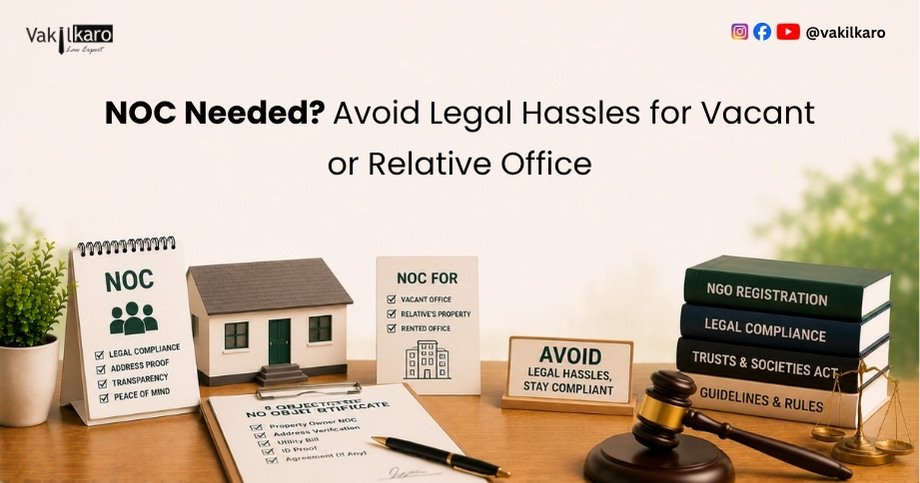
If you're setting up an NGO or registering a Section 8 company in India, one key step is securing a registered office address. A common query is whether a NOC is needed if the office space is owned or rented by a relative. The answer is yes. A NOC ensures legal transparency and is required during Section 8 registration, NGO registration, and 12A & 80G tax exemption applications. Whether it’s a home office or a relative's property, submitting a NOC, utility bill, and ownership proof is essential for compliance and smooth processing.
Key Takeaways
- A common query is whether a NOC is needed if the office space is owned or rented by a relative.
- Whether it’s a home office or a relative's property, submitting a NOC, utility bill, and ownership proof is essential for compliance and smooth processing.
- This brings us to a very common and practical question: "Do I need a No Objection Certificate (NOC) if the office space is owned or rented by a relative?" The answer is simple yet significant—yes, you absolutely do.
- The NOC (No Objection Certificate) from the landlord (even if they’re a relative) acts as a declaration that the NGO has permission to use the premises as its registered office.
- Ensuring that all paperwork is complete, accurate, and accessible can save you from unnecessary follow-ups or rejections: NOC (No Objection Certificate): If the property is owned or rented by someone else—even a relative—you must submit a signed NOC clearly stating their consent to use the premises as your NGO’s or Section 8 company’s registered office.
Is a NOC Required If Your NGO Office Is in a Relative’s Property?
When establishing an NGO or registering a Section 8 company in India, there are several compliance requirements to meet—drafting legal documents, appointing board members, acquiring PAN and TAN, and most importantly, choosing a valid registered office address. A frequently asked question arises during this process: “If the office space is owned or rented by a family member, is a No Objection Certificate (NOC) still required?” The simple answer is yes.
Even if the space belongs to your parents, siblings, or any close relative, a NOC is mandatory to prove that the organization has legitimate permission to use the premises. This holds true for both residential and commercial properties. The NOC becomes a key document for Section 8 company registration, NGO registration, and especially while applying for 12A and 80G registrations, which offer income tax exemptions and benefits for donors.
The registered office address provided during the registration must be backed by valid documentation such as a utility bill, rent agreement (if applicable), and a properly signed NOC from the property owner. These documents are scrutinized by authorities like the Registrar of Companies and the Income Tax Department to verify the authenticity and transparency of your NGO’s operations.
A NOC not only strengthens your application but also prevents delays or rejections due to incomplete paperwork. It establishes that your organization operates from a legally approved location and upholds trust with regulatory bodies.
So, whether you're using your father’s home, a friend’s flat, or any rent-free space offered by relatives, securing a written NOC is a crucial and non-negotiable step. It ensures your NGO’s compliance journey is smooth, credible, and fully aligned with Indian legal requirements.
Starting an NGO or registering a Section 8 company in India is a meaningful and impactful journey. Whether your mission is to educate underprivileged children, promote environmental awareness, or provide healthcare access, formalizing your organization legally is the first major step toward creating lasting change. This process, while incredibly rewarding, involves several essential legal and administrative tasks. From drafting the Memorandum of Association (MoA) and Articles of Association (AoA) to selecting responsible board members, and obtaining PAN, TAN, and other statutory registrations—every step plays a critical role in shaping the foundation of your non-profit.
One of the most overlooked yet vital components of this registration process is the identification of a registered office address. This address is where official communications from government authorities will be sent, and it becomes the legal identity of your organization. Understandably, many grassroots NGOs and small Section 8 companies—especially those run by young social entrepreneurs or volunteers—tend to operate out of modest spaces. Often, these are homes or offices belonging to friends, relatives, or even the founders themselves.
This brings us to a very common and practical question: "Do I need a No Objection Certificate (NOC) if the office space is owned or rented by a relative?"
The answer is simple yet significant—yes, you absolutely do. Even if the property belongs to your parents, siblings, or any other close relative, obtaining a written NOC is a legal necessity. Whether the property is residential or commercial, a NOC acts as formal consent to use the premises as your NGO’s or Section 8 company’s registered office. It plays an important role not only during company registration but also while applying for tax exemptions such as 12A and 80G under the Income Tax Act.
In the following sections, we’ll dive deeper into why this document is required, what it should contain, and how it supports your compliance with Indian NGO laws.
Why a NOC is Essential for NGO or Section 8 Company Registration?
Legal Recognition and Transparency
When you register a Section 8 company (a type of NGO focused on promoting charity, education, art, etc.) or apply for NGO registration under the Societies Registration Act or Trust Act, one of the key requirements is a valid registered office address. This address is officially recorded with the Registrar of Companies (RoC) and appears on legal documents, certificates, and licenses.
The NOC (No Objection Certificate) from the landlord (even if they’re a relative) acts as a declaration that the NGO has permission to use the premises as its registered office. It enhances transparency and protects both parties in case of any future legal or administrative issues.
Scenarios When a NOC is Needed
Understanding when a No Objection Certificate (NOC) is required can be confusing, especially when dealing with properties owned or rented by relatives. To make this clearer, let’s explore some common scenarios and what documentation is needed in each.
✅ Scenario 1: The Property is Rented by a Relative
If your NGO or Section 8 company intends to operate from a property that is rented by a family member—say, your uncle or sister—the rules are quite straightforward:
- You will need to submit a copy of the rent agreement between your relative (tenant) and the actual property owner. This helps validate your connection to the space.
- Despite being family, a separate NOC must be obtained from your relative. This serves as formal permission for your organization to use the rented space as a registered office.
- A utility bill such as an electricity or water bill must also be provided to confirm the current address.
Even though it may seem informal or unnecessary within family circles, legal documentation ensures transparency and satisfies the Registrar of Companies and other authorities during registration.
✅ Scenario 2: The Property is Owned by a Relative
If you’re using property that is owned outright by a relative—say, your father's house or your cousin’s commercial office:
- A NOC from the owner is still essential, even if you aren’t paying rent. It shows that the property owner has no objection to the use of their premises for your NGO’s official activities.
- You must also include a recent utility bill in the owner’s name, serving as valid address proof.
- While a rent agreement isn't needed, including a copy of the ownership document—such as a property tax receipt or sale deed—can strengthen your application.
❌ Scenario 3: The Property is Owned by You (the Applicant)
In cases where the founder or one of the directors of the NGO or Section 8 company owns the property:
- A NOC is not required because the applicant is also the legal owner.
- However, you must still provide valid address proof, such as a utility bill in your name.
- Sometimes, authorities may ask for a self-declaration, affirming that the property is being used as the registered office for the organization.
These scenarios highlight a crucial compliance aspect: personal relationships do not replace legal documentation in the eyes of Indian law. Whether rented or owned, a NOC adds legitimacy, ensures proper authorization, and avoids unnecessary delays during registration and tax exemption processes like 12A and 80G.
What Should Be Included in a NOC?
A NOC is a simple declaration on plain paper or stamp paper, stating that the landlord has no objection to the premises being used as the registered office of a Section 8 company or NGO.
Here’s a sample format:
To Whomsoever It May Concern,
I, [Name of Owner], S/o or D/o [Parent’s Name], residing at [Full Address], am the legal owner of the premises situated at [Full Address].
I hereby provide my No Objection Certificate to allow [NGO/Section 8 Company Name] to use the aforementioned property as their registered office for the purpose of Section 8 company registration / NGO activities.
I have no objection to this arrangement.
Signature: ___________
Date: _______________
Name: ______________
Contact Number: ___________
Attach:
- Ownership proof or rent agreement.
- Latest utility bill.
Importance of NOC During 12A and 80G Registration
Now let’s connect the dots with 12A and 80G registration, which are crucial for tax exemptions.
What is 12A and 80G Registration?
- 12A Registration: Exempts an NGO or Section 8 company from paying income tax on the surplus income.
- 80G Registration: Allows donors to claim tax deductions on donations made to the NGO.
Why Does the Registered Office Matter Here?
When applying for 12A and 80G registration, the Income Tax Department scrutinizes your documents closely. A valid registered office address with NOC helps demonstrate:
- That your organization is genuine.
- That you operate from a real and accessible location.
- That your documents are consistent and legally sound.
Without a NOC, your registration could be rejected or delayed on the grounds of incomplete documentation.
FAQs on NOC Requirement for NGO/Section 8 Registration
Q1: My relative is a director in the Section 8 company. Do I still need a NOC?
Yes, even if the landlord is a director or a board member, a NOC must be submitted separately. This ensures the legal separation of ownership and operational responsibilities.
Q2: Can I submit a rent agreement instead of NOC?
No. The rent agreement alone is not enough unless it explicitly states that the property can be used for business or NGO purposes. A NOC is mandatory for ROC and income tax filings.
Q3: Can I change the registered office after NGO registration?
Yes. You can file a Form INC-22 for changing the registered office address of a Section 8 company. A fresh NOC from the new landlord will be needed.
Q4: Does the property need to be commercial for NGO use?
No, you can operate from a residential property, provided you have a valid NOC. Many NGOs and Section 8 companies begin operations from a home office.
Real-World Example
Let’s say Riya wants to register a Section 8 company called “EduForAll Foundation” to offer free educational workshops. Her father owns a house where she wants to set up a small office.
Even though she’s family, she still needs:
- A NOC from her father, granting permission to use the space.
- A copy of a utility bill as address proof.
- Possibly, a self-declaration affirming the address usage.
Once she registers the company and applies for 12A and 80G registration, these documents help her establish the credibility of her organization to the authorities.
Tips for a Smooth Registration Process
Registering an NGO or a Section 8 company in India can be an incredibly rewarding step—but only if you're fully prepared. Address proof is one of the most common areas where applicants face delays or rejections, often due to minor oversights. Here are some practical tips to help you navigate this part of the process efficiently:
✅ Keep All Supporting Documents Well-Organized
Documentation is the backbone of the registration process. Ensuring that all paperwork is complete, accurate, and accessible can save you from unnecessary follow-ups or rejections:
- NOC (No Objection Certificate): If the property is owned or rented by someone else—even a relative—you must submit a signed NOC clearly stating their consent to use the premises as your NGO’s or Section 8 company’s registered office.
- Utility Bill: This includes recent electricity, water, or gas bills that show the name and address of the property owner. It serves as official address proof and must be current (usually not older than two months).
- Rent Agreement or Property Ownership Proof: If you're using a rented space, submit the lease/rent agreement. If the property is owned (by you or a relative), include a property tax receipt, sale deed, or other ownership documents.
✅ Choose an Address You Can Reliably Access and Control
To minimize legal complexities later:
- Opt for a property owned by you or a close relative where obtaining and updating documents won’t be an issue.
- Avoid using temporary or short-term spaces. Changing your registered office later involves filing Form INC-22, updating bank details, and notifying the Registrar of Companies (RoC), which can be time-consuming and may cause service disruptions.
✅ Ensure Consistency Across All Documents
Even the smallest inconsistency in address details across your documents can delay your registration or even lead to rejection:
- Double-check that the address mentioned in your NOC, utility bill, and application forms (like SPICe+ or Form INC-9) matches exactly—word for word.
- Pay attention to details such as flat numbers, building names, PIN codes, and spelling errors. Government officials cross-verify every line, and inconsistencies can raise red flags.
Conclusion
So, back to the main question: Do I need a NOC if the office is rented or owned by a relative?
Absolutely, yes.
In the eyes of law, relation doesn’t override documentation. A NOC is not just a formality—it’s a vital piece of the compliance puzzle for:
- Section 8 company registration
- NGO registration under various laws
- 12A and 80G registration for tax exemptions
Whether you’re operating from your uncle’s house, your mother’s apartment, or a flat owned by your cousin, a NOC gives your organization the legal backing it needs. It also ensures a smoother ride through the bureaucratic maze of Indian NGO compliance.
So, get that NOC signed, staple it to your address proof, and move one step closer to building the change you want to see in the world.
Why Choose Vakilkaro for Your Legal Needs?
When it comes to legal services, accuracy, speed, and trust are everything. At Vakilkaro, we understand that legal compliance isn't just about ticking boxes—it’s about building a solid foundation for your organization, business, or personal ventures. Whether you're registering an NGO, incorporating a Section 8 company, applying for 12A & 80G, or need help with taxation, licensing, or legal drafting, Vakilkaro is your trusted partner at every step.
✅ Comprehensive Legal Solutions Under One Roof
From company incorporation to tax filings, compliance audits to intellectual property protection, Vakilkaro offers a one-stop solution for all your legal requirements. You don’t need to juggle multiple consultants—we handle everything end-to-end with transparency and professionalism.
✅ Expertise in NGO & Section 8 Company Registration
We specialize in NGO registration, Section 8 company formation, and critical post-registration services like 12A & 80G registration. Our team ensures your paperwork is accurate and your filings are completed in a timely, hassle-free manner—maximizing your chances of quick approval.
✅ Transparent Pricing & Personalized Support
With Vakilkaro, there are no hidden costs. We offer affordable packages tailored to your needs, with full visibility of every step in the process. Plus, our legal advisors and case managers provide personalized guidance, so you never feel lost in legal jargon or bureaucracy.
✅ Timely Execution and PAN-India Reach
Whether you're in a metro city or a small town, our digital-first approach ensures you get pan-India access to legal services. We combine smart technology with human expertise to deliver faster turnaround times and error-free documentation.
✅ Trusted by Thousands
Vakilkaro has served thousands of startups, NGOs, and entrepreneurs across India. Our reputation is built on customer satisfaction, legal accuracy, and a commitment to helping every client grow with confidence and compliance.
Official External Resources
Use these primary/official sources to verify rules, forms, fees, timelines and regulatory updates before publication.
Frequently asked questions
NOC Needed? Avoid Legal Hassles for Vacant or Relative Office+
A common query is whether a NOC is needed if the office space is owned or rented by a relative. This brings us to a very common and practical question: "Do I need a No Objection Certificate (NOC) if the office space is owned or rented by a relative?" The answer is simple yet significant—yes, you absolutely do.
