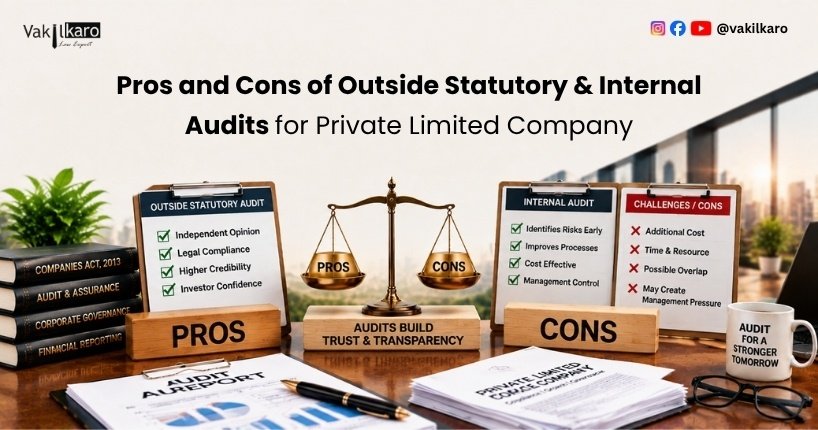
Financial audits beyond statutory requirements are essential for Private Limited Companies (Pvt Ltd) seeking growth, transparency, and investor trust. While the Companies Act mandates annual statutory audits, internal audits and financial health checks vary in frequency based on company size and stage. These audits support risk management, funding readiness, and operational efficiency. Whether quarterly or annually, such reviews help maintain compliance and strategic direction. Vakilkaro, a leading legal-tech platform, aids companies in audit scheduling, corporate governance, and regulatory compliance. Their expert support ensures audit readiness and enhances credibility—especially important during fundraising, board reviews, and business expansion for private companies.
Key Takeaways
- Financial audits beyond statutory requirements are essential for Private Limited Companies (Pvt Ltd) seeking growth, transparency, and investor trust.
- While the Companies Act mandates annual statutory audits, internal audits and financial health checks vary in frequency based on company size and stage.
- The Strategic Importance of Internal Audits for Private Limited Companies Internal audits and financial health checks are vital tools for ensuring the long-term success and stability of a Private Limited Company Registration (Pvt Ltd).
- While statutory audits are mandatory under the Companies Act and occur annually for companies exceeding specific financial thresholds, internal audits are discretionary and can be tailored to a company’s size, structure, and operational needs.
- Conclusion While statutory audits are annual, internal audits and financial health checks vary based on a company’s risk appetite, governance culture, and growth ambitions.
The Strategic Importance of Internal Audits for Private Limited Companies
Internal audits and financial health checks are vital tools for ensuring the long-term success and stability of a Private Limited Company Registration (Pvt Ltd). While statutory audits are mandatory under the Companies Act and occur annually for companies exceeding specific financial thresholds, internal audits are discretionary and can be tailored to a company’s size, structure, and operational needs. These internal assessments play a pivotal role in maintaining financial hygiene, identifying risks, and preparing for critical business milestones.
Unlike statutory audits, which focus on regulatory compliance, internal audits evaluate internal controls, working capital management, taxation, and operational efficiency. Their frequency depends on a company’s growth stage—startups may conduct audits annually or biannually, while mature or venture-backed firms may benefit from quarterly reviews. These checks are especially useful before equity funding, loan applications, or major expansion decisions, enabling better planning and governance.
Boards of Directors and Key Managerial Personnel (KMPs) often initiate these audits based on business needs, ensuring that the company is financially sound and transparent in its dealings. Internal audits are equally crucial for Section 8 companies (non-profits), where compliance with CSR norms, fund utilization, and grant conditions must be meticulously tracked.
Vakilkaro, a trusted legal-tech partner, provides end-to-end support for internal audits and financial management. Their services include audit scheduling, regulatory compliance, corporate governance consultation, and financial documentation. Vakilkaro also helps with company registration, startup advisory, and regular filings like GST and ITR Filing, ensuring businesses remain audit-ready at all times.
Ultimately, while statutory audits are a legal requirement, proactive internal audits serve as a strategic instrument for sustainable growth. By investing in regular financial health checks, Private Limited Companies can enhance investor confidence, mitigate risks, and make informed decisions for future expansion—setting a solid foundation for long-term success.
Financial discipline is one of the cornerstones of any well-governed Private Limited Company (Pvt Ltd). It ensures not only legal compliance but also empowers the business to scale sustainably, make sound strategic decisions, and build credibility with investors and stakeholders. While statutory audits are compulsory for companies that meet certain thresholds under the Companies Act, 2013, many companies choose to go beyond the minimum legal requirement by implementing internal audits and financial health checks tailored to their specific operational needs.
Internal audits and periodic financial reviews help companies proactively identify risks, optimize processes, evaluate internal controls, and monitor cash flows. For a Pvt Ltd company—recognized as a separate legal entity with limited liability and governed by its Memorandum of Association (MOA) and Articles of Association (AOA)—such practices support good corporate governance, accurate reporting, and informed decision-making by the Board of Directors and shareholders.
These internal checks are not one-size-fits-all. Early-stage startups, growing SMEs, large private firms, and even Section 8 companies (not-for-profit entities) all differ in how frequently and deeply they examine their financial health. Factors like capital contribution, equity structure, fundraising plans, debt obligations, and expansion goals influence how often these internal audits are scheduled.
This blog offers a detailed exploration of the frequency, purpose, and strategic importance of financial health checks beyond statutory requirements. It also explains how they connect with broader themes like company registration, board governance, shareholding patterns, director responsibilities, compliance with ROC filings, and readiness for events such as mergers, equity dilution, or IPO planning.
Legal-tech platforms like Vakilkaro play a critical role by offering audit scheduling, compliance tools, and strategic advisory tailored to Private Limited Companies. Whether you're newly incorporated or planning your next growth milestone, understanding the importance of internal audits could be your next best business decision.
Understanding the Framework of a Private Limited Company (Pvt Ltd)
A Private Limited Company (Pvt Ltd) is one of the most popular and preferred forms of business incorporation in India, especially among startups, small businesses, and growing enterprises. Its structured format offers several distinct advantages that make it an ideal choice for entrepreneurs seeking credibility, operational flexibility, and financial protection.
The hallmark benefits of a Private Limited Company include:
- Separate Legal Entity: The company exists independently from its owners. This allows it to own assets, incur liabilities, and enter into contracts in its own name.
- Limited Liability: Shareholders’ personal assets remain protected. Their liability is limited to the unpaid value of their shares.
- Ease of Fundraising: Private limited companies can raise capital through the issuance of equity shares, preference shares, and convertible instruments.
- Regulatory Flexibility: While compliance is mandatory, it is more manageable and adaptable compared to public companies, making Pvt Ltd ideal for growing businesses.
Once company registration is complete, the Registrar of Companies (ROC) issues the Certificate of Incorporation, assigning a Company Identification Number (CIN). The company is then governed by two foundational legal documents—the Articles of Association (AOA) and the Memorandum of Association (MOA)—which define its internal governance and scope of operations.
However, incorporation is just the beginning. Maintaining good corporate governance is crucial for credibility, growth, and compliance with the Companies Act, 2013. This includes regular board meetings, adherence to statutory compliance, annual filings, and conducting internal audits and financial health checks. These practices help monitor capital contributions, equity movement, working capital efficiency, and overall business health.
Vakilkaro, a leading legal-tech platform in India, plays a crucial role in supporting businesses throughout their lifecycle. From Private Limited Company registration, drafting MOA and AOA, obtaining Digital Signature Certificates (DSCs) and Director Identification Numbers (DINs), to setting up audit frameworks and ensuring compliance with ROC filings—Vakilkaro provides end-to-end solutions. Their expertise ensures that businesses not only get started correctly but also stay compliant and investor-ready at every stage of growth.
Statutory Audit vs Internal Audit
- A statutory audit is a legal requirement under the Companies Act, 2013 for companies with certain turnover and capital thresholds.
- An internal audit, on the other hand, is a tool of corporate governance, designed to evaluate internal controls, working capital management, compliance, and financial health.
Statutory Audit Thresholds
According to the Companies Act, internal audits are mandatory for:
- Unlisted companies with paid-up capital of ₹50 crore or more
- Turnover of ₹200 crore or more
- Outstanding loans or borrowings of ₹100 crore or more
However, companies below these thresholds are not exempt from financial accountability. That’s where voluntary internal audits or financial health checks come in.
How Often Are Internal Audits Conducted?
For companies that aren't required to undergo a mandatory internal audit, the frequency is determined internally by the Board of Directors, often upon advice from audit committees, KMPs (Key Managerial Personnel), or SME consultants.
Typical Audit Frequencies:
Company Type Frequency of Internal Audit
Early-stage startups Bi-annually or annually
Growth-stage private companies Quarterly
Large or venture-backed firms Monthly or Bi-monthly
Section 8 Companies (NGOs) Annually or per funding cycle
These internal audits help businesses meet financial reporting goals, pre-empt regulatory penalties, and prepare for fundraising, venture capital rounds, or mergers & acquisitions (M&A).
Scope of Financial Health Checks
Besides internal audits, financial health checks are carried out by CFOs, external advisors, or legal-tech platforms like Vakilkaro to assess:
- Cash Flow Management
- Debt vs Equity Financing
- Corporate Taxation and GST Compliance
- Profitability Ratios
- Capital Contribution Monitoring
- Working Capital Efficiency
These checks often form part of:
- Quarterly Board Meetings
- Annual General Meetings (AGMs)
- Business Valuation exercises
- Exit Strategy planning
- IPO Readiness (for conversion to public companies)
Role of the Board and Shareholders
In a Pvt Ltd company, financial oversight is a key responsibility of the Board of Directors, who pass board resolutions to approve audit schedules, authorize budgets, and monitor shareholding patterns, beneficial ownership, and capital movement.
For private companies, especially where transfer of shares, fundraising, or restructuring is involved, routine financial reporting ensures transparency between shareholders, directors, and external investors.
Key Events When Financial Health Checks Are Recommended
- Before Equity Dilution or Fundraising
- before Loan Applications or Debt Financing
- When Expanding Operations (Business Expansion)
- During Crisis Management
- At the Time of Regulatory Inspections or Tax Assessments
Internal Audits for Section 8 Company Registration
Section 8 companies (not-for-profits) also benefit from regular financial checks—even though their compliance standards differ.
These entities must follow:
- Section 8 Company Registration norms
- CSR accounting rules
- Fund utilization monitoring
- Compliance with grants and foreign contributions
Internal audits here validate transparency, utilization efficiency, and support external funding eligibility.
How Vakilkaro Supports Financial Health Monitoring
As a legal-tech platform, Vakilkaro provides robust financial and compliance solutions:
Vakilkaro’s Services Include:
- Company Registration & Incorporation
- Statutory & Internal Audit Scheduling
- Secretarial Standards Implementation
- Articles of Association & MOA Drafting
- Digital Signature Certificate (DSC) Procurement
- ROC Annual Filing & Corporate Governance Compliance
- Director Identification Number (DIN) Registration
- GST & ITR Filing
- Audit and Assurance Consulting
- Shareholding Agreement Review
Their proprietary Corporate Compliance Software ensures your business stays audit-ready, reducing risk and enhancing investor confidence.
Tools and Techniques Used in Internal Audits
- Audit Trail Software
- Financial Modelling Tools
- ERP Integration
- Cash Flow Projections
- Variance Analysis
- Due Diligence Reporting for M&A
These tools help maintain accuracy, compliance, and strategic insight into business performance.
SME and Startup Scenarios
For startups and SMEs, internal audits aren’t merely about compliance—they’re a foundation for investor due diligence.
Reasons Why Startups Opt for Regular Audits:
- Prepares for private equity rounds
- Improves valuation accuracy
- Helps establish trust with VCs
- Ensures adherence to shareholding agreements
Platforms like Vakilkaro assist in startup registration, documentation of employment contracts, vendor agreements, and setting up sound corporate strategy frameworks.
Common Audit Triggers Beyond Regulation
- Auditor’s Red Flag
- Financial Irregularities
- Shareholder Disputes
- Corporate Litigation
- Regulatory Inspections
- IPR Asset Valuation
Companies that monitor regularly can resolve or prevent these escalations proactively.
Conclusion
While statutory audits are annual, internal audits and financial health checks vary based on a company’s risk appetite, governance culture, and growth ambitions.
Best Practices:
- Conduct at least one internal audit per year for financial hygiene
- Use quarterly checks to track working capital and operating margins
- Engage professionals like Vakilkaro for structured reporting and audit readiness
Ultimately, whether you’re a new entrepreneur or a seasoned corporate entity, incorporating a disciplined financial review schedule outside of mandatory audits is key to resilience and credibility.
Thinking of strengthening your audit practices or registering a Pvt Ltd company?
Connect with Vakilkaro today and gain access to tailored audit, compliance, and registration solutions that empower your growth.
Official External Resources
Use these primary/official sources to verify rules, forms, fees, timelines and regulatory updates before publication.
Frequently asked questions
Pros and Cons of Outside Statutory & Internal Audits for Private Limited Company+
While the Companies Act mandates annual statutory audits, internal audits and financial health checks vary in frequency based on company size and stage. The Strategic Importance of Internal Audits for Private Limited Companies Internal audits and financial health checks are vital tools for ensuring the long-term success and stability of a Private Limited Company Registration (Pvt Ltd).
