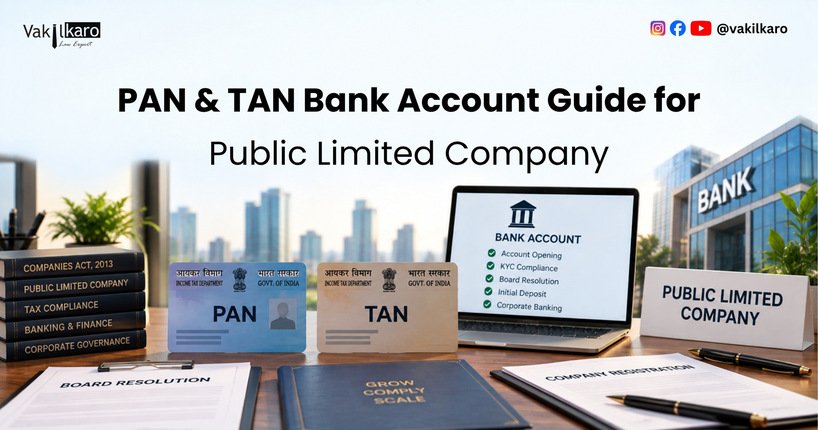
| Particular | Details |
|---|---|
| PAN | Permanent Account Number |
| TAN | Tax Deduction & Collection Account Number |
| Bank Account | Company Current Account |
| Applicable For | Public Limited Company |
| Authority | Income Tax Department & Scheduled Bank |
| Purpose | Taxation & Business Transactions |
What is PAN?
Company incorporation establishes the legal existence of the business.
However, before commercial operations begin, the company should also establish its financial identity through:
- PAN
- TAN (where applicable)
- Company Current Account
These steps generally support taxation, banking and financial administration.
Permanent Account Number (PAN) is the primary tax identification number issued to the company by the Income Tax Department.
A company generally requires PAN for:
- Income Tax Compliance
- Banking
- Financial Transactions
- Business Documentation
- Statutory Registrations
PAN serves as the company's tax identity.
What is TAN?
Tax Deduction and Collection Account Number (TAN) is required for entities responsible for deducting or collecting tax at source.
Where applicable, TAN is generally used for:
- TDS Compliance
- TCS Compliance
- Statutory Tax Reporting
A company that is liable to deduct tax at source should obtain TAN.
Why is a Company Bank Account Important?
A dedicated company current account generally helps:
- Receive Business Payments
- Make Business Payments
- Maintain Financial Records
- Separate Personal & Company Funds
- Improve Financial Transparency
Professional financial management begins with a dedicated business banking system.
PAN, TAN & Bank Account Summary Table
Why Should Personal & Company Funds Be Separate?
Professional companies generally avoid mixing:
- Personal Banking
- Company Banking
Separate banking generally improves:
- Accounting
- Audit
- Compliance
- Financial Governance
Benefits of PAN, TAN & Company Bank Account
Professionally completing these post-incorporation steps generally provides:
- Better Financial Identity
- Tax Compliance
- Banking Convenience
- Corporate Credibility
- Organised Financial Administration
Vakilkaro Insight
Many promoters believe incorporation alone is enough to begin business.
In practice, companies generally become operational only after completing essential post-incorporation formalities such as establishing tax identity and business banking arrangements.
Founder Checklist
Before starting business operations, ensure:
✔ Certificate of Incorporation Received
✔ PAN Available
✔ TAN Obtained (where applicable)
✔ Company Current Account Opened
✔ Directors' KYC Ready
✔ Banking Documents Organised
✔ Accounting System Planned
✔ Financial Policies Prepared
✔ Compliance Calendar Created
✔ Professional Review Completed
PAN, TAN & Banking Journey
Certificate of Incorporation
↓
PAN
↓
TAN (if applicable)
↓
Current Bank Account
↓
Accounting Setup
↓
Business Operations
Why Choose Vakilkaro?
Vakilkaro assists businesses with:
- Public Limited Company Registration
- PAN Assistance
- TAN Assistance
- Company Bank Account Documentation
- Corporate Compliance
- Post-Incorporation Advisory
Our experts help businesses complete their post-incorporation formalities efficiently and establish a strong financial foundation.
PAN, TAN & Company Bank Account Process
After receiving the Certificate of Incorporation (COI), a Public Limited Company should complete its post-incorporation financial formalities before commencing regular business operations.
These generally include:
- PAN
- TAN (where applicable)
- Company Current Bank Account
Completing these formalities helps establish the company's financial and taxation framework.
Step 1 – Obtain the Certificate of Incorporation
The first requirement is the successful incorporation of the company.
After incorporation, the company generally receives:
- Certificate of Incorporation (COI)
- Corporate Identification Number (CIN)
These documents form the basis for various post-incorporation registrations.
Step 2 – PAN for the Company
A Permanent Account Number (PAN) is the company's primary tax identity.
The company generally requires PAN for:
- Income Tax Compliance
- Opening Bank Accounts
- Financial Transactions
- Business Registrations
- Tax Filings
Professional companies should preserve their PAN records securely.
Step 3 – TAN (Where Applicable)
A Tax Deduction and Collection Account Number (TAN) is generally required where the company has obligations relating to tax deduction or collection at source.
Professional companies generally use TAN for:
- Tax Deduction at Source (TDS)
- Tax Collection at Source (TCS)
- Statutory Tax Compliance
Applicants should evaluate whether TAN is applicable to their business activities.
Step 4 – Open a Company Current Account
A Public Limited Company generally opens a dedicated Current Bank Account for business operations.
A company current account generally helps:
- Receive Business Payments
- Make Business Payments
- Maintain Financial Records
- Separate Company & Personal Funds
Professional banking improves financial governance.
Step 5 – Submit Banking Documents
Banks generally request corporate documents before opening a current account.
Professional documentation may generally include:
- Certificate of Incorporation
- PAN
- Board Resolution (where applicable)
- KYC Documents of Authorised Signatories
- Registered Office Proof
- Other documents required by the bank
Individual banks may prescribe additional documentation.
Step 6 – Complete KYC
Banks generally complete Know Your Customer (KYC) verification for the authorised signatories.
Professional KYC generally includes:
- Identity Verification
- Address Verification
- PAN Verification
- Photograph
- Contact Details
Accurate information helps complete the banking process smoothly.
Step 7 – Activate the Company Bank Account
After verification and document review, the bank may activate the company's current account.
The company can then generally:
- Receive Payments
- Make Payments
- Conduct Business Transactions
- Maintain Banking Records
Business transactions should ordinarily be routed through the company account.
Documents Required for PAN
Professional companies generally maintain:
- Certificate of Incorporation
- Corporate Identification Number (CIN)
- Incorporation Records
The applicable documentation requirements should always be verified before submission.
Documents Required for TAN
Where applicable, companies generally maintain:
- PAN
- Certificate of Incorporation
- Supporting Corporate Documents
Additional documentation may depend upon the applicable legal requirements.
Documents Required for Bank Account
Banks generally require:
Company Documents
- Certificate of Incorporation
- PAN
- Constitutional Documents (where applicable)
Authorised Signatory Documents
- PAN
- Identity Proof
- Address Proof
- Photograph
Registered Office Documents
- Address Proof
- Utility Bill (where applicable)
- Other supporting records required by the bank
Document requirements may vary between banks.
Why Use a Separate Company Bank Account?
Professional companies generally avoid using personal bank accounts for business transactions.
Separate banking generally helps:
- Improve Accounting
- Maintain Financial Transparency
- Simplify Audit
- Improve Corporate Governance
- Reduce Record-Keeping Errors
A dedicated current account supports organised financial management.
Common Post-Incorporation Mistakes
Many companies experience avoidable issues because post-incorporation formalities are delayed.
Common mistakes generally include:
- Delaying PAN Application
- Not Obtaining TAN (where applicable)
- Using Personal Bank Accounts
- Poor Banking Documentation
- Weak Financial Planning
- Incomplete KYC
- Missing Board Resolution (where required)
- Poor Record Management
- Delayed Accounting Setup
- Lack of Professional Guidance
Professional planning significantly reduces these risks.
PAN, TAN & Bank Account Checklist
Before commencing business operations, ensure:
✔ Certificate of Incorporation Received
✔ PAN Available
✔ TAN Obtained (where applicable)
✔ Company Current Account Opened
✔ Authorised Signatory KYC Completed
✔ Banking Documents Organised
✔ Accounting System Planned
✔ Financial Policies Prepared
✔ Corporate Records Preserved
✔ Professional Legal & Compliance Review Conducted
Best Practices
Professionally managed Public Limited Companies generally:
- Complete PAN formalities immediately after incorporation.
- Obtain TAN wherever legally applicable.
- Open a dedicated company current account.
- Never mix personal and company funds.
- Maintain organised banking records.
- Preserve all financial documents.
- Complete KYC accurately.
- Implement accounting systems from day one.
- Review banking arrangements periodically.
- Seek professional legal and financial guidance whenever required.
Vakilkaro Expert Insight
Many promoters believe that receiving the Certificate of Incorporation is sufficient to begin business operations.
In reality, a professionally managed company should first establish its financial identity by completing PAN, TAN (where applicable) and banking formalities.
A structured post-incorporation process generally helps:
- Improve Financial Governance
- Strengthen Compliance
- Simplify Accounting
- Build Business Credibility
- Support Long-Term Corporate Growth
Completing these formalities promptly creates a strong financial foundation for the company's future operations.
Benefits of PAN, TAN & Company Bank Account
Obtaining a PAN, TAN (where applicable) and opening a dedicated Company Current Bank Account are among the most important post-incorporation activities for a Public Limited Company.
These registrations do far more than fulfil legal requirements—they establish the company's financial identity and support professional business operations.
A properly established financial framework generally strengthens:
- Tax Compliance
- Corporate Governance
- Financial Transparency
- Banking Operations
- Business Credibility
- Long-Term Growth
Establishes the Company's Financial Identity
One of the biggest benefits of PAN and TAN is that they establish the company's official identity for taxation and regulatory purposes.
Professional businesses generally use PAN for:
- Income Tax Compliance
- Financial Transactions
- Banking
- Government Registrations
- Business Documentation
A properly established tax identity improves operational efficiency.
Better Corporate Credibility
Businesses with organised financial documentation generally inspire greater confidence among:
- Banks
- Investors
- Customers
- Government Authorities
- Business Partners
Professional financial administration strengthens corporate reputation.
Better Banking Operations
Opening a dedicated Current Account allows the company to conduct business professionally.
A company bank account generally helps:
- Receive Business Payments
- Make Vendor Payments
- Manage Business Expenses
- Maintain Transaction Records
Professional banking supports organised financial management.
Separation of Personal & Company Finances
One of the most important principles of corporate governance is maintaining a clear separation between personal and company funds.
A dedicated company account generally helps:
- Improve Accounting
- Simplify Audit
- Strengthen Compliance
- Reduce Financial Errors
Professional businesses avoid mixing personal and business transactions.
Better Financial Transparency
A dedicated banking system generally improves transparency by creating:
- Clear Banking Records
- Organised Transaction History
- Better Financial Reporting
- Stronger Internal Controls
Financial transparency improves public and investor confidence.
Improved Accounting
Professional accounting becomes significantly easier when all company transactions are routed through the company's current account.
This generally improves:
- Bookkeeping
- Bank Reconciliation
- Financial Statements
- Audit Preparation
Organised banking strengthens financial governance.
Better Tax Compliance
PAN and TAN generally support organised tax administration.
Professional businesses generally use them for:
- Income Tax Compliance
- TDS Compliance (where applicable)
- Financial Reporting
- Statutory Documentation
Timely compliance reduces future administrative issues.
Better Business Credibility
Professional financial systems generally improve confidence among:
- Financial Institutions
- Vendors
- Corporate Clients
- Investors
Well-organised financial records support stronger business relationships.
Easier Loan & Banking Facilities
Banks generally evaluate:
- Company PAN
- Banking Records
- Financial Documentation
- Business Transactions
Professional banking improves the company's financial profile.
Better Corporate Governance
Professional financial systems generally strengthen:
- Internal Controls
- Financial Monitoring
- Board Oversight
- Corporate Accountability
Good governance begins with organised financial administration.
Long-Term Financial Stability
Well-planned banking and taxation systems generally support:
- Business Growth
- Financial Planning
- Corporate Expansion
- Operational Continuity
Professional financial systems contribute to sustainable corporate development.
Practical Challenges
Although PAN, TAN and banking formalities appear straightforward, businesses often experience practical challenges.
Common challenges generally include:
- Delayed PAN Processing
- Incomplete Banking Documents
- KYC Issues
- Incorrect Corporate Information
- Weak Accounting Planning
Professional guidance generally helps reduce these issues.
Common Post-Incorporation Mistakes
Many companies experience avoidable financial difficulties because post-incorporation formalities are not completed properly.
Common mistakes generally include:
- Delaying PAN Activation
- Not Obtaining TAN (where applicable)
- Using Personal Bank Accounts
- Delayed Current Account Opening
- Weak Banking Documentation
- Poor Financial Planning
- Missing Accounting Setup
- Inadequate Record Management
- Delayed Compliance
- No Professional Financial Review
Professional planning significantly improves financial governance.
Best Practices
Professionally managed Public Limited Companies generally:
- Complete PAN formalities immediately after incorporation.
- Obtain TAN wherever legally applicable.
- Open a dedicated company current account.
- Keep company and personal finances separate.
- Maintain organised banking records.
- Preserve all financial documents.
- Implement accounting software early.
- Review banking arrangements periodically.
- Strengthen internal financial controls.
- Obtain professional legal and financial guidance whenever required.
Founder Financial Checklist
Before commencing business operations, ensure:
✔ Certificate of Incorporation Received
✔ PAN Available
✔ TAN Obtained (where applicable)
✔ Company Current Account Opened
✔ Banking KYC Completed
✔ Accounting System Implemented
✔ Financial Policies Prepared
✔ Corporate Banking Records Organised
✔ Compliance Calendar Prepared
✔ Professional Legal & Financial Review Conducted
Vakilkaro Expert Insight
Many entrepreneurs believe that company incorporation is complete once the Certificate of Incorporation is issued.
However, the real operational foundation of the business begins only after establishing the company's financial identity.
A professionally managed company generally focuses on:
- PAN
- TAN (where applicable)
- Dedicated Company Bank Account
- Organised Accounting
- Financial Transparency
- Corporate Governance
Businesses that complete these post-incorporation formalities promptly generally experience smoother operations, stronger compliance and better long-term financial management.
Frequently asked questions
What is PAN for a Public Limited Company?+
Permanent Account Number (PAN) is the company's unique tax identification number issued by the Income Tax Department. It is generally required for: • Income Tax Compliance • Banking • Financial Transactions • Statutory Registrations
Why is PAN required after company registration?+
PAN generally helps the company: • File Income Tax Returns • Open a Current Bank Account • Conduct Financial Transactions • Comply with Tax Laws It serves as the company's primary tax identity.
What is TAN?+
Tax Deduction and Collection Account Number (TAN) is a unique number used where a company has obligations relating to deduction or collection of tax at source. It supports statutory tax compliance.
Is TAN mandatory for every company?+
TAN is generally required where the company is liable to deduct or collect tax at source under the applicable provisions of tax law. Companies should evaluate their obligations based on the nature of their activities.
Can Vakilkaro help obtain PAN and TAN?+
Yes. Vakilkaro assists with: • PAN Assistance • TAN Assistance • Public Limited Company Registration • Post-Incorporation Compliance • Corporate Advisory Professional guidance helps simplify the process.
Why should a Public Limited Company open a Current Bank Account?+
A dedicated company current account generally helps: • Receive Business Payments • Make Business Payments • Maintain Financial Records • Separate Personal & Company Funds Professional banking strengthens financial governance.
Can a company use the promoter's personal bank account?+
No. Professional companies generally maintain a separate company current account for all business transactions. Using personal accounts for company transactions is generally discouraged because it affects accounting, audit and corporate governance.
Which documents are generally required to open a company bank account?+
Banks generally require: • Certificate of Incorporation • PAN • Board Resolution (where applicable) • KYC Documents of Authorised Signatories • Registered Office Proof Requirements may vary from one bank to another.
Why is KYC required?+
Banks generally complete Know Your Customer (KYC) verification to establish the identity of authorised signatories before activating the company account.
Can the company start business without opening a bank account?+
Although incorporation creates the legal entity, a dedicated company bank account is generally required for conducting regular business transactions professionally.
Why should company and personal funds remain separate?+
Separate banking generally helps: • Improve Accounting • Strengthen Financial Transparency • Simplify Audit • Improve Corporate Governance Professional businesses avoid mixing personal and company finances.
Can PAN be used for banking?+
Yes. The company's PAN is generally one of the primary documents required while opening a company current account.
Can PAN details be updated?+
Where permitted under the applicable legal framework, changes should be made by following the prescribed procedures of the concerned authority. Professional guidance is recommended before making updates.
Can TAN details be updated?+
Yes. Where applicable, changes relating to TAN should generally follow the prescribed procedures of the Income Tax Department.
Why is a company bank account important for accounting?+
Professional accounting generally becomes easier because all business transactions are recorded through a dedicated company account. This supports: • Bookkeeping • Bank Reconciliation • Financial Statements • Audit
Why should banking records be preserved?+
Professional record management generally helps: • Improve Governance • Support Audit • Maintain Compliance • Improve Financial Reporting Accurate banking records strengthen financial transparency.
Can a company have multiple bank accounts?+
Yes. Subject to business requirements and bank procedures, companies may maintain multiple bank accounts where appropriate. Professional financial management should be maintained for every account.
Why should PAN and TAN information be accurate?+
Correct information generally helps: • Improve Tax Compliance • Reduce Administrative Errors • Improve Government Reporting Accurate records support efficient compliance.
Can Vakilkaro review banking documentation?+
Yes. Vakilkaro assists with reviewing: • Banking Documents • PAN Documentation • TAN Documentation • Corporate Records • Post-Incorporation Documentation Professional review improves documentation quality.
What is the biggest benefit of obtaining PAN, TAN and a company bank account?+
Professional completion of these formalities generally provides: • Financial Identity • Tax Compliance • Banking Readiness • Corporate Credibility • Better Financial Governance
Why should accounting begin immediately after opening the bank account?+
Professional companies generally begin accounting immediately to ensure: • Proper Transaction Recording • Financial Transparency • Better Compliance • Organised Record Management Early accounting improves long-term governance.
Can organised banking improve investor confidence?+
Yes. Professional financial systems generally demonstrate: • Good Governance • Financial Discipline • Corporate Transparency Well-maintained banking records improve business credibility.
Why should promoters complete post-incorporation formalities quickly?+
Early completion generally helps: • Begin Business Operations • Improve Compliance • Reduce Administrative Delays • Establish Financial Systems Prompt action supports smoother business operations.
What are the common post-incorporation mistakes?+
Common mistakes generally include: • Delayed PAN Processing • Not Obtaining TAN (where applicable) • Using Personal Accounts • Weak Banking Documentation • Delayed Accounting Setup • Poor Financial Planning Professional planning significantly reduces these risks.
Can banking systems improve corporate governance?+
Yes. Professional banking generally improves: • Financial Transparency • Internal Controls • Board Oversight • Accountability Strong financial systems support better governance.
Why should companies preserve PAN and TAN records?+
Professional companies generally preserve these records for: • Tax Compliance • Banking • Corporate Documentation • Regulatory Verification Proper record management supports long-term administration.
Can a dedicated company bank account improve business credibility?+
Yes. Banks, investors and business partners generally prefer companies that maintain organised financial systems and dedicated corporate banking.
Why should promoters seek professional post-incorporation guidance?+
Professional guidance generally helps: • Complete PAN & TAN Formalities • Improve Banking Documentation • Strengthen Financial Governance • Reduce Compliance Errors Professional planning supports long-term business success.
How do PAN, TAN and a company bank account support future business growth?+
Together they generally help establish: • Tax Identity • Banking Infrastructure • Financial Transparency • Organised Business Operations These systems provide a strong financial foundation for expansion.
Why choose Vakilkaro for PAN, TAN & Banking assistance?+
Vakilkaro provides complete assistance including: • Public Limited Company Registration • PAN Assistance • TAN Assistance • Company Bank Account Documentation • Post-Incorporation Compliance • Corporate Governance Advisory • Legal Documentation • Long-Term Business Support Our experts help businesses complete post-incorporation formalities efficiently and establish strong financial systems that support sustainable corporate growth. Common Myths "The company can use the director's personal bank account." Incorrect. Professional companies generally maintain a dedicated company current account to ensure proper accounting, governance and financial transparency. "PAN alone is enough for every tax compliance." Incorrect. Where applicable, companies may also require TAN for tax deduction and collection obligations. "A company bank account is only required when business grows." Incorrect. Professional businesses generally establish a dedicated current account immediately after incorporation to support organised financial operations. "Banking documents are useful only during account opening." Incorrect. These records remain important for accounting, audit, compliance and corporate governance throughout the company's lifecycle. "Professional post-incorporation support is unnecessary." Incorrect. Professional guidance generally helps improve documentation quality, banking readiness, tax compliance and long-term financial governance. Related Guides Foundation Guides • Public Limited Company Registration Service Page • DSC Guide • DIN Guide • Documents Required Guide • Share Capital Guide Growth Guides • Benefits Guide • Corporate Governance Guide • Business Expansion Guide Compliance Guides • Annual Compliance Guide • Accounting & Audit Guide Schema Recommendation Implement: • FAQ Schema • Article Schema • Breadcrumb Schema • Organization Schema Developer Notes • Place the PAN, TAN & Bank Account Summary Table within the running main content after the relevant explanatory H2 section. • Apply FAQ Schema to all FAQs. • Highlight the Post-Incorporation Checklist as a visual callout. • Display the PAN, TAN & Banking Journey as a process diagram. • Internally link to the Public Limited Company Registration Service Page, Documents Required Guide, Share Capital Guide, Annual Compliance Guide, Accounting & Audit Guide, and Corporate Governance Guide.
