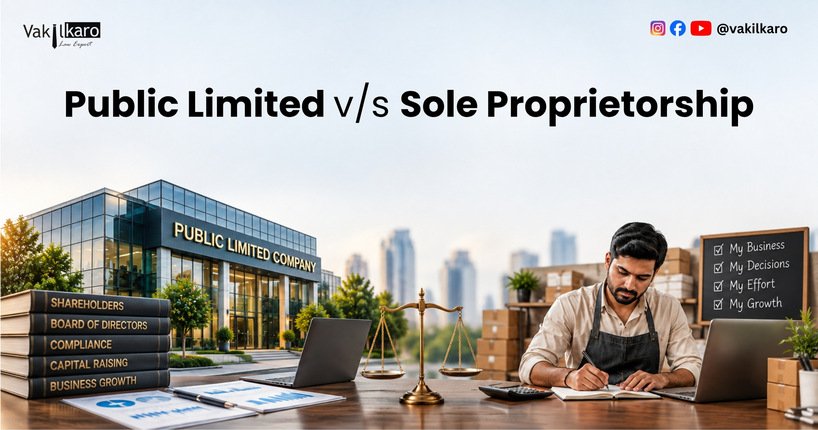
| Particular | Public Limited Company | Sole Proprietorship |
|---|---|---|
| Governing Law | Companies Act, 2013 | No separate incorporation law |
| Legal Status | Separate Legal Entity | No Separate Legal Entity |
| Ownership | Shareholders | Single Owner |
| Management | Board of Directors | Sole Proprietor |
| Liability | Limited | Generally Unlimited |
| Compliance | Higher | Comparatively Lower |
| Governance | Structured | Individual Control |
| Public Fundraising | Possible (subject to law) | Not Applicable |
| Suitable For | Large Businesses | Small Businesses |
Key Differences
Public Limited Company
Generally suitable for:
- Large Enterprises
- Corporate Groups
- Manufacturing Businesses
- Infrastructure Projects
- Institutional Growth
Sole Proprietorship
Generally suitable for:
- Freelancers
- Shop Owners
- Local Traders
- Individual Professionals
- Small Retail Businesses
Comparison Table
Which One Should You Choose?
Choose a Public Limited Company if you need:
- Large Business Operations
- Multiple Shareholders
- Limited Liability
- Corporate Governance
- Future Fundraising
Choose a Sole Proprietorship if you need:
- Single Ownership
- Easy Business Setup
- Simple Operations
- Lower Compliance
- Complete Personal Control
Vakilkaro Recommendation
A Sole Proprietorship is generally suitable for entrepreneurs starting a small business with limited operational complexity.
A Public Limited Company is generally more suitable for businesses planning institutional growth, large-scale operations, stronger governance and future investment opportunities.
The final decision should always be based on business vision, liability considerations and long-term expansion plans.
Public Limited Company vs Sole Proprietorship
A Public Limited Company and a Sole Proprietorship are two fundamentally different business structures.
A Public Limited Company is designed for businesses planning institutional growth, multiple shareholders and structured corporate governance, whereas a Sole Proprietorship is intended for a single individual operating and controlling a business independently.
Choosing the appropriate structure depends upon:
- Business Vision
- Ownership Preference
- Liability Protection
- Compliance Capacity
- Long-Term Growth Plans
1. Governing Law
A Public Limited Company is incorporated under the Companies Act, 2013, whereas a Sole Proprietorship generally operates through the proprietor without incorporation as a separate company.
2. Legal Status
Public Limited Company
A Public Limited Company is a separate legal entity distinct from its shareholders.
Sole Proprietorship
A Sole Proprietorship generally does not have a legal identity separate from its proprietor.
3. Ownership
Public Limited Company
Ownership is divided among shareholders.
Sole Proprietorship
Ownership remains with one individual.
4. Management
Public Limited Company
Managed through:
- Board of Directors
Sole Proprietorship
Managed directly by:
- Sole Proprietor
The proprietor generally controls all business decisions.
5. Liability
Public Limited Company
Shareholders generally enjoy limited liability according to the applicable legal framework.
Sole Proprietorship
The proprietor generally has unlimited liability.
Personal assets may be exposed to business liabilities where applicable.
6. Business Continuity
Public Limited Company
Generally enjoys perpetual succession.
The company generally continues irrespective of changes in ownership or management.
Sole Proprietorship
Business continuity is generally linked to the proprietor.
7. Compliance Requirements
Public Limited Company
Professional companies generally maintain:
- ROC Filings
- Board Meetings
- Annual General Meetings
- Financial Statements
- Statutory Audit
- Corporate Governance
Sole Proprietorship
Generally involves comparatively fewer statutory compliance requirements.
8. Corporate Governance
Public Limited Company
Professional governance generally includes:
- Board of Directors
- Internal Controls
- Corporate Policies
- Shareholder Meetings
Sole Proprietorship
Governance generally depends entirely upon the proprietor.
Formal corporate governance structures are generally absent.
9. Decision-Making
Public Limited Company
Professional decisions generally require:
- Board Approval
- Shareholder Approval (where applicable)
- Corporate Resolutions
Sole Proprietorship
The proprietor generally makes business decisions independently.
Decision-making is generally faster.
10. Fundraising
Public Limited Company
Professional companies generally have a stronger legal framework for raising capital, subject to applicable legal and regulatory provisions.
Sole Proprietorship
Funding generally comes from:
- Personal Investment
- Business Income
- Loans
Public fundraising is not available.
11. Compliance Cost
Public Limited Company
Generally involves:
- Higher Compliance Cost
- Professional Advisory
- Governance Cost
Sole Proprietorship
Generally involves comparatively lower compliance and administrative expenses.
12. Administrative Complexity
Public Limited Company
Administration generally includes:
- Board Governance
- Shareholder Records
- Corporate Documentation
- Regulatory Compliance
Sole Proprietorship
Administration is comparatively simple.
13. Ownership Transfer
Public Limited Company
Ownership through shares may generally be transferred according to the applicable legal framework.
Sole Proprietorship
Ownership generally remains with the proprietor.
Business transfer usually requires separate legal and commercial arrangements.
14. Business Expansion
Public Limited Company
Generally suitable for:
- Large Expansion
- Institutional Growth
- Corporate Scaling
Sole Proprietorship
Generally suitable for:
- Small Business Growth
- Local Expansion
- Individual Entrepreneurship
15. Investor Preference
Public Limited Company
Professional governance generally improves institutional investor confidence.
Sole Proprietorship
External investment opportunities are generally more limited because ownership remains with one individual.
16. Business Credibility
Public Limited Company
Generally enjoys stronger institutional recognition because of:
- Corporate Governance
- Professional Structure
- Financial Transparency
Sole Proprietorship
Generally enjoys credibility among:
- Local Customers
- Small Businesses
- Individual Service Providers
17. Suitable Businesses
Public Limited Company
Generally suitable for:
- Manufacturing
- Infrastructure
- Corporate Groups
- Large Enterprises
Sole Proprietorship
Generally suitable for:
- Retail Shops
- Freelancers
- Small Traders
- Individual Professionals
18. Long-Term Growth
Public Limited Company
Designed for:
- Institutional Growth
- Large-Scale Expansion
- Multiple Investors
Sole Proprietorship
Designed for:
- Individual Business Growth
- Small Business Operations
19. Risk Exposure
Public Limited Company
Professional governance and limited liability generally reduce personal financial exposure.
Sole Proprietorship
Business and personal financial risks are generally closely connected because the proprietor and the business are not legally separate.
20. Best Choice
Choose Public Limited Company if:
✔ Large Business Vision
✔ Multiple Shareholders
✔ Limited Liability Required
✔ Corporate Governance Needed
✔ Institutional Growth Planned
✔ Future Capital Raising Required
Choose Sole Proprietorship if:
✔ Individual Entrepreneur
✔ Small Business
✔ Simple Operations
✔ Lower Compliance Preferred
✔ Complete Personal Control
✔ Local Business Operations
Feature Comparison Table
Common Selection Mistakes
Many entrepreneurs choose the wrong business structure because they focus only on simplicity.
Common mistakes generally include:
- Ignoring Unlimited Liability
- Choosing Sole Proprietorship for a Large Business
- Ignoring Future Expansion Plans
- Weak Capital Planning
- Ignoring Governance Requirements
- Choosing Only on Registration Cost
- Ignoring Investor Requirements
- Weak Risk Assessment
- No Long-Term Business Strategy
- Not Seeking Professional Legal Advice
Professional planning significantly improves business structure selection.
Comparison Checklist
Before selecting either structure, ensure:
✔ Business Vision Clearly Defined
✔ Ownership Preference Identified
✔ Liability Risk Evaluated
✔ Expansion Plans Prepared
✔ Compliance Capacity Assessed
✔ Capital Requirement Evaluated
✔ Long-Term Strategy Finalised
✔ Future Investment Requirement Reviewed
✔ Professional Legal Review Conducted
✔ Appropriate Business Structure Selected
Vakilkaro Expert Insight
Many entrepreneurs compare a Public Limited Company and a Sole Proprietorship only on the basis of ease of starting the business.
In reality, the most important difference lies in liability protection, governance and long-term scalability.
- A Sole Proprietorship generally offers simplicity, complete control and lower compliance for individual entrepreneurs.
- A Public Limited Company generally provides limited liability, structured governance, wider ownership opportunities and stronger long-term growth potential.
Choosing the right structure from the beginning generally helps reduce future restructuring costs, improve governance and create a stronger legal foundation for sustainable business growth.
Long-Term Comparison: Public Limited Company vs Sole Proprietorship
A Public Limited Company and a Sole Proprietorship are designed for completely different business objectives.
A Sole Proprietorship is generally ideal for individuals starting a small business with complete personal control, whereas a Public Limited Company is designed for businesses planning institutional growth, multiple investors and long-term corporate expansion.
Choosing the right structure should always depend upon:
- Business Vision
- Risk Appetite
- Capital Requirement
- Future Expansion
- Governance Requirements
Growth Potential
Public Limited Company
A Public Limited Company is generally designed for:
- Large-Scale Business Operations
- National Expansion
- International Growth
- Institutional Development
Its corporate structure supports long-term scalability.
Sole Proprietorship
A Sole Proprietorship is generally suitable for:
- Individual Entrepreneurs
- Local Businesses
- Small Retail Businesses
- Freelancers
Growth is possible, but businesses planning large-scale expansion often evaluate restructuring into a company structure.
Liability Protection
Public Limited Company
Shareholders generally enjoy limited liability according to the applicable provisions of the Companies Act, 2013.
Personal assets are generally protected from business liabilities beyond the applicable legal limits.
Sole Proprietorship
The proprietor generally has unlimited liability.
Business liabilities may directly affect the proprietor's personal assets where applicable.
Corporate Governance
Public Limited Company
Professional governance generally includes:
- Board of Directors
- Shareholder Meetings
- Internal Controls
- Corporate Policies
- Governance Framework
Structured governance supports institutional business management.
Sole Proprietorship
Business governance generally depends entirely upon the proprietor.
Formal governance systems are generally minimal.
Fundraising Capability
Public Limited Company
Professional governance generally provides a stronger legal framework for raising capital, subject to applicable legal and regulatory requirements.
This structure is generally suitable for businesses planning significant future investment.
Sole Proprietorship
Funding generally comes from:
- Personal Savings
- Business Profits
- Bank Loans
Public fundraising is not available.
Operational Flexibility
Public Limited Company
Professional management generally follows structured governance procedures.
Important decisions may generally require:
- Board Approval
- Shareholder Approval
- Corporate Documentation
Sole Proprietorship
The proprietor generally makes decisions independently.
Decision-making is usually faster because there are no formal governance procedures.
Compliance Burden
Public Limited Company
Professional companies generally maintain:
- Annual Compliance
- Board Meetings
- Annual General Meetings
- Financial Statements
- Statutory Audit
- ROC Filings
Compliance responsibilities are comparatively higher.
Sole Proprietorship
Generally involves comparatively fewer statutory compliance obligations.
This generally reduces administrative burden.
Cost of Operations
Public Limited Company
Professional operations generally involve:
- Compliance Costs
- Governance Costs
- Audit Costs
- Professional Advisory
Operating costs are generally higher.
Sole Proprietorship
Generally involves comparatively lower:
- Compliance Costs
- Administrative Expenses
- Professional Costs
Ownership Structure
Public Limited Company
Ownership is divided among shareholders through shares.
Professional ownership generally supports:
- Wider Investment
- Organised Capital Structure
- Corporate Growth
Sole Proprietorship
Ownership remains entirely with one individual.
Business decisions and ownership remain fully concentrated.
Business Continuity
Public Limited Company
Generally enjoys perpetual succession.
The company generally continues irrespective of changes in shareholders or directors.
Sole Proprietorship
Business continuity is generally dependent upon the proprietor.
Investor Preference
Public Limited Company
Professional governance and financial transparency generally improve investor confidence.
Sole Proprietorship
External investment opportunities are generally more limited because ownership remains with one individual.
Corporate Reputation
Public Limited Company
Generally enjoys stronger institutional recognition because of:
- Corporate Governance
- Professional Management
- Financial Transparency
Sole Proprietorship
Generally enjoys credibility among:
- Local Customers
- Individual Clients
- Small Business Communities
Long-Term Sustainability
Public Limited Company
Generally suitable for:
- Institutional Growth
- Corporate Continuity
- Long-Term Expansion
Sole Proprietorship
Generally suitable for:
- Individual Entrepreneurship
- Small Business Operations
- Local Market Presence
Practical Challenges
Public Limited Company
Common challenges generally include:
- Higher Compliance
- More Documentation
- Structured Governance
- Higher Administrative Costs
Sole Proprietorship
Common challenges generally include:
- Unlimited Liability
- Dependence on a Single Owner
- Limited Capital Resources
- Limited Large-Scale Growth Opportunities
Professional planning generally helps businesses overcome these challenges.
Which Structure is Better?
Choose a Public Limited Company if you plan:
✔ Large Business Operations
✔ Multiple Shareholders
✔ Limited Liability
✔ Strong Corporate Governance
✔ Institutional Growth
✔ Future Capital Raising
Choose a Sole Proprietorship if you plan:
✔ Individual Entrepreneurship
✔ Small Business Operations
✔ Lower Compliance
✔ Complete Business Control
✔ Simple Business Structure
✔ Local Market Operations
Common Selection Mistakes
Many entrepreneurs compare these structures only on the basis of ease of registration.
Common mistakes generally include:
- Ignoring Unlimited Liability
- Choosing Sole Proprietorship Despite Large Growth Plans
- Weak Governance Planning
- Ignoring Future Funding Requirements
- Poor Risk Assessment
- Choosing Only on Registration Cost
- Ignoring Long-Term Expansion
- Weak Financial Planning
- No Business Growth Strategy
- Not Seeking Professional Legal Advice
Professional planning significantly improves business structure selection.
Best Practices
Professionally managed businesses generally:
- Define long-term business goals before incorporation.
- Evaluate liability exposure carefully.
- Plan future funding requirements.
- Review governance requirements.
- Build scalable business systems.
- Maintain organised financial records.
- Review business structure periodically.
- Prepare for future expansion.
- Strengthen financial planning.
- Obtain professional legal and business advisory whenever required.
Founder Decision Checklist
Before choosing between a Public Limited Company and a Sole Proprietorship, ensure:
✔ Business Vision Clearly Defined
✔ Ownership Preference Finalised
✔ Liability Risk Evaluated
✔ Expansion Plans Prepared
✔ Compliance Capacity Reviewed
✔ Capital Requirement Assessed
✔ Long-Term Strategy Prepared
✔ Future Investment Plans Evaluated
✔ Professional Legal Review Conducted
✔ Appropriate Business Structure Selected
Vakilkaro Expert Insight
Many entrepreneurs compare a Public Limited Company and a Sole Proprietorship only on the basis of simplicity.
However, the most important deciding factor is how you want your business to grow over the next 5–10 years.
- A Sole Proprietorship generally provides simplicity, complete ownership and lower compliance for individual entrepreneurs.
- A Public Limited Company generally provides limited liability, structured governance, wider ownership opportunities and stronger long-term scalability.
Selecting the appropriate business structure from the beginning generally helps reduce future restructuring costs, improve governance and create a stronger legal foundation for sustainable business growth.
Frequently asked questions
What is the difference between a Public Limited Company and a Sole Proprietorship?+
A Public Limited Company is a separate legal entity owned by shareholders and managed by a Board of Directors. A Sole Proprietorship is owned and managed by a single individual, and the business generally does not have a legal identity separate from the proprietor.
Which business structure is better?+
Neither structure is universally better. The appropriate choice depends on: • Business Vision • Ownership Preference • Capital Requirement • Risk Appetite • Long-Term Growth Plans
Which structure is suitable for individual entrepreneurs?+
A Sole Proprietorship is generally suitable for: • Freelancers • Retail Shop Owners • Small Traders • Individual Professionals • Local Businesses
Can Vakilkaro help choose the right business structure?+
Yes. Vakilkaro assists with: • Public Limited Company Registration • Business Structure Advisory • Corporate Governance Planning • Compliance Advisory • Legal Documentation • Long-Term Business Planning Professional guidance helps entrepreneurs choose the most suitable business structure.
Is a Public Limited Company a separate legal entity?+
Yes. A Public Limited Company has its own legal identity separate from its shareholders and directors. The company can generally own property, enter into contracts and continue independently of its owners.
Is a Sole Proprietorship a separate legal entity?+
Generally, no. A Sole Proprietorship and its proprietor are generally treated as the same legal person for business purposes.
Which structure provides limited liability?+
A Public Limited Company generally provides limited liability to shareholders under the applicable provisions of the Companies Act, 2013. A Sole Proprietorship generally involves unlimited personal liability.
Which structure has lower compliance?+
A Sole Proprietorship generally has comparatively lower compliance requirements than a Public Limited Company. However, entrepreneurs should also consider future business growth before selecting a structure.
Which structure is easier to manage?+
A Sole Proprietorship is generally easier to manage because: • One Owner • Independent Decision-Making • Comparatively Lower Compliance • Simpler Administration
Which structure has stronger corporate governance?+
A Public Limited Company generally maintains: • Board of Directors • Corporate Policies • Internal Controls • Structured Governance Professional governance generally supports institutional business management.
Which structure is better for fundraising?+
A Public Limited Company generally provides a stronger legal framework for raising capital, subject to applicable legal and regulatory requirements. A Sole Proprietorship generally depends upon: • Personal Investment • Business Profits • Bank Finance
Which structure is better for long-term expansion?+
A Public Limited Company is generally more suitable for: • Large Business Operations • National Expansion • Institutional Growth • Corporate Scaling
Which structure has lower operating costs?+
A Sole Proprietorship generally involves comparatively lower: • Compliance Costs • Administrative Costs • Governance Costs
Which structure has easier decision-making?+
A Sole Proprietorship generally allows faster decision-making because the proprietor independently manages the business.
Can a Sole Proprietorship be converted into a company?+
Yes. Where appropriate, a Sole Proprietorship may be converted into a company by following the applicable legal procedures. Professional legal guidance is recommended before restructuring.
Which structure is better for institutional investors?+
Professional investors generally evaluate: • Corporate Governance • Financial Transparency • Business Structure • Growth Potential A professionally governed Public Limited Company generally provides a framework that may be more suitable for institutional investment.
What is the biggest advantage of a Public Limited Company?+
A Public Limited Company generally provides: • Limited Liability • Structured Governance • Wider Ownership • Better Institutional Growth Opportunities • Strong Corporate Credibility
What is the biggest advantage of a Sole Proprietorship?+
A Sole Proprietorship generally provides: • Complete Business Control • Easy Formation • Lower Compliance • Simple Management • Faster Decision-Making
Which structure is suitable for large businesses?+
A Public Limited Company is generally suitable for businesses planning: • Large Operations • Multiple Investors • Corporate Expansion • Institutional Growth
Which structure is suitable for small businesses?+
A Sole Proprietorship is generally suitable for businesses operated by a single entrepreneur with comparatively simple management requirements.
Can a Sole Proprietorship grow into a large business?+
Yes. A Sole Proprietorship can expand significantly. As the business grows, entrepreneurs may evaluate whether converting to a company structure better supports future ownership, governance and investment needs.
Which structure has stronger business credibility?+
Both structures are legally recognised. However, a professionally managed Public Limited Company generally enjoys stronger institutional recognition because of its governance framework and corporate structure.
What are the common mistakes while choosing between these structures?+
Common mistakes generally include: • Choosing Only on Registration Cost • Ignoring Unlimited Liability • Ignoring Future Expansion • Weak Governance Planning • Poor Financial Planning • Ignoring Future Investment Needs Professional planning generally reduces these risks.
Can Vakilkaro review an existing business structure?+
Yes. Vakilkaro assists with reviewing: • Existing Business Structure • Growth Strategy • Governance Framework • Compliance Position • Corporate Documentation Professional review helps determine whether restructuring may be appropriate.
Which structure is better for risk protection?+
A Public Limited Company generally provides stronger personal liability protection because shareholders' liability is generally limited under the applicable legal framework.
Should liability be considered before selecting a business structure?+
Yes. Entrepreneurs should carefully evaluate: • Business Risk • Personal Asset Protection • Long-Term Liability Exposure • Business Scale before selecting any legal structure.
Why should entrepreneurs seek professional legal guidance?+
Professional guidance generally helps: • Select the Appropriate Structure • Improve Governance Planning • Reduce Registration Errors • Strengthen Compliance • Support Long-Term Business Growth
Can a Sole Proprietorship attract investment?+
A Sole Proprietorship may obtain funding through personal investment, retained earnings or borrowings. Businesses seeking wider ownership or institutional investment often evaluate company structures as they grow.
How should entrepreneurs choose between a Public Limited Company and a Sole Proprietorship?+
Entrepreneurs should evaluate: • Business Vision • Ownership Preference • Liability Risk • Capital Requirement • Compliance Capacity • Long-Term Growth Strategy before making a final decision.
Why choose Vakilkaro for business structure advisory?+
Vakilkaro provides comprehensive assistance including: • Public Limited Company Registration • Business Structure Advisory • Corporate Governance Planning • Legal Documentation • [MCA](https://www.mca.gov.in/) Compliance • Long-Term Business Advisory Our experts help entrepreneurs choose the most appropriate legal structure based on their business objectives, ownership preferences and future expansion plans. Common Myths "A Sole Proprietorship and a Public Limited Company offer the same legal protection." Incorrect. A Public Limited Company generally provides limited liability and a separate legal identity, whereas a Sole Proprietorship generally does not. "Every business should start as a Public Limited Company." Incorrect. The appropriate structure depends on business size, funding requirements, ownership model and long-term goals. "A Sole Proprietorship cannot become a large business." Incorrect. Many successful businesses begin as Sole Proprietorships and later evaluate restructuring as they grow. "Lower compliance always makes a Sole Proprietorship the better option." Incorrect. Entrepreneurs should also evaluate liability exposure, scalability and future investment needs before making a decision. "Professional legal advice is unnecessary." Incorrect. Professional guidance generally helps businesses select the correct structure, avoid future restructuring costs and establish a stronger legal foundation. Related Guides Foundation Guides • Public Limited Company Registration Service Page • Directors & Shareholders Guide • Share Capital Guide • Corporate Governance Guide Growth Guides • Benefits Guide • Business Expansion Guide • Limitations Guide Compliance Guides • Annual Compliance Guide • Board Meeting & AGM Guide • Accounting & Audit Guide Schema Recommendation Implement: • FAQ Schema • Article Schema • Breadcrumb Schema • Organization Schema • Comparison Schema (where supported) Developer Notes • Display the Comparison Table immediately below the Hero section. • Apply FAQ Schema to all FAQs. • Highlight the Business Structure Decision Checklist as a visual callout. • Display the Decision Journey as a comparison flowchart. • Internally link to the Public Limited Company Registration Service Page, Corporate Governance Guide, Annual Compliance Guide, Business Expansion Guide, Share Capital Guide, and Benefits Guide.
