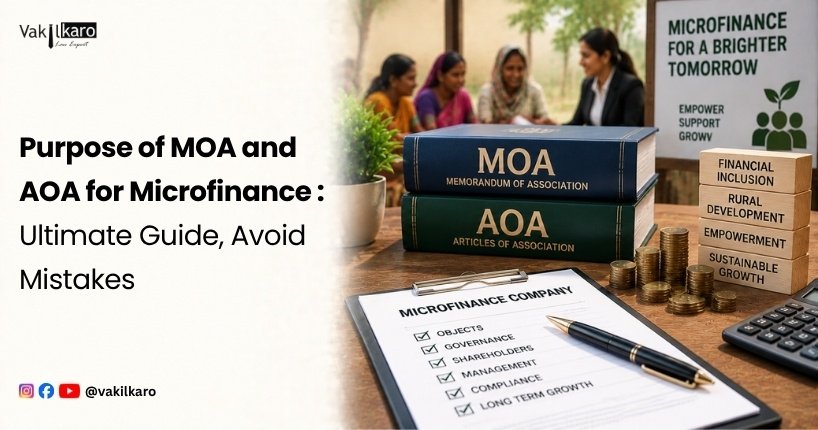
Microfinance institutions (MFIs) play a vital role in delivering credit to underserved communities in India. With growing interest in microfinance company registration, drafting accurate legal documents—especially the MOA (Memorandum of Association) and AOA (Articles of Association)—is critical. These documents define your organization’s purpose, governance, and compliance framework. Whether you're pursuing a Section 8 microfinance company registration or a similar structure, a well-crafted MOA and AOA will streamline approval, support funding efforts, and ensure long-term compliance. This guide explains what must be included in these charters to meet legal, financial, and operational requirements for successful microfinance operations.
Key Takeaways
- Whether you're pursuing a Section 8 microfinance company registration or a similar structure, a well-crafted MOA and AOA will streamline approval, support funding efforts, and ensure long-term compliance.
- With the growing demand for Section 8 microfinance company registration, especially under Section 8, it has become crucial for aspiring microfinance organizations to understand the significance of their founding documents—Memorandum of Association (MOA) and Articles of Association (AOA).
- Whether you're opting for Section 8 microfinance company registration or any other route, the MOA and AOA define your company’s purpose, objectives, structure, and rules of governance.
- Together, the MOA and AOA form the legal and operational backbone of any microfinance company registration process, ensuring the business is set up with a clear mission and a sound structure.
- Costs and Procedures: At a Glance Particular Description Incorporation of Micro Finance Company Through MCA portal (SPICe+ form) MOA/AOA Drafting Should be customized for microfinance objectives Microfinance Company Registration Fees Varies by state, typically between ₹6,000 – ₹12,000 Section 8 Microfinance Company Registration Fees Includes professional fees, stamp duty, MCA filing, etc.
Importance of MOA and AOA in Microfinance Company Registration
Microfinance institutions (MFIs) serve as a lifeline for millions by extending credit and financial services to low-income individuals and underserved communities across India. With the growing demand for Section 8 microfinance company registration, especially under Section 8, it has become crucial for aspiring microfinance organizations to understand the significance of their founding documents—Memorandum of Association (MOA) and Articles of Association (AOA).
These documents form the legal backbone of a microfinance company. The MOA outlines the company’s core purpose and operational boundaries. For those pursuing Section 8 microfinance company registration, it is essential to clearly define the objective of promoting financial inclusion—through micro-lending, credit support, and financial literacy initiatives for economically weaker sections. This declaration not only helps in gaining approval from the Registrar of Companies (RoC) but also assures regulators that the business is aligned with charitable and social welfare principles.
On the other hand, the AOA governs how the organization functions internally. It includes crucial rules about the appointment of directors, decision-making procedures, loan policies, member rights, and the use of surplus funds. For companies focused on financial empowerment, the AOA must explicitly state that no profits will be distributed as dividends and all income will be reinvested in social development activities.
Whether you're going through the micro finance company registration process or seeking funding from government or CSR sources, a well-drafted MOA and AOA ensure legal clarity, compliance, and operational efficiency. They are also indispensable for organizations planning to scale their operations or register with regulators like the RBI.
In conclusion, MOA and AOA are far more than administrative formalities. They are foundational documents that shape the legitimacy, structure, and future potential of your microfinance company, making their careful preparation a top priority in the registration journey.
Microfinance institutions (MFIs) have transformed the financial landscape in India by offering credit access to low-income and underserved communities. The demand for microfinance company registration has increased exponentially as entrepreneurs, NGOs, and social enterprises look to empower rural populations and micro-entrepreneurs through responsible lending.
One of the most crucial steps in the micro finance company registration process is drafting the Memorandum of Association (MOA) and Articles of Association (AOA)—the constitutional documents of your company. Whether you're opting for Section 8 microfinance company registration or any other route, the MOA and AOA define your company’s purpose, objectives, structure, and rules of governance. This blog explores in detail what should be included in the MOA and AOA specifically for microfinance purposes, keeping legal, operational, and compliance aspects in mind.
Understanding the Basics: What Are MOA and AOA in Microfinance Companies?
Before delving into the specifics of drafting these documents for a microfinance institution, it's important to grasp what the Memorandum of Association (MOA) and Articles of Association (AOA) are, and why they hold such a central place in the legal framework of a company.
Memorandum of Association (MOA)
The MOA is often referred to as the charter or constitution of the company. It is a mandatory document required during the micro finance company incorporation process, as it legally defines the foundation on which the company is built. The MOA outlines the main objectives for which the company is formed, along with the scope of its operations. It clearly declares the company’s intention to engage in microfinance activities such as micro-lending, financial inclusion services, promoting rural credit, and uplifting underserved communities.
In the context of a Section 8 microfinance company registration, the MOA also demonstrates the non-profit nature of the organization. It ensures that all income and profits will be used solely to achieve social and financial welfare objectives, not for the distribution of dividends. Regulatory bodies, like the Registrar of Companies (RoC) and the Reserve Bank of India (RBI), examine the MOA closely to ensure the company aligns with permitted activities in the microfinance sector.
Articles of Association (AOA)
The AOA, in contrast, serves as the rulebook for the company’s internal management. While the MOA outlines "what" the company will do, the AOA explains "how" it will be done. It includes detailed procedures regarding:
- Appointment and roles of directors
- Conduct of board and general meetings
- Membership criteria and rights
- Rules for loan disbursement and repayment
- Handling of funds and compliance obligations
For any company going through the micro finance registration process, a well-drafted AOA is essential for establishing transparency, governance, and accountability.
Together, the MOA and AOA form the legal and operational backbone of any microfinance company registration process, ensuring the business is set up with a clear mission and a sound structure.
Why Are MOA and AOA So Important for Microfinance Companies?
For microfinance company registration as a Section 8 company, the MOA and AOA become critical during:
- Approval by the Registrar of Companies (RoC)
- Compliance checks by RBI (if required)
- MFI registration process
- NGO MFI registration
- Partnerships and funding
An accurately framed MOA/AOA ensures clarity, legal compliance, and alignment with your vision as a microfinance service provider.
Types of Microfinance Companies in India
There are primarily two types of entities allowed to operate microfinance services:
- NBFC-MFIs (RBI registered) – Requires high capital and regulatory compliance.
- Section 8 Companies doing Microfinance Business – Popular due to low capital requirement and ease of section 8 microfinance company registration fees.
This blog focuses on section 8 microfinance company registration setup, where the MOA/AOA plays a pivotal role.
What Should Be Included in the MOA for Microfinance Companies?
The MOA for a section 8 microfinance company registration must include the following clauses:
Name Clause
Should end with “Foundation,” “Association,” “Trust,” or “Forum.” Since this is a section 8 micro finance company registration, the name should not include “Limited” or “Private Limited.”
Registered Office Clause
Mention the state in which your company will be registered.
Objects Clause (Most Important for Microfinance)
Clearly define that the primary objective is to provide microloans, financial literacy, and credit facilities to low-income individuals or groups.
Sample language:
"To carry on the business of promoting financial inclusion by extending small loans, micro-credit, self-help group financing, livelihood advancement, and related financial services for social welfare purposes."
Other activities may include:
- Supporting micro-entrepreneurs
- Promoting rural employment
- Encouraging women empowerment through lending
- Offering savings and credit training
This aligns with micro finance company under section 8 objectives.
Liability Clause
State that the liability of members is limited by guarantee, not by shares, as required in section 8 microfinance companies
Capital Clause
Although Section 8 microfinance company registration cost is relatively low, mention the capital structure (authorized capital and member guarantees).
Subscription Clause
Details of initial subscribers and their consent.
What Should Be Included in the AOA for Microfinance Companies?
The AOA outlines the internal governance policies of your microfinance section 8 company.
Key sections to include:
Membership and Admission
Define the eligibility, rights, and responsibilities of members, especially regarding voting rights and financial conduct.
Meetings
Detail procedures for holding:
- Annual General Meetings (AGMs)
- Extraordinary General Meetings (EGMs)
- Quorum requirements
- Voting methods
Board of Directors
- Composition
- Powers
- Appointment and removal
- Frequency of meetings
This is crucial in microfinance company registration process to show governance structure.
Loans and Advances Policy
Specify the types of financial services offered:
- Individual lending
- Group lending
- Interest rates
- Repayment policies
This is a critical section when applying for the micro finance company licence or microfinance registration RBI.
Utilization of Profits
As per Section 8 norms, profits must be reinvested in objectives. AOA must clearly state:
- No dividends will be paid
- Surplus funds are to be used for community development
Audit and Compliance
Detail audit frequency, maintenance of records, and financial disclosures. This is especially important for organizations seeking donor funding or planning to scale.
Dissolution Clause
Define the procedure and usage of remaining assets post-dissolution (must go to another Section 8 company or NGO).
Legal Relevance: Compliance with MCA and RBI
A well-drafted MOA and AOA ensure smooth processing of:
- Microfinance registration
- Section 8 microfinance company registration process
- Microfinance company licence
- Micro finance company registration procedure
They are examined closely during scrutiny by the Ministry of Corporate Affairs (MCA) and Reserve Bank of India (if applying for NBFC-MFI status in the future).
FAQs: MOA/AOA for Microfinance Companies
Can I start a microfinance company without RBI approval?
Yes, under Section 8 micro finance company registration, RBI approval is not initially required if lending is done from members’ contributions or donations, not public deposits.
What is the ideal structure for small-scale microfinance?
A section 8 company microfinance is ideal due to low microfinance company registration fees, minimal capital needs, and legal flexibility.
Do I need professional help to draft the MOA/AOA?
Yes. Since it is a legal document and critical to micro finance registration process, consult experts or legal professionals familiar with microfinance section 8 company registration.
Costs and Procedures: At a Glance
Particular Description
Incorporation of Micro Finance Company Through MCA portal (SPICe+ form)
MOA/AOA Drafting Should be customized for microfinance objectives
Microfinance Company Registration Fees Varies by state, typically between ₹6,000 – ₹12,000
Section 8 Microfinance Company Registration Fees Includes professional fees, stamp duty, MCA filing, etc.
Micro Finance Company Registration Fee Additional cost if adding capital clauses and legal vetting
Timeline Typically 15–25 working days
Benefits of Properly Drafted MOA/AOA
- Ensures smooth micro finance registration
- Satisfies RoC and RBI scrutiny
- Attracts donors and funding institutions
- Legal safeguard in case of disputes
- Builds credibility for partnerships
- Required for CSR grants and international funding
Importance of Language and Clarity
Avoid generic templates. A microfinance company registration process in Hindi version may be required for vernacular filing in some states. Ensure that translations maintain the legal intent of original documents.
Common Mistakes to Avoid
- Vague or overly broad objectives in MOA
- Including dividend clauses (against Section 8 rules)
- Not specifying microfinance activities clearly
- Using “Private Limited Company” or “Ltd.” in name
- Leaving out governance and compliance protocols
Final Thoughts
When it comes to microfinance company registration, your Memorandum of Association (MOA) and Articles of Association (AOA)) are not just formal documents—they are the legal foundation and operational compass of your enterprise. These documents define your organization's objectives, governance mechanisms, compliance boundaries, and its long-term mission in the microfinance space.
A thoughtfully drafted MOA ensures your company’s intent aligns with the broader goals of financial inclusion, rural development, and community empowerment—particularly crucial for those pursuing Section 8 microfinance company registration. Meanwhile, the AOA provides a clear internal framework for how the organization will operate, manage loans, handle member rights, and comply with statutory obligations.
Whether you are a startup seeking to enter the sector or an NGO scaling into micro-lending through a micro finance section 8 company, the clarity and precision of these documents can significantly impact your approval process, credibility with regulators, and access to donor or CSR funding. Poorly drafted or generic documents may lead to delays, rejection, or even legal complications down the line.
This is where Vakilkaro becomes your trusted partner. Vakilkaro specializes in microfinance company registration, offering tailored legal drafting services for MOA and AOA that meet both regulatory compliance and sector-specific objectives. From ensuring your objects clause reflects microfinance activities accurately, to structuring your governance in line with Section 8 norms, Vakilkaro streamlines your entire documentation process.
With Vakilkaro, you’re not just filing paperwork—you’re laying the groundwork for a credible, compliant, and impactful microfinance institution. If you're planning to register or scale a microfinance company, investing in expertly drafted MOA and AOA with Vakilkaro isn’t just wise—it’s essential for your sustainable growth.
Official External Resources
Use these primary/official sources to verify rules, forms, fees, timelines and regulatory updates before publication.
Frequently asked questions
Purpose of MOA and AOA for Microfinance: Ultimate Guide, Avoid Mistakes+
With the growing demand for Section 8 microfinance company registration, especially under Section 8, it has become crucial for aspiring microfinance organizations to understand the significance of their founding documents—Memorandum of Association (MOA) and Articles of Association (AOA). Whether you're opting for Section 8 microfinance company registration or any other route, the MOA and AOA define your company’s purpose, objectives, structure, and rules of governance.
