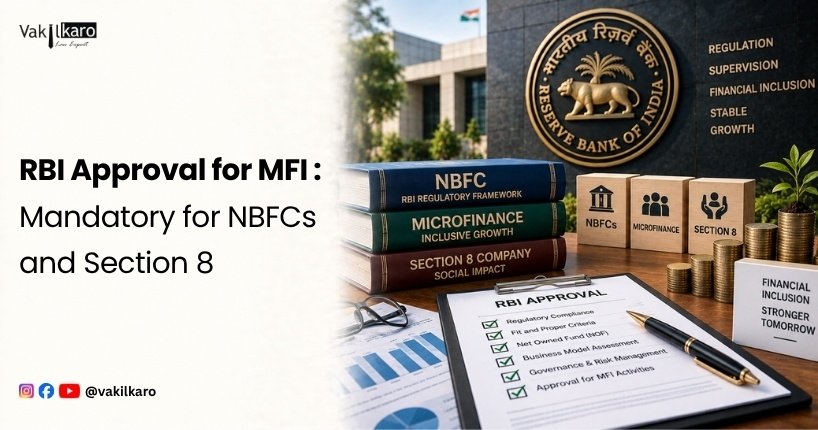
India’s microfinance sector empowers millions with access to credit. For an NBFC-MFI, RBI approval and a microfinance company licence are mandatory before lending begins. However, if you choose a microfinance company under Section 8, you don’t need RBI approval as long as you don’t take public deposits. This guide explains the differences, the registration process, compliance requirements, and key considerations to choose the right model. Whether you’re focused on profit or social impact, understanding these regulations ensures your microfinance journey starts strong and legally compliant.
Key Takeaways
- For an NBFC-MFI, RBI approval and a microfinance company licence are mandatory before lending begins.
- This article will help you understand in detail: When RBI approval is compulsory The microfinance registration process The compliance differences between NBFC-MFI and micro finance Section 8 companies How to navigate the microfinance company registration process Practical guidance in English and Hindi (microfinance company registration process in Hindi) What is an NBFC-MFI?
- The main features include: Charitable purpose (financial inclusion, poverty alleviation) No distribution of profits to members No requirement for RBI approval (unless collecting public deposits) Lower compliance costs In other words, a micro finance Section 8 company can provide micro-loans but must reinvest surplus income into furthering its social mission.
- This is not true. ✅ If you operate as a not-for-profit Section 8 company without deposit-taking, you don’t need RBI approval. ✅ If you are a profit-seeking NBFC, you must comply with RBI licensing.
- Conclusion Whether you choose to launch an NBFC-MFI or a microfinance company under Section 8, having absolute clarity about RBI approval requirements is non-negotiable.
RBI Approval for Microfinance Registration: When It’s Needed and When It’s Not
India’s microfinance sector has reshaped access to credit for low-income communities. However, entrepreneurs frequently wonder whether Reserve Bank of India (RBI) approval is compulsory to start a microfinance venture. The answer depends on the business model you choose.
If you intend to operate as an NBFC-MFI—a Non-Banking Financial Company Registration engaged in microfinance—RBI authorization is absolutely mandatory. You must secure a microfinance company licence before disbursing even a single rupee in loans. To do this, you must first incorporate a private or public limited company under the Companies Act, meet the minimum Net Owned Fund requirement (₹5 crore in most regions, ₹2 crore in the Northeast), and file a detailed application with RBI’s regional office. RBI will then conduct a thorough review of your business plan, governance structure, and promoters’ backgrounds before granting the Certificate of Registration.
Conversely, if you set up a microfinance company as a not-for-profit Section 8 entity, RBI approval is not needed—provided you do not accept public deposits. Section 8 companies are governed by the Companies Act, 2013 and operate exclusively for charitable purposes, such as poverty alleviation and financial inclusion. They reinvest any profits in their mission and cannot distribute dividends.
This flexibility is why many NGOs and impact-focused organizations prefer the Section 8 route. It avoids the heavy capital requirements and stringent oversight applied to NBFCs. Additionally, the section 8 microfinance company registration process under Section 8 is simpler, requires no RBI licence, and aligns well with donor funding and CSR grants.
Before launching, founders must carefully evaluate whether their objectives are philanthropic or profit-driven. Understanding these distinctions ensures compliance and sets a strong foundation for sustainable growth in India’s evolving microfinance landscape.
India’s microfinance landscape has transformed the way millions of underserved individuals access credit and improve their livelihoods. Whether you are considering a profit-oriented microfinance NBFC (Non-Banking Financial Company) or a not-for-profit micro finance Section 8 company, it’s vital to understand the regulatory requirements that apply to your business.
One of the most common questions among entrepreneurs is:
“Is RBI approval mandatory for starting a microfinance company?”
The short answer is:
✅ Yes —if you want to operate as an NBFC-MFI (Microfinance Institution), you must obtain a microfinance company licence from the Reserve Bank of India (RBI).
✅ No —if you are incorporating a microfinance company under Section 8, RBI approval is not required, provided you do not accept public deposits.
This article will help you understand in detail:
- When RBI approval is compulsory
- The microfinance registration process
- The compliance differences between NBFC-MFI and micro finance Section 8 companies
- How to navigate the microfinance company registration process
- Practical guidance in English and Hindi (microfinance company registration process in Hindi)
What is an NBFC-MFI?
NBFC-MFI stands for Non-Banking Financial Company – Microfinance Institution. This is a financial entity registered under the Companies Act, 2013 and regulated by the Reserve Bank of India. An NBFC-MFI:
- Provides micro-loans to low-income individuals
- Operates as a for-profit enterprise
- Must comply with RBI prudential norms
- Requires a microfinance company licence
According to RBI’s Master Directions, an NBFC intending to function as an MFI must:
- Maintain a minimum Net Owned Fund (NOF) of ₹5 crore (or ₹2 crore in Northeastern states)
- Register with RBI
- Obtain a Certificate of Registration
- Ensure that at least 85% of its net assets are in qualifying microfinance loans
When is RBI Approval Mandatory?
If you plan to:
- Lend for profit
- Use external funding sources
- Offer financial products regulated by RBI
- Raise deposits (with restrictions)
you must complete the microfinance registration process RBI requires.
This means that before you can issue even a single loan as an NBFC-MFI, you need:
- Company incorporation
- Capital infusion
- RBI licensing
What is a Section 8 Microfinance Company?
A microfinance company under Section 8 is a not-for-profit entity registered under Section 8 of the Companies Act, 2013. The main features include:
- Charitable purpose (financial inclusion, poverty alleviation)
- No distribution of profits to members
- No requirement for RBI approval (unless collecting public deposits)
- Lower compliance costs
In other words, a micro finance Section 8 company can provide micro-loans but must reinvest surplus income into furthering its social mission.
Why Many NGOs Prefer Section 8 Microfinance Registration
The Section 8 route has gained popularity because:
- It has no minimum capital requirement like NBFC-MFI
- The microfinance company registration process is simpler
- No RBI approval is needed if you don’t accept deposits
- It aligns with philanthropic funding and donor grants
- It projects social credibility
If you are focusing on rural development, women’s empowerment, or financial literacy, microfinance company registration as a Section 8 company can be a strategic choice.
RBI Approval: The NBFC-MFI Licensing Process
Let’s break down the microfinance registration process RBI mandates:
1️. Incorporate a Company
You must first register a Private Limited Company or Public Limited Company under the Companies Act.
2️. Capital Requirements
You need to infuse:
- ₹5 crore NOF (Net Owned Fund) in most states
- ₹2 crore in Northeastern regions
Note: Capital must be equity, not borrowed.
3️. Prepare Application
Key documents include:
- Certificate of Incorporation
- MOA & AOA stating microfinance objectives
- Banker’s Report
- Board Resolution
- Audited financials
- KYC of Directors
4️. Submit to RBI
File your application via the COSMOS portal and send hard copies to the RBI’s regional office.
5️. RBI Due Diligence
The Reserve Bank will:
- Scrutinize your documents
- Verify promoters’ backgrounds
- Check compliance with Master Directions
6️. Certificate of Registration
Upon satisfaction, RBI grants your microfinance company licence. Only after this can you start lending.
Section 8 Microfinance Company Registration Process
If you’re setting up a micro finance Section 8 company, the process is simpler:
1️. Name Reservation
File RUN (Reserve Unique Name) on MCA portal.
2️. Draft MOA & AOA
Ensure your objectives are charitable and mention microfinance as the main activity.
3️. Apply for Section 8 License
File INC-12 along with necessary declarations.
4️. Incorporation Filing
Submit SPICe+ forms for company incorporation.
5️. PAN & TAN Allotment
Receive your tax IDs.
6️. Bank Account Opening
Deposit initial subscription capital (no minimum mandated).
This microfinance company registration process does not require RBI approval unless you plan to take public deposits (which is generally prohibited).
Important Clarification: No RBI Licence for Section 8
It is a common misconception that all microfinance activities need RBI registration. This is not true.
✅ If you operate as a not-for-profit Section 8 company without deposit-taking, you don’t need RBI approval.
✅ If you are a profit-seeking NBFC, you must comply with RBI licensing.
This difference is why many NGOs and grassroots organizations prefer the microfinance company under Section 8 framework.
Documentation Checklist for Section 8 Microfinance Registration
Here’s a checklist to simplify the microfinance company registration as a Section 8 company:
✅ Identity & Address Proof of Directors
✅ DIN (Director Identification Number)
✅ MOA & AOA
✅ Declarations under INC-15 & INC-14
✅ Projected Financial Statements
✅ Consent letters from directors
✅ Application fees to MCA
Benefits of Section 8 Microfinance Companies
1️. No RBI Licence Needed (if no deposits are accepted)
2️. No minimum capital barrier
3️. Eligibility for CSR funding and government grants
4️. Strong credibility in social sectors
5️. Lower compliance burden compared to NBFC-MFIs
Microfinance Registration Process in Hindi
For entrepreneurs searching for microfinance company registration process in Hindi, here’s a simple version:
माइक्रोफाइनेंस कंपनी सेक्शन 8 के अंतर्गत रजिस्ट्रेशन प्रक्रिया:
1️. नाम आरक्षण (RUN फॉर्म द्वारा)
2️. मेमोरेंडम व आर्टिकल्स तैयार करें
3️. सेक्शन 8 लाइसेंस हेतु INC-12 फाइल करें
4️. कंपनी रजिस्ट्रेशन के लिए SPICe+ फॉर्म सबमिट करें
5️. PAN व TAN प्राप्त करें
6️. बैंक खाता खोलें
ध्यान दें: इस प्रक्रिया में RBI की मंजूरी की आवश्यकता नहीं होती, यदि आप सार्वजनिक जमा नहीं ले रहे हैं।
Risks of Non-Compliance
NBFC without RBI Licence = Illegal operation, penalties, and possible imprisonment under RBI Act, 1934.
Section 8 Company taking deposits = Breach of Companies Act, potential winding up, and penalties.
Choosing the Right Model
Before you start the microfinance registration process, ask yourself:
- Is your purpose profit or philanthropy?
- Can you raise ₹5 crore equity capital?
- Will you collect public deposits?
- Who are your target beneficiaries?
If your goal is purely social impact, a micro finance Section 8 company is usually the better choice.
Frequently Asked Questions
Q1: Is RBI approval needed for Section 8 Microfinance Company?
No, if you are not taking deposits. RBI licence is only required for NBFC-MFI.
Q2: Can a Section 8 company make a profit?
Yes, but profits must be reinvested and not distributed as dividends.
Q3: What language resources are available?
Many portals now provide the microfinance registration process in Hindi to help regional entrepreneurs.
Conclusion
Whether you choose to launch an NBFC-MFI or a microfinance company under Section 8, having absolute clarity about RBI approval requirements is non-negotiable. Each route has its own implications: Section 8 companies can effectively drive financial inclusion without the burden of high capital thresholds or complex RBI licensing, while NBFC-MFIs can unlock much larger pools of commercial funding and scale faster—but under far stricter compliance and regulatory oversight.
Getting these decisions wrong can expose you to significant legal, financial, and reputational risks. That’s why it is essential to proceed with meticulous planning. You must assess your mission—whether it is social impact or profit generation—evaluate your readiness to meet capital norms, and build a governance framework that satisfies regulators, investors, and donors alike.
Vakilkaro can help you navigate this process seamlessly. Our team has extensive experience advising on microfinance company registration, whether you are setting up a Section 8 not-for-profit or applying for an NBFC licence with the Reserve Bank of India. We assist you with:
✅ Drafting and reviewing your Memorandum of Association and Articles of Association
✅ Filing all statutory forms with the Ministry of Corporate Affairs and RBI
✅ Preparing robust compliance documentation
✅ Developing internal policies that satisfy prudential norms
✅ Training your directors on their legal obligations
From clarifying whether your model requires RBI approval to handholding you through every step of incorporation and licensing, Vakilkaro offers end-to-end support tailored to your objectives.
If you’re ready to begin your microfinance journey, grow responsibly, and build trust with stakeholders, reach out to Vakilkaro today. We can also help you convert this information into a detailed checklist, an actionable implementation plan, or training material for your board and team.
Official External Resources
Use these primary/official sources to verify rules, forms, fees, timelines and regulatory updates before publication.
Frequently asked questions
RBI Approval for MFI: Mandatory for NBFCs and Section 8+
For an NBFC-MFI, RBI approval and a microfinance company licence are mandatory before lending begins. This article will help you understand in detail: When RBI approval is compulsory The microfinance registration process The compliance differences between NBFC-MFI and micro finance Section 8 companies How to navigate the microfinance company registration process Practical guidance in English and Hindi (microfinance company registration process in Hindi) What is an NBFC-MFI?
