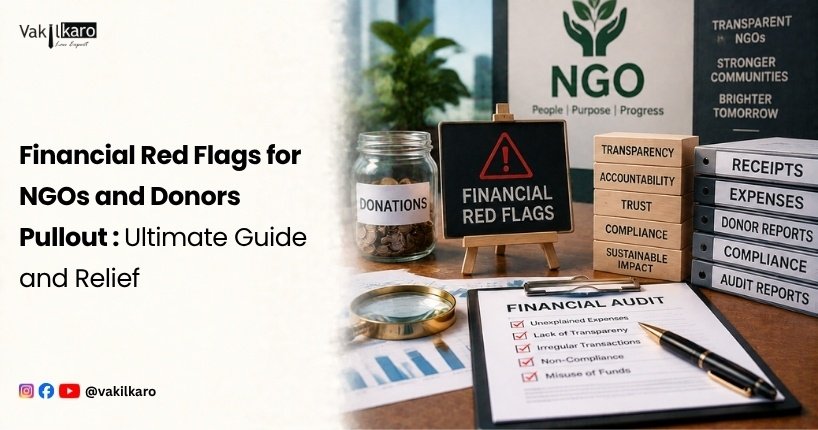
For NGOs, trust is everything—and financial transparency is its backbone. Even a well-intentioned organization can lose donor confidence if its financial reports raise red flags. In this comprehensive blog, we examine key financial missteps that deter donor support, including issues flagged during audits, non-compliance with legal standards, and governance gaps.
From errors in NGO registration to Section 8 company compliance lapses and missing 12A/80G certificates, we explore how these pitfalls harm credibility. We also explain how robust practices—aligned with NGO Darpan, NITI Aayog, MSME registration, and Ministry of Corporate Affairs guidelines—can secure sustainable funding and institutional trust.
Key Takeaways
- Financial Reporting Red Flags That Can Deter Donors from Supporting NGOs In the nonprofit sector, transparency and accountability are the cornerstones of donor trust.
- This blog aims to guide NGOs through the financial red flags that donors look out for and explain how organizations can avoid them.
- Together, these red flags suggest poor financial governance and can disqualify NGOs from critical funding pipelines—no matter how impactful their program outcomes may be.
- Unvetted Related-Party Transactions: A Major Red Flag for Donors One of the most critical areas of concern in NGO financial reporting is related-party transactions.
- Poor Cash Flow Management: A Hidden Red Flag for NGOs One of the most overlooked yet significant red flags in NGO financial reporting is poor cash flow management.
Financial Reporting Red Flags That Can Deter Donors from Supporting NGOs
In the nonprofit sector, transparency and accountability are the cornerstones of donor trust. While many NGOs are founded with noble intentions, they risk losing donor confidence when financial irregularities emerge in their reports. Even a single inconsistency can raise concerns for corporate CSR teams, government bodies, or international funders.
One of the first warning signs is unclear legal identity. NGOs that fail to clarify whether they are registered as a Trust, Society, or Section 8 company Registration under the Ministry of Corporate Affairs often appear unstructured. In particular, Section 8 companies are expected to maintain strict compliance by filing timely annual reports, board resolutions, and audited financials—any deviation signals governance issues.
Another major red flag is incomplete or inconsistent audit reports. Donors look for clear, qualified audits from certified professionals. If reports are unsigned, contain disclaimers, or include unexplained financial adjustments, it reflects poorly on the organization’s financial management. Furthermore, questionable income patterns—such as unusually large, last-minute donations or vague income sources—can hint at manipulation or improper accounting.
Administrative overspending is another issue. When operational costs significantly outweigh program expenses, it raises concerns about efficiency. Similarly, unaccounted-for expenses like excessive travel or consultant fees without documentation can deter funding.
Other critical red flags include related-party transactions lacking transparency, poor cash flow management, and discrepancies between grants received and reported liabilities. NGOs that fail to file required documents under MCA, or whose 12A and 80G registrations have lapsed, risk being disqualified from government grants and donor partnerships.
To avoid these issues, NGOs must prioritize clear audits, timely registrations (including NGO Darpan and MSME), and internal controls. Investing in sound financial systems and transparent practices doesn’t just ensure compliance—it builds the credibility that inspires donor confidence and long-term support.
In the world of nonprofit organizations, trust is the currency that sustains impact. While a compelling mission and field-level results are essential, they are not enough to secure long-term support from donors. Financial integrity—ensuring that all funds are managed transparently, responsibly, and in accordance with regulations—is equally vital. A well-intentioned NGO can lose credibility instantly if its financial records appear irregular, inconsistent, or poorly maintained.
Donors today—whether corporate CSR departments, government grant bodies, or international agencies—rely heavily on financial documents to assess an organization’s trustworthiness. Inconsistent income statements, unverified expenses, or non-compliance with statutory requirements are immediate red flags. Such issues don’t just reduce an NGO’s chances of receiving funding—they also signal deeper issues related to governance and internal control.
This blog aims to guide NGOs through the financial red flags that donors look out for and explain how organizations can avoid them. We will delve into common pitfalls such as poor audit practices, lack of transparent reporting, misuse of funds, and expired legal registrations. At the same time, we’ll explore how legal compliance frameworks—starting with basic NGO registration and extending to Section 8 company registration, 12A and 80G certification, NGO Darpan registration under NITI Aayog, MSME registration for livelihood projects, and regular filings with the Ministry of Corporate Affairs (MCA)—can strengthen donor confidence.
By the end of this guide, nonprofit leaders will understand that compliance is not just about satisfying regulators; it's about building a foundation of credibility, transparency, and sustainability. With strong financial systems in place, NGOs not only improve internal governance but also unlock the trust needed to attract long-term funding and create lasting impact.
Governance Structure Issues: Undermining Donor Confidence
One of the most fundamental red flags in an NGO’s financial reporting is a poorly defined or mismanaged governance structure. Donors, whether they are individuals, corporate CSR teams, or government agencies, expect clarity and professionalism when reviewing an organization’s legal and operational framework. Any ambiguity or negligence in this area raises doubts about the NGO’s accountability, compliance, and long-term sustainability.
a. Unclear Legal Identity
While many NGOs in India are formally registered as either Trusts, Societies, or Section 8 companies, the absence of clear and accessible documentation about their structure can create confusion. If an NGO’s registration certificate, bylaws, or foundational documents are vague or inconsistent, donors may question its legitimacy. This is especially true for international or high-value funders who require certainty about the legal status of their recipients.
Section 8 company registration, governed by the Ministry of Corporate Affairs (MCA), is increasingly favored among donors due to its robust framework. These entities are mandated to uphold high standards of governance, including maintaining a board of directors, conducting regular meetings, and adhering to strict disclosure norms. For donors, this structure signals a level of professionalism and transparency that goes beyond the basic requirements of Trusts or Societies.
b. Missing or Misfiled MCA Reports
For Section 8 companies, compliance doesn’t end with registration. They must file key documents annually, including financial statements (Form AOC-4), annual returns (Form MGT-7), and records of board meetings and resolutions. Failure to submit these documents—or filing them late—can be interpreted as a lack of internal control and weak organizational discipline.
Donors interpret such lapses as risk indicators, suggesting possible mismanagement or even misuse of funds. In competitive funding environments, these shortcomings can be enough to disqualify an NGO from consideration, regardless of the impact it claims to create.
Incomplete or Inconsistent Audit Reports: A Critical Warning Sign for Donors
One of the most telling indicators of an NGO’s financial health and credibility is the quality of its audit reports. While impact stories and outreach numbers can be impressive, donors—especially those involved in CSR initiatives, government grants, or international funding—closely scrutinize audited financial statements to ensure accountability and compliance. Incomplete, inconsistent, or poorly executed audit reports can signal deeper structural problems and quickly erode donor confidence.
a. Lack of Qualified Audits
Audit reports must be issued by certified Chartered Accountants (CAs) who are registered with relevant authorities. A professionally conducted audit includes a detailed assessment of an NGO’s financial practices, controls, and compliance. Donors see unqualified audit reports (those with no adverse opinions or disclaimers) as a mark of financial integrity.
On the other hand, audit reports that lack an auditor’s signature, contain vague conclusions, or include disclaimers are serious red flags. These suggest either that the NGO could not provide complete documentation or that the auditor identified material concerns. In either case, donors may view the organization as financially unreliable.
Furthermore, failure to obtain a valid audit report may impede the renewal or approval of essential registrations like 12A and 80G Registration, which are critical for tax exemption and donor tax deductions. Without these, donor incentives decline sharply, and CSR eligibility can be lost.
b. Unexplained Adjustments or Restatements
Transparency is paramount. If an NGO frequently revises or restates its financials without clear, documented reasons, it raises concerns about financial manipulation or poor bookkeeping. Such inconsistencies suggest that the NGO may be retroactively trying to fix errors—or worse, mask inappropriate financial behavior.
These irregularities not only damage credibility but can also hinder approval processes for NGO Darpan, MSME registration, or grant compliance checks from bodies like NITI Aayog and the Ministry of Corporate Affairs.
Suspicious Income Recognition: A Red Flag in NGO Financial Reporting
Accurate and transparent income recognition is fundamental to earning donor trust and maintaining eligibility for major funding opportunities. When income is recorded in an irregular or suspicious manner, it can raise significant concerns for corporate donors, government agencies, and foreign funders alike. Two common red flags in this category are lumpy donations and soft grant accounting —both of which can severely impact an NGO's reputation and access to funding.
a. Lumpy Donations
“Lumpy donations” refer to large, irregular inflows of funds, particularly those received close to the end of a financial year. While occasional large donations are not unusual, patterns of repeated year-end infusions can be viewed as attempts to manipulate the financial appearance of the organization. Donors may suspect the NGO is trying to inflate its income artificially or accommodate funds from undisclosed sources to meet compliance thresholds or pad its year-end balance.
This behavior undermines transparency and can suggest that the NGO lacks a steady, diversified funding model. For NGOs with 12A and 80G registration, such discrepancies can lead to increased scrutiny from tax authorities. It may also raise compliance concerns during Section 8 company registration reviews by the Ministry of Corporate Affairs.
b. Soft Grant Accounting
Soft grant accounting refers to situations where grant income is not properly matched with the related expenses or deliverables. For example, if an NGO books an entire grant as income upfront but spreads out the related project costs over several years without proper disclosure, it creates a distorted picture of financial health. This lack of alignment can mislead stakeholders and violate basic accounting principles.
Such practices are especially risky for organizations registered with NGO Darpan and seeking funding through NITI Aayog, where financial reporting accuracy is a prerequisite for participation in government-funded schemes. Donors expect income to be recognized consistently and in accordance with the actual flow of work and expenditure.
Together, these red flags suggest poor financial governance and can disqualify NGOs from critical funding pipelines—no matter how impactful their program outcomes may be.
Expense Reporting Red Flags: How Financial Inefficiencies Undermine Donor Trust
Transparent and responsible expense reporting is critical to an NGO's credibility and long-term sustainability. Donors, especially those involved in CSR, government schemes, and international development programs, closely examine how funds are spent. If an organization fails to clearly demonstrate that donor money is being used efficiently and for its intended purpose, it raises immediate concerns. Several expense-related red flags can negatively influence donor decisions:
a. High Administrative Costs
Administrative expenses include salaries for non-program staff, office rent, utilities, legal fees, and management costs. While necessary, these expenses must be balanced. Donors typically expect that at least 70–80% of funds are allocated directly to program delivery. When administrative costs exceed 20% of total expenditures, it signals inefficiency or potential misuse of funds. For NGOs with Section 8 company registration under the Ministry of Corporate Affairs, maintaining this balance is particularly important to meet compliance standards and attract CSR partnerships. A high overhead-to-program cost ratio may also hinder the renewal of 12A and 80G registrations, which rely on financial integrity.
b. Unjustified Travel and Overhead
Travel and overhead costs are another area where mismanagement can quickly erode donor confidence. Excessive or undocumented spending on travel, luxury accommodation, or high consultancy fees—particularly those tied to leadership—raises red flags. Without clear records (like travel logs, per diem policies, or consultant agreements), such expenses appear wasteful. In CSR-funding or government-supported projects, unjustified overhead often leads to audits and funding rejection.
c. Insufficient Program Spend Documentation
NGOs must thoroughly document how funds are used for program activities. Lack of records—such as attendance registers for training, photos of distributed materials, or receipts for infrastructure—calls into question the legitimacy of “program expenses.” This becomes a critical issue when reporting on platforms like NGO Darpan or applying for grants through NITI Aayog. Poor documentation not only affects donor confidence but can also prevent eligibility for future funding rounds.
In summary, clear, accurate, and detailed expense reporting isn’t just best practice—it’s essential. It helps safeguard donor trust, ensures compliance with registration bodies like the MCA, and solidifies the NGO’s credibility across the philanthropic and government sectors.
Unvetted Related-Party Transactions: A Major Red Flag for Donors
One of the most critical areas of concern in NGO financial reporting is related-party transactions. These are financial dealings between the NGO and individuals or entities closely associated with its governance—such as trustees, board members, staff relatives, or organizations in which insiders have an interest. While such transactions aren't inherently wrong, failing to vet, justify, and disclose them properly is a major red flag for donors, particularly those involved in CSR funding, international aid, or government grants.
a. Transactions with Affiliate Individuals
When an NGO makes payments to its own leadership—such as trustees, directors, or their immediate family members—without clear documentation, it raises serious conflict-of-interest concerns. This is particularly problematic if:
- There's no formal contract or service agreement outlining the scope of work
- Compensation appears excessive or misaligned with market rates
- There’s no board-approved resolution justifying the transaction
Donors—especially those reviewing applications through platforms like NGO Darpan or during Section 8 company registration audits by the Ministry of Corporate Affairs (MCA)—may interpret such practices as self-dealing. It suggests the NGO lacks financial discipline and governance integrity. Furthermore, it could jeopardize 12A and 80G registration, since the Income Tax Department requires nonprofits to avoid financial benefits to specified persons under Section 13 of the Income Tax Act.
b. Non-Competitive Procurement
Another common issue is the awarding of contracts or service agreements—like printing, logistics, or training services—to entities that are directly or indirectly linked to the NGO’s leadership, without a competitive procurement process. This includes:
- Absence of a formal tender or bidding process
- No published or board-approved procurement policy
- Lack of price benchmarking or comparative quotes
Such practices compromise fairness and transparency, and most CSR guidelines and government tenders require documented procurement norms. Donors are wary of supporting organizations where procurement seems manipulated or concealed, as it could indicate potential embezzlement or favoritism.
Why It Matters
Strong financial governance includes:
- A published Conflict-of-Interest policy
- Board oversight of related-party contracts
- Transparent procurement procedures
- Disclosure of such transactions in audit reports and MCA filings (for Section 8 companies)
Unvetted related-party transactions not only undermine trust but can also trigger funding rejections, audits, penalties, and even legal scrutiny. For NGOs aiming to build a credible reputation and long-term donor relationships, these practices must be systematically documented, reviewed, and disclosed.
Poor Cash Flow Management: A Hidden Red Flag for NGOs
One of the most overlooked yet significant red flags in NGO financial reporting is poor cash flow management. While most donors and auditors initially focus on income and expenses, how an NGO manages its day-to-day liquidity speaks volumes about its financial discipline and operational health. Donors, CSR teams, and government grant bodies increasingly assess cash flow patterns to determine whether an NGO can sustainably manage funds, especially during large-scale project implementation.
a. Large Cash Balances Without Justification
When an NGO holds substantial amounts of cash—either in hand or in its bank accounts—without a clear rationale or accompanying bank reconciliations, it sends up red flags for the following reasons:
- Risk of misappropriation: Large unutilized or unexplained cash can easily be misused, especially if internal controls are weak or not independently verified.
- Lack of program deployment: High idle cash balances may indicate delays in project execution or under-utilization of grants—undermining the NGO’s credibility with donors who expect timely and purpose-driven fund usage.
- Weak financial planning: If there’s no documented budgetary plan or explanation for holding such reserves, donors begin to doubt the NGO’s ability to manage and forecast its finances.
For NGOs registered as Section 8 companies under the Ministry of Corporate Affairs (MCA), unexplained cash reserves can result in audit qualifications. Moreover, under 12A and 80G registration norms, unexplained income or unutilized grants may attract scrutiny from the Income Tax Department.
b. Overdraft Cycles
Frequent overdrafts or short-term borrowing to cover operational expenses is another warning sign of unstable financial management. When NGOs repeatedly rely on borrowed funds to meet recurring expenses such as salaries, rent, or utilities, it suggests:
- Cash flow planning failures
- Over-commitment to programs without matching income
- No financial cushion for emergencies or grant delays
Such behavior is particularly detrimental when applying for CSR funds or government grants through NGO Darpan or NITI Aayog, where financial self-sufficiency and forecasting are considered essential.
Moreover, if overdrafts are not accompanied by a clear repayment plan, it raises serious concerns about the NGO’s solvency and management capacity. It may also lead to disqualification during donor vetting, especially for large-scale or multi-year grants.
Grants vs. Liabilities Mismatch: A Silent Red Flag in NGO Finances
Accurate financial reporting in NGOs is not just about listing income and expenditure—it's equally about reflecting liabilities and obligations in a truthful, timely manner. A common yet serious red flag that deters donors is a mismatch between grants received and liabilities recorded, particularly when dealing with multi-year funding and deferred expenses. These inconsistencies signal poor accounting practices, potential fund mismanagement, and non-compliance with legal standards—key deterrents for CSR funders, government bodies, and foreign donors.
a. Unspent Multi-Year Grants
When NGOs receive grants intended for use over multiple years, proper financial practice requires that any unutilized portion be shown as a liability or “unspent balance” in the financial statements. This ensures that:
- The donor’s intent is honored, especially when funds are meant for staggered implementation.
- The NGO remains accountable for completing the project over the full grant cycle.
- Financial statements do not overstate the organization’s income or surplus in the current year.
However, many NGOs fail to reflect this liability. Instead, they record the entire grant as income in the year of receipt—even if only a portion has been used. This leads to misrepresentation of financial health, triggering red flags during audits. Donors may perceive this as intentional inflation of income or a lack of financial planning.
For NGOs registered under the Companies Act, 2013 as Section 8 companies, such misreporting violates Ministry of Corporate Affairs (MCA) norms and can result in audit qualifications or denial of renewals for registrations like 12A and 80G.
b. Deferred/Accrued Expenses Missing
On the other side of the mismatch is the failure to account for future or accrued expenses—services rendered or goods delivered, but not yet paid for. Omitting these leads to:
- Underreported liabilities, giving an artificially high surplus or cash reserve
- Distorted financial health, misleading stakeholders and funding agencies
- Audit challenges, as this reflects weak internal financial governance
For example, if an NGO runs a training program in March but pays its trainers in April, the expense must still be recorded in March (the financial year it occurred). Failing to do so inflates the year-end surplus and undermines transparency.
Such gaps are especially problematic when reporting on platforms like NGO Darpan, which is monitored by NITI Aayog. Government evaluators scrutinize NGOs for financial integrity and multi-year grant accountability. Any mismatch could lead to removal from grant eligibility lists or blacklisting.
Strategies for Mitigation
- Conduct professional CA audits annually
- Establish robust internal control frameworks
- Ensure timely MCA and TAN/GST/TDS filings
- Renew tax registrations early
- Institutionalize procurement and travel policies
- Develop transparency channels—dashboards, annual reports, donor portals
- Register on MSME and maintain program cost tracking
- Address audit findings promptly
- Integrate MIS and real-time financial tracking
- Seek legal and compliance support
Role of Vakilkaro
Vakilkaro helps NGOs build:
- Section 8 registration alongside MCA compliance
- 12A/80G credentialing
- NGO Darpan and MSME registration support
- Audit and financial process design
- CSR grant proposal readiness
Conclusion
In today’s increasingly scrutinized funding environment, financial red flags—whether they stem from audit irregularities, governance lapses, inaccurate income reporting, or poor cash management—can seriously hinder an NGO’s ability to attract and retain donors. Both institutional funders and CSR partners demand more than just good intentions; they seek transparency, professionalism, and strict compliance with financial and legal norms.
Failing to meet these expectations by neglecting key legal registrations such as NGO registration, 12A and 80G certification, NGO Darpan enrollment, and Ministry of Corporate Affairs (MCA) compliance for Section 8 companies sends a strong signal of unpreparedness and financial risk. This not only weakens your chances of securing CSR partnerships, government grants, and international funds, but also erodes stakeholder confidence over time.
On the other hand, transparent, timely, and accurate financial reporting—backed by qualified audits and robust internal controls—acts as a powerful enabler. It communicates your organization’s seriousness, governance culture, and operational maturity. With clear books, sound systems, and verified registrations, NGOs not only meet eligibility benchmarks for advanced funding but also build lasting relationships with donors who value accountability.
Strong financial practices also pave the way for strategic growth, whether that means expanding into new regions, bidding for larger tenders, or piloting scalable social enterprise models. In essence, investing in your NGO’s financial integrity isn’t just a checkbox on a compliance list—it is a long-term investment in your mission, your credibility, and your impact.
So, if you're committed to real change, start with financial clarity. Let your numbers tell a story of trust, responsibility, and the power to transform lives.
Official External Resources
Use these primary/official sources to verify rules, forms, fees, timelines and regulatory updates before publication.
Frequently asked questions
Financial Red Flags for NGOs and Donors Pullout: Ultimate Guide and Relief+
Financial Reporting Red Flags That Can Deter Donors from Supporting NGOs In the nonprofit sector, transparency and accountability are the cornerstones of donor trust. This blog aims to guide NGOs through the financial red flags that donors look out for and explain how organizations can avoid them.
