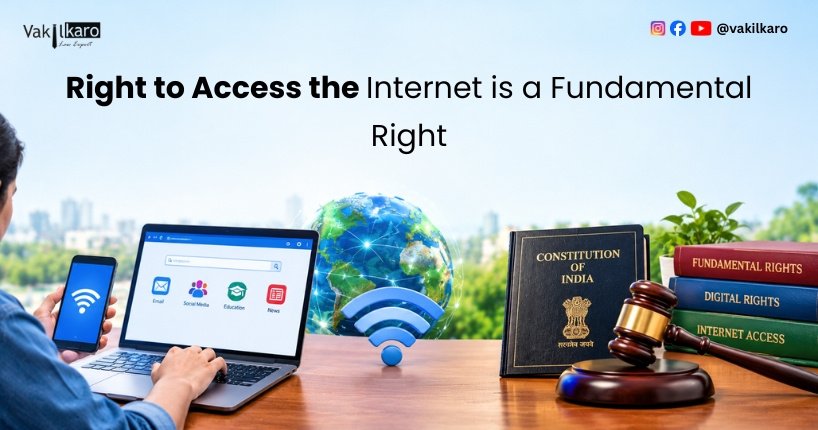
What Is the Right to Access the Internet?
The right to access the internet concerns the ability to connect to and use online communication, information, education and essential digital services. It is not simply about entertainment or social media. Government benefits, examination portals, job applications, banking, business transactions and public debate increasingly depend on connectivity. Excluding people from these facilities can therefore affect several constitutional freedoms at once.
Landmark Supreme Court Update: 15 October 2026
In Just Rights for Children Alliance & Anr. v. S. Harish & Ors. (2026 INSC 1149), paragraph 292 of the Supreme Court order dated 15 October 2026 expressly recognised access to and use of the internet as a fundamental right of every individual under Article 21 read with Article 19(1)(a). Children enjoy this protection irrespective of age. The Court was considering implementation of its earlier 2024 directions concerning online child sexual exploitation and abuse material, not deciding a challenge to a specific internet shutdown.
The litigation concerned online child sexual exploitation and abuse material. Rather than treating children themselves as the problem, the Court favoured measures directed at harmful material, accountable platforms and the people responsible for abuse. It rejected blanket exclusion of children from internet access as a disproportionate response to online risks.
The Court discussed parental guidance, child-mode features, private-by-default accounts and restrictions on unwanted contact. It directed the Union to work on appropriate guidelines, procedures and legal changes for platform safety, reporting and removal of exploitation material. These implementation directions and proposals must not be confused with rules already in force. The matter was listed for 10 December 2026, so later compliance developments should be checked separately.
Constitutional Articles That Protect Internet Access
Article 19(1)(a): Freedom of Speech and Expression
People use online platforms to exchange ideas, access journalism, raise complaints and participate in democratic discussion. Article 19(1)(a) protects expression through digital media. However, Article 19(2) permits reasonable restrictions for constitutionally specified purposes, including public order, security of the State and other listed grounds. Restrictions must be legally justified rather than imposed merely because online discussion is inconvenient.
Article 19(1)(g): Freedom of Trade and Business
Online selling, digital payments, customer communications and other business operations depend on connectivity. Article 19(1)(g) protects legitimate trades and professions conducted through the internet, subject to Article 19(6). A prolonged shutdown can interrupt orders and compliance filings. Businesses exploring Private Limited Company Registration or online operations should plan lawful digital continuity and documentation.
Article 21: Life, Liberty and Dignity
Article 21 protects life and personal liberty and has been interpreted in light of modern realities. Digital exclusion may obstruct health information, identity verification, employment and access to public services. The October 2026 judgment expressly connected the right to access the internet to Article 21, while recognising legitimate, proportionate online safety measures.
Articles 14 and 21A: Equality and Education
Article 14 addresses arbitrary or unequal state action. Article 21A concerns free and compulsory education for children between six and fourteen years. Together with Article 21, these principles are relevant when online-only systems place students, rural communities and people with disabilities at a disadvantage. They do not mean that every student must receive an identical device or connection without regard to policy and law.
How Earlier Supreme Court Decisions Shaped This Right
Anuradha Bhasin v. Union of India (2020)
The Supreme Court protected online speech and online trade in Anuradha Bhasin v. Union of India. It held that indefinite internet suspension was impermissible under the then-applicable 2017 rules, and required proportionate measures, publication of restriction orders and judicial review. Importantly, that bench expressly did not decide whether internet access itself was a standalone fundamental right. The 2026 decision therefore goes further in its formulation.
Pragya Prasun v. Union of India (2025)
In Pragya Prasun v. Union of India (30 April 2025, 2025 INSC 599), the Supreme Court recognised digital access as intrinsic to Article 21. The petitions concerned digital KYC barriers facing persons with disabilities, including people unable to complete conventional facial or visual verification. The Court emphasised reasonable accommodation, inclusive government systems and accessible alternatives. This means that merely putting a service online is insufficient when eligible users cannot use it.
Can the Government Legally Shut Down the Internet?
Yes, temporary restrictions may still be lawful where constitutional and statutory conditions are satisfied. A fundamental right is not necessarily absolute. Authorities must identify a valid legal basis, a legitimate public emergency or public safety objective where required, and a measure proportionate to that objective. A blanket, arbitrary or indefinite restriction is particularly difficult to justify.
The Telecommunications (Temporary Suspension of Services) Rules, 2024 (G.S.R. 724(E), notified on 22 November 2024) replaced the 2017 suspension rules, subject to transitional protection for existing orders. Under Rule 3, a suspension order must be published, record reasons, identify the geographical area and type of service, and specify a duration not exceeding 15 days. Before issuing it, the authority must consider whether the objective can be achieved through another reasonable means.
The competent authority is ordinarily the Union Home Secretary or the State Home Department Secretary. In unavoidable circumstances, a duly authorised officer not below Joint Secretary rank at the Centre may issue an order, subject to confirmation within 24 hours. The order must reach the Review Committee within 24 hours, and the committee must meet within five days to review legality. The 15-day limit is per order, not blanket permission to renew restrictions automatically. Any subsequent order must independently satisfy the law.
Why the Right Does Not Mean Free Internet
The constitutional recognition protects against unlawful exclusion and supports accessible public systems. It does not, by itself, direct telecom operators to provide free broadband, guarantee a handset to every person or prevent reasonable subscription charges. Courts assess the duty of a particular authority against the facts, law and available remedies.
Internet Shutdowns Versus Website Blocking
An internet shutdown affects network connectivity or a class of telecom services across a defined area. Blocking a particular website or online resource involves a different legal mechanism, including Section 69A of the Information Technology Act, 2000 and the applicable blocking rules. Treating those two measures as interchangeable can lead to incorrect legal advice. A challenge must identify which authority acted, which law was invoked and what the order actually restricts.
Does the Fundamental Right Apply to Children?
Yes. The October 2026 order confirms that children share the right to access the internet. The Court did not conclude that every child should use every platform or view every type of content without protection. Instead, safety measures should be carefully targeted and age-appropriate. Protecting children from grooming, exploitation and harmful material remains a legitimate objective.
Digital Accessibility: Why Equal Access Matters
The right to access the internet must be meaningful for people who use screen readers, assisted verification or regional languages. Recognising the right to access the internet is only useful when websites and services can be used by people with different abilities and circumstances. Captcha screens, inaccessible mobile interfaces, language barriers and compulsory video-only identity verification may exclude otherwise eligible users. The 2025 digital KYC decision is particularly relevant to banks, fintech businesses and agencies supplying essential online services.
Practical Impact on Businesses, NGOs and Professionals
For organisations, the right to access the internet also highlights how strongly registrations, tax compliance and public service delivery depend on dependable digital systems. A business may rely on digital connectivity for invoices, GST returns, statutory submissions, staff management and consumer communication. For example, companies seeking GST Registration and Compliance support should preserve filing records, deadlines and evidence of any service disruption. Internet access does not automatically excuse a missed statutory deadline. Relief, if any, depends on the relevant law and official extension or order.
Online brands should also consider Trademark Registration, Website Privacy Policy documentation and consumer communication.
What Can You Do If Internet Access Is Unlawfully Restricted?
First, establish the facts. Record the location, affected telecom services, start and end times and the authority said to have issued the restriction. Preserve screenshots, service-provider notifications, official notices and evidence of concrete harm. Check whether the government has published an order and the grounds for it.
Second, identify the correct legal route. Affected persons may seek clarification or make a representation to the relevant authority. Where appropriate, a lawyer may assess a writ petition under Article 226 before the High Court, including issues of legality, proportionality, territorial scope, duration and procedural compliance. A constitutional case requires more than showing that an internet connection stopped working.
Third, distinguish government-imposed restrictions from an ordinary telecom outage, account suspension, cybercrime incident or private service dispute. Different facts call for different remedies. In suspected online fraud cases, the National Cyber Crime Reporting Portal provides a government reporting route. Reporting a cybercrime does not itself challenge a shutdown order.
Affected by an internet shutdown, account block or online fraud? VakilKaro's advocates can review the order or incident, send a legal notice, help file a cybercrime complaint and advise on a High Court writ petition under Article 226. Call +91 98281 23489 or book a consultation.
Common Misunderstandings About Internet Rights
A fundamental right does not create an unrestricted entitlement to illegal online content. It does not prevent lawful and proportionate steps against abuse or protect criminal conduct. It also does not make every private platform decision a direct constitutional violation. Constitutional claims ordinarily concern State action, although separate statutes may regulate private businesses.
Conclusion
The right to access the internet is a fundamental right in India, and the Supreme Court’s 15 October 2026 decision supplies a clear constitutional statement extending to adults and children. Earlier decisions on online expression, trade and digital accessibility remain important. The practical principle is balance: protect digital freedom and inclusion while permitting safeguards that are lawful, necessary and proportionate. People facing a restriction should examine the actual order, its legal basis and the appropriate remedy rather than assume every interruption is unconstitutional.
Running an online business? Protect your brand and stay compliant with Trademark Registration, a Website Privacy Policy and GST Registration from VakilKaro's in-house CAs, CSs and advocates. Talk to an expert.
Frequently asked questions
Is the right to access the internet a fundamental right in India?+
Yes. The Supreme Court expressly recognised it under Article 21 read with Article 19(1)(a) on 15 October 2026.
Which Supreme Court case recognised this right in 2026?+
Just Rights for Children Alliance & Anr. v. S. Harish & Ors., order dated 15 October 2026, 2026 INSC 1149.
Does the fundamental right apply to children?+
Yes. The Court stated that children, irrespective of age, enjoy constitutional protection for internet access.
Can authorities still impose internet restrictions?+
Yes, subject to applicable law, legitimate purposes, proper procedure and proportionality.
Can an internet shutdown order last longer than 15 days?+
The 2024 rules cap the specified duration of an individual suspension order at 15 days. Any further order must independently satisfy legal requirements.
Must internet suspension orders be published?+
Yes. The 2024 suspension rules require publication and clear reasons in the order.
Is free internet now guaranteed to everyone?+
No. Recognition of a fundamental right is not the same as an automatic entitlement to free connectivity or a particular data plan.
Does the 2026 ruling ban parental controls?+
No. It favours proportionate, age-appropriate protection instead of blanket exclusion of children.
Can students challenge arbitrary denial of digital services?+
Depending on the facts, applicable rights and the responsible authority, legal remedies may be available.
What did Anuradha Bhasin decide?+
It protected online speech and business and imposed safeguards on internet shutdowns, but did not decide a standalone right of internet access.
Why is Pragya Prasun important?+
It linked inclusive digital access and accessible KYC processes to Article 21, especially for persons with disabilities.
Is website blocking identical to an internet shutdown?+
No. They involve different legal powers and must be assessed separately.
Can businesses automatically avoid penalties during a shutdown?+
No. Any filing relief depends on the applicable legislation, official directions and individual circumstances.
Where can someone report online financial fraud?+
The official National Cyber Crime Reporting Portal can be used for reporting cybercrime.
Can a person challenge a shutdown in court?+
A legally affected person may consult counsel about judicial review, including a suitable High Court writ petition.
Can VakilKaro help if my right to access the internet is violated?+
Yes. VakilKaro's advocates review the restriction order or incident, send legal notices, assist with cybercrime complaints and advise on writ petitions. Call +91 98281 23489 or book a consultation online.
Is the right to access the internet absolute?+
No. The right to access the internet can be restricted for lawful purposes such as public order or security, but the restriction must follow proper procedure and be proportionate.