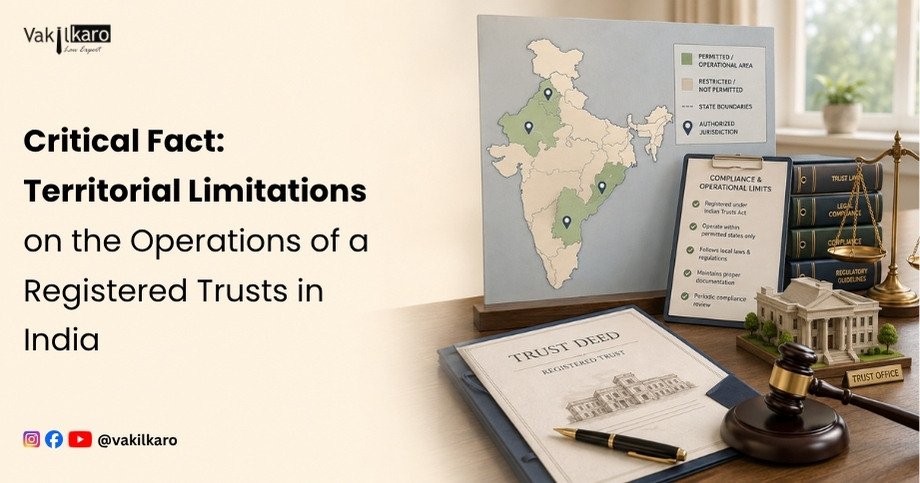
In India, a Trust is a legal tool widely used for charitable or religious purposes. While registered in one state, it can legally operate across state borders, provided its Trust Deed allows such scope and state-specific laws are observed. This blog explores territorial limitations on Trusts, compliance obligations, and how they compare with national-ready structures like Private Limited Companies and Section 8 Companies, which offer broader operational freedom, corporate governance, and funding access. Learn the key differences and why some organizations may prefer structured incorporation for seamless multi-state or nationwide operations.
Key Takeaways
- This blog explores territorial limitations on Trusts, compliance obligations, and how they compare with national-ready structures like Private Limited Companies and Section 8 Companies, which offer broader operational freedom, corporate governance, and funding access.
- The answer is yes—there is no absolute territorial limitation on the operations of a registered Trust.
- These corporate entities, governed by the Companies Act, 2013, are registered with the Registrar of Companies and face no state-based restrictions on operations.
- In India, there is no absolute territorial limitation on the operations of a registered Trust.
- Comparative Table: Trust vs Pvt Ltd vs Section 8 Company Key Compliance Points for Multi-State Operations of a Trust If a Trust registered in one state expands its activities to another, it must: Ensure its Trust Deed permits such operations.
Can a Registered Trust Operate Across States in India?
In India, Trusts are a popular legal structure used to promote charitable, religious, and welfare-based activities. One common question among founders and trustees is whether a Trust, once registered in a particular state, can legally extend its activities to other parts of the country. The answer is yes—there is no absolute territorial limitation on the operations of a registered Trust. However, a few important legal and compliance considerations must be kept in mind.
Trusts in India are governed either by the Indian Trusts Act, 1882 (primarily for private trusts), or by state-specific Public Trust Acts for public charitable trusts. While registration in one state allows the Trust to legally exist and function, expanding into other states may require adherence to local regulations, especially if the state has its own Trust Act. For instance, states like Maharashtra, Gujarat, and Rajasthan have specific laws requiring registration or notification for Trusts operating within their jurisdiction.
Moreover, the scope of the Trust’s operations must be clearly outlined in the Trust Deed. If the Trust Deed includes provisions for national-level activities, the organization can legitimately expand its services or initiatives across multiple states. For tax exemptions under Sections 12A and 80G of the Income Tax Act, or to accept foreign donations under FCRA, the Trust must maintain transparent operations and detailed records.
While Trusts can operate nationally with careful compliance, those seeking nationwide outreach, professional governance, or structured fundraising may find a Private Limited Company or a Section 8 Company more suitable. These corporate entities, governed by the Companies Act, 2013, are registered with the Registrar of Companies and face no state-based restrictions on operations.
Ultimately, the right structure depends on your mission, operational goals, and long-term vision.
India’s legal ecosystem provides multiple frameworks for individuals and organizations to formalize their missions—be it for commercial ventures, charitable causes, religious activities, or social development. Depending on the objective, one can choose from different legal entities such as a Private Limited Company (Pvt Ltd) for profit-making ventures, a Section 8 Company for non-profit initiatives, or a Trust, which has long been a preferred model for philanthropy and community service.
Among these, Trusts are particularly popular for establishing institutions like schools, hospitals, temples, and social welfare programs due to their relatively simple setup process and modest regulatory requirements. A Trust is typically governed by the Indian Trusts Act, 1882 for private trusts, or respective state-specific public trust laws in the case of public charitable trusts.
One of the most frequently asked questions by trustees and founders is whether the scope of a Trust’s operations is confined to the state in which it is registered. This concern becomes especially relevant when the Trust begins to grow and aims to extend its services to beneficiaries across state lines. Does the law impose geographical restrictions? Or can a Trust seamlessly operate nationwide?
This blog addresses these critical questions in detail. We will explore whether any territorial limitations exist for a registered Trust, what legal obligations and compliance measures come into play when expanding operations across states, and how this compares with entities like Private Limited Companies, which have a separate legal entity status, and Section 8 Companies, which are non-profit corporations under the Companies Act, 2013. By the end of this guide, readers will better understand which legal structure best suits their organizational needs, especially for those planning multi-state or national operations.
Understanding a Trust in India
A Trust in India is a legally recognized arrangement wherein one individual or entity, known as the settlor, voluntarily transfers ownership of certain assets—whether movable or immovable—to another person or group of people, known as the trustees. This transfer is made with the expectation that the trustees will manage the property or assets responsibly, not for their own benefit, but for the advantage of a third party or group, referred to as the beneficiaries.
The fundamental purpose of creating a trust is to ensure that the settlor’s vision—whether it is philanthropic, religious, or personal—is carried out in a structured and legally binding manner. To formalize this arrangement, the settlor and trustees execute a legal document called the Trust Deed, which serves as the constitution of the Trust. This deed defines the Trust’s objectives, outlines the powers and duties of the trustees, details the management rules, and identifies the intended beneficiaries.
Trusts in India can be broadly categorized into two types:
- Public Trusts – These are created for the benefit of the general public or a significant section of society. Their primary aim is to serve charitable, educational, medical, religious, or cultural purposes. Public Trusts often qualify for tax exemptions under Sections 12A and 80G Registration of the Income Tax Act and are governed by state-specific public trust laws in several states.
- Private Trusts – These are created for the benefit of specific individuals, such as family members or heirs. Their purpose is often asset protection, estate planning, or ensuring financial security for dependents. Private Trusts are governed by the Indian Trusts Act, 1882.
To attain legal recognition, a Trust must be registered with the local Sub-Registrar’s Office, where the executed Trust Deed is officially recorded.
Can a Trust Operate Outside Its Registered State?
In India, there is no absolute territorial limitation on the operations of a registered Trust. A Trust registered in one state is legally permitted to operate across the country. However, certain practical and compliance-based considerations must be taken into account:
State-Specific Laws
While private trusts are governed by the Indian Trusts Act, public trusts are subject to state-specific laws. If a Trust operates in a state with its own Public Trust Act (like Maharashtra, Gujarat, or Rajasthan), the Trust may need to comply with local requirements or register separately for that jurisdiction.
Objectives in Trust Deed
A Trust can only carry out operations as permitted under the objectives outlined in its Trust Deed. If the objectives are broad and include nationwide work, the Trust can engage in activities across different states.
Regulatory and Tax Compliance
To claim tax exemptions under Sections 12A and 80G of the Income Tax Act, and to receive foreign contributions under FCRA, the Trust must follow specific guidelines. If operating in multiple states, maintaining transparency and state-wise reporting becomes essential.
How Trusts Differ from Private Limited and Section 8 Companies?
Private Limited Company (Pvt Ltd)
- Incorporation: Registered under the Companies Act, 2013.
- Company Identification Number (CIN) issued by the Registrar of Companies (ROC).
- Key Features: Limited liability, separate legal entity, ease of raising funds.
- Governance: Managed by a Board of Directors, each holding a Director Identification Number (DIN).
- Compliance: Must conduct Board Meetings, Annual General Meetings (AGM), and file Financial Statements and Income Tax Returns (ITR).
- Ideal For: Business operations, startups, or any organization looking to issue equity shares, attract private equity, or enter into shareholders’ agreements.
A Pvt Ltd company enjoys seamless national operations and does not face state-specific operational limitations.
Section 8 Company
- Formed under the Companies Act to promote charitable or not-for-profit objectives.
- Requires Section 8 company registration with the ROC and central government approval.
- Operates nationwide without the need for state-specific registrations.
- Eligible for tax exemptions, foreign contributions, and government grants.
- Must comply with strict corporate governance, including Articles of Association (AOA)) and Memorandum of Association (MOA).
Comparative Table: Trust vs Pvt Ltd vs Section 8 Company
Key Compliance Points for Multi-State Operations of a Trust
If a Trust registered in one state expands its activities to another, it must:
- Ensure its Trust Deed permits such operations.
- Maintain proper documentation and financial records per state-specific rules.
- Register with local authorities where mandatory (especially for landholding or running schools, hospitals, etc.).
- Apply for FCRA registration if foreign donations are involved.
- Obtain a new PAN if required for state-level activities or branch offices.
Why Consider Other Structures for Multi-State Operations?
Private Limited Company
If your objectives are commercial, with plans for capital contribution, debt financing, or business expansion, a Pvt Ltd structure is preferable. It offers:
- Ease of doing business
- Better control over shareholding patterns
- Scalability and funding through venture capital, IPO, or M&A
- Clarity in corporate taxation and financial reporting
Section 8 Company
If your objective is social welfare but on a structured, professional scale, Section 8 is ideal. Benefits include:
- Perpetual succession
- Limited liability
- Higher trust among donors and CSR partners
- Access to government schemes, fundraising platforms, and international collaborations
Technology and Corporate Compliance in Modern Governance
Whether operating as a Trust, Pvt Ltd, or Section 8 company, using modern business incorporation services, digital signature certificates (DSC), e-governance tools, and corporate compliance software ensures transparency and efficiency.
These platforms streamline:
- Startup registration
- Annual filing and audit
- Financial statements preparation (Balance Sheet, P&L, Auditor’s Report)
- Board resolutions, vendor agreements, NDAs
- Risk management, IPR registration, and dispute resolution
Conclusion
To conclude, while there is no explicit territorial limitation imposed by law on the operations of a registered Trust in India, its ability to function beyond the state of registration hinges on key factors such as the scope defined in its Trust Deed, and compliance with state-specific regulations. A Trust that is registered in one state can indeed extend its initiatives to other states, provided its foundational document authorizes such activities and it adheres to relevant legal and administrative requirements in each jurisdiction it operates.
However, for organizations planning pan-India operations, engaging in structured fundraising, seeking foreign contributions, or aiming for institutional collaborations, other legal structures might be more appropriate. A Private Limited Company (Pvt Ltd), being a separate legal entity under the Companies Act, 2013, offers nationwide operational freedom, defined shareholding patterns, access to private equity, and the ability to scale with ease. Similarly, a Section 8 Company, though non-profit in nature, provides the advantage of corporate governance, limited liability, and greater credibility among government bodies, CSR partners, and foreign donors.
Choosing the right legal framework—be it a Trust, Pvt Ltd company, or Section 8 company—depends entirely on your organization’s mission, compliance readiness, financial strategy, and long-term vision. What matters most is ensuring that your entity is legally sound, well-structured, and equipped to grow responsibly and transparently.
Engaging with professional service providers or legal advisors can simplify the incorporation process, help with compliance management, and ensure your organization stays aligned with evolving legal requirements. Whether your goal is philanthropy, entrepreneurship, or social transformation, a well-chosen legal structure is the first step toward sustainable impact.
Why Choose Vakilkaro for Trust Registration and Other Legal Services?
When it comes to legal processes like Trust registration, Private Limited Company incorporation, or Section 8 Company registration, accuracy, compliance, and speed are critical. Vakilkaro offers a comprehensive solution tailored to individuals, startups, non-profits, and growing enterprises across India.
Here’s why Vakilkaro stands out as your trusted legal partner:
✅ Expertise Across Legal Entities
Vakilkaro's experienced legal team is well-versed in Indian regulatory frameworks—be it under the Indian Trusts Act, Companies Act, 2013, or various state-specific laws. Whether you're registering a Public Trust, forming a Pvt Ltd company, or applying for Section 8 Company registration, they ensure all statutory requirements are met efficiently.
✅ End-to-End Services
From drafting Trust Deeds, MOA/AOA, Board Resolutions, and Shareholders’ Agreements to obtaining DSCs, DINs, and CINs, Vakilkaro handles everything under one roof. Their all-inclusive packages remove the guesswork from processes like company registration, startup incorporation, and compliance filings.
✅ Affordability and Transparency
Vakilkaro offers fixed, affordable pricing with no hidden fees—ideal for NGOs, SMEs, and startups managing limited budgets. Their cost-effective packages for Private Limited Company registration, Trust formation, and FCRA/80G/12A filings help you stay compliant without financial strain.
✅ Compliance & Governance Support
They provide ongoing assistance for annual filings, ITR, GST registration, board meeting documentation, audit reports, and secretarial standards—ensuring your entity remains legally sound and penalty-free.
✅ Digital-First Approach
Using tech-enabled solutions like corporate compliance software, Vakilkarosimplifies record-keeping, statutory reporting, and regulatory inspections—ideal for today’s digitally driven business environment.
Whether you’re starting a Trust, registering a Pvt Ltd company, or forming a Section 8 entity, Vakilkaro ensures speed, accuracy, and legal peace of mind—so you can focus on your mission while they handle the legal complexity.
Official External Resources
Use these primary/official sources to verify rules, forms, fees, timelines and regulatory updates before publication.
Frequently asked questions
Critical Fact: Territorial Limitations on the Operations of a Registered Trusts in India+
This blog explores territorial limitations on Trusts, compliance obligations, and how they compare with national-ready structures like Private Limited Companies and Section 8 Companies, which offer broader operational freedom, corporate governance, and funding access. The answer is yes—there is no absolute territorial limitation on the operations of a registered Trust.
