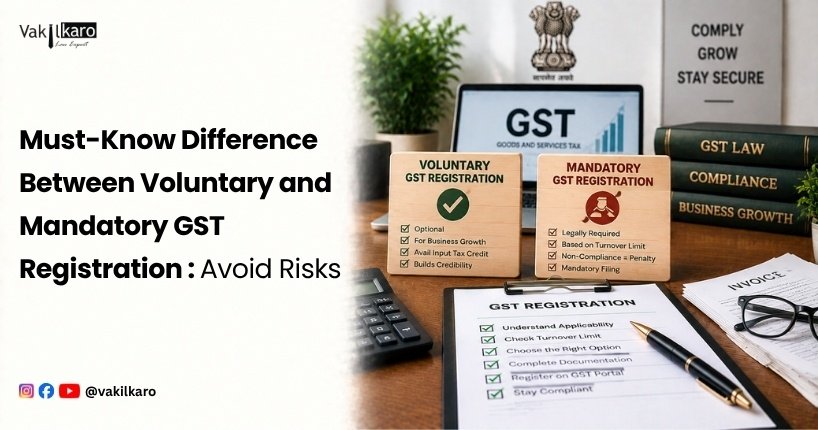
Understanding GST registration is crucial for any business in India. This guide explains the key difference between voluntary and mandatory GST registration. Mandatory registration is required when your turnover exceeds prescribed limits or you meet specific criteria. Voluntary registration, on the other hand, is an option you can choose anytime to enhance credibility and claim input tax credits. Whether you need to register or decide to do it strategically, timely compliance is essential. Vakilkaro makes it simple to apply for GST, get your GSTIN number, and stay compliant. Avoid risks and register GST for your business confidently today.
Key Takeaways
- This guide explains the key difference between voluntary and mandatory GST registration.
- Broadly, GST registration can be either mandatory or voluntary, and knowing the difference is essential for making the right decision for your company.
- One of the most common questions entrepreneurs and business owners ask is: What is the difference between voluntary and mandatory GST registration?
- Unlike mandatory registration, voluntary GST registration is when you choose to register business for GST even though your turnover is below the threshold and you have no legal compulsion.
- Conclusion The main difference between voluntary and mandatory GST registration lies in whether you are legally required to register or choose to do so for strategic benefits.
Voluntary vs. Mandatory GST Registration: What You Need to Know
For any business operating in India, understanding GST registration is critical to staying compliant and building credibility. Broadly, GST registration can be either mandatory or voluntary, and knowing the difference is essential for making the right decision for your company.
Mandatory GST registration applies when your business meets certain legal requirements. If your annual turnover crosses the specified threshold—₹40 lakhs for goods or ₹20 lakhs for services—you must register. The same rule applies if you engage in interstate trade, supply through e-commerce platforms like Amazon, operate under the reverse charge mechanism, or act as an agent for other suppliers. Failing to register when required can lead to penalties, interest charges, and loss of eligibility to claim input tax credits.
In contrast, voluntary GST registration is an option business can choose even if their turnover is below the threshold. Many entrepreneurs decide to register voluntarily to enhance their credibility, appeal to larger clients who prefer working with GST-registered suppliers, and unlock the ability to claim input tax credits on purchases and expenses. Voluntary registration also makes it easier to expand operations in the future without disruption.
However, opting in means you must follow all compliance obligations, including filing regular GST returns—even if there are no sales. Therefore, before you decide to apply, it’s wise to evaluate whether the benefits outweigh the additional compliance workload.
Navigating these requirements doesn’t have to be overwhelming. With support from Vakilkaro, businesses can easily register online, get their GSTIN number, and maintain compliance with confidence. Vakilkaro’s experts guide you through every step—from preparing documents and submitting applications to handling e-way bill registration and ongoing filing. Whether you must register or simply want to, their professional assistance ensures your GST journey is smooth and hassle-free.
In India, the Goods and Services Tax (GST) has become a cornerstone of modern business operations. Whether you manage a small startup, run a fast-growing e-commerce venture, or lead an established enterprise, understanding your GST obligations is no longer optional—it’s essential. GST affects how you bill your customers, claim input tax credits, maintain records, and even how you expand into new markets.
One of the most common questions entrepreneurs and business owners ask is: What is the difference between voluntary and mandatory GST registration? This question matters because choosing the right approach can impact your compliance costs, cash flow, and credibility in the marketplace.
Mandatory GST registration applies when your turnover crosses specific thresholds or when you engage in activities like interstate trade, e-commerce sales, or supply under the reverse charge mechanism. If you fall into these categories, registering is legally required. On the other hand, many businesses with lower turnover choose voluntary GST registration to gain advantages such as claiming input tax credit, building trust with clients, and preparing for future growth.
This guide will walk you through everything you need to know: who must register for GST, who can choose to apply for GST voluntarily, the benefits and challenges of each option, and how to register for GST online quickly and accurately.
Navigating GST can feel complex, but you don’t have to do it alone. Vakilkaro specializes in simplifying GST compliance for businesses of all sizes. Whether you’re unsure about your eligibility, need help preparing your documents, or want expert support to track your application, Vakilkaro’s professionals are here to guide you step by step. With their assistance, you can register confidently, avoid penalties, and focus on growing your business without worrying about compliance hurdles.
What Is GST Registration?
GST registration is the process by which a business obtains a unique identification number known as a GSTIN number (Goods and Services Tax Identification Number). This number must be quoted on all invoices, returns, and communications related to GST compliance.
Whether you are required to register my business for GST depends on the nature and scale of your operations. Once you complete your GST application, you gain access to the GST portal to file returns, pay taxes, and comply with the law.
Businesses that register GST for business receive certain legal rights and responsibilities, such as:
- Collecting GST from customers
- Claiming input tax credit
- Filing periodic returns
- Maintaining GST-compliant records
What Is Mandatory GST Registration?
Mandatory GST registration applies when your business meets specific thresholds or criteria defined under GST law. In other words, you must register for GST number if you fall into any of these categories:
- Turnover Threshold
- If your annual aggregate turnover exceeds ₹40 lakhs (₹20 lakhs in special category states) for goods, or ₹20 lakhs for services, registration becomes mandatory.
- Interstate Supply
- If you supply goods or services across state lines, you must register for GST number online, regardless of turnover.
- E-commerce Operators
- If you sell through e-commerce platforms like Amazon or Flipkart, GST registration is mandatory.
- Reverse Charge Mechanism
- If you are liable to pay tax under reverse charge, you need GST registration.
- Casual Taxable Person and Non-resident Taxable Person
- If you occasionally supply goods or services in a state where you have no fixed place of business, you must apply for GST registration.
- Input Service Distributors
- Companies distributing credit to branches must register.
- Agents of a Supplier
- Agents making taxable supplies on behalf of others also fall under mandatory registration.
In all these cases, failure to register company for GST can lead to penalties, interest, and loss of input tax credit.
What Is Voluntary GST Registration?
Unlike mandatory registration, voluntary GST registration is when you choose to register business for GST even though your turnover is below the threshold and you have no legal compulsion.
For example:
- You run a consulting firm with ₹12 lakhs annual turnover (below the ₹20 lakhs limit).
- You want to supply goods or services to big companies who prefer GST-compliant invoices.
- You wish to claim input tax credit on your purchases.
In such cases, you can apply for GST voluntarily. Once your application is approved and you get your GSTIN number, you must comply with all provisions just like any other registered taxpayer.
Key Differences Between Voluntary and Mandatory GST Registration
Let’s break down the main differences:
Criteria Mandatory GST Registration Voluntary GST Registration
Legal Requirement Compulsory if turnover or conditions are met Completely optional
Threshold Exceeds turnover limit or special criteria Below threshold, no criteria
Benefits Legal compliance, input tax credit Input tax credit, improved credibility
Compliance Mandatory filing, payment of taxes Same compliance obligations
Cancellation Difficult if conditions remain Can request cancellation if conditions permit
Benefits of Voluntary GST Registration
Many businesses choose to register for GST voluntarily because it offers clear advantages:
- Input Tax Credit
You can claim GST paid on your purchases and expenses. This lowers your overall tax liability.
- Credibility with Clients
Large clients prefer dealing with GST-registered vendors. When you get GST number, it builds trust and professionalism.
- Ease of Expansion
If you plan to cross turnover thresholds later, early registration ensures seamless transition.
- Participation in E-commerce
Most platforms require a valid GSTIN.
- Brand Perception
Displaying a GSTIN number on invoices and website enhances brand reputation.
Drawbacks of Voluntary GST Registration
While there are benefits, there are also responsibilities:
- You must file monthly or quarterly GST returns.
- Even if you don’t make sales, you must file NIL returns.
- Non-compliance can lead to penalties.
- Once registered, you can’t collect GST without issuing compliant invoices.
So, before you apply for GST number, weigh these factors carefully.
How to Register for GST
Whether your registration is voluntary or mandatory, the process is the same. Here’s a step-by-step guide:
Collect Necessary Documents
- PAN of the business
- Proof of business address
- Bank account details
- Aadhaar and photo of promoter
- Authorization letter, if applicable
Visit the GST Portal
Head to the official GST portal to register for GST online.
Submit Application
- Fill out Part A of the GST application to receive a Temporary Reference Number (TRN).
- Use the TRN to complete Part B with documents and details.
Verification
- Authorities may verify your application.
- You may receive clarification requests.
Approval and GSTIN Allotment
Once approved, you receive your new GST registration certificate and your unique GSTIN.
E-way Bill Registration
Whenever you transport goods within India that are valued at more than ₹50,000 in a single consignment, it is mandatory to generate an e-way bill. This requirement applies whether you are moving goods between states or within the same state.
The e-way bill is an electronic document created on the GST portal to track the movement of goods in real time. It contains critical details, including the consignor and consignee’s GSTIN numbers, the invoice number and date, the value of the goods, the place of dispatch and delivery, and details of the transporter or vehicle.
Generating an e-way bill serves multiple purposes. First, it ensures you remain compliant with GST regulations, reducing the risk of penalties during inspections or road checks. Second, it increases transparency by providing authorities with a digital trail of your shipments. Third, it helps streamline logistics by enabling transporters and recipients to verify information quickly.
To create an e-way bill, you must log in to the government’s e-way bill portal using your GST credentials. Once you fill in the necessary information and submit the form, a unique 12-digit e-way bill number is generated. You must carry a copy of this document—either printed or electronically—during transport.
Failing to produce a valid e-way bill when asked by an inspector can result in the detention or seizure of your goods and hefty fines. That’s why generating e-way bills accurately and on time is critical for any GST-registered business moving high-value consignments.
If you are new to GST or unsure how to complete your e-way bill registration, Vakilkaro can assist you end to end. Their experts help you prepare documentation, generate e-way bills without errors, and maintain smooth, compliant transport of goods across India.
When Should You Apply for GST?
- Mandatory registration: As soon as you cross the turnover threshold or meet any other condition.
- Voluntary registration: Any time you decide it benefits your business.
Can You Cancel GST Registration?
Yes. If you voluntarily registered but no longer want to remain under GST, you can apply for cancellation. However, you must clear any dues and file final returns.
Common Mistakes to Avoid
- Waiting too long to apply for GST once you exceed turnover limits.
- Not issuing proper invoices after you get GST number.
- Missing return filing deadlines.
- Not updating your business details.
Why You Should Consider Vakilkaro for GST Registration
Navigating GST law can be confusing. Whether you’re trying to decide if you must register company for GST or want to apply for GST registration voluntarily, expert guidance saves time and reduces risk.
Vakilkaro helps businesses at every step:
- Advising whether you need mandatory or voluntary GST registration
- Preparing and filing your GST application
- Assisting with e way bill registration
- Helping you register for GST number online
- Providing ongoing compliance support
With Vakilkaro, you get a dedicated GST consultant who will handle the paperwork and track your application progress until you receive your GSTIN number.
The Role of GST in Business Growth
GST compliance is more than a legal formality—it’s a gateway to credibility and growth. Clients, suppliers, and investors increasingly prefer GST-registered businesses because they demonstrate professionalism and transparency.
By taking the initiative to register my business for GST, you:
- Open doors to large contracts
- Simplify interstate trade
- Ensure eligibility for government tenders and funding
FAQs on GST Registration
Q: Is it better to register voluntarily before reaching the turnover limit?
A: It depends. If you plan to claim input tax credit or serve GST-registered clients, voluntary registration is beneficial.
Q: Can I get input tax credit if I register voluntarily?
A: Yes, once you register for GST number, you are entitled to input tax credit on eligible purchases.
Q: How long does it take to get my GST number?
A: Typically 3–7 working days if all documents are in order.
Q: Do I need separate registration for each state?
A: Yes, if you operate branches in multiple states, you must register GST for business separately in each state.
Conclusion
The main difference between voluntary and mandatory GST registration lies in whether you are legally required to register or choose to do so for strategic benefits. Mandatory registration becomes unavoidable once your annual turnover exceeds the prescribed threshold or you meet other criteria such as supplying goods across state borders, selling through e-commerce platforms, or operating under the reverse charge mechanism. If any of these conditions apply, you must register without delay to avoid penalties and ensure compliance.
On the other hand, voluntary GST registration is a proactive decision many businesses make even when they are below the turnover limit. By registering voluntarily, you position your business as credible and trustworthy in the eyes of clients, partners, and suppliers. It also allows you to claim input tax credits on your purchases and expenses, making your pricing more competitive. For growing startups and service providers, this can be a smart step toward long-term expansion and smooth operations.
Regardless of whether you are registering out of obligation or choice, obtaining your GSTIN is an important milestone in your business journey. With the option to apply for GST online, the process has become much more accessible and streamlined than ever before. However, the rules, deadlines, and documentation requirements can still feel overwhelming, especially if you are new to GST or managing multiple registrations.
That’s why partnering with experienced professionals like Vakilkaro can make all the difference. Vakilkaro’s team of experts ensures your GST application is complete, accurate, and filed promptly. From conducting an initial GST name search to guiding you through the application, generating e-way bills, and staying compliant with filing deadlines, Vakilkaro provides comprehensive support at every step.
If you’re ready to secure your GSTIN and build a compliant, professional business, connect with Vakilkaro today. They will help you register your company for GST confidently, so you can focus on growing your business without the stress of compliance challenges.
Official External Resources
Use these primary/official sources to verify rules, forms, fees, timelines and regulatory updates before publication.
Frequently asked questions
Must-Know Difference Between Voluntary and Mandatory GST Registration: Avoid Risks+
This guide explains the key difference between voluntary and mandatory GST registration. One of the most common questions entrepreneurs and business owners ask is: What is the difference between voluntary and mandatory GST registration?
