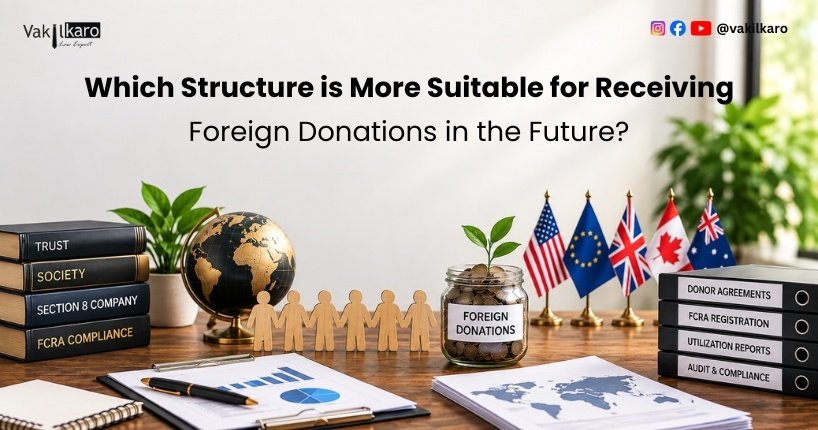
When setting up an NGO in India, choosing the right legal structure is vital for attracting foreign donations. Trusts, Societies, and Section 8 Companies each have distinct advantages. Trusts are simple but face challenges in governance and transparency. Societies offer democratic governance but can face state-specific regulatory hurdles. Section 8 Companies, with their formal structure and compliance, are most preferred by international donors. They offer better accountability and easier FCRA registration, making them ideal for NGOs seeking foreign contributions. Understanding registration requirements, including FCRA, 12A, and 80G, will help ensure smooth international fundraising efforts.
Key Takeaways
- Choosing the Right Legal Structure for Receiving Foreign Donations in India When establishing a non-profit organization (NGO) in India, selecting the appropriate legal structure is a critical decision, especially if you plan to receive foreign donations in the future.
- In conclusion, if your NGO aims to receive foreign donations, the Section 8 Company structure is the most suitable due to its strong governance, transparency, and ease of compliance.
- This blog will delve into the specifics of the three primary NGO structures—Trusts, Societies, and Section 8 Companies—and analyze which one is most suitable for receiving foreign donations.
- 5.4 Challenges for Section 8 Companies in Receiving Foreign Donations More Formalities and Compliance: While the structure and governance of a Section 8 company make it easier to receive foreign donations, it also requires more formalities and ongoing compliance.
- If you are planning to receive foreign donations in the future, the Section 8 Company is the most suitable structure.
Choosing the Right Legal Structure for Receiving Foreign Donations in India
When establishing a non-profit organization (NGO) in India, selecting the appropriate legal structure is a critical decision, especially if you plan to receive foreign donations in the future. In India, NGOs can be registered under three main legal frameworks: Trusts, Societies, and Section 8 Companies. Each of these structures has its unique characteristics and governance frameworks, which play a vital role in determining their eligibility to receive foreign funds.
Trusts, although simpler to set up, often face difficulties when it comes to transparency and governance. Since Trusts are managed by a small group of trustees, foreign donors may be hesitant to contribute, as they typically seek organizations with more formal structures and clear accountability. Trusts must also apply for Foreign Contribution (Regulation) Act(FCRA) registration to legally accept foreign donations, but their relatively informal governance may hinder their ability to attract large-scale international funding.
On the other hand, Societies are membership-based organizations with more democratic governance structures. While Societies offer advantages like clearer operational guidelines and broader public support, they too must apply for FCRA registration to receive foreign donations. Additionally, Societies face challenges related to state-specific laws and administrative requirements that can complicate the process.
Section 8 Companies, which are governed by the Companies Act of 2013, provide the highest level of accountability and governance. These companies must adhere to stringent compliance measures, including regular meetings, board resolutions, and audits. Due to their formal governance structure and transparency, Section 8 Companies are often the preferred choice for foreign donors. The ease with which they can obtain FCRA registration further enhances their appeal for large-scale foreign contributions.
In conclusion, if your NGO aims to receive foreign donations, the Section 8 Company structure is the most suitable due to its strong governance, transparency, and ease of compliance. However, it’s essential to assess your organization’s goals and long-term plans before making a final decision.
Starting a non-profit organization (NGO) in India is a significant and rewarding endeavor, especially when the mission is to serve the community or bring about social change. However, before diving into the operational aspects of your NGO, one of the most crucial decisions you’ll need to make is selecting the appropriate legal structure for your organization. This choice is fundamental, as it will shape not only your governance and operational framework but also your capacity to secure donations and support for your cause, particularly when it comes to receiving foreign contributions.
In India, NGOs can be set up under three primary legal structures: Trusts, Societies, and Section 8 Companies. Each of these structures comes with its own set of benefits and challenges. While all of them can be used to establish a non-profit organization, the legal framework you choose will impact how your NGO is perceived, its ease of operation, and its eligibility for specific types of funding—especially international donations.
When planning to receive foreign donations, however, the decision becomes even more pivotal. Foreign donations are a critical source of funding for many NGOs in India, as international donors often prefer to contribute to organizations that adhere to clear governance structures, compliance measures, and transparency protocols. For this reason, understanding which legal structure aligns with the ability to attract and manage foreign funding is key.
This blog will delve into the specifics of the three primary NGO structures—Trusts, Societies, and Section 8 Companies—and analyze which one is most suitable for receiving foreign donations. We’ll discuss the pros and cons of each structure, their ability to meet the compliance and governance requirements of international donors, and the role of important registrations such as NGO registration, Section 8 company registration, and the crucial 12A and 80G registrations.
By the end of this blog, you will have a clear understanding of which legal structure will best position your NGO to receive foreign donations, helping you make an informed decision that aligns with your organization’s long-term goals and objectives.
Understanding Foreign Donations and the Legal Framework
Before delving into the specific structures, it’s important to understand the legal framework that governs foreign donations in India. The Foreign Contribution (Regulation) Act (FCRA) of 2010 regulates the receipt and utilization of foreign contributions by NGOs in India. The FCRA ensures that foreign donations are used for charitable purposes and in compliance with Indian laws.
To be eligible to receive foreign funds, NGOs must be registered under FCRA. This registration is mandatory for any organization intending to accept foreign donations, and it is separate from NGO registration, Section 8 company registration, or 12A and 80G registration.
The FCRA registration process involves stringent compliance checks, and NGOs must maintain proper accounts, audits, and periodic reports on the use of foreign funds.
The Role of 12A and 80G in Receiving Foreign Donations
Before we examine the different structures, let's understand the relevance of 12A and 80G registration.
- 12A registration under the Income Tax Act ensures that the income of your NGO is exempt from tax, provided the funds are used for charitable purposes.
- 80G registration allows donors to claim tax deductions for their donations to your NGO.
These two registrations are essential for attracting local donations, but they are not directly linked to receiving foreign contributions. However, having 12A and 80G registration is a sign of credibility and compliance that can help your NGO build trust with international donors.
Trusts and Foreign Donations
3.1 Structure of Trusts
A Trust is a legal arrangement where a person (the trustee) holds property or assets for the benefit of others. In India, Trusts are governed by the Indian Trusts Act, 1882 or the respective state laws. Trusts are typically used for smaller-scale charitable organizations and have a relatively simple governance structure.
However, there are several factors to consider when thinking about foreign donations for a Trust.
3.2 FCRA Registration for Trusts
Trusts can receive foreign donations, but to do so, they must first be registered under the Foreign Contribution (Regulation) Act (FCRA). The process is similar for all organizations, but Trusts are generally seen as less structured compared to Section 8 Companies, which can affect their ability to attract large-scale foreign donations.
For example, some international funding agencies prefer to work with more formal, structured organizations that have established governance frameworks, which is not always the case with Trusts. Furthermore, foreign donors may find Trusts less transparent than other structures because there is often limited internal oversight, and the decision-making process may not be as formal or democratic.
3.3 Challenges for Trusts in Receiving Foreign Donations
- Limited Transparency: While Trusts can apply for FCRA registration, they often face scrutiny from foreign donors who are looking for transparency and a clear accountability framework.
- Governance Issues: Since Trusts typically rely on a small group of trustees for decision-making, this may not align with the expectations of foreign donors who prefer more structured governance systems.
- Less Scalability: Trusts may struggle to scale their operations and attract large international funding, especially when compared to Section 8 Companies that offer greater transparency and governance.
Societies and Foreign Donations
4.1 Structure of Societies
A Society is a membership-based organization formed under the Societies Registration Act, 1860. Societies typically have a broader base of members, and they are managed by an elected committee. Societies are generally used for cultural, educational, and social welfare activities.
4.2 FCRA Registration for Societies
Like Trusts, Societies are eligible to apply for FCRA registration to receive foreign donations. The process is similar to that of a Trust, but Societies have certain advantages in terms of governance.
4.3 Advantages of Societies for Receiving Foreign Donations
- Democratic Governance: The membership-based model allows for greater transparency and inclusivity. Foreign donors often prefer Societies because of their formal election processes and governance structures.
- Clear Bylaws and Documentation: Societies are required to maintain clear bylaws and documents that govern their operations. This can increase the trustworthiness of the organization in the eyes of foreign donors.
- Broader Public Trust: Societies typically have a broader base of support from members, which can be appealing to foreign donors. A larger membership base suggests that the NGO is rooted in the community.
4.4 Challenges for Societies in Receiving Foreign Donations
- State-Specific Laws: The regulations for Societies can vary from state to state, which can create confusion and complicate the process of FCRA registration. Some states have stricter requirements than others.
- Annual Filings: Societies must file annual returns with the Registrar of Societies, which may increase administrative costs and complexity for receiving foreign donations.
Section 8 Companies and Foreign Donations
5.1 Structure of Section 8 Companies
A Section 8 Company is a non-profit entity governed by the Companies Act, 2013. Section 8 companies must apply for a special license from the Registrar of Companies (ROC) to be incorporated. The key characteristic of a Section 8 company is that it does not distribute profits but reinvests them for its social objectives.
5.2 FCRA Registration for Section 8 Companies
Section 8 companies are well-positioned to attract foreign donations because they offer a higher degree of accountability and governance than Trusts and Societies. A Section 8 company registration provides a formal framework for governance, with requirements for regular meetings, board resolutions, and statutory compliance.
5.3 Advantages of Section 8 Companies for Receiving Foreign Donations
- Higher Credibility and Trust: International donors tend to prefer Section 8 Companies due to their formal structure and robust compliance systems. The company model provides a higher level of governance and transparency, which is essential for attracting large-scale foreign contributions.
- Structured Governance: Section 8 Companies must have a Board of Directors, and decisions are made through board resolutions, ensuring a clear, accountable decision-making process.
- Legal and Statutory Compliance: Section 8 companies must comply with the Companies Act, 2013, and other regulations, ensuring that they maintain proper financial records, audits, and annual returns. This compliance is essential for meeting FCRA requirements and building trust with international donors.
- Ease of Obtaining FCRA Registration: Given their formal governance structure and higher levels of accountability, Section 8 Companies are often able to navigate the FCRA registration process more smoothly than Trusts or Societies.
5.4 Challenges for Section 8 Companies in Receiving Foreign Donations
- More Formalities and Compliance: While the structure and governance of a Section 8 company make it easier to receive foreign donations, it also requires more formalities and ongoing compliance. The company must file annual returns with the Registrar of Companies (ROC), maintain statutory registers, and hold regular board meetings.
- Higher Initial Costs: The registration process for a Section 8 company is more complex and may involve higher initial costs compared to Trusts and Societies. However, these costs are often outweighed by the long-term benefits of foreign donations and credibility.
Comparison of Structures for Foreign Donations
Conclusion: Which Structure is Best for Foreign Donations?
If you are planning to receive foreign donations in the future, the Section 8 Company is the most suitable structure. Its formal governance, robust compliance system, and higher credibility with international donors make it the preferred choice for NGOs aiming to scale their operations and attract substantial foreign funding.
However, it is essential to evaluate your NGO’s specific goals, scale, and long-term plans before deciding on the structure. Trusts and Societies can also receive foreign donations, but they might face challenges in terms of governance transparency and credibility.
Ultimately, understanding the nuances of NGO registration, Section 8 company registration, and securing 12A and 80G registration will help you make an informed choice and pave the way for successful international fundraising efforts.
Why Choose Vakilkaro for Your NGO and Legal Services?
Vakilkaro offers expert legal services for NGOs, guiding you through the complex process of setting up a Trust, Society, or Section 8 Company. We specialize in ensuring compliance with FCRA registration, 12A, and 80G registrations, which are essential for receiving foreign donations and tax benefits. Our team provides end-to-end services, from registration to ongoing legal support, ensuring your NGO is fully compliant with Indian laws.
We offer affordable, transparent pricing, and personalized services tailored to your organization’s needs. With Vakilkaro, you can focus on your mission while we take care of the legal complexities, ensuring smooth foreign donation acceptance and long-term success.
Official External Resources
Use these primary/official sources to verify rules, forms, fees, timelines and regulatory updates before publication.
Frequently asked questions
Which Structure is More Suitable for Receiving Foreign Donations in the Future?+
Choosing the Right Legal Structure for Receiving Foreign Donations in India When establishing a non-profit organization (NGO) in India, selecting the appropriate legal structure is a critical decision, especially if you plan to receive foreign donations in the future. 5.4 Challenges for Section 8 Companies in Receiving Foreign Donations More Formalities and Compliance: While the structure and governance of a Section 8 company make it easier to receive foreign donations, it also requires more formalities and ongoing compliance.
