
Section 8 Company Registration in Haryana is completed under Section 8 of the Companies Act, 2013 through the MCA incorporation system. The central incorporation rules are largely uniform across India, while stamp duty, registered-office evidence and ROC mapping can depend on the state, district and filing details. A well-prepared application may often complete in about 7-15 working days after complete documents, subject to name approval, MCA scrutiny and resubmission.
What Is Section 8 NGO Registration in Haryana?
Section 8 Company Registration in Haryana means incorporating a non-profit company with its registered office in Haryana. The entity is licensed under Section 8 of the Companies Act, 2013 and is intended for objects such as education, research, social welfare, charity, sports, art, science, protection of environment, promotion of commerce or other recognised public-benefit purposes. The company can earn lawful income and receive donations or grants, but its profits and surplus must be applied to its objects and cannot be distributed as dividend to members.
For founders in Haryana, the state does not create a separate Section 8 incorporation law. The important local variables are the registered-office location, state stamp duty and the MCA/ROC jurisdiction mapped to the office address. The company can later operate projects outside Haryana, subject to any sector-specific or local permissions required for those activities.
Who Should Consider This Structure?
Section 8 Company Registration in Haryana can be suitable for founders planning education, health, skills, social welfare, environment and community development. It is often preferred where the organisation expects institutional donors, corporate partnerships, employees, multi-district programmes, structured board governance or long-term expansion.
- Education, skill development, literacy and research organisations
- Health, disability, poverty-relief and community welfare initiatives
- Environment, conservation, climate and sustainability programmes
- Sports, art, culture and heritage organisations
- Non-profit industry, professional or entrepreneurship-support bodies
- Foundations and social-impact organisations seeking a corporate governance structure
Eligibility and Basic Requirements
The core eligibility for Section 8 Company Registration in Haryana follows the same central company-law framework used across India. A private-form Section 8 Company generally begins with at least two members and two directors. A public-form company generally requires at least seven members and three directors. There is no separate statutory minimum paid-up capital merely because the entity is a Section 8 Company.
- Lawful non-profit or public-benefit objects permitted under Section 8
- Suitable proposed name reflecting the organisation’s character and objects
- Directors and subscribers with complete KYC and contact information
- A genuine registered office in the chosen state with acceptable proof
- Digital Signature Certificates for required signatories
- Carefully drafted Memorandum and Articles of Association
- Declarations, consents and linked incorporation information required by the MCA system
MCA guidance states that a proposed Section 8 name should contain an appropriate expression such as Foundation, Forum, Association, Federation, Chambers, Confederation, Council, Electoral Trust or a similar expression. For a fresh Section 8 Company, the licence is processed through SPICe+ and INC-12 is not filed merely to obtain the initial Section 8 licence.
Documents Required for a Section 8 Company in Haryana
The exact file depends on whether the subscribers and directors are Indian residents, non-residents, foreign nationals or body corporates. A typical file includes:
- PAN and Aadhaar or other acceptable identity proof of Indian subscribers/directors
- Recent residential address proof and contact details
- Passport and overseas address proof for foreign individuals, with notarisation/apostille/consularisation where applicable
- Registered-office proof for the address in Haryana, such as ownership evidence or rent/lease documentation
- Owner NOC where the premises are not owned by the company
- Recent utility bill for the registered office
- Proposed names with object rationale
- Detailed objects and activity note
- DSCs for signatories
- MOA, AOA and required declarations/consents
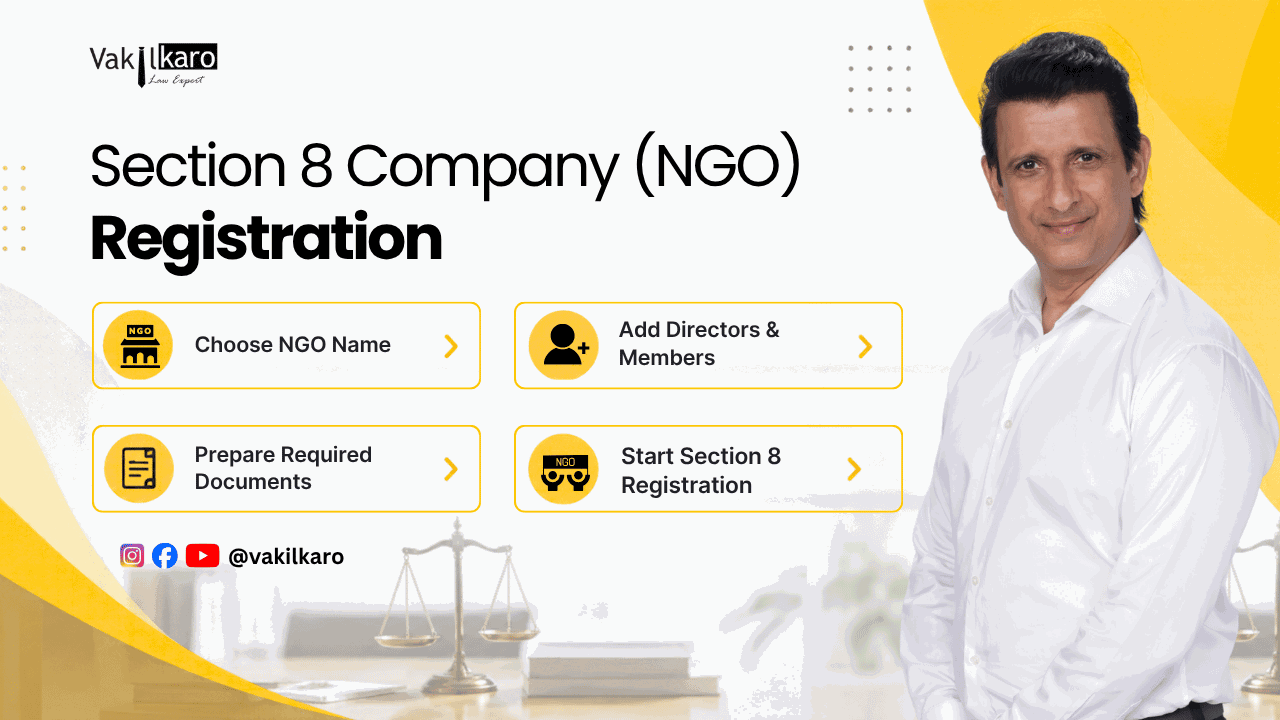
Step-by-Step Section 8 Registration Process in Haryana
- Step 1
Choose the NGO structure and define the actual charitable or public-benefit activities, beneficiaries and funding model.
- Step 2
Finalise suitable name options that match the objects and do not conflict with existing company names or trademarks. If the organisation also wants exclusive protection for its brand name or logo, a separate Trademark Registration may be considered after checking availability.
- Step 3
Collect KYC, registered-office documents, owner consent and DSC requirements for directors/subscribers.
- Step 4
Draft the Section 8 MOA and AOA with workable non-profit objects, governance rules and restrictions on distribution of profits.
- Step 5
Prepare and file SPICe+ and applicable linked forms through the Ministry of Corporate Affairs (MCA) V3 incorporation system. DIN allotment for eligible proposed directors may be integrated into the filing.
- Step 6
Complete linked incorporation requirements, including AGILE-PRO-S where applicable for integrated registrations and bank-account application.
- Step 7
Respond carefully to any CRC/MCA resubmission on name, objects, documents or declarations.
- Step 8
After approval, complete bank KYC/activation, accounting setup, board actions and post-incorporation registrations required for the NGO’s funding model.
Government Fees, Stamp Duty and Professional Cost in Haryana
There is no universal all-inclusive government fee for Section 8 Company Registration in Haryana. The statutory amount depends on the company structure, authorised capital or guarantee model, number of signatories, state stamp duty and the filing configuration. Stamp duty is linked to the state of the registered office, so a company registered in Haryana may have a different statutory cost from a company registered in another state.
| Cost Component | How to Treat It |
|---|---|
| MCA incorporation filing | Calculated under the applicable MCA fee rules. Eligible filings may receive the available filing-fee concession, but this does not eliminate state stamp duty or every linked charge. |
| Haryana stamp duty | State-linked and calculated from the actual filing details. Do not advertise one fixed amount for every Section 8 Company. |
| DSC charges | Commercial/vendor charge based on the number of required signatories and certificate provider. |
| Professional fee | Starting from ₹2,999 + GST. The final professional fee may vary depending on the scope of work, company structure, documentation requirements and any additional assistance required for Section 8 Company Registration in Haryana. |
| Foreign-document certification | Extra notarisation, apostille, consularisation or translation cost may apply for overseas participants. |
Timeline for Section 8 Company Registration in Haryana
An indicative service timeline for Section 8 Company Registration in Haryana is often around 7-15 working days after complete and correct documents are available. This is not a statutory guarantee. Name availability, MCA/CRC workload, object-clause quality, subscriber profile, state stamp-duty configuration and resubmission requirements can increase the time.
Founders should keep extra time before grant deadlines, bank commitments or programme launches. Tax approvals, FCRA, DARPAN and CSR-related registrations have separate timelines and should not be presented as part of the incorporation timeline.
State-Specific Points for Haryana
For Section 8 Company Registration in Haryana, the registered office may be located in Gurugram, Faridabad, Panipat, Hisar and Karnal or any other eligible location within the state. The address should be genuine, supported by current documents and capable of receiving statutory communications. The state-specific difference in the incorporation cost is mainly the stamp-duty component and any document-related cost attached to the local registered office.
MCA reorganised several ROC jurisdictions with effect from February 2026. The exact ROC mapping for the registered office should therefore be confirmed from the current MCA system rather than relying on an old directory or a generic state label.
Post-Incorporation NGO Registrations and Compliance
Completing Section 8 Company Registration in Haryana creates the legal entity, but it does not automatically grant every tax, grant or funding approval. The organisation should evaluate the following separately:
- Income-tax registration and donor approval are separate from incorporation. Organisations commonly refer to these approvals as 12A and 80G Registration. For fresh applications filed on or after 1 April 2026, the Income-tax Act, 2025 framework applies. New non-profit organisations seeking provisional registration or approval generally use Form 104, while regular registration or approval is generally sought through Form 105, as applicable. The current form and filing requirements should be checked on the Income Tax e-Filing Portal before submission.
- Foreign contribution is governed separately under the FCRA framework. A Section 8 Company cannot receive regulated foreign contribution merely because it is incorporated. Where applicable, it must obtain FCRA Registration or prior permission and comply with the designated FCRA account and reporting requirements published on the FCRA Online Portal.
- NGO DARPAN registration may be relevant for specified government interactions, schemes, grants and FCRA-related processes. Organisations should review the requirements on the official NGO DARPAN portal according to their funding and programme plans.
CSR implementing agency readiness: where the Section 8 Company proposes to implement CSR projects, check the Companies (CSR Policy) Rules, tax-approval conditions, track-record requirements where applicable and CSR-1 registration.
Annual tax and accounting compliance should be planned from day one. Organisations that need assistance with income-tax returns, audits and donation-reporting requirements may also use Vakilkaro’s Trust & NGO Tax Filing service as a separate compliance requirement.
Annual Compliance After Registration
- Maintain proper books of account, supporting vouchers, donor/grant records and bank reconciliation
- Hold and document board/member meetings as applicable and maintain statutory records
- Prepare financial statements and complete statutory audit where applicable
- File annual MCA financial statements and annual return within the applicable timelines
- Complete income-tax return, audit and donation-reporting compliance where applicable
- Maintain separate records and returns for FCRA funds if the organisation holds FCRA registration/prior permission
- Track restricted grants and use funds only for approved objects and donor conditions
- Review related-party payments, salaries and reimbursements for proper approvals and reasonableness
Where Section 10A commencement-of-business requirements apply to the company’s structure, the applicable declaration should also be examined after incorporation rather than assuming that every Section 8 Company has identical commencement filing obligations.
Key Restrictions and Legal Safeguards
- Profits and surplus cannot be distributed to members as dividend.
- Funds should be applied toward the approved Section 8 objects.
- Activities outside the constitutional objects can create regulatory, tax and donor risks.
- Tax exemption and donor deduction are not automatic upon incorporation.
- Foreign contribution should not be accepted without FCRA compliance where the law applies.
- Material changes to objects, governance or structure should follow the prescribed company-law procedure.
- Serious or continuing non-compliance can lead to penalties and regulatory action affecting the Section 8 licence.
Common Mistakes to Avoid
- Using a generic or commercial-sounding object clause that does not clearly establish the non-profit purpose
- Choosing a name without checking MCA availability and possible trademark conflicts
- Using an address that cannot be supported by current occupancy/ownership documents
- Advertising one fixed government fee for every state and capital structure
- Assuming Section 8 incorporation automatically gives tax exemption, 80G, CSR eligibility or FCRA permission
- Accepting foreign funds before checking FCRA requirements
- Treating annual compliance as optional after incorporation
- Failing to maintain grant-wise and donor-wise records
Why Choose Vakilkaro for Section 8 NGO Registration in Haryana?
Vakilkaro provides structured support for Section 8 Company Registration in Haryana, from eligibility and name planning to object drafting, document review, SPICe+ filing coordination and post-incorporation guidance. The approach is designed for clients who want clear scope, practical documentation and a compliance plan rather than only a certificate.
- State-aware fee and stamp-duty explanation instead of misleading universal government-fee claims
- Object-clause and MOA/AOA drafting support aligned with the proposed activities
- Director/subscriber and registered-office document checklist
- SPICe+ and linked-form filing coordination
- Resubmission support within the agreed service scope
- Guidance on 12A/80G, DARPAN, CSR-1, FCRA and annual compliance when separately applicable
- Pan-India digital support for founders and governing teams