Trademark Registration in Ladakh is governed by the Trade Marks Act, 1999 and the Trade Marks Rules, 2017 across India. The state mainly affects the applicant's business location and territorial Registry handling, not the substantive trademark law. Registration time varies with examination, objections, hearing, publication and any third-party opposition.
What Is Trademark Registration in Ladakh?
Trademark Registration in Ladakh is the process of applying to register a distinctive mark used or proposed to be used for goods or services. A trademark may protect a brand name, word, logo, label, device, slogan or another eligible sign when it satisfies the legal requirements.
Trademark law is a Central law and applies uniformly across India. State-specific service pages are useful because the applicant's location can affect territorial Registry handling and practical filing details. For the India-wide overview, you can also review the trademark registration service for general filing information.
Registry Jurisdiction for Applicants in Ladakh
Applicants connected with Ladakh should confirm the territorial Trade Marks Registry shown by the official filing system on the filing date. Territorial mapping can depend on the applicant's principal place of business in India or the applicable address for service. This page therefore avoids treating a historical office mapping as an absolute rule.
The exact filing jurisdiction should be checked against the applicant's principal place of business or address for service on the date of filing. The electronic system and current Registry practice should be followed where an older jurisdiction table and the live filing system differ.
Who Can Apply for a Trademark?
Trademark Registration in Ladakh may be filed by the person or entity claiming to be the proprietor of the mark. Typical applicants include:
- Individuals and sole proprietors
- Partnership firms and LLPs
- Private Limited Companies, Public Limited Companies and OPCs
- Recognised startups and eligible small enterprises
- Trusts, societies, Section 8 companies and other legal entities
- Joint applicants where legally appropriate
- Foreign applicants using an address for service in India as required
Where an applicant is claiming startup status, the recognition details should be checked through the official Startup India recognition framework. Small-enterprise details, where relevant, should be supported through the applicable official Udyam registration portal.
What Can Be Registered?
| Type of mark | Typical use |
|---|---|
| Word mark | Brand name, product name, service name or distinctive word element |
| Logo / device mark | Logo, symbol, label or graphic representation |
| Tagline / slogan | Distinctive phrase capable of identifying commercial source |
| Shape / packaging | Certain distinctive three-dimensional or packaging features, subject to law |
| Colour combination | A distinctive combination where the applicable requirements are met |
| Other eligible mark | Any other sign recognised by trademark law and capable of registration |
A word mark and a logo mark protect different aspects of branding. If the business relies on both the name and the logo, separate applications may be considered depending on the protection strategy.
What May Face Objection or Refusal?
A trademark can face objection if it lacks distinctiveness, directly describes the goods or services, is customary in trade, contains restricted matter, or conflicts with an earlier mark. Sections 9 and 11 are commonly relevant during substantive examination.
A preliminary search helps identify obvious risk but cannot guarantee acceptance. The Registrar independently examines the application, and third parties can also oppose an accepted application after publication.
Trademark Search and Class Selection
Before Trademark Registration in Ladakh, the proposed mark should be checked for identical, phonetically similar, visually similar and conceptually similar earlier marks. An exact-name search alone may not reveal every potential conflict.
Trademark applications are filed for specified goods and services. The international Nice Classification groups goods and services into 45 classes. The selected class and description should match the applicant's genuine current or proposed business activities.
One application can contain more than one class, but class selection should not be expanded merely to collect broad coverage. Overbroad or inaccurate descriptions can create practical problems.
Documents and Information Required
| Requirement | Why it is needed |
|---|---|
| Applicant name, constitution and address | Identifies the proposed proprietor and filing particulars |
| Identity or entity details | Supports the applicant's legal status where required |
| Trademark representation | Shows the exact word, logo or mark being filed |
| Goods / services description | Defines the class and commercial scope |
| First-use details, if claimed | Supports a prior-use filing basis |
| User affidavit and proof, where applicable | Supports a claimed earlier-use date |
| Startup / small-enterprise proof, where applicable | Supports the applicant category claimed in the filing |
| Authorisation / Power of Attorney, where applicable | Authorises a professional representative to act |
If the mark has not yet been used, the application can be filed on a proposed-to-be-used basis. If earlier use is claimed, the claimed date should be genuine and supported by the prescribed affidavit and appropriate documentary evidence.
Professional Fee
| Service | Professional fee |
|---|---|
| Trademark registration filing support | Starting from ₹1,999 + GST per class |
The professional fee relates to the selected service scope. Government filing charges are payable separately as prescribed on the filing date. Any additional work outside the selected package, such as a detailed objection response, hearing, opposition proceeding or other post-filing matter, should be confirmed separately before work begins.
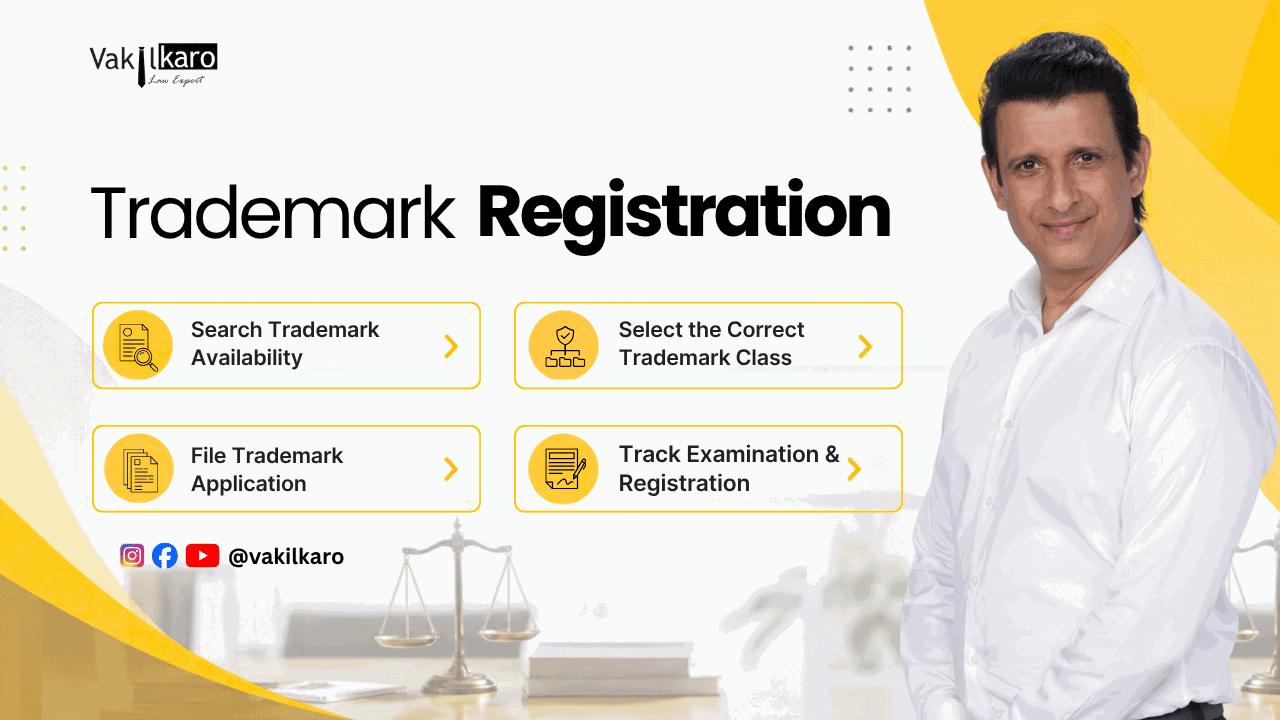
Step-by-Step Process for Trademark Registration in Ladakh
- Step 1
Confirm the correct proprietor and applicant category.
- Step 2
Conduct a preliminary search for identical and confusingly similar earlier marks.
- Step 3
Select the correct class or classes and draft the goods or services description.
- Step 4
Choose the correct filing basis, such as proposed to be used or prior use.
- Step 5
Prepare the trademark representation, applicant details and supporting documents.
- Step 6
Prepare and submit Form TM-A with the prescribed government filing charge.
- Step 7
Track formalities and substantive examination after filing.
- Step 8
Reply to an Examination Report within the prescribed period if an objection is raised.
- Step 9
Attend a show-cause hearing if the Registry schedules one.
- Step 10
Monitor publication in the Trade Marks Journal and the opposition period.
- Step 11
After successful completion, preserve the registration certificate and monitor future compliance.
The government's current step sequence can be checked through the official trademark filing process.
Examination Objection and Hearing
An examination objection is issued by the Trade Marks Registry after substantive scrutiny. Common issues include lack of distinctiveness, descriptiveness and conflict with earlier trademarks. Where an Examination Report is issued, the response should be filed within the applicable period and should address the Registry's specific grounds.
Where professional drafting is required, separate trademark objection assistance can be considered. If the written response does not resolve the issue, the Registry may schedule a hearing.
Publication and Trademark Opposition
If the application is accepted, it is advertised in the Trade Marks Journal. A third party may oppose the application within the legally prescribed publication window. Opposition is different from an examination objection because it is initiated by a third party rather than by the Registry.
If a published application is challenged, the applicant may need separate trademark opposition assistance depending on the facts and stage of the proceeding.
Timeline for Trademark Registration
There is no guaranteed completion period for Trademark Registration in Ladakh. Filing can usually be completed after the required details and documents are ready, but final registration depends on Registry processing and case-specific events.
| Stage | Practical position |
|---|---|
| Application preparation and filing | Depends on readiness of search, class, documents and applicant details |
| Examination | Registry-driven and can vary |
| Examination reply | Must follow the period stated under the applicable rules and communication |
| Hearing, if any | Depends on Registry scheduling |
| Journal publication | Follows acceptance |
| Opposition stage | Depends on whether a third party files opposition |
| Final registration | Only after the application successfully completes the required stages |
Use of ™ and ® Symbols
The ™ symbol can be used to indicate a trademark claim and is commonly used after filing. The ® symbol should be used only after the mark is actually registered. Filing an application does not itself convert the mark into a registered trademark.
Validity, Renewal and Post-Registration Care
A registered trademark is generally valid for ten years and can be renewed for further ten-year periods by following the prescribed renewal procedure. The proprietor should maintain accurate ownership details, monitor unauthorised use, preserve relevant use records and track renewal deadlines.
When the renewal stage approaches, separate trademark renewal assistance may be used if required.
Long periods of non-use can create vulnerability in appropriate legal proceedings. A registration should therefore be treated as an actively managed intellectual-property asset.
Key Rules Clients Should Know
Important procedural requirements are contained in the Trade Marks Rules, 2017. Clients should particularly watch examination communications, hearing notices, publication status, ownership changes and renewal dates. Any rule or portal requirement should be rechecked at the time of filing because forms and procedures can be updated.
Common Mistakes in Trademark Registration in Ladakh
- Filing without checking similar earlier marks
- Using the wrong applicant name or ownership structure
- Selecting an incorrect or incomplete class
- Claiming an inaccurate first-use date
- Assuming one class protects every business activity
- Treating a preliminary search as a guarantee of registration
- Ignoring an Examination Report or hearing notice
- Using the ® symbol before registration
Why Choose Vakilkaro for Trademark Registration in Ladakh?
Vakilkaro provides structured support for trademark search, applicant review, class selection, documentation, TM-A preparation and filing guidance. The focus is to keep the process clear for the client and to identify avoidable issues before submission.
| Support area | What the client receives |
|---|---|
| Pre-filing review | Applicant, ownership and filing-basis check |
| Trademark search | Preliminary similarity and availability review |
| Class selection | Class and goods/services description guidance |
| TM-A filing | Preparation and online filing support |
| Status guidance | Explanation of major Registry stages |
| Objection / hearing | Expert support available where required, subject to scope |