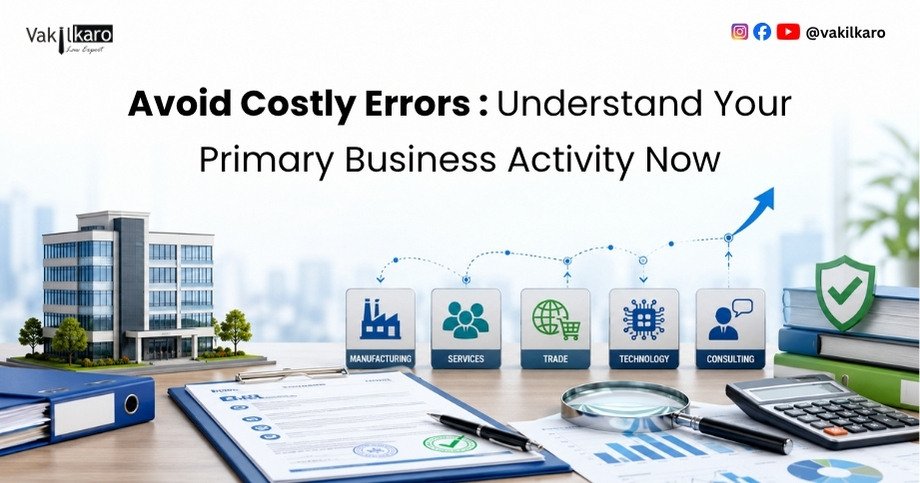
Defining the primary business activity is a crucial part of the Private Limited Company registration process. It specifies the company's main purpose and ensures correct classification under regulatory frameworks, affecting licenses, taxation, and compliance. This activity is detailed in the Memorandum of Association (MOA) and is vital for smooth approvals by the Registrar of Companies (ROC). Whether setting up a traditional Pvt Ltd or going for a Section 8 Company registration, a clear primary activity supports better corporate governance, financial reporting, business expansion, and investor confidence, laying the foundation for long-term operational and legal success.
Key Takeaways
- Whether setting up a traditional Pvt Ltd or going for a Section 8 Company registration, a clear primary activity supports better corporate governance, financial reporting, business expansion, and investor confidence, laying the foundation for long-term operational and legal success.
- Whether you are setting up a standard Private Limited Company (Pvt Ltd) or opting for a Section 8 Company registration for charitable purposes, the accurate articulation of your primary business activity is essential.
- Examples of Primary Business Activities When registering a Private Limited Company (Pvt Ltd) or completing a Section 8 Company registration, selecting the right primary business activity is essential for accurate regulatory classification, licensing, taxation, and operational transparency.
- Shareholders and Shareholding Pattern Founders and early Shareholders must have a clear, mutual understanding of the company's primary business activity to avoid disagreements and operational misalignment in the future.
- In today’s competitive business landscape, where transparency, compliance, and agility are paramount, defining your primary business activity correctly is the first crucial step toward building a thriving and enduring business entity.
The Importance of Defining the Primary Business Activity During Company Registration
When forming a company, particularly during Private Limited Company registration, one of the earliest and most important steps is to define the primary business activity or the nature of business. This declaration is crucial because it determines how the company will be regulated, which licenses it must secure, and how it will be classified for tax purposes. Properly stating the primary business activity is a mandatory requirement for obtaining the Certificate of Incorporation from the Registrar of Companies (ROC).
The primary business activity outlines the company’s main purpose, whether in manufacturing, consulting, education, healthcare, or trading. For non-profit entities under Section 8 Company registration, the business activity must align with charitable objectives. This information is specifically mentioned in the Memorandum of Association (MOA) under the “Main Objects” clause and must be consistent with the Articles of Association (AOA).
Correctly defining the business activity impacts multiple aspects of corporate functioning. It affects regulatory classification under the Companies Act, influences the company’s brand positioning, and dictates necessary licenses (e.g., FSSAI for food businesses or SEBI registration for financial services). Additionally, the applicable Goods and Services Tax (GST) rates and income tax obligations are tied to the company's stated business activity.
A clearly defined primary business activity also strengthens corporate governance. The Board of Directors, Shareholders, and Key Managerial Personnel (KMP) must align strategies, Board Resolutions, and financial reports with the company’s declared operations. For fundraising, clarity in business activity is vital as investors, Private Equity firms, and Venture Capitalists prioritize transparency during due diligence.
In today's compliance-driven environment, supported by e-Governance for Companies and Corporate Compliance Software, defining and maintaining the correct primary business activity is not just a regulatory necessity but a strategic advantage for growth and stability.
Starting a business involves a series of critical legal and strategic decisions, and one of the very first — and most vital — steps during the Private Limited Company registration process is clearly defining the primary business activity or the nature of business. This early declaration forms the backbone of the company's corporate identity and operational strategy. It directly impacts how the company will be regulated under the Companies Act, what licenses and industry-specific approvals it must secure, how its taxation will be structured, and the overall legal obligations it must meet.
Without a clear and accurate statement of its business activity, a company risks delays in the Company registration process, potential legal penalties, and operational restrictions in the future. A well-defined primary business activity not only ensures smooth incorporation with the Registrar of Companies (ROC) but also builds a foundation for good corporate governance, risk management, and financial compliance.
Whether you are setting up a standard Private Limited Company (Pvt Ltd) or opting for a Section 8 Company registration for charitable purposes, the accurate articulation of your primary business activity is essential. It influences how your Memorandum of Association (MOA) is drafted, how your company’s Certificate of Incorporation and Company Identification Number (CIN) are structured, and how your company will interact with tax authorities, regulatory bodies, and future investors.
In this blog, we will deeply explore the concept of Primary Business Activity — its meaning, its critical role at different stages of incorporation, its legal significance, and how founders and directors can leverage a clear business activity statement to ensure compliance, foster growth, and position their companies for long-term success in today’s competitive and highly regulated business environment.
Understanding Primary Business Activity
The primary business activity describes the main commercial or non-commercial purpose for which a company is formed. Whether it’s manufacturing, trading, consulting, education, health services, or any charitable activity (in the case of Section 8 Companies), it must be clearly defined at the time of Company Registration.
This activity is mentioned explicitly in the Memorandum of Association (MOA) under the "Main Objects" clause. Once the ROC approves the incorporation process, this activity becomes an official part of the company's registered records.
Why Defining the Primary Business Activity is Important?
Clearly defining the primary business activity during Private Limited Company registration is far more than a procedural requirement. It has far-reaching implications on how the company is governed, regulated, taxed, funded, and perceived in the business ecosystem. Here’s why this step is absolutely crucial:
Regulatory Classification
The primary business activity directly determines how the company is classified under the Companies Act and other applicable laws. Different industries are governed by different regulatory frameworks, standards, and requirements. For example, a financial services company falls under the purview of SEBI regulations, while a manufacturing company may be governed by environmental and labor laws. Correct classification ensures that the company meets sector-specific compliance from day one, avoiding legal complications in the future.
Corporate Identity
Your company’s nature of business significantly shapes its branding, corporate messaging, and market positioning. Whether your company operates in technology, manufacturing, education, healthcare, or charitable services (in case of a Section 8 Company registration), a well-defined business activity helps convey a clear and strong identity to customers, partners, and investors. It establishes trust and professional credibility in the competitive marketplace.
Licenses and Registrations
Different business activities require different approvals and industry-specific licenses. For instance, a food processing unit must secure an FSSAI license, while a financial advisory firm must register with SEBI. Clearly stating the primary business activity ensures that the company obtains the correct set of licenses, making operations legally compliant and reducing the risk of penalties or shutdowns.
Taxation
The applicable Goods and Services Tax (GST) rates, corporate tax benefits, and industry-specific exemptions often depend heavily on the nature of the business. Misclassification could lead to wrongful tax payments, denial of incentives, or legal disputes with tax authorities. Proper business activity declaration enables the company to optimize its tax structure legally and benefit from government schemes intended for specific sectors.
Statutory Compliance
Compliance obligations such as Annual Filings, ROC submissions, financial disclosures, and maintaining statutory registers are influenced by the company's primary business activity. Companies engaged in specialized industries may also have additional compliance reporting requirements. A well-defined activity helps streamline regulatory submissions and ensures smooth interaction with authorities like the Registrar of Companies (ROC).
Fundraising and Investments
When seeking Private Equity, Venture Capital, or other strategic investments, clarity on the company’s primary business model becomes critical. Investors prefer companies with a well-documented, focused sector classification because it simplifies due diligence, market assessment, and future growth potential evaluation. A clear business activity strengthens the company’s case in investment pitches, improves valuation prospects, and builds investor confidence.
How to Declare the Primary Business Activity During Company Registration?
Defining and declaring the primary business activity is a crucial and formal part of the Private Limited Company registration process. A well-articulated declaration ensures the company’s seamless incorporation, prevents regulatory hurdles, and lays a clear foundation for compliance and operations. Here’s how the primary business activity is declared during Company registration:
Memorandum of Association (MOA)
The Memorandum of Association (MOA) is one of the most important legal documents during incorporation. It outlines the company’s constitution, scope, and powers. The Main Objects clause of the MOA specifically captures the company's primary business activity.
This section must be drafted with precision, describing the company's main operations, the purpose for which it is formed, and its intended activities. It should be detailed enough to cover the company’s core operations but flexible enough to allow reasonable business expansion without needing immediate amendments.
Mistakes or vague descriptions in the MOA can lead to challenges during Registrar of Companies (ROC) approval or later during licensing and compliance audits.
Company Identification Number (CIN)
Once the company’s registration is approved, it receives a Company Identification Number (CIN) as part of its Certificate of Incorporation. The CIN is a unique alphanumeric code that embeds important information, including the company’s listing status, industry sector, and state of incorporation.
The sector code in the CIN is directly linked to the declared primary business activity. Therefore, an inaccurate description during registration could result in an incorrect CIN, causing long-term compliance and operational difficulties.
Articles of Association (AOA)
While the Articles of Association (AOA) focus primarily on a company’s internal management rules and governance structures, they must align with the MOA, especially in terms of business activity. The AOA must not authorize actions or operations inconsistent with the declared primary business activity mentioned in the MOA.
This consistency ensures clarity during board operations, shareholder agreements, and internal decision-making processes.
Registrar of Companies (ROC) Approval
After submitting all incorporation documents, the Registrar of Companies (ROC) carefully examines the primary business description.
The ROC checks for:\n\n- Alignment with naming conventions (names must relate to the nature of business)\n- Proper sector categorization for regulatory compliance\n- Consistency between the MOA and AOA\n\nIf the primary business activity is not clearly stated, overly broad, or inconsistent across documents, the ROC may issue resubmission or clarification requests, leading to delays in Incorporation. In severe cases, the application could be rejected.
Thus, careful drafting, professional guidance, and adherence to statutory templates are essential when declaring the business activity during company registration.
Examples of Primary Business Activities
When registering a Private Limited Company (Pvt Ltd) or completing a Section 8 Company registration, selecting the right primary business activity is essential for accurate regulatory classification, licensing, taxation, and operational transparency. Different industries have distinct business models, regulatory needs, and sector-specific compliance obligations. Let’s explore some examples across various sectors:
Technology Startups
For technology companies, typical primary business activities include software development, SaaS (Software as a Service) solutions, mobile app development, IT consulting, and artificial intelligence (AI) driven products. In today's digital economy, tech startups must also specify whether they are focusing on product development, software services, cybersecurity, or AI-based innovation when filing their incorporation documents.
Manufacturing Units
Manufacturing companies deal with the production of goods such as garments, electronics, automotive parts, consumer products, chemicals, and food items. When registering, manufacturers must precisely state the category and type of manufacturing they intend to undertake to obtain appropriate industry-specific licenses and ensure accurate regulatory classification under environmental and industrial safety laws.
Consulting Firms
Consulting firms may engage in financial advisory, management consulting, legal consulting, human resources advisory, or marketing consultancy. The nature of consulting should be clearly mentioned in the MOA. Some consulting activities, especially in finance or law, might require special licensing or regulatory permissions before starting operations.
Trading Companies
Trading companies operate in buying and selling goods — either domestically or internationally. Activities can include import-export businesses, wholesale trading, retail trading, and distribution services. For trading businesses, specifying the type of goods being traded is necessary for customs registrations, GST filings, and logistics-related compliance.
Educational Institutions
Businesses involved in education must declare activities such as running private schools, coaching institutes, vocational training centers, or e-learning platforms. Education companies often require additional approvals from educational boards, skill development councils, or state regulatory bodies depending on the type of institution.
Healthcare Services
Healthcare-related companies include clinics, hospitals, pharmaceutical research labs, telemedicine services, and health tech platforms. Such businesses must register their nature of operations precisely, as this influences licensing requirements from bodies like the Clinical Establishment Authority, the Drugs Control Department, and others.
Non-Profits (Section 8 Companies)
Non-profit organizations registered under Section 8 of the Companies Act typically engage in charitable activities, education, relief to the poor, advancement of science, art, or culture, and environmental protection. Section 8 Companies must clearly specify their purpose in promoting public welfare and cannot have profit motives. Accurate classification is critical for tax exemption eligibility and regulatory compliance under the Companies Act and Income Tax laws.
Shareholders, Corporate Governance, and Statutory Compliance in Relation to Primary Business Activity
When a Private Limited Company (Pvt Ltd) or a Section 8 Company is incorporated, aligning the shareholders, the shareholding pattern, and the governance framework with the company's primary business activity is crucial for operational clarity and long-term success.
Shareholders and Shareholding Pattern
Founders and early Shareholders must have a clear, mutual understanding of the company's primary business activity to avoid disagreements and operational misalignment in the future. All stakeholders should agree on the company's business focus, strategic goals, and expansion plans.
The Shareholding Pattern—which details the ownership distribution among shareholders—should mirror the respective contributions (capital, resources, intellectual property) made towards supporting the primary business objectives. This ensures fairness and reflects the business’s original purpose during fundraising, profit distribution, and future decision-making processes.
Corporate Governance
Strong Corporate Governance practices are essential to ensure the company remains true to its stated primary business activity. The Board of Directors must consistently align all Board Resolutions and strategic decisions with the company's core operations as defined during incorporation.
Key leadership positions, such as the Managing Director and Key Managerial Personnel (KMP)—including the Company Secretary, Chief Financial Officer (CFO), and others—should focus on strengthening and growing the primary business. Their roles are not just operational but also strategic, ensuring that the company's actions remain consistent with its declared nature of business.
Additionally, regular Board Meetings, Annual General Meetings (AGM), and Extraordinary General Meetings (EGM) must discuss and document activities related to the core business. This creates a transparent environment, maintains shareholder trust, and fulfills legal obligations under the Companies Act.
Statutory Compliance and Financial Reporting
After incorporation, companies must meet several statutory and financial reporting requirements, all of which must accurately reflect their primary business activity:
- Annual Compliance Documents: Key filings like the Balance Sheet, Profit and Loss Account, Financial Statements, and the Auditor’s Report must clearly mention and match the company’s main and secondary activities. Any discrepancy between operational activities and registered objects can attract scrutiny from regulatory authorities.
- Goods and Services Tax (GST) and Income Tax Return (ITR) Filings: These filings must be consistent with the company’s declared nature of business. Different GST rates and tax treatments apply depending on the business sector.
- Internal and External Audits: Conducted by the Statutory Auditor, these audits must validate that the revenue streams and operational results align with the business activities mentioned in the MOA and declared during company registration.
Failing to maintain accurate alignment between actual operations and declared business activities can lead to fines, penalties, and reputational harm, especially during regulatory inspections or investor due diligence processes.
Importance During Business Expansion and Fundraising
As a Private Limited Company (Pvt Ltd) or Section 8 Company grows and scales its operations, the relevance of having a clearly defined and well-documented primary business activity becomes even more critical. Growth often brings changes and diversification, and maintaining regulatory alignment throughout this journey is essential for smooth expansion, legal compliance, and successful fundraising.
Adding New Lines of Business
In the natural course of business growth, companies often explore opportunities beyond their original scope. This could include:\n\n- Launching new products or services\n- Entering new markets or industries\n- Expanding geographical reach\n\nWhen a company plans to add new lines of business not previously covered in the Memorandum of Association (MOA), it is mandatory to formally update its registered objectives. Without this update, the company risks operating beyond its legally authorized activities, leading to regulatory violations.
Modifying Existing Business Objectives
Sometimes, strategic shifts or market conditions require companies to modify their existing business goals. Whether pivoting from a service model to a product-based business or transitioning from domestic to international operations, these changes must be reflected officially.
Modifying the primary business activity demands:\n\n- Passing a Board Resolution\n- Obtaining shareholder approval in an Extraordinary General Meeting (EGM)\n- Amending the MOA accordingly\n- Filing the necessary documentation with the Registrar of Companies (ROC)
Failing to formalize changes can not only disrupt compliance but also weaken investor confidence and complicate external partnerships.
Business Expansion and Strategic Planning
Clear articulation of primary business activities aids in strategic planning for Business Expansion. It ensures that future growth initiatives are aligned with regulatory frameworks and that the company can obtain any new licenses or clearances promptly. Properly declared activities also help in benchmarking performance and planning sector-specific business strategies.
Moreover, an updated and transparent declaration of business activities strengthens internal governance. It ensures that Board of Directors, Key Managerial Personnel (KMP), and stakeholders have a unified understanding of the company's long-term goals.
Fundraising, Venture Capital, and M&A Opportunities
For companies seeking Venture Capital (VC), Private Equity (PE) investments, or planning Mergers and Acquisitions (M&A), the clarity and consistency of primary business activities are paramount.
During due diligence, investors and acquiring companies scrutinize:\n\n- The company’s MOA and Articles of Association (AOA)\n- Financial statements in relation to declared business activities\n- Regulatory filings and compliance status\n\nClear documentation:\n\n- Enhances transparency\n- Reduces perceived risk for investors\n- Improves company valuation\n- Facilitates quicker decision-making in investment or acquisition processes
On the other hand, discrepancies between actual operations and registered business activities can derail fundraising efforts, lower investor trust, and even attract regulatory penalties.
Risks of Misrepresentation of Primary Business Activity
While defining the primary business activity might seem like a routine part of the Private Limited Company registration process, any misrepresentation, vagueness, or inaccuracy can have serious and far-reaching consequences. In the highly regulated corporate environment today, transparency and accuracy in registration documents, including the Memorandum of Association (MOA) and Articles of Association (AOA), are critical for a company's credibility, operations, and legal standing.
Here’s what can happen if a company misrepresents or inadequately defines its primary business activity:
Regulatory Action
Government bodies, including the Registrar of Companies (ROC), actively monitor businesses to ensure that companies operate within the scope of their registered objectives. If a mismatch between the declared primary business activity and actual operations is discovered, regulatory authorities may initiate inspections, issue notices, and demand corrective measures. In severe cases, enforcement actions such as show-cause notices or prosecution under the Companies Act may be initiated.
Cancellation of Certificate of Incorporation
For extreme cases of deliberate misrepresentation, the ROC or competent authorities have the power to cancel or revoke the company's Certificate of Incorporation. Such cancellation dissolves the company's legal standing as a Separate Legal Entity, exposing its directors and shareholders to personal liability and resulting in loss of credibility and financial stability.
Penalties under the Companies Act
Incorrect or misleading declarations are treated as violations under the Companies Act. Companies found guilty may face significant monetary penalties, disqualification of directors, and restrictions on future incorporations. Non-compliance also mandates rectification measures, causing operational disruptions and reputational harm.
Problems During Due Diligence for Funding Rounds
During fundraising exercises, whether through Private Equity, Venture Capital, or debt instruments, investors and lenders conduct rigorous due diligence. Any discrepancy between stated and actual business activities can:\n\n- Delay funding rounds\n- Lead to reduced company valuations\n- Cause loss of potential investment opportunities\n- Trigger investor distrust and legal investigations
A transparent and aligned business profile is crucial to passing due diligence smoothly.
Complications in Obtaining Sector-Specific Licenses
Certain sectors like food, finance, healthcare, and education require specific regulatory approvals and operational licenses. If a company’s primary business activity is not accurately stated, it may face difficulties in securing these licenses or permits, leading to delayed launches, halted projects, or even closure orders from authorities.
Without proper sector classification, compliance with rules like GST registrations, environmental clearances, or professional board accreditations becomes complex and error-prone.
Modern Trends: Technology and Business Activity Management
In today’s fast-evolving corporate landscape, technology has revolutionized the way companies handle the declaration, management, and updating of their primary business activities. Gone are the days when company registration and compliance were tedious, manual, and error-prone processes. With the advent of e-Governance for Companies initiatives and the widespread adoption of digital tools, managing business activities has become faster, more transparent, and significantly more efficient.
Rise of e-Governance Platforms
Government initiatives promoting e-Governance have made it easier for businesses to file registration documents, update statutory information, and maintain compliance through online portals. In India, for example, the Ministry of Corporate Affairs (MCA) has developed integrated platforms such as MCA21, where companies can submit incorporation forms, amend their Memorandum of Association (MOA), file annual returns, and modify business activity codes seamlessly. This digital transformation has drastically reduced processing times and improved the transparency of corporate records.
Role of Corporate Compliance Software
Corporate Compliance Software solutions have further enhanced business activity management by automating complex processes, minimizing human errors, and ensuring real-time regulatory adherence. These tools assist companies in:\n\n- Auto-filling Registration Forms: Based on predefined templates and integrated industry databases, companies can now auto-fill incorporation documents accurately, saving time and reducing mistakes.\n\n- Mapping Business Activities to Regulatory Codes: Correct mapping of primary business activities to sector-specific codes (like NIC Codes in India) ensures proper classification, aiding taxation, licensing, and sectoral compliance.\n\n- Efficient Management of Amendments: If companies need to modify or expand their primary business activity, compliance software allows easy tracking of changes, drafting of resolutions, ROC filings, and updating of statutory registers without manual intervention.
Importance of Digital Signature Certificates (DSC)
The use of Digital Signature Certificates (DSC) has become mandatory for securely signing and submitting digital documents related to Private Limited Company registration, updates to the primary business activity, and other compliance filings. DSCs ensure data integrity, authenticity, and faster processing while reducing the reliance on physical paperwork. They are critical in today’s digital-first compliance ecosystem.
Ease of Doing Business and Regulatory Transparency
Globally, governments are focusing heavily on improving the Ease of Doing Business. Clear, accessible, and technology-driven mechanisms for business activity declarations are a key part of this agenda. Transparency in business objectives, supported by online records and standardized processes, not only builds trust with investors and regulators but also encourages faster business setups, smoother expansions, and improved foreign investments.
Conclusion
Defining the primary business activity is not just a formality during Private Limited Company registration; it is a strategic decision that affects every operational, legal, and financial aspect of a company’s journey.
Whether you are forming a conventional Pvt Ltd company or pursuing a Section 8 Company registration, articulating a clear and accurate primary business activity ensures smoother Company registration, strong Corporate Governance, regulatory compliance, operational efficiency, and higher investor confidence.
Founders should work closely with professional Business Incorporation Services providers and Legal Advisory experts to carefully draft the MOA and align it with their corporate vision. In today’s competitive business landscape, where transparency, compliance, and agility are paramount, defining your primary business activity correctly is the first crucial step toward building a thriving and enduring business entity.
Official External Resources
Use these primary/official sources to verify rules, forms, fees, timelines and regulatory updates before publication.
Frequently asked questions
Avoid Costly Errors: Understand Your Primary Business Activity Now+
Whether you are setting up a standard Private Limited Company (Pvt Ltd) or opting for a Section 8 Company registration for charitable purposes, the accurate articulation of your primary business activity is essential. Shareholders and Shareholding Pattern Founders and early Shareholders must have a clear, mutual understanding of the company's primary business activity to avoid disagreements and operational misalignment in the future.
