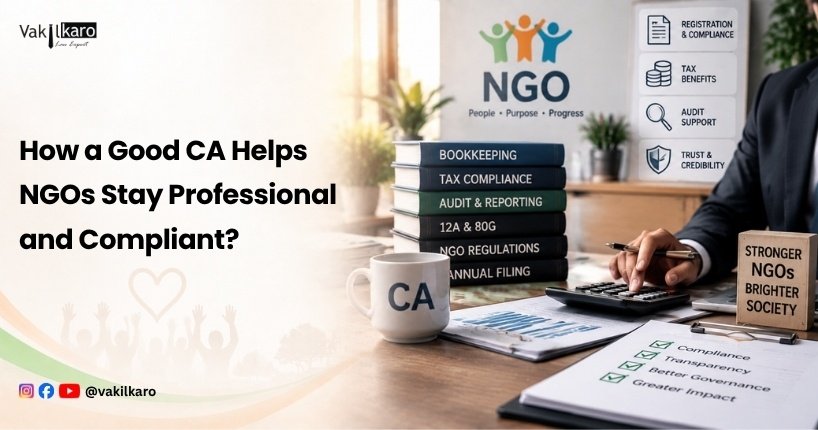
A qualified Chartered Accountant (CA) is vital for any NGO aiming to stay compliant, transparent, and growth-ready. From helping with initial NGO or Section 8 registration to securing 12A and 80G tax exemptions, a CA ensures accurate audits, MCA filings, and regulatory adherence. They also manage donor reporting, GST, TDS, and NGO Darpan updates. Beyond compliance, a good CA strengthens financial systems, internal controls, and audit preparedness. Platforms like Vakilkaro further support CA-led NGOs by streamlining documentation and governance. In today’s competitive nonprofit landscape, a good CA empowers your NGO with professionalism, trust, and long-term sustainability.
Key Takeaways
- A qualified Chartered Accountant (CA) is vital for any NGO aiming to stay compliant, transparent, and growth-ready.
- In essence, a CA helps you build a Section 8 Company that is not only legally compliant but also institutionally respected, donor-ready, and designed for long-term credibility and impact.
- However, to access these grants, NGOs must be registered and compliant on platforms such as NGO Darpan, managed by NITI Aayog.
- MCA Mandates & Section 8 Annual Compliance For NGOs registered as Section 8 Companies under the Companies Act, 2013, staying compliant with the Ministry of Corporate Affairs (MCA) is not just a legal obligation—it’s a reflection of the organization's governance, transparency, and long-term sustainability.
- A capable Chartered Accountant (CA) plays a central role in designing and implementing these systems to help NGOs minimize risk, ensure compliance, and operate with professional integrity.
The Crucial Role of a Chartered Accountant in Ensuring NGO Compliance and Growth
For any NGO striving to build trust, maintain credibility, and scale its impact, having a competent Chartered Accountant (CA) is no longer optional—it’s essential. A good CA plays a foundational role in ensuring financial discipline, regulatory compliance, and transparent reporting, all of which are vital for sustaining operations and attracting donor confidence.
From the outset, a CA assists in choosing the appropriate legal structure—whether Trust, Society, or Section 8 mirofinance company—based on the NGO’s mission and future funding goals. They guide the organization through the intricacies of registration, including drafting constitutional documents and aligning them with the requirements of CSR eligibility and government grants.
Once operational, the CA ensures compliance with statutory obligations such as 12A and 80G registrations for tax exemptions, periodic MCA filings, audit readiness, and financial disclosures on platforms like NGO Darpan. Their support extends to managing Goods and Services Tax (GST), Tax Deducted at Source (TDS), and other tax liabilities, reducing the risk of penalties and financial irregularities.
A strong CA is also instrumental in setting up internal controls, cost allocation systems, fraud prevention mechanisms, and board governance documentation—essential elements for multi-state operations and funding compliance. Their role becomes even more critical when NGOs scale or prepare proposals for CSR and government grants, where clear audited financials and budget notes are non-negotiable.
Platforms like Vakilkaro complement a CA’s expertise by helping streamline compliance paperwork, train NGO boards, and integrate tech-enabled solutions for smoother governance. Together, this synergy fosters professionalism, enhances credibility, and supports long-term sustainability.
In today’s complex regulatory environment, a capable CA serves as more than an accountant—they are a strategic advisor, risk manager, and key partner in helping NGOs grow with confidence and integrity.
In today’s increasingly regulated and competitive nonprofit sector, Non-Governmental Organizations (NGOs) are expected to meet higher standards of financial transparency, governance, and compliance than ever before. Donors—whether individual philanthropists, corporate CSR wings, or government bodies—demand clear accountability for every rupee spent. Regulatory authorities, too, are tightening oversight, requiring accurate bookkeeping, timely audited financial statements, detailed tax filings, and strict legal compliance.
Whether you are a newly formed NGO setting up your legal and financial foundations or an established organization managing complex projects funded through government grants, CSR partnerships, or foreign contributions, navigating these responsibilities can be overwhelming. This is where the role of a Chartered Accountant (CA) becomes not only valuable but indispensable.
A skilled and experienced CA brings more than accounting proficiency. They are your financial strategist, compliance navigator, and governance advisor—working behind the scenes to ensure that your NGO’s operations align with all statutory requirements. From choosing the right legal structure (such as Trust, Society, or Section 8 Company) to obtaining vital tax exemptions like 12A and 80G, and from ensuring timely MCA (Ministry of Corporate Affairs) filings to assisting with audits and grant proposals, a good CA supports your organization every step of the way.
More importantly, a proactive CA helps you anticipate risks, implement sound financial controls, and present professionally audited records that inspire donor confidence. Their input can even be a deciding factor in winning or retaining critical funding opportunities. In essence, a high-performing CA is not merely a service provider—they are a trusted compliance partner who enhances your organization’s credibility, resilience, and potential for growth.
In the following sections, we’ll explore exactly how a Chartered Accountant adds value to your NGO, and why investing in professional financial support is a strategic step toward sustainable social impact.
Navigating Initial Setup & NGO Registration
Starting an NGO with the right legal and financial structure is critical to long-term success. The foundation you lay at this early stage will impact not just your compliance obligations, but also your ability to access funding, gain recognition, and scale your impact over time. This is where the guidance of a knowledgeable Chartered Accountant (CA) becomes invaluable.
One of the first and most important decisions an NGO must make is choosing the appropriate legal form—Trust, Society, or Section 8 Company. Each structure comes with its own regulatory framework, governance norms, and compliance requirements. For instance, a Trust may offer ease of registration and operation, while a Society requires more democratic decision-making processes. A Section 8 Company, on the other hand, is governed under the Companies Act, 2013 and is widely recognized for its transparency, credibility, and suitability for large-scale operations and funding, particularly from corporate CSR partners and foreign donors.
A good CA will assess your mission, intended scale, and funding goals to recommend the most suitable structure. They will also help you navigate the often complex registration process, which includes obtaining digital signatures, name approval, PAN/TAN applications, and formal incorporation.
Additionally, your CA plays a crucial role in drafting your Memorandum of Association (MoA) and Articles of Association (AoA) or trust deed, ensuring that your governing documents are aligned with your vision and acceptable to funding agencies and regulatory authorities. These documents not only define your operational scope but also shape your eligibility for tax exemptions and compliance with laws like the Income Tax Act, FCRA Registration, and Companies Act.
By ensuring that your NGO starts on a legally sound and strategically designed path, a CA sets the stage for seamless compliance, transparent operations, and future readiness for CSR collaborations, government grants, and sustainable growth.
Structuring for Section 8 Company Registration
Opting to register your NGO as a Section 8 Company under the Companies Act, 2013 is a strategic decision that sends a strong message of credibility, transparency, and long-term vision. Unlike Trusts or Societies, a Section 8 Company is recognized as a not-for-profit corporate entity with a robust governance framework. While the registration process is more structured and documentation-heavy, the benefits in terms of legal standing and donor trust are significant. A skilled Chartered Accountant (CA) plays an instrumental role in navigating this path effectively.
One of the first steps involves preparing comprehensive financial projections, organizational plans, and clearly defined board structures to satisfy the scrutiny of the Ministry of Corporate Affairs (MCA). The MCA assesses whether the proposed entity genuinely aims to promote charitable objectives and is structurally capable of upholding public trust. Your CA helps draft these essential documents to reflect realistic growth, sustainability, and financial prudence.
Simultaneously, the CA ensures the statutory setup of accounting systems by establishing GAAP-compliant books of accounts. This level of professionalism from the outset makes it easier for the NGO to undergo audits, manage donor reporting, and maintain regulatory filings in the future.
Incorporation under Section 8 also requires acquiring your PAN, TAN, and GST registration, all of which your CA facilitates to ensure your organization is fully tax-compliant and operationally ready.
Beyond the technicalities, a good CA offers critical advisory on establishing board independence, defining fiduciary duties, and building a sound governance structure. These factors are not just formalities—they enhance your NGO’s appeal to institutional donors, CSR partners, and regulatory bodies.
In essence, a CA helps you build a Section 8 Company that is not only legally compliant but also institutionally respected, donor-ready, and designed for long-term credibility and impact.
Securing Tax Exemptions
For any NGO, obtaining 12A and 80G registrations is a crucial milestone. These certifications not only provide vital tax benefits but also enhance the organization’s credibility in the eyes of donors, government agencies, and corporate CSR partners. Securing them, however, requires a strategic and well-documented approach—something a competent Chartered Accountant (CA) is best equipped to manage.
The 12A registration is essential for NGOs to claim income-tax exemption on their surplus income. Without this exemption, the organization’s earnings could be taxed like a regular business, significantly reducing the funds available for charitable activities. A CA ensures that the NGO’s incorporation documents, objectives, and activities align with the charitable criteria laid out by the Income Tax Department. They also help compile the necessary documentation, such as trust deeds, MOA, and activity reports, and manage the application process efficiently through the Income Tax portal.
Alongside 12A, obtaining 80G certification is equally important, as it allows donors to claim tax deductions on their contributions to the NGO. This certification acts as a powerful incentive for corporate and individual donors, making it easier for the organization to raise funds. A CA ensures that the NGO’s financial practices, governance standards, and reporting structures meet the compliance benchmarks required for 80G approval.
A key part of the process involves preparing and maintaining accurate, audit-ready financial statements and transparent fund accounting. Your CA verifies that all revenue and expenditure are properly categorized, donor funds are tracked with clarity, and financial records align with the expectations of the Income Tax authorities.
In short, a qualified CA removes the guesswork from the tax exemption process. They streamline your NGO’s path to securing 12A and 80G registrations, helping you protect surplus income, attract tax-conscious donors, and demonstrate institutional integrity.
Ensuring Regularity on NGO Darpan & NITI Aayog
In India, government grants play a significant role in supporting the work of NGOs. However, to access these grants, NGOs must be registered and compliant on platforms such as NGO Darpan, managed by NITI Aayog. This portal serves as a central repository of information and a gateway to government funding opportunities. To maintain active status and grant eligibility, regular compliance is non-negotiable—and that’s where a skilled Chartered Accountant (CA) becomes essential.
A CA helps ensure that your NGO consistently meets all compliance and reporting obligations on NGO Darpan. This includes preparing and uploading annual audited financial statements, activity reports, and other mandatory disclosures. The accuracy, transparency, and timeliness of these submissions play a vital role in projecting your organization as trustworthy and capable of managing public funds.
In addition, a CA plays a crucial role in reconciling grant receipts with actual program expenditures. Government agencies often scrutinize whether allocated funds have been used for their intended purpose. Misreporting or inconsistencies can result in penalties, delisting from the portal, or disqualification from future grants. Your CA ensures that every rupee received is properly accounted for and matched against specific program costs.
Furthermore, NITI Aayog has introduced monitoring protocols that require periodic updates, financial transparency, and responsiveness to queries. A CA facilitates your compliance with these protocols by maintaining up-to-date financial records and promptly addressing any discrepancies or audit flags that may arise.
By staying current and accurate with your NGO Darpan filings, your organization not only meets the eligibility criteria for government grants but also enhances its visibility, credibility, and reputation among funding bodies. With a CA managing these critical compliance aspects, your NGO is better positioned to build trust, attract support, and scale its impact through public funding.
MSME Registration & Social Enterprise Compliance
For NGOs engaged in vocational training, livelihood generation, or income-enhancement programs, especially those working in rural development, women’s empowerment, or skill-building, MSME registration can open up new avenues of growth and sustainability. While traditionally seen as a designation for for-profit enterprises, many social enterprises and impact-oriented NGOs qualify under the Micro, Small and Medium Enterprises (MSME) criteria. A knowledgeable Chartered Accountant (CA) is essential to navigating this space effectively.
A CA plays a key role in assessing the NGO’s eligibility for MSME registration based on its activities, turnover, and operational structure. Once eligibility is established, the CA helps prepare detailed cost statements, audited balance sheets, and financial projections required for the registration process. These financial documents must reflect the NGO’s income-generating activities or enterprise components in a way that aligns with MSME norms, without compromising its nonprofit objectives.
In addition to documentation, the CA can assist in setting up statutory Management Information Systems (MIS) that enhance operational transparency and regulatory compliance. These systems help track revenue, measure program efficiency, and maintain accurate accounting records that align with both Income Tax and MSME Department expectations.
Once registered, MSME status unlocks several government incentives such as subsidies, low-interest loans, priority in public procurement, and access to skill development schemes. NGOs can leverage these benefits to expand training programs, develop sustainable micro-enterprise models, or strengthen vocational centers—all while maintaining social impact.
Moreover, for CSR-focused companies and donors, MSME-registered NGOs offer a dual advantage: social impact with economic viability. In short, MSME compliance—when guided by a capable CA—not only brings regulatory credibility but also positions NGOs to diversify funding, strengthen enterprise models, and scale sustainably with the support of public and private sector incentives.
MCA Mandates & Section 8 Annual Compliance
For NGOs registered as Section 8 Companies under the Companies Act, 2013, staying compliant with the Ministry of Corporate Affairs (MCA) is not just a legal obligation—it’s a reflection of the organization's governance, transparency, and long-term sustainability. Unlike Trusts or Societies, Section 8 Companies are corporate entities, and as such, they must adhere to the same annual compliance requirements applicable to profit-making companies. A qualified Chartered Accountant (CA) plays an indispensable role in helping Section 8 NGOs fulfill these mandates smoothly and efficiently.
Each financial year, the MCA mandates the filing of two key documents: the Annual Return (Form MGT-7) and Financial Statements (Form AOC-4). These documents detail the company’s financial performance, governance structure, board composition, shareholding patterns (if applicable), and key resolutions passed during the year. Missing deadlines or filing inaccurate information can result in penalties, legal scrutiny, or even disqualification of directors. Your CA ensures timely, accurate submission of these forms, in line with statutory timelines and disclosure norms.
In addition to filings, every Section 8 Company must conduct a statutory audit by a registered Chartered Accountant, even if there is no significant financial activity. This audit is not only required for compliance but also reassures donors and regulators of financial integrity.
Governance documentation is another critical aspect of MCA compliance. Your CA supports the preparation and maintenance of board meeting minutes, general resolutions, and statutory registers, ensuring that your NGO follows proper corporate procedures and decision-making protocols.
With ever-evolving regulatory expectations, a CA also monitors any MCA updates that may affect your NGO and advises the board on proactive compliance measures. In short, a competent CA does more than file forms—they act as a compliance partner, ensuring your Section 8 Company maintains good standing with the MCA, builds donor trust, and upholds the highest standards of governance.
Internal Controls & Financial Discipline
For any NGO aiming to grow sustainably and maintain the trust of donors, regulators, and beneficiaries, strong internal controls and financial discipline are essential. These are not just operational necessities—they are the backbone of transparent, accountable, and efficient nonprofit management. A capable Chartered Accountant (CA) plays a central role in designing and implementing these systems to help NGOs minimize risk, ensure compliance, and operate with professional integrity.
A CA begins by helping the organization establish clear accounting policies that standardize how transactions are recorded and reported. This includes setting up structured payroll systems, documenting bill flows, and creating a transparent chart of accounts. These practices ensure consistency, reduce errors, and provide a clear financial picture at any given time.
In today’s compliance-driven funding environment, especially when dealing with CSR grants, proper procurement practices are vital. A CA assists in drafting and enforcing procurement guidelines that meet donor expectations and align with legal norms. This includes vetting vendors, maintaining bid documents, and ensuring that purchasing decisions are both cost-effective and transparent.
Effective cash-flow forecasting and bank reconciliation are additional tools your CA uses to maintain financial health. These ensure that your NGO registration is never caught off guard by cash shortages, delayed grants, or mismatched records, which could otherwise disrupt program delivery or trigger regulatory red flags.
Perhaps most importantly, a CA puts in place fraud prevention mechanisms such as segregation of duties, approval workflows, and periodic vendor audits. These internal checks act as safeguards against misuse of funds and build confidence among stakeholders.
Ultimately, by implementing robust internal control systems, a CA not only supports day-to-day operational accuracy but also fosters long-term resilience, credibility, and scalability—qualities essential for any NGO with serious impact goals.
Managing Financial Reporting & Transparency
In the nonprofit world, financial transparency is more than a best practice—it is a core pillar of trust, accountability, and sustained funding. NGOs that demonstrate clear, consistent, and timely financial reporting are more likely to gain and retain the support of donors, government agencies, and CSR partners. A skilled Chartered Accountant (CA) is vital in ensuring your organization’s financial reporting meets these high expectations while staying aligned with regulatory standards.
One of the CA’s primary responsibilities is to help the NGO deliver accurate and timely quarterly and annual financial reports. These reports are often tailored to different audiences, including donors, board members, statutory regulators, and platforms like NGO Darpan. Each stakeholder may have different reporting formats, deadlines, and data points they prioritize—your CA ensures that all reports are consistent, compliant, and insightful, without discrepancies or delays.
At the end of the financial year, the CA oversees the final audit process, which includes not only preparing the financial statements but also incorporating internal audit observations. These insights often touch upon risk areas, financial practices, or compliance gaps, and addressing them proactively can improve operational efficiency and reduce exposure to future scrutiny.
In today’s digital-first landscape, public financial disclosures are increasingly expected from credible NGOs. Whether it’s uploading audited financials on your website, sharing reports with CSR donors, or publishing them on NGO Darpan, your CA ensures these disclosures are both accurate and aligned with your organization’s public image and compliance requirements.
Transparent financial reporting directly influences an NGO’s ability to renew CSR partnerships, maintain tax exemptions, and qualify for future grants. It signals professionalism, accountability, and readiness to manage donor funds responsibly. With a capable CA managing this critical function, your NGO can confidently meet stakeholder expectations and strengthen its long-term financial sustainability.
How Vakilkaro Supports CA-Managed NGOs?
Platforms like Vakilkaro complement CA expertise by offering:
- Paperwork and compliance coordination
- Training and hand-holding for boards
- Integration into legal compliance technology
Together with a CA, this forms a partnership that drives NGO credibility and scale.
Final Thoughts
In the era of NGO registration, audit mandates, cross-regional expansion, CSR/grant scrutiny, and multi-tier compliance, a CA provides more than audit numbers—they provide trust, transparency, and scaling resilience.
From structuring your organization (NGO or Section 8), securing 12A/80G approval, ensuring NGO Darpan eligibility, managing MCA mandates, to MSME status when offering services—your CA is a growth enabler and risk manager.
Investing in strong CA support is investing in financial credibility. In the race for sustainable impact, a CA positions your NGO for credibility, resilience, and donor success.
Official External Resources
Use these primary/official sources to verify rules, forms, fees, timelines and regulatory updates before publication.
Frequently asked questions
How a Good CA Helps NGOs Stay Professional and Compliant?+
In essence, a CA helps you build a Section 8 Company that is not only legally compliant but also institutionally respected, donor-ready, and designed for long-term credibility and impact. MCA Mandates & Section 8 Annual Compliance For NGOs registered as Section 8 Companies under the Companies Act, 2013, staying compliant with the Ministry of Corporate Affairs (MCA) is not just a legal obligation—it’s a reflection of the organization's governance, transparency, and long-term sustainability.
